
Short answer
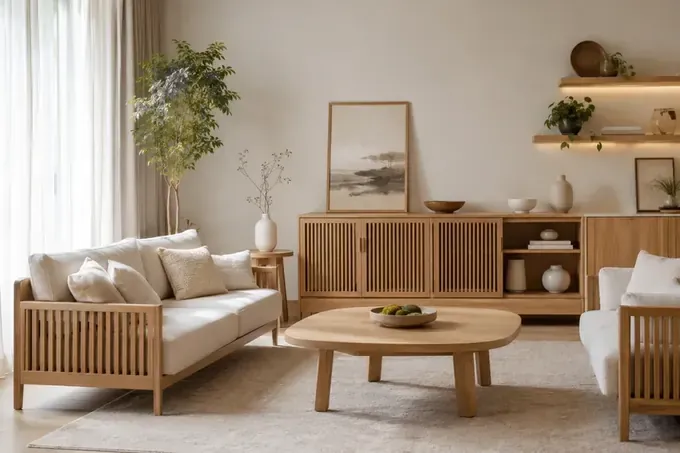
Furniture trends today are warm natural tones, wood and matte textures, soft shapes and storage built into the apartment's architecture. We bring them into custom cabinet furniture through Egger and Kronospan board decors and enamel that we spray in our own workshop, and we show the combination in a 3D design in 1–2 days.
Which furniture trends last longer than one season
Fashion in cabinet furniture changes more slowly than fashion in textiles and decor. We look at long-lasting directions in palette and shape, as well as solutions that are gradually leaving apartments.
Naturalness and a warm palette
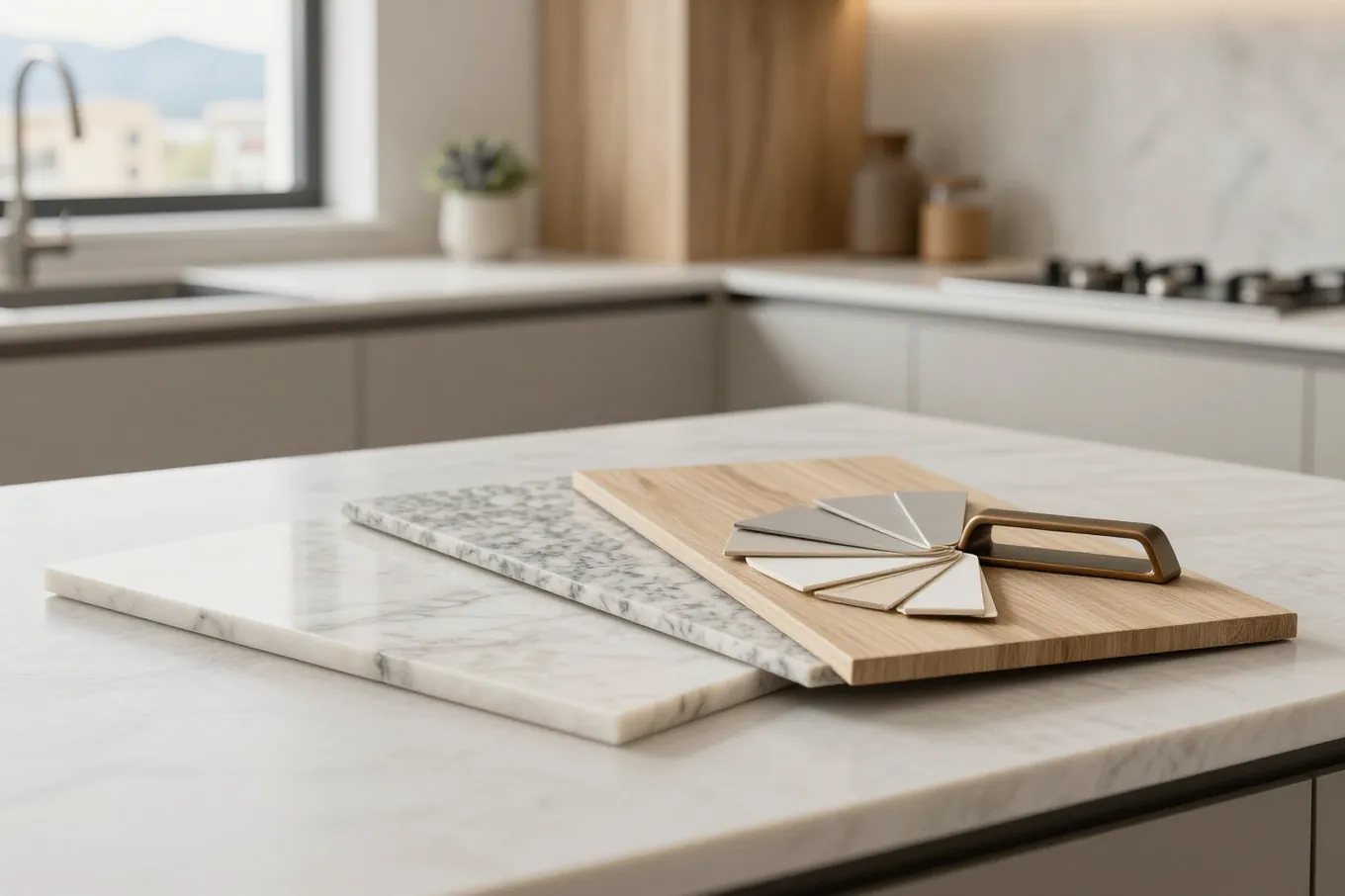
The main furniture trends we see in orders are warm natural tones and wood textures instead of cold gray and mirrored gloss. Clients ask for fronts in baked milk, sand, light and medium oak, walnut, and choose the carcass to match the walls so the wardrobe doesn't clash with the finishes. This direction has held for more than one season because it rests on a habit of a calm home, not on a bright exhibition novelty. Brass hardware, light stone countertops and linen textiles suit warm fronts, and together they build a cohesive interior. A warm palette looks good in the evening light of lamps and doesn't feel office-like, the way a combination of white gloss and gray concrete does. For cabinet furniture this is convenient: Egger and Kronospan board decors in wood and solid warm colors are available in the suppliers' permanent collections. A warm base pairs more easily with any accents, so changing curtains, a rug or chairs won't require replacing the wardrobes.
Soft shapes in cabinet furniture
Rounded corners have moved from upholstered furniture into cabinet furniture: radiused wardrobe ends, rounded countertop edges, smooth edges of open shelves and arched niches. Such shapes make a space calmer and safer, especially in a narrow hallway and in a child's room, where a sharp carcass corner ends up at a child's head height. A radius can be on a side open section, on the end of a kitchen island, on a shelf above a desk or on a mirror in the entryway. Fully curved fronts are less common: they are harder to make and paint, and in an apartment one or two rounded elements are enough to set the character. We close the rounding on the carcass with radius edging, so the edge stays smooth and doesn't catch clothing. An arch above a niche with lighting or a rounded edge of a shelving unit reads as a trend and doesn't require changing all the furniture. A rounding is most appropriate where a person walks past the corner every day, not on a far wardrobe.
What is gradually leaving interiors
- Cold gloss: white and gray glossy fronts across an entire wall give way to matte and wood surfaces with soft reflection.
- Abundance of decor: applied cornices, twisted balusters and variegated hardware are going away, and the shape of the item becomes the main decoration.
- All-dark wenge: a solid very dark carcass in a small room weighs it down and is replaced by warm mid-tones.
- Variegated photo prints: bright pictures on sliding wardrobe doors are replaced by solid panels, wood decors and tinted mirrors.
- Full-width wall units: bulky living room wall units give way to built-in storage systems and light suspended modules.
- Outgoing doesn't mean bad: if a solution is liked and suits the lifestyle, it remains a good one even without trend status.
Furniture colors in the interior and their combinations
The color of a wardrobe and kitchen lasts longer than the color of walls, because repainting a wall is easier than replacing fronts. We break down base shades, deep accents and successful pairings for an apartment.
Warm neutral and earthy shades
Furniture colors in interiors have shifted noticeably toward warm neutrals — milky, sandy, greige, clay and light wood tones. We most often paint fronts in these shades or match them with a solid-color board decor, and they sit well with both white and colored walls. Earthy shades, from caramel to muted olive, add depth without harsh contrast and look good next to warm-toned parquet. Cool light gray remains an option for minimalist interiors with white walls and metal, but next to warm parquet it often looks bluish. The same shade changes depending on the side of the world: in a room with north-facing windows beige turns grayer, in the south it becomes warmer and more yellow. Check the chosen shade next to the floor and walls in daylight by holding a front sample vertically, as it will stand in the wardrobe.
Deep colors as an accent
Deep green, sage, navy, terracotta and wine work best as an accent of one item rather than all the furniture in the apartment. A green island in a light kitchen, a blue wardrobe in the hallway or terracotta fronts of a TV cabinet set the character of the room, while the other pieces stay a neutral background. Repeat the accent color in a small detail of another room, for example in a shelf, and the apartment will look put together. A saturated color pairs well with wood decor and brass and black hardware, and less well with cool white gloss. In a small space a dark accent is placed on the lower part or on one wall so it doesn't take away light. A matte surface makes a deep tone velvety, while gloss turns it into a mirror where dust and fingerprints show. An accent on one item is easy to change after a few years by repainting only its fronts rather than all the furniture in the room.
Base and accent combinations
| Base tone | Accent | Where it fits |
|---|---|---|
| Milky | sage green | kitchen, kids' room |
| Light oak | navy | hallway, study |
| Sandy | terracotta | living room, bedroom |
| Greige | graphite | kitchen, bathroom |
| Walnut | olive | living room, library |
| Matte white | light wood | small rooms |
| Clay | milky | bedroom, walk-in closet |
Textures and front surfaces
Texture is seen with the eyes and felt with the fingers every time a wardrobe door is opened. We break down wood decors, matte and gloss enamel, as well as details in metal, glass and stone.
Wood decors with a lively texture
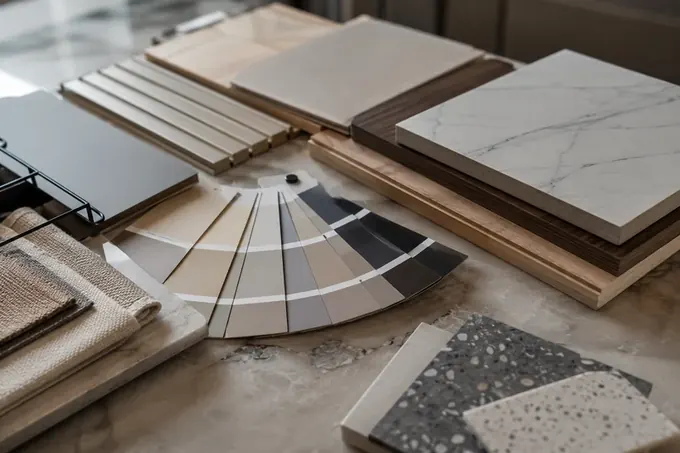
The Egger and Kronospan décors we work with increasingly replicate wood with pronounced texture: visible grain, knots, tonal shifts and a slight surface relief. Synchronized pore, where the pattern on the board matches the embossing, makes the front look like veneer even up close. Oak décors are popular, from light bleaching to smoked tones, along with walnut and calm species without contrasting stripes, and instead of glossy cherry people choose matte warm shades. Such a surface hides small scratches and fingerprints better than a solid color, so it suits the hallway and kids' room, where furniture gets bumped with bags, toys and shoes. Wood décor pairs well with matte enamel: for example, the carcass and shelves in wood, while the fronts are solid color. Choose one wood décor per room and, if you need a second, make it noticeably different in tone, otherwise two similar oaks next to each other look like a selection mistake rather than a deliberate choice.
Matte enamel and gloss
Matte enamel in our workshop is the most frequent choice for fronts, because it gives a deep, even color without glare and lamp reflections. We paint the fronts in our own painting area and can match a shade to a sample, not just from a ready palette. A matte surface hides small wall imperfections and fingerprints better than a glossy one, and dark tones look velvety on it. The coating goes through primer, sanding and several layers with drying, so the color lies evenly across the entire surface. Gloss hasn't disappeared but has changed its role: from "the whole kitchen" it has become an accent — a glass display cabinet, a separate row of fronts or a small cabinet. Semi-matte enamel with a slight sheen has become a compromise for those who like light in reflection but don't want to wipe every mark. Keep gloss on small surfaces at eye level, where it isn't constantly touched by hands — that way it stays striking and doesn't require daily care.
Metal, glass and stone in the details
- Thin metal: black, brass profile, legs and bracket handles add graphic lines and emphasize the wood texture of the fronts.
- Fluted glass: textured glass in a display cabinet hides the contents of the shelves but lets light through and makes the wardrobe lighter.
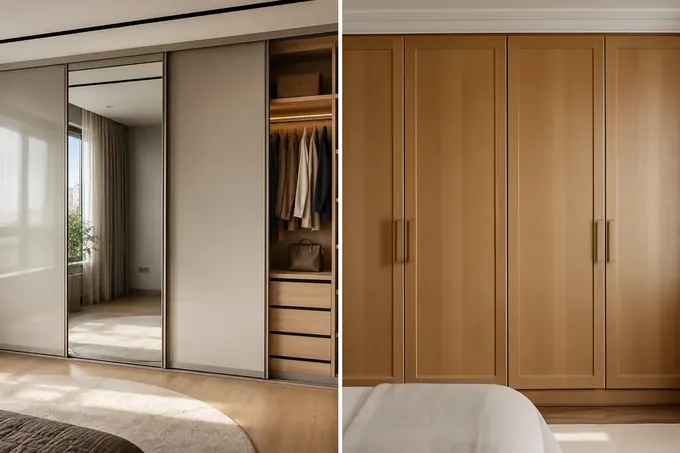
- Tinted mirror: bronze and graphite mirror on a sliding wardrobe is softer than a regular one and visually expands the hallway.
- Stone and its imitation: a countertop or shelf with stone veining works as an accent next to matte fronts.
- Slatted panels: vertical slats on fronts and the wall behind the bed add relief and gently divide the space.
- Moderation in details: two or three materials per room look thoughtful, while five or more turn the interior into a set of samples.
Kitchen furniture trends in color and layout
The kitchen changes faster than other rooms because it combines work, storage and a place for guests. We break down two-tone solutions, handleless fronts and appliances hidden behind fronts.
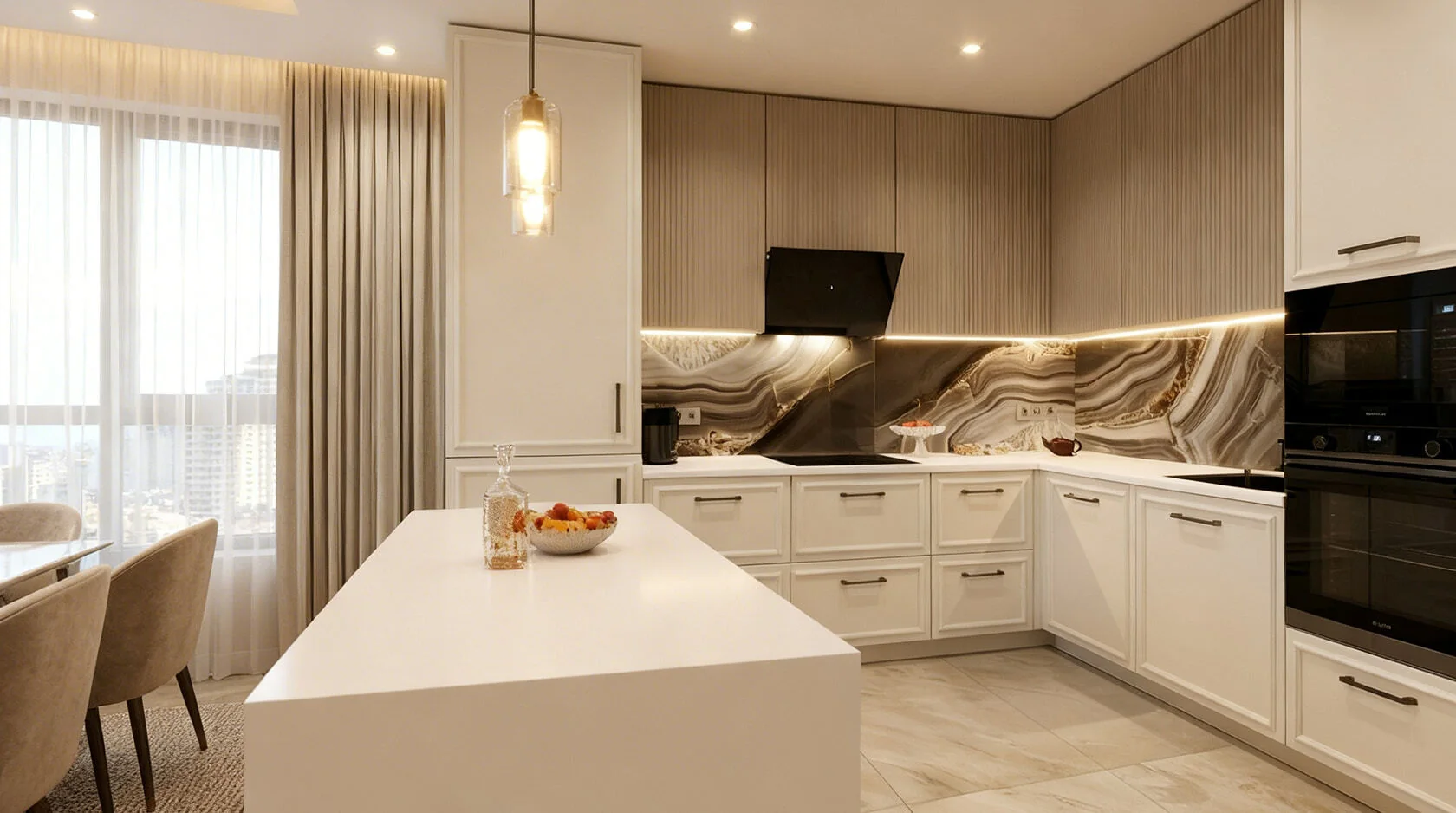
Two-tone kitchen and dark lower level
Among kitchen furniture trends, the two-tone scheme holds especially steady: lower modules darker, upper ones lighter or in the wall color. We have 900+ kitchens behind us, and clients choose this option more and more often because it combines character and practicality. A dark lower section shows splashes, footwear marks and small chips near the floor less, while a light upper section doesn't press on a small room and reflects light. Pairs of graphite and milky, dark green and light oak, blue and matte white work well. The island and peninsula are often made in an accent color, while the main line is neutral, and then the island reads as a separate piece of furniture. A dark upper section suits only tall and bright kitchens, otherwise the room seems lower. Leave the third color for the countertop and backsplash, and more than three tones in one kitchen turn it into a palette of samples.
Handleless fronts
We make smooth handleless fronts with an integrated profile along the top edge, with a milled recess or with push-to-open mechanisms. Such a kitchen looks like a solid wall, not broken up by rows of brackets and buttons, especially in matte enamel and solid-color decor, and it is easier to wipe without protruding parts. The integrated profile, that is, a horizontal niche between the countertop and the front, is convenient on lower modules, while on upper ones push-to-open or lift-up systems with a push mechanism work well. We install hardware from Blum, Hettich and Boyard, and for Blum the manufacturer's 25-year warranty applies to hinges, lift-up systems and drawer runners. The solution has its peculiarities: on light handleless fronts, fingerprints near the edge become visible over time, so a matte finish is more practical here than gloss. On the dishwasher and refrigerator, opening is planned separately, because their doors are heavier and require a different mechanism.
Hidden appliances and pantry storage
- Appliances behind fronts: a built-in dishwasher, refrigerator and microwave hide behind fronts in the kitchen color, and we plan modules for them in advance.
- Pantry cabinet: a tall cabinet with pull-out baskets replaces a separate pantry and holds supplies, grains and household chemicals.
- Coffee niche: a closing cabinet with a socket hides the coffee machine and kettle, while the countertop stays free.
- Lift-up fronts: upper cabinets with lift-up systems open upward and don't get in the way when working at the countertop.
- Work area lighting: an LED strip under the upper cabinets illuminates the countertop and at the same time emphasizes the texture of the backsplash.
- Pull-out board: a hidden panel under the countertop provides an additional work surface and tucks away when it is not needed.
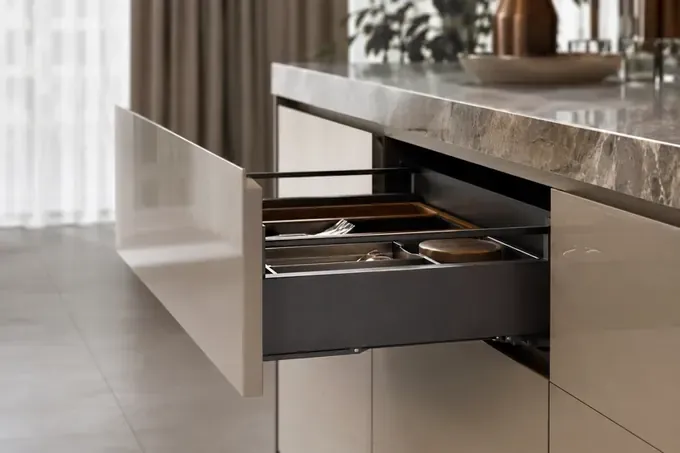
- Drawers instead of shelves: deep drawers in the lower row are more convenient than hinged cabinets and let you see the dishes from above.
Storage that has become part of the interior
The wardrobe has stopped being a standalone item and is increasingly becoming part of the wall. We break down floor-to-ceiling wardrobes, the combination of open and closed sections, and the filling of walk-in closets and hallways.
Floor-to-ceiling wardrobes and built-in niches
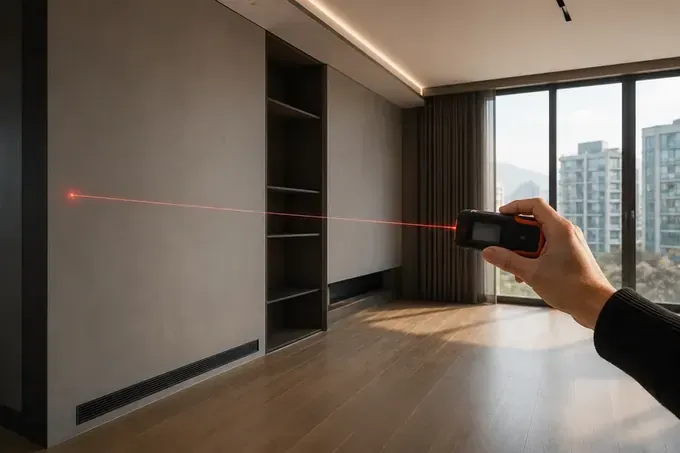
Floor-to-ceiling wardrobes are one of the most practical modern solutions: they use the full height of the room and leave no shelf on top to collect dust. We design such wardrobes based on measurements, taking into account floor and ceiling unevenness, so the carcass fits into the niche without noticeable gaps, and the top strip is adjusted on site during installation. Over 13 years in the Almaty market, we most often build such systems into hallways and bedrooms, where a high ceiling would otherwise remain empty. The upper tier with separate short doors is kept for seasonal items and suitcases, the middle for everyday clothes, the lower for shoes and drawers. Fronts in the wall color make the wardrobe almost invisible, and the room looks bigger, while fronts in wood decor turn it into a warm wall panel. A built-in wardrobe makes sense in your own apartment: it stays in place when you move.
Open and closed sections in one wardrobe
The balance of open and closed sections in a single piece changed wardrobes where everything is hidden behind identical doors. An open shelf with books, ceramics, plants brings the wall to life, while closed fronts around it hide what is not meant for prying eyes. In the living room, an open niche with lighting is often placed above the TV stand, in the bedroom at the headboard, in the hallway for keys and bags by the entrance. Open sections need a back panel in a contrasting or wood tone, otherwise they look empty, and built-in lighting along the top edge highlights the items on the shelves. It is important to consider cleaning and the family's habits: dust is more noticeable on open shelves, and cluttered items ruin the intended look, especially if the shelves are visible right from the room entrance. Keep the open part to no more than a third of the wardrobe and close the rest with fronts — that way the wall stays light and tidy without daily rearranging.
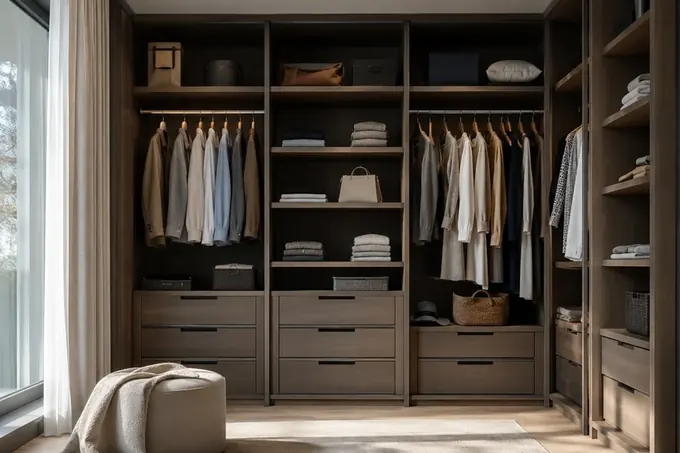
Filling for walk-in closets and hallways
- Motion-sensor lighting: the light turns on when the door opens, and we install it in deep wardrobes and windowless walk-in closets.
- Two-level rods: two rods for shirts and trousers hold twice as many short items as one tall one.
- Drawers with dividers: inner drawers with compartments for underwear and accessories keep things organized without boxes on shelves.
- Shoe shelves: angled and pull-out shelves in the hallway keep shoes visible and ventilate better than closed drawers.
- Bench in a niche: a seat inside the hallway wardrobe saves space and makes the storage system complete.
- Full-length mirror: a mirrored door or insert inside the walk-in closet replaces a separate floor mirror.
Modern furniture for the home that is not tied to a season
A trend should be adopted so that years later the furniture still pleases you and does not need replacing. We explain how to separate the base from the accents and how to check the combination before cutting the board.
A base for years and accents for a change
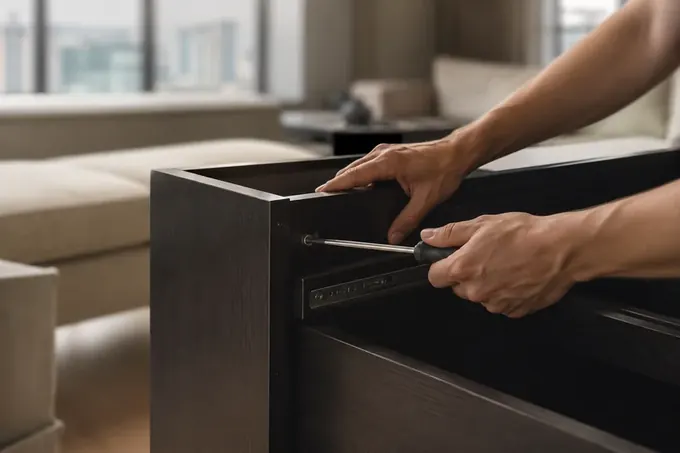
Trendy furniture for the home lasts a long time if the carcass and main fronts are kept in a neutral palette, while the trend lives in details that are easy to change. We offer our clients this principle: wardrobes, kitchen and walk-in closet in a calm tone, with the accent color on a single cabinet, island or row of fronts. Handles, lighting, open shelves, display glass and decorative panels are changed separately, without redoing the carcass, and the interior is refreshed in a single visit from a craftsman. Our warranty on the item is 24 months under the contract, and a carcass made of Egger and Kronospan boards with sealed edges lasts far longer than any seasonal trend holds. A bright color across all the furniture in a room, from the wardrobe to the bedside cabinets, gets tiresome faster and is harder to match with new textiles and appliances. If you are unsure about a bold color, start with one item: if you wish, its fronts can be repainted or replaced later.
How to see the combination before ordering
We show the combination of colors and textures in a 3D design that we prepare in 1–2 days after a free measurement — with the real dimensions of the room, windows and doors. In the design you can compare several options: a dark and light kitchen base, a woodgrain or solid-color carcass, fronts with and without handles. The screen conveys proportions and layout but not the exact shade, so the color is additionally checked on physical samples of décors and enamel. A sample is best viewed in the room where the furniture will stand, in the daytime and in the evening under its own lighting, next to the floor, tiles and wallpaper. A warm lamp makes beige more yellow, a cool one makes it grayer, and the difference can be noticeable. You can view décor and enamel samples in our showroom, and then take a couple of options home for comparison. Approve the color only after you have seen a sample under your own light — redoing painted fronts will take more time than one extra day of doubt.
Trendy solutions and how practical they are
| Solution | What's good about it | What to keep in mind |
|---|---|---|
| Matte enamel | deep color without glare | gentle cleaning without abrasives |
| Woodgrain décor | hides scratches and fingerprints | one décor per room |
| Fronts without handles | a seamless look | fingerprints at the edge |
| Dark kitchen base | splashes are less visible | a light top for balance |
| Floor-to-ceiling wardrobe | maximum storage | stays put when you move |
| Open niches | a lively wall | dust and tidiness |
| Rounded edges | a safe passage | radius fronts are more complex |
Summary: how to pick furniture that won't date in a season
A short guide for those choosing color, texture and a storage system and who want their furniture to stay relevant for a long time, not just one season.
- Palette: warm neutral tones and wood shades hold up longer than cool gray and gloss and pair with any accents.
- Accents: deep green, blue or terracotta are more appropriate on a single piece that is easy to repaint or replace later.
- Textures: wood decor with a lively grain and matte enamel look more expensive than gloss and handle daily use more easily.
- Kitchen: a two-tone scheme with a dark base, handleless fronts and hidden appliances remain the main ideas of the kitchen space.
- Storage: floor-to-ceiling wardrobes and a balance of open and closed sections turn the storage system into part of the room's architecture.
- Check: color is approved on a sample under your own lighting, and proportions — on a three-dimensional project with real dimensions.
Article updated 30 September 2026Calculate kitchen price All blog articles