
Temirzhan Nurpeisov
Furniture assembly carpenter11 years
★ 4.81 · 47 ratings
For business · Retail
We make tilted shelving, shelves with trays and island display cabinets for a bakery's assortment or bread department, with a coating suitable for contact with bread. Measurement and 3D design are free, the price is in the contract, warranty 24 months.
Measurement and 3D design are free and carry no obligation · price fixed in the contract · Kaspi Instalments up to 24 months
01Types
 01
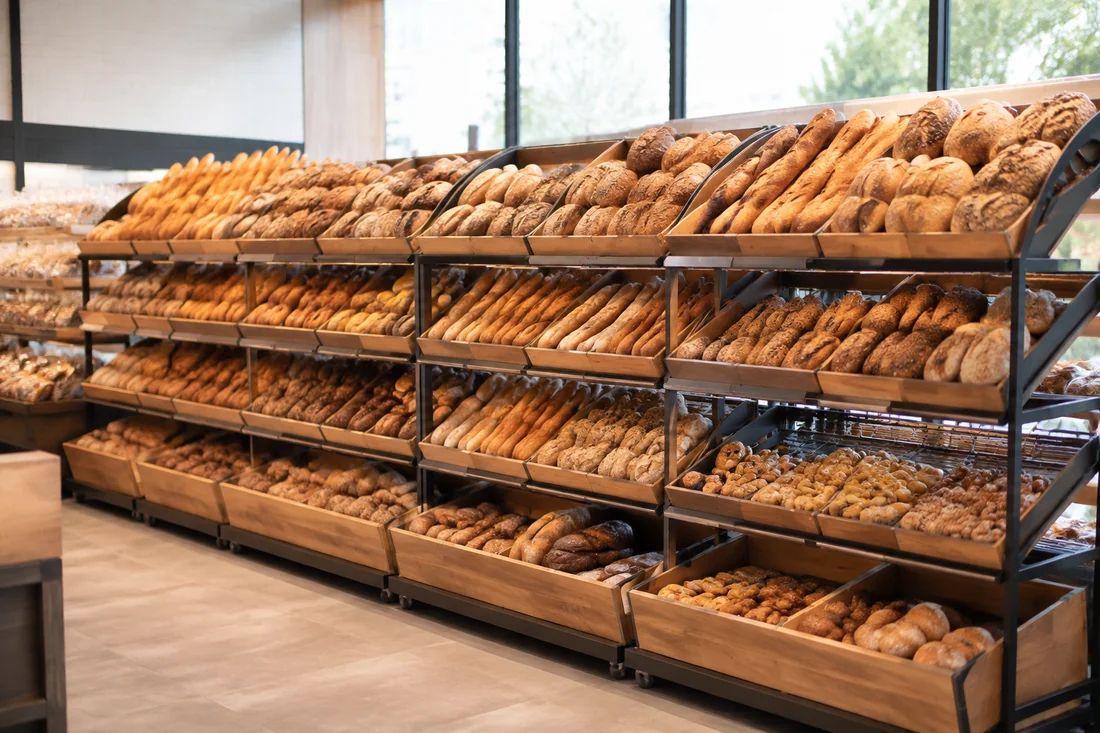
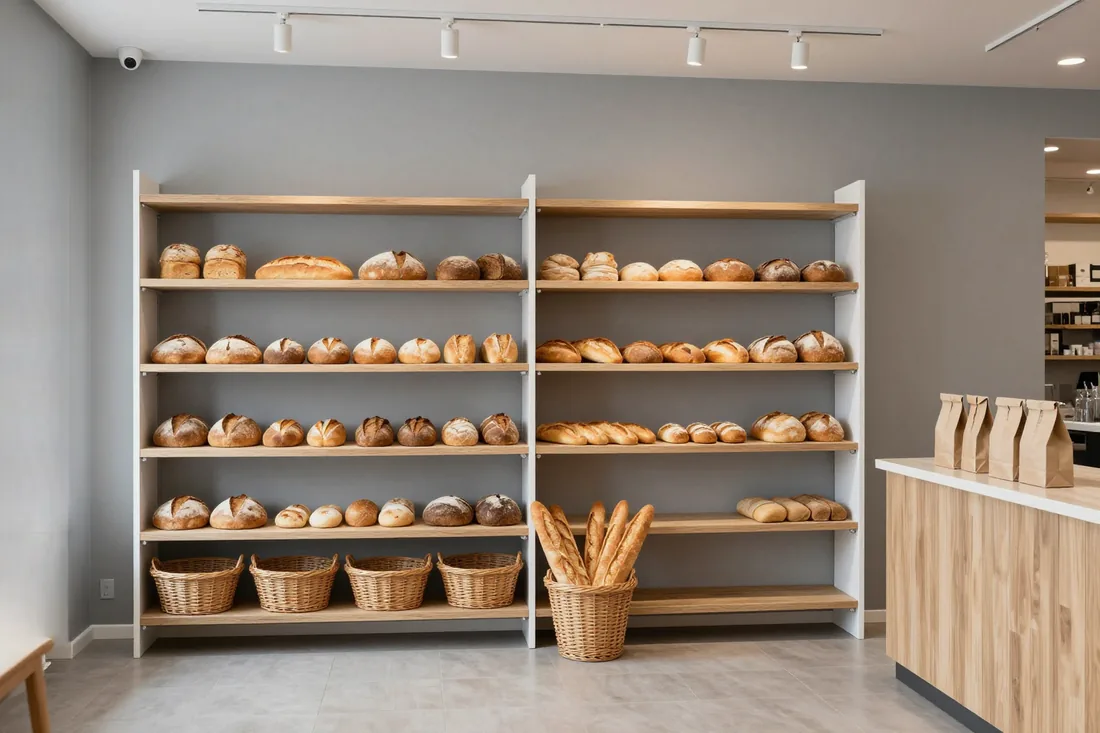
Open shelves along the wall for pan and hearth bread: a simple and affordable option for a mini-market or small bakery.
from 32 000 ₸
 02
Angled shelves with sides turn the loaves toward the customer: the display is visible from the aisle, and the bread doesn't roll onto the floor.
from 38 000 ₸
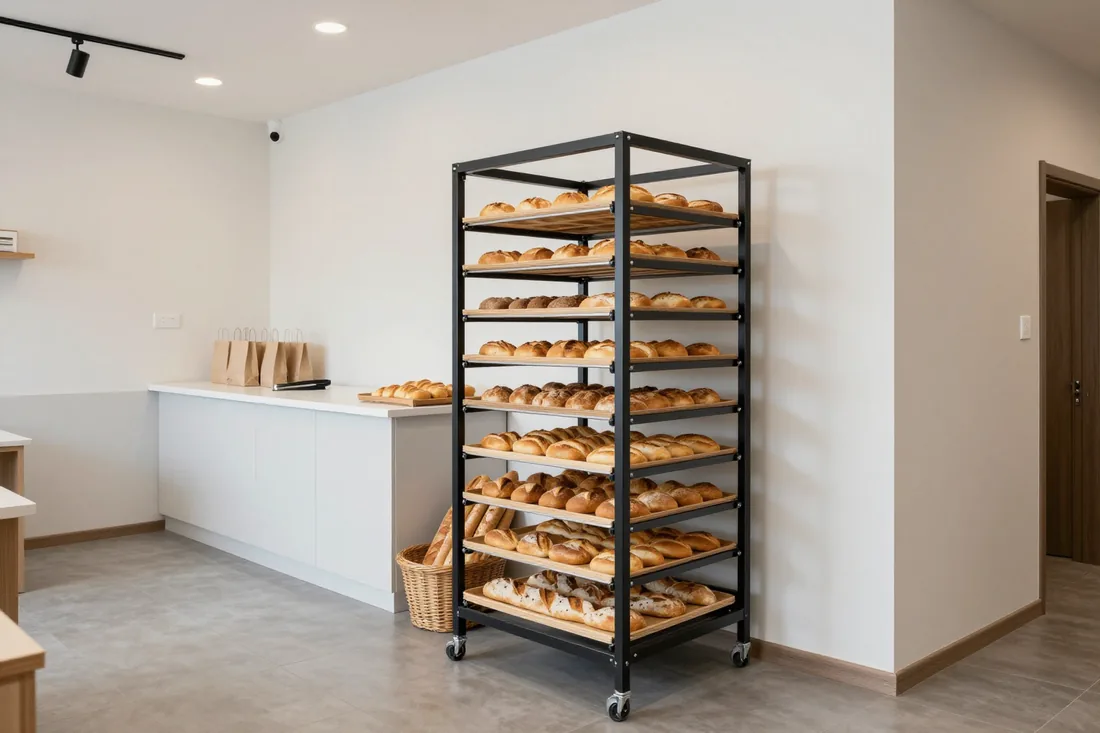 03
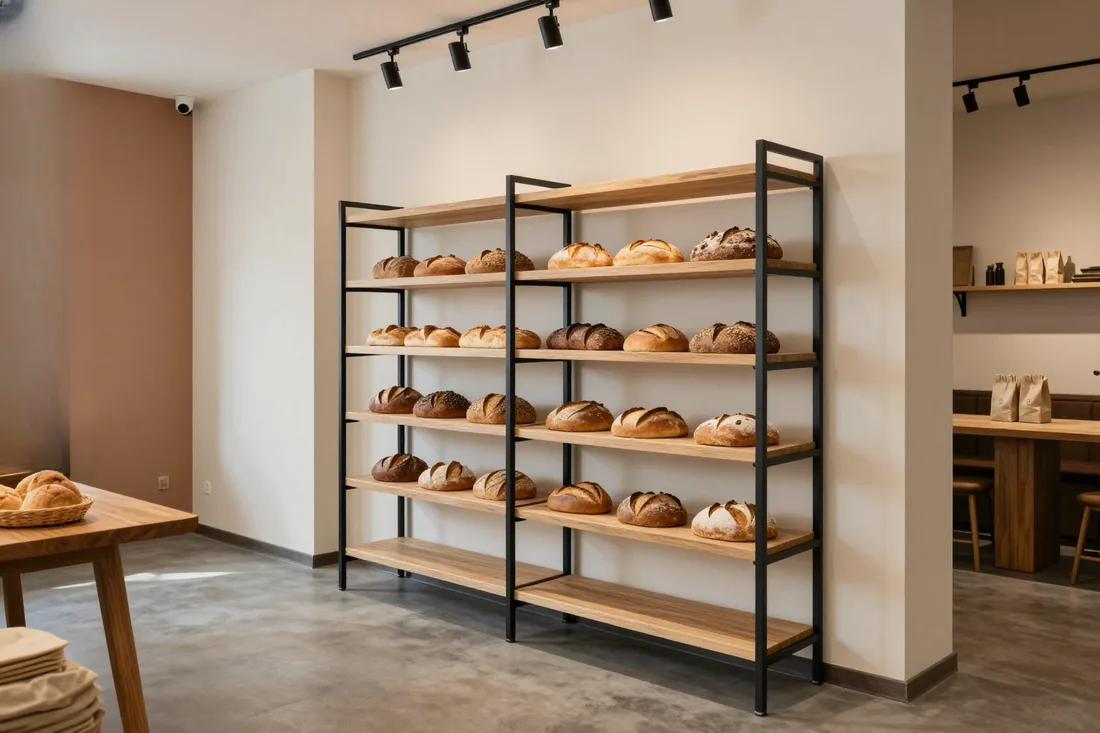
Metal frame with pull-out plywood trays: convenient for changing goods as a whole tray and washing shelves without disassembling the shelving.
from 45 000 ₸
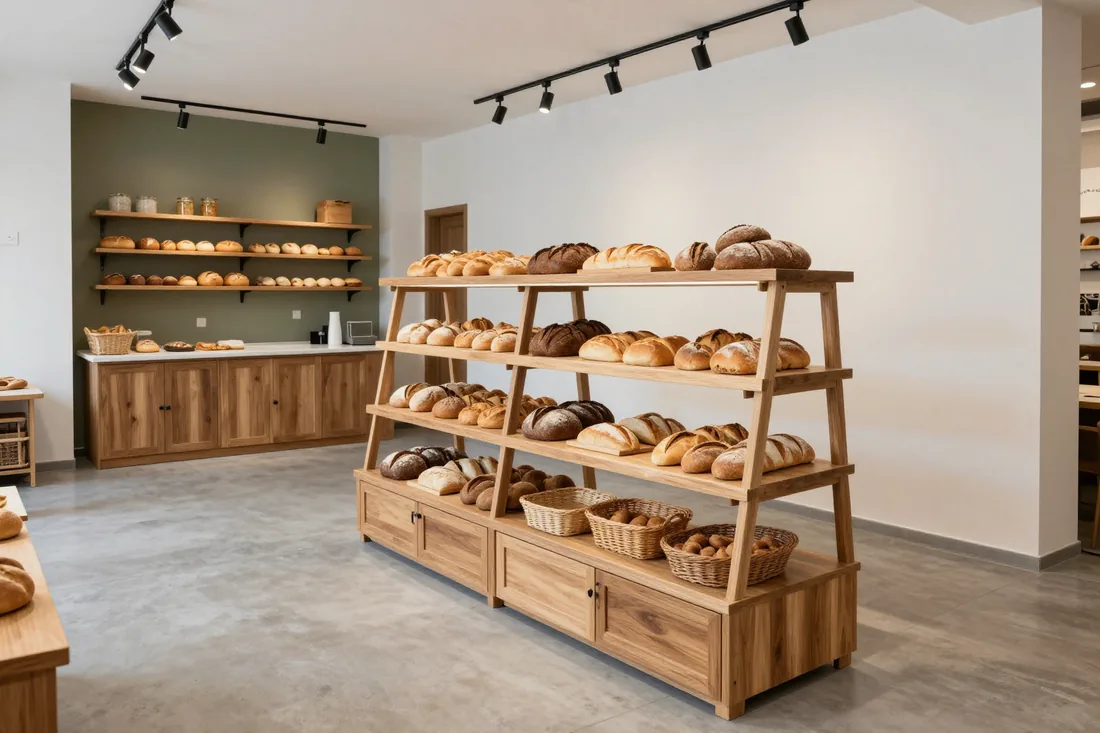 04
A multi-tier display cabinet in the center of the hall with access from all sides — for a bakery and a supermarket bread department with customer flow.
from 72 000 ₸
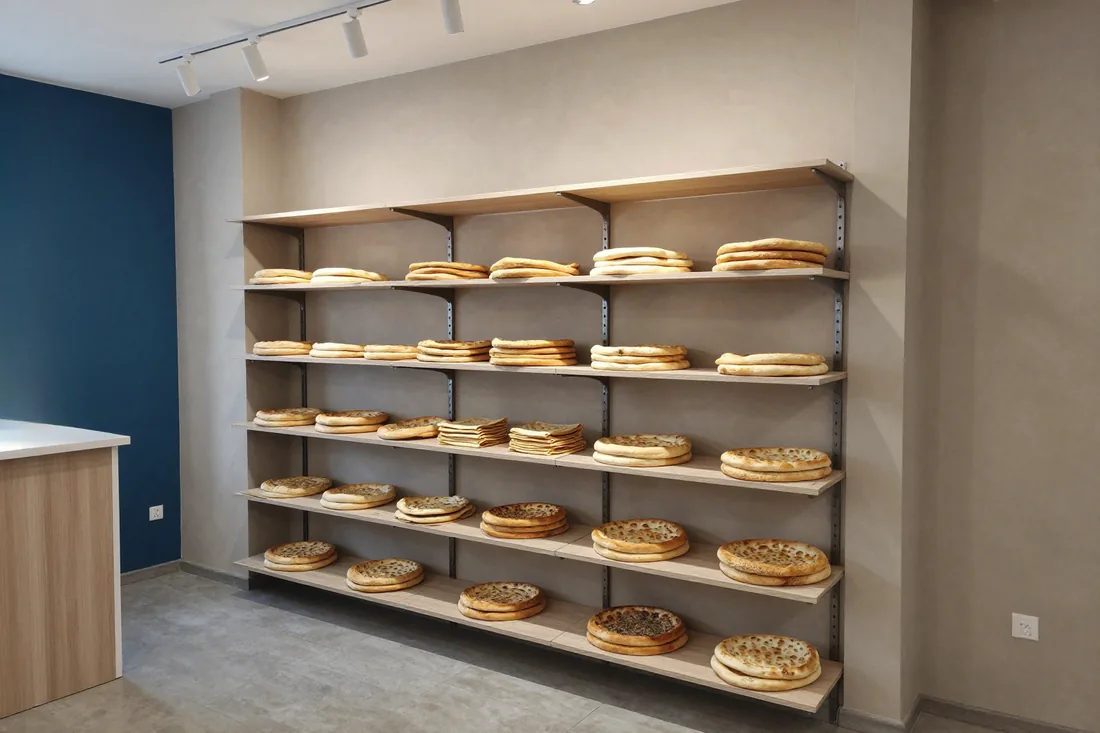 05
Wide shallow shelves for lavash, flatbreads and tandoor bread, so flat bread lies freely and doesn't break.
from 42 000 ₸
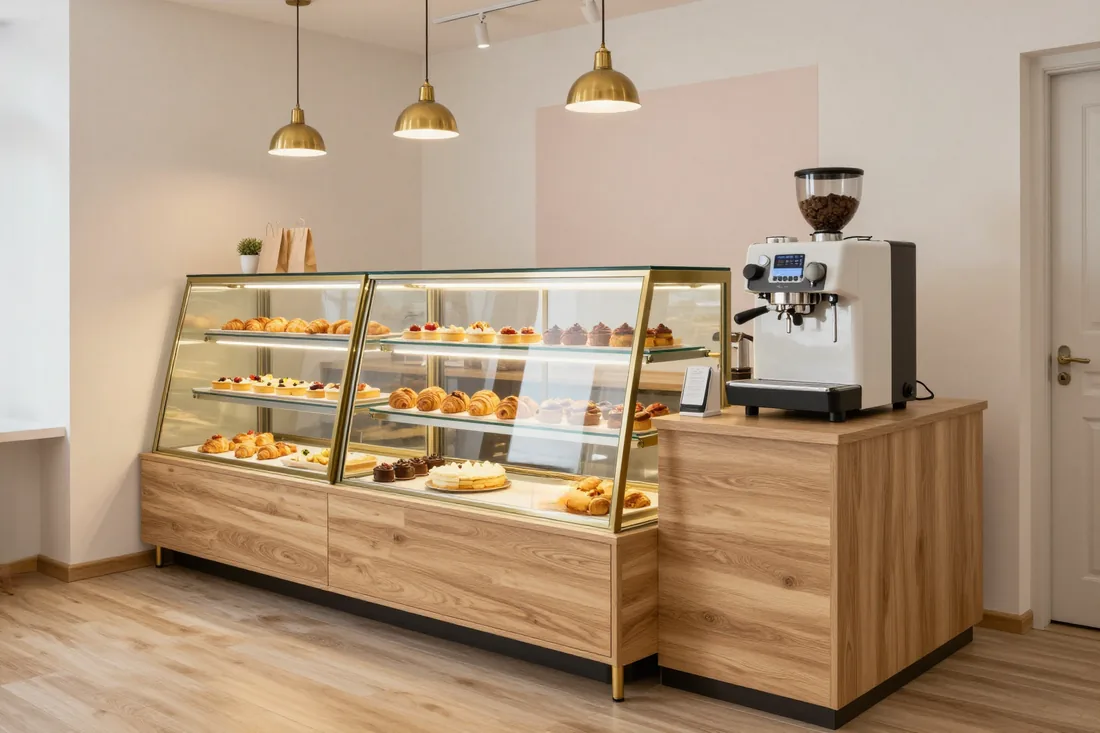 06
Glass-enclosed tiers for pastries and cakes: the baked goods stay visible but protected from dust and customers' hands.
from 65 000 ₸
02Projects
Site, scope, materials and lead time — per project.
 Store
Samal microdistrict, Medeu district
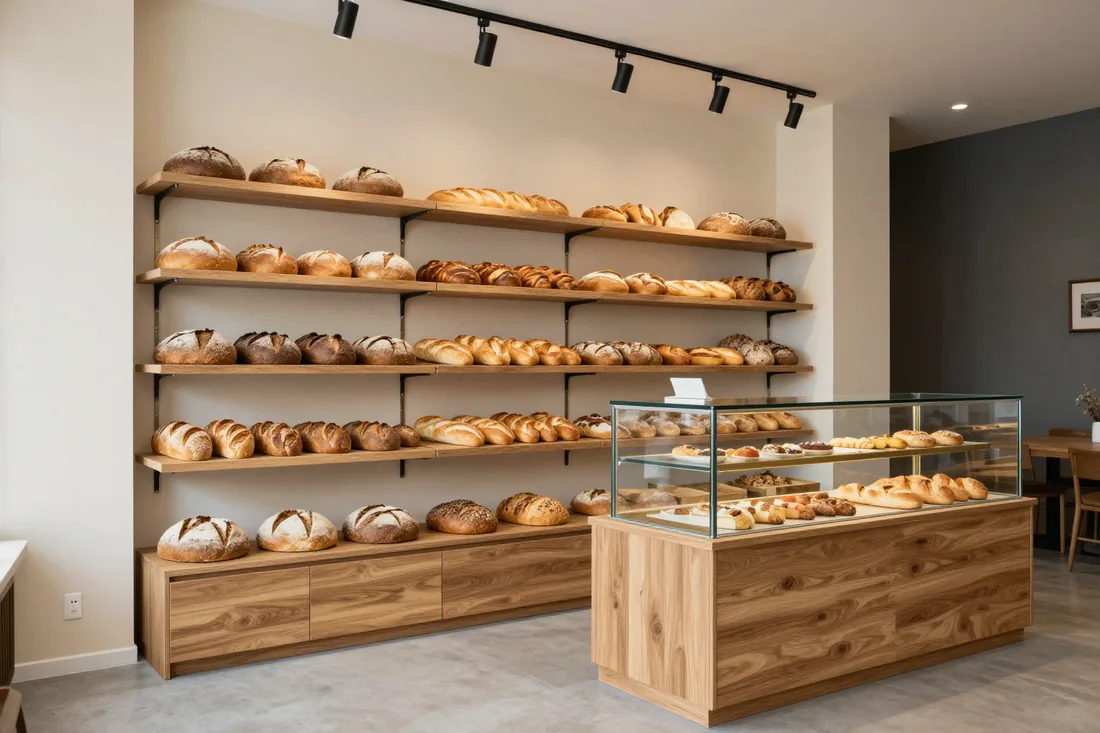
Bread line for a craft bakery in solid oak: slanted cascade shelves facing the customer and a closed display case for pastries. Brass edging and food-grade oil gave it a premium "bakery" look.
 Store
Aport Shopping Center, Alatau district
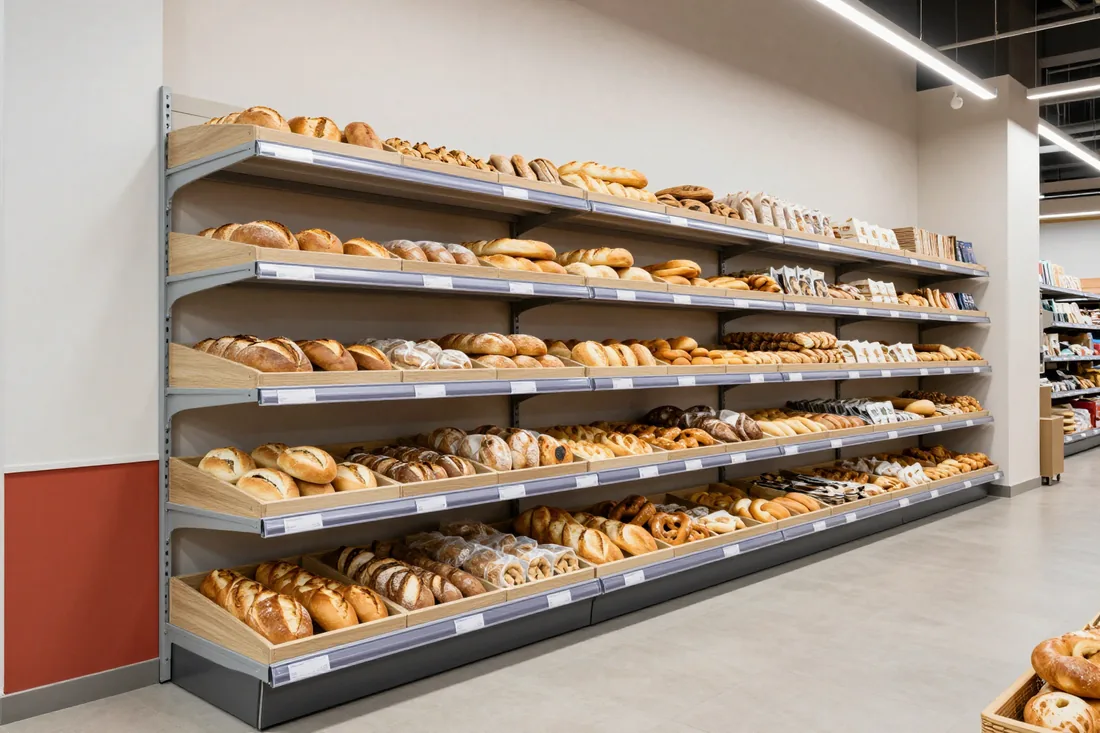
Supermarket bread department: a line of double-sided shelving with slanted shelves and price holders. Ventilated display keeps the bread fresh until evening; installation was done at night.
 Store
Aksai microdistrict, Auezov district
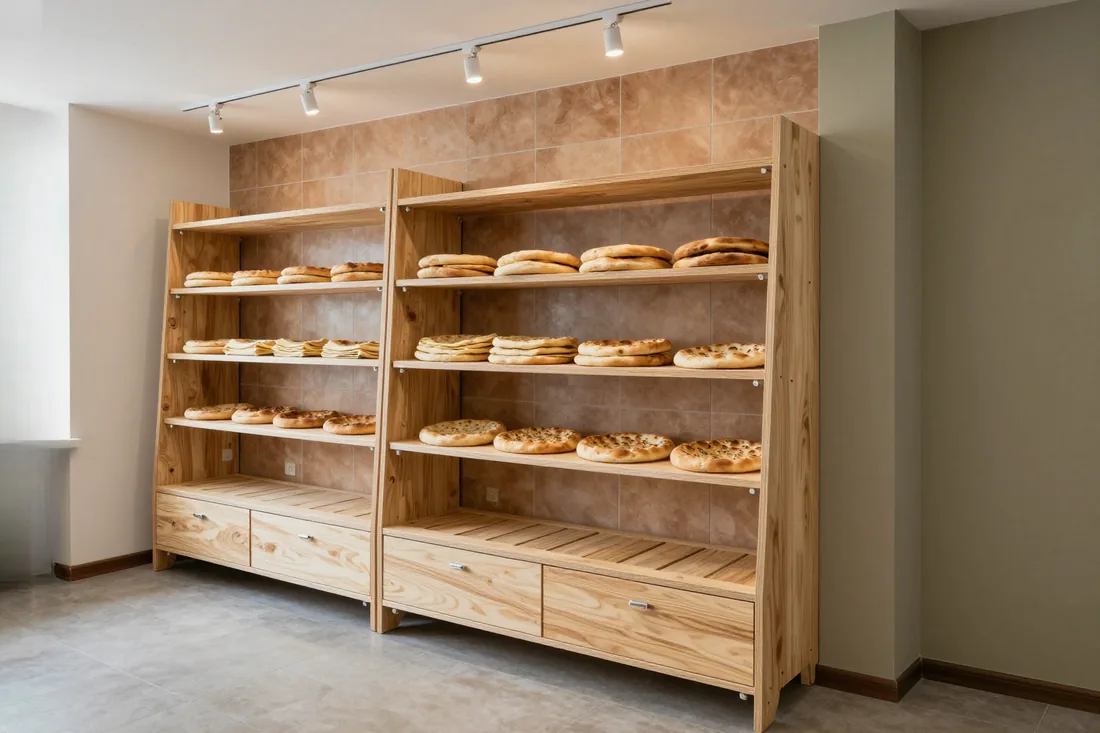
Shelving for a tandoor bakery for lavash and flatbreads: deep slanted shelves for large sheets and a slatted bottom for ventilation so hot baked goods don't get soggy underneath.
 Store
industrial zone, Turksib district
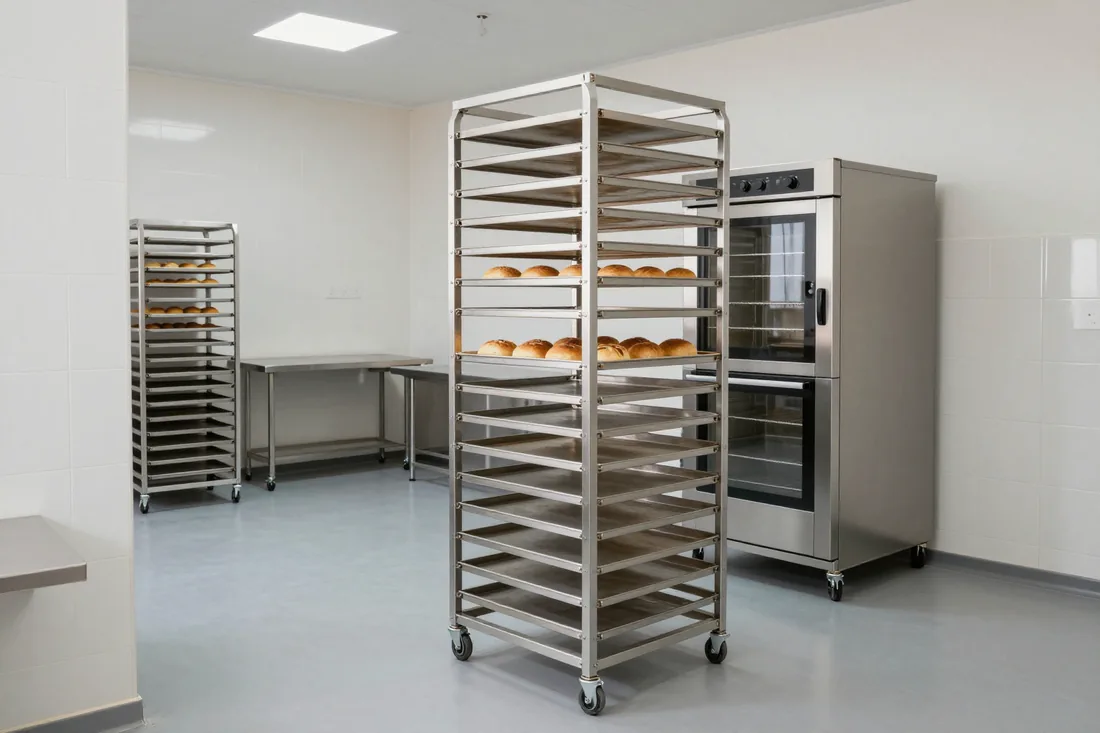
Production bakery racks for the workshop: up to 18 levels for 600×400 mm trays, an open ventilated frame for cooling and braked castors for moving batches from the oven.
 Store
Esentai City residential complex, Bostandyk district
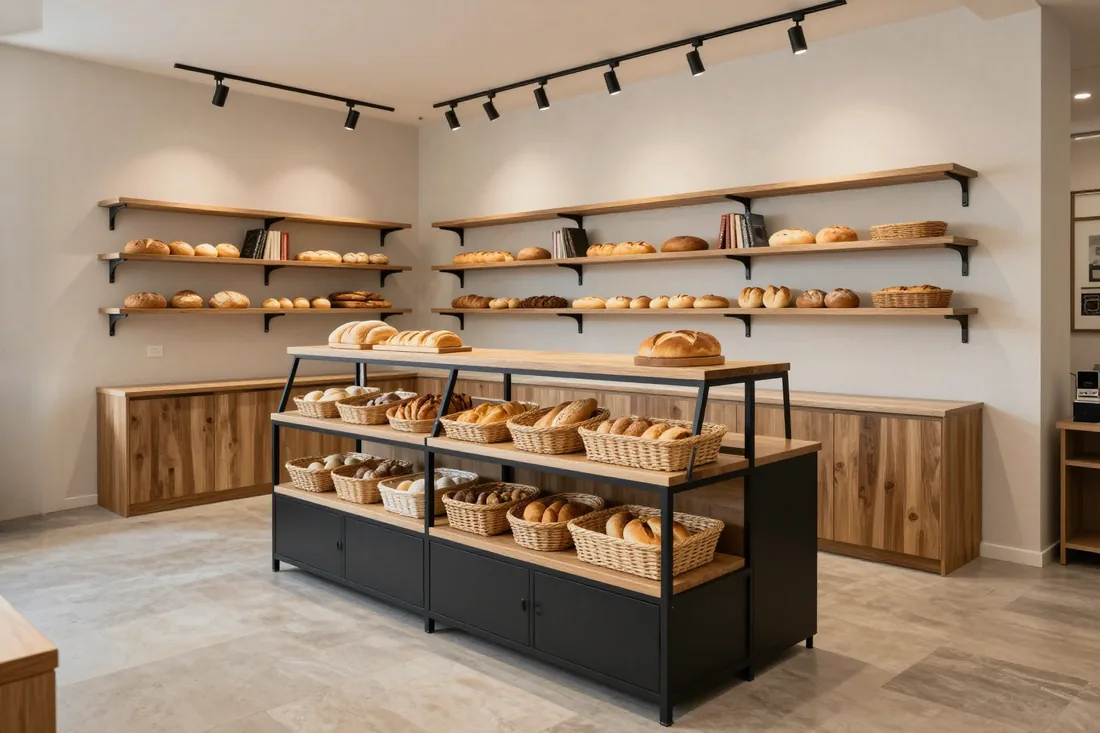
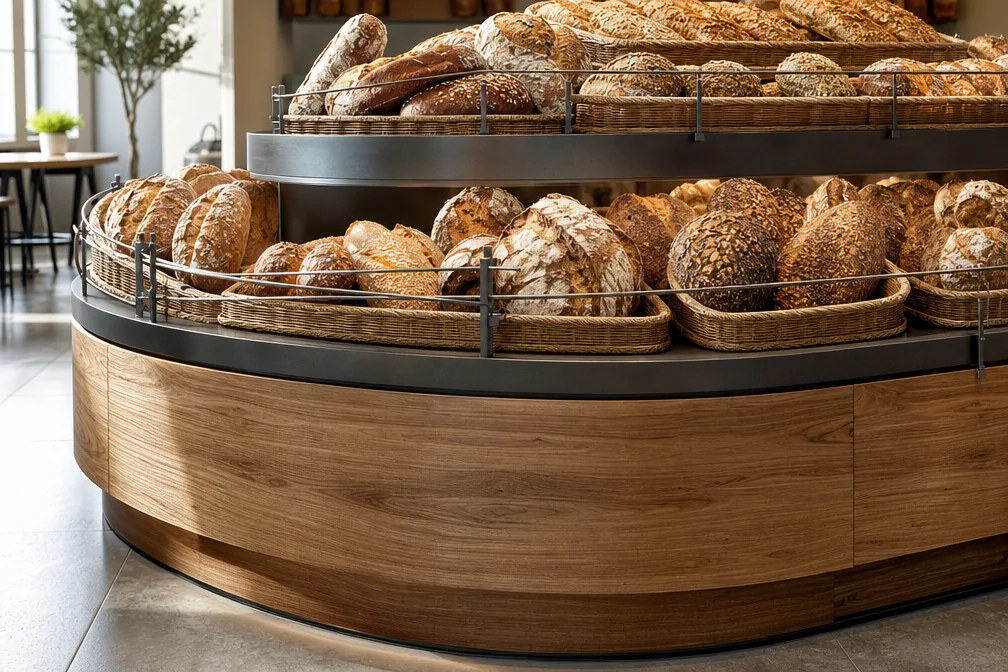
Island bread display in the center of the bakery: slanted shelves and woven baskets on all sides give all-round access to the bread. The weave lets loaves breathe, and the baskets are removable for washing.
 Store
Orbita microdistrict, Bostandyk district
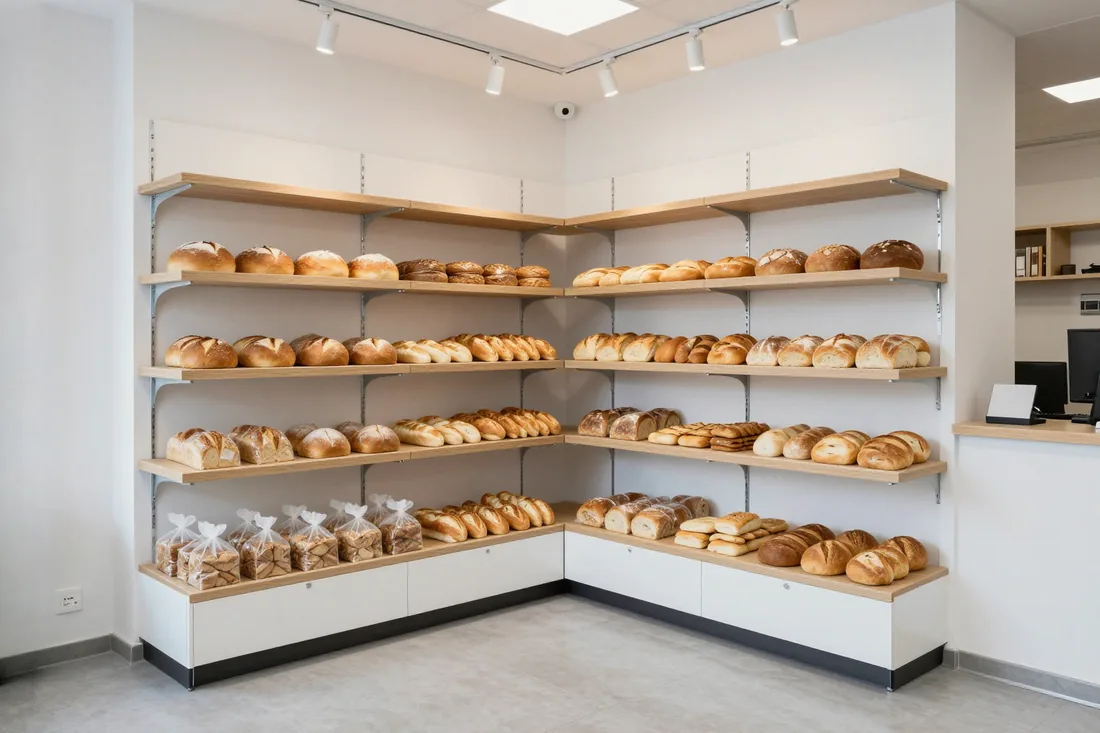
Bread corner in a neighborhood mini-market: narrow wall-mounted shelving and a corner unit closed off the line, with pull-out trays for packaged bread below. Fitted into a tight opening by the checkout without losing the aisle.
03How we work with stores
04Prices
The "from" price is for a shelving unit in the basic configuration. Width, number of tiers, trays and glass are confirmed at a free in-store measurement, and the final amount is fixed in the contract before production starts.
05For legal entities
We work with LLPs and sole proprietors on bank transfer. Price, materials and lead times are in the contract before production begins.
Request a contract and invoice06Principles

01 / 06
07Production
Six steps in our 600 m² workshop. You can see each of them with your own eyes: the showroom and production are under one roof.
Egger · Kronospan · E1
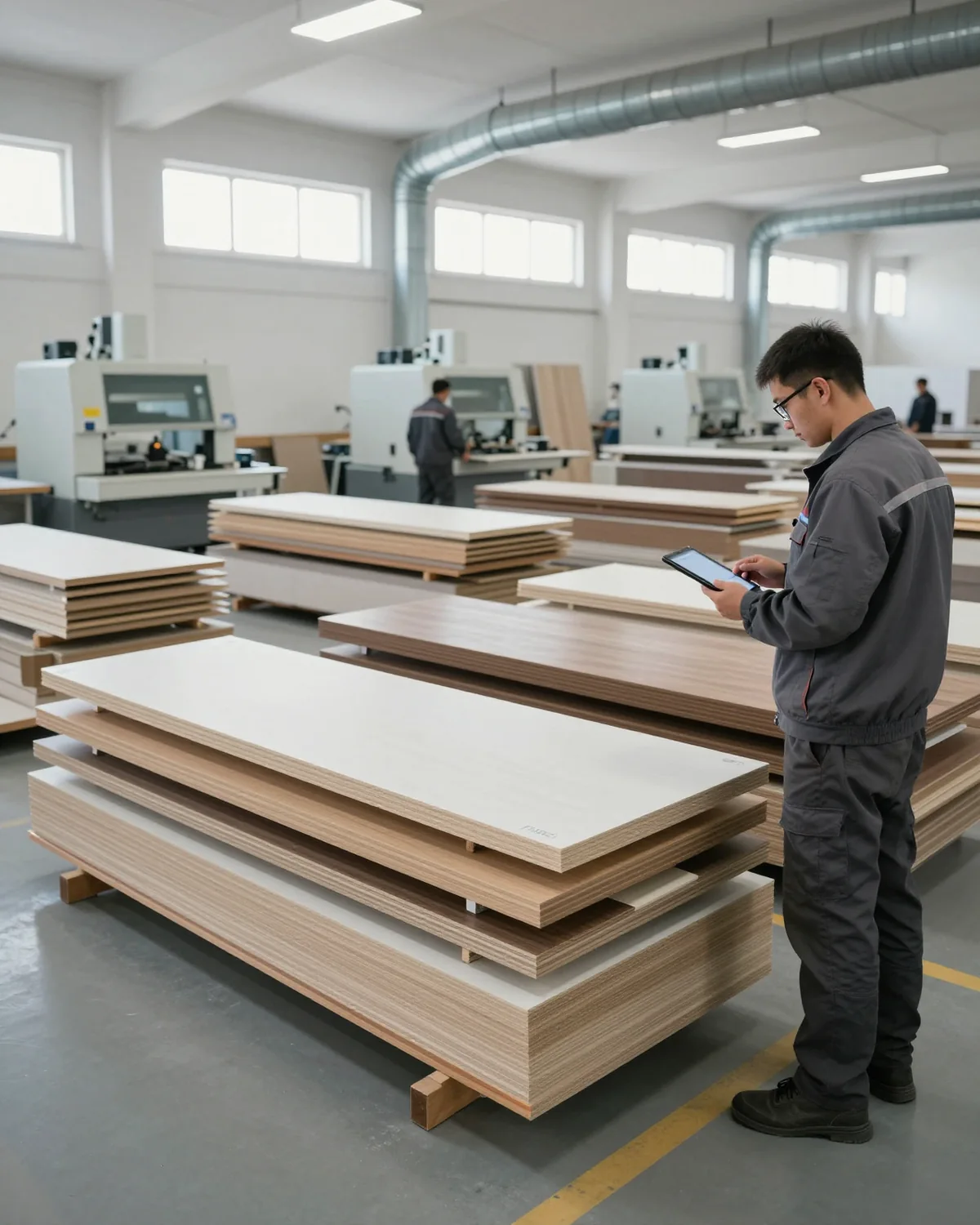
Egger and Kronospan boards of emission class E1 arrive at the workshop warehouse. Laminated chipboard decors — 40+, thickness 16–18 mm. Class E1 — for sales floors and display cases.
Laser measuring to 1 mm
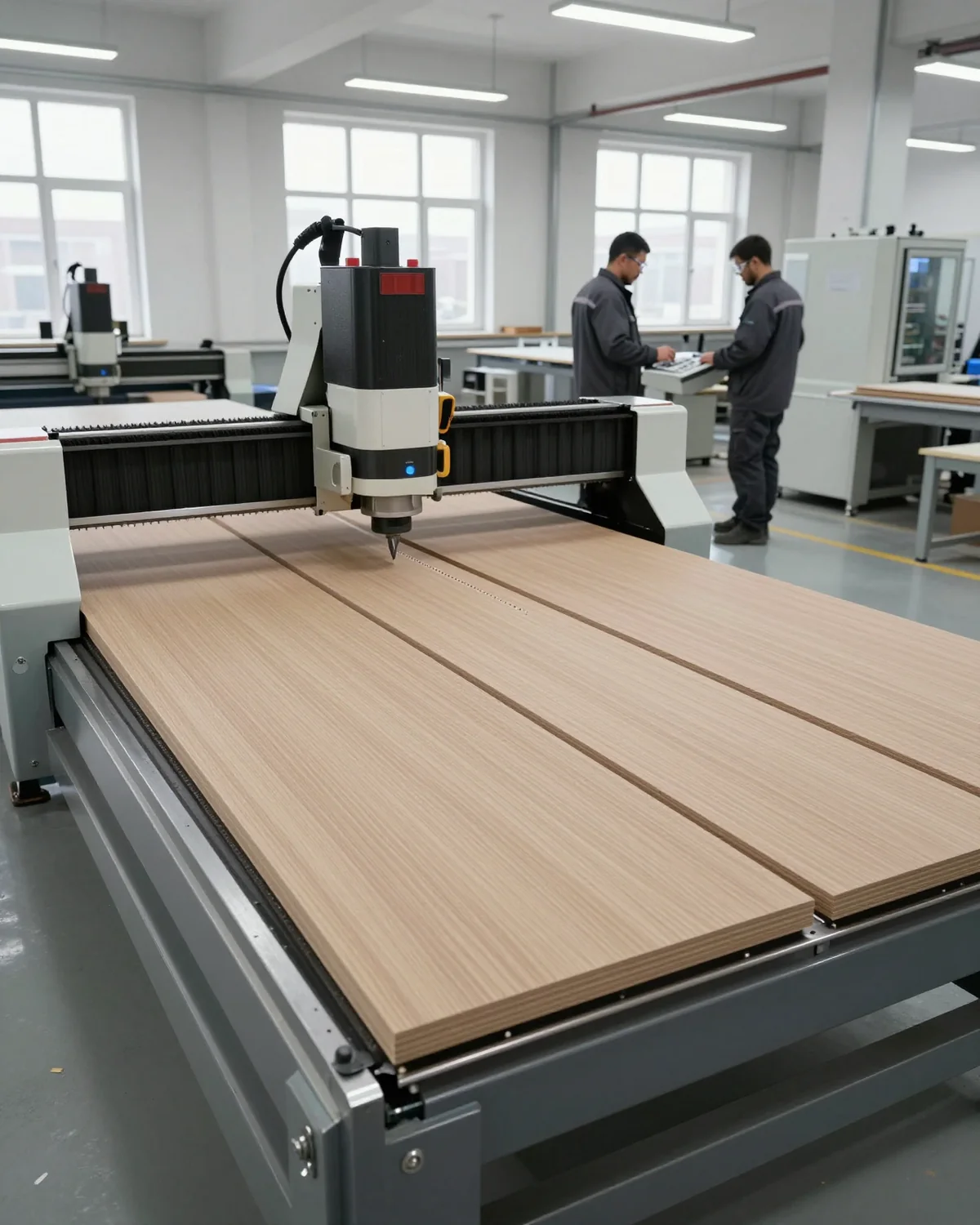
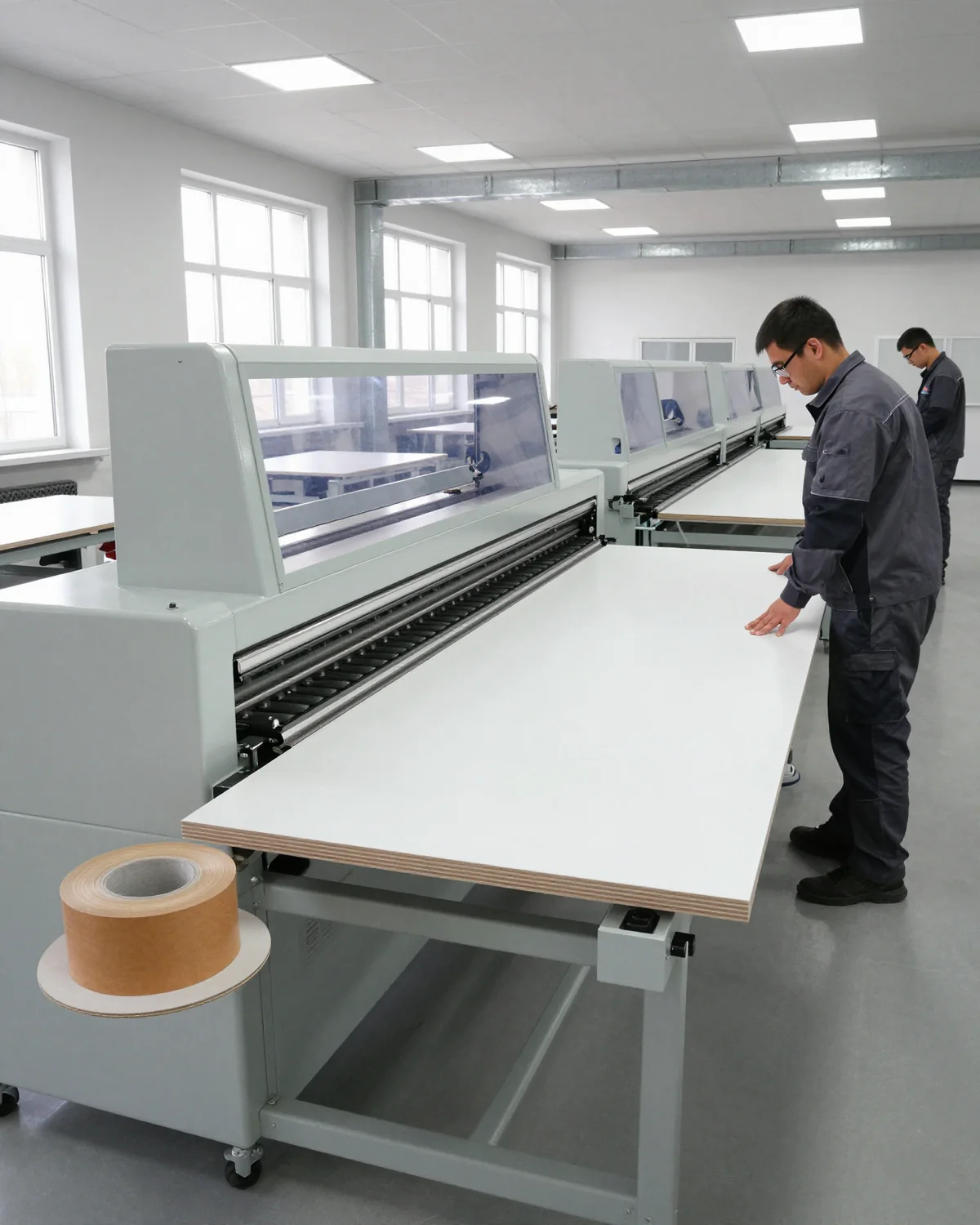
A design engineer prepares the drawings, and the machine cuts the board to them. Dimensions come from a laser measurement accurate to 1 mm.
Blum · Hettich · Boyard
The edge-banding machine seals the edges, then we drill holes for Blum hinges and Hettich runners.
Any RAL colour
A finishing specialist paints the fronts according to RAL — matte and gloss. We set the slanted shelves and edges at the test assembly and check the angle against the project, and we test the shelves under load before shipping.
Pre-assembly in the workshop
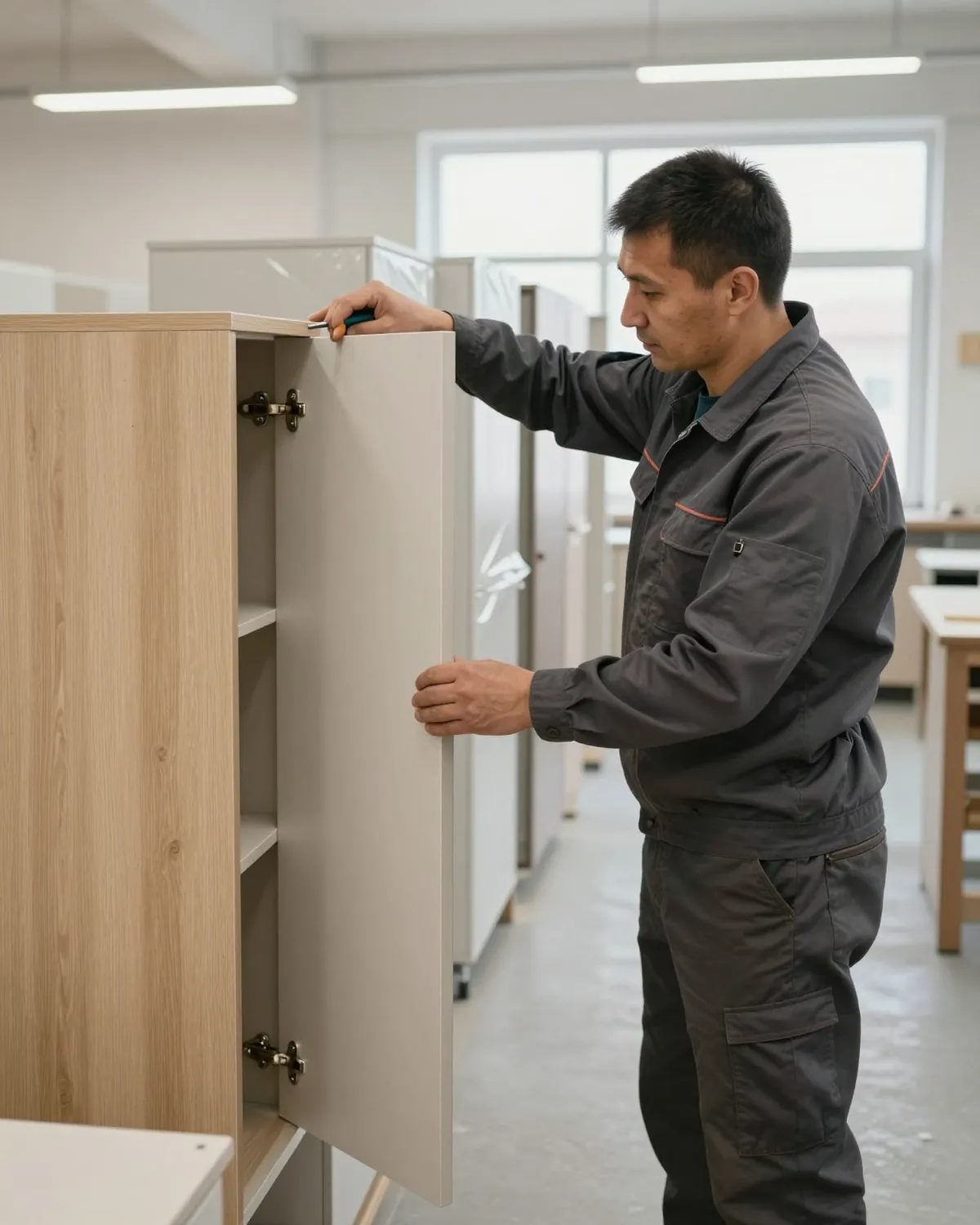
We assemble the modules in the workshop before dispatch, checking front gaps and drawer travel. The quality control department signs the item off for shipping.
Night installation according to the mall's rules
We deliver, bring in, assemble in 1 day, adjust the furniture and clean up after ourselves. From signing the acceptance act — 24-month warranty.
08Team
MEBLIX workshop craftsmen who make and assemble furniture to order.
01 / 07Furniture assembly carpenter11 years
★ 4.81 · 47 ratings

Cabinet furniture repair craftsman20 years
★ 4.99 · 73 ratings
Furniture and kitchen unit assembler23 years
★ 4.97 · 300 ratings

Made-to-order furniture maker7 years
★ 4.26 · 32 ratings

Furniture maker5 years
★ 4.23 · 30 ratings

Joiner and carpenter20 years
★ 5.0 · 113 ratings

Furniture front and hardware fitter17 years
★ 4.61 · 92 ratings
09FAQ
Didn’t find the answer? Message us — a manager replies, not a bot.
Ask on WhatsAppWe choose the angle to suit the assortment: for pan bread and loaves the shelf is set steeper, for baguettes and sweet pastries — flatter. A few-centimeter-high edge holds the display, and the loaves don't slide toward the customer's feet.
Yes, we coat the shelves with lacquer or oil approved for contact with bread, and we seal the ends with edge banding. For open display without packaging we recommend removable trays: they are convenient to wash separately from the shelving.
The powder-coated metal frame withstands frequent washing and heavy loads; supermarkets and bakeries choose it. Wood and solid timber are chosen by artisan bakeries for the warm look; plywood shelves can also be mounted on a metal base.
Yes, for flat bread we make wide shallow shelves with a low edge so lavash and flatbreads lie in stacks and don't break. Such shelves are often placed next to the counter or the tandoor.
See the prices of the wall-mounted "Baton" bread shelving and the narrow "Slim" in the price list above on this page. The final amount depends on the width and number of tiers, and you can estimate your own option in the calculator. We fix it in the contract after the measurement.
Lead times for each model are listed in the price list on this page; they depend on the material and construction. If the bakery is opening on a specific date, tell us at the measurement: a rush order is possible.
The shelves are wiped daily with a damp cloth, and once a week the removable trays are washed. The coating and PVC edge keep moisture out of the board, so the shelves don't swell from regular cleaning.
It's possible if there is a passage between the island and the walls for customers and delivery carts. At the measurement we check the width of the passages and show in the 3D design whether the island will fit or whether a wall-mounted model is better.
For LLPs and sole proprietors we draw up a contract and issue an invoice for bank transfer. You pay half before the workshop starts, the remainder — after signing the acceptance act, together with which we hand over the delivery note.
Under the contract we give a 24-month warranty on the frame, shelves, coating and assembly from the date of the acceptance act. If Blum runners are installed on the shelving, the manufacturer's 25-year warranty applies to them separately.
10Reviews
4,9
average rating
on Google and Zoon
Everyone can see a review on the platform: this is how other people check whom to trust with an order. If something went wrong, write to us and we will reply within 1–2 business days.
Message us on WhatsApp11Article
We make bakery shelving to match the assortment and the size of the sales floor: sloped shelves with side rails, trays, island display cabinets and shelves for lavash made of laminated chipboard, plywood, solid wood and metal frames. We coat the shelves with a compound approved for contact with bread. Measurement and 3D design are free and take 1–2 days, and the warranty on the item is 24 months under the contract.
A bread tier differs from an ordinary retail shelf in its angle, depth and rail height. These three parameters determine whether the customer will see the display from the aisle.
A sloped shelf turns the loaf with its cut and golden crust toward the customer, so the display reads from the aisle, not just up close. On a flat tier only the top of the item is visible, and the back row hides behind the front one. The slope also helps the salesperson: when the front loaf is taken, the next ones slide down to the rail on their own, and the shelf looks full until evening. A low rail on the edge keeps items from falling, and the price tag on it stays at eye level. Flat tiers are left for packaged bread, backup stock on the bottom level and flatbreads, which slide on a slope. One shelving unit often combines both types: sloped tiers on top show the goods, straight ones below hold backup stock for the shift.
| Type of bread | Which shelf | Detail |
|---|---|---|
| Pan bread, baguette roll | sloped, medium depth | high rail |
| Hearth bread, round loaf | sloped, deep | rail and dividers |
| Baguette | vertical cells or baskets | length stops |
| Lavash, flatbreads | wide flat | low rail |
| Sweet pastries, buns | flat or in a display case | trays, glass |
| Packaged items | flat | price tag holder |
We calculate the angle and tier spacing from the list of items the bakery or store displays during the day. Bakery shelving for pan bread gets a steeper slope and a higher rail, for baguettes and pastries a gentle shelf with trays, for lavash a wide flat shelf. The spacing between tiers is set by the height of the largest item plus room for the customer's hand, so a round loaf and buns rarely sit on identical shelves. At the free measurement we check the walls, windows and sockets, and we prepare the 3D layout design in 1–2 days and show every tier on it. The more precise the assortment list with item sizes and the morning delivery, the fewer revisions in the project and the closer the finished shelving unit is to the real display.
Open display requires materials that handle daily washing and do not absorb moisture. Let us go through the coating, the materials themselves and edge protection.
We finish surfaces made of laminated chipboard, plywood and solid wood with lacquer or oil that are safe for contact with bread, so items can be placed without a bag. The finish seals the pores of the wood and the board, and a damp cloth does not raise the grain or leave stains. We apply it in our 600 m² workshop in several coats with intermediate sanding so the surface is smooth and does not catch the crust. We treat not only the top surface but also the underside: otherwise, during washing, water gets in from below and the board gradually absorbs moisture. Solid oak is best suited to an oil that highlights the grain and is easy to refresh. When ordering, it is worth asking whether the display will be unpackaged, as this determines the choice of finish.
| Material | Where it works best | What to look for |
|---|---|---|
| Laminated chipboard 16–18 mm | wall-mounted and corner shelving | edge banding on all ends |
| Plywood | trays, sloped shelves | finish on both sides |
| Solid oak | artisan bakery | oil, gentle washing |
| Metal frame | supermarket, display cabinets | powder coating |
| Stainless steel | bakery production area | production zones only |
An open board end absorbs water during washing, so we close all ends of the tiers and side rails with 2 mm PVC edge banding on an edgebanding machine. Without edge banding, laminated chipboard swells along the edge after just a few weeks of damp cleaning, and the swollen edge cracks and collects crumbs. We make the joints between the tier, the side panel and the rail tight, with no gaps where debris usually accumulates and insects breed. On a metal frame, the shelf rests on supports and water runs down without lingering at the welds. We carry out a test assembly in the workshop: we check the tiers under load and look for any open ends. Tight joints and closed edges extend the life of the shelving more than a more expensive material.
The place of bread in the sales area affects sales no less than the shelf itself. Here is how to choose between a wall and an island, which aisles to keep, and what to do in a tight space.
Wall-mounted sections are placed along a long wall, while an island display cabinet goes only where a free aisle remains around it on every side. Bakery shelving for a convenience store is most often wall-mounted: it takes up less space and holds stock on the lower tiers. An island display cabinet is appropriate in a bakery and a supermarket where the flow of customers walks around the display and takes bread from any side. During the free measurement we mark columns, the stockroom door and the route of the cart with the morning delivery, and in the 3D design we show whether the island will block this route. If the display cabinet gets in the way of deliveries, it is better to replace it with a corner or wall-mounted model of the same capacity than to unload bread the long way around every morning.
In a tight mini-market, narrow and corner shelving units help out by using wall sections and corners without taking up aisle space. A narrow model fits between the fridge and the door, while a corner unit uses the corner that is usually empty or cluttered with boxes. We make such shelves to the dimensions of a specific wall, so the shelves reach right into the corner and leave no gaps. A baguette at the checkout is often bought last, on the way out, so a small section next to the checkout counter works better than a far corner of the sales floor. In mini-markets inside shopping centres, we carry out installation at night or at weekends, according to the mall's rules, so the store doesn't have to close. If the space is very small, start with one section and later order a second in the same finish.
A standard sloped tier holds loaves well, but flat, long and soft bread breaks, falls or goes stale on it. It needs its own tier shape.
Lavash and tandoor flatbreads are placed on wide, shallow shelves with a low rim so the stack lies flat and the edges don't crease. On a sloped shelf, flatbread slides down and gets crushed, so for it we make level tiers with a small step. Bakery shelves for a shop with lavash are usually placed closer to the counter or tandoor: this bread is bought more often than others and often straight from the oven. We coat plywood and solid wood with a finish suitable for contact with bread, since flatbreads are almost always displayed unwrapped. In a bakery by the tandoor, a woven basket on the bottom tier also comes in handy — it's convenient for keeping a stock of flatbreads until the next bake. We select the tier width to match the largest flatbread diameter in the range.
Baguettes are displayed vertically in baskets and cells or on long tiers with end stops. Vertical display saves wall width: a cell the width of a hand holds several baguettes, and the shopper sees them in full. Cells are angled backwards so the baguette rests against the back wall and doesn't fall forward when being chosen. If baguettes lie horizontally, the tier needs to be longer than the longest item and have low stops at the edges, otherwise the bread hangs over and breaks. Woven baskets suit an artisan bakery and give the section a warm look, while plywood cells are easier to wash and quicker to clean of crumbs. In a small shop, a baguette cell is often built right into the end of a wall-mounted shelving unit.
We recommend placing sweet pastries, pies, and baked goods without packaging in a display case with tempered glass rather than on an open shelf. Behind glass, baked goods are protected from dust and customers' hands, and soft tops do not get squashed during selection. A bakery display case usually stands on the counter or next to the till, and the salesperson serves items with tongs. Inside, we make several even tiers with trays so buns of different sizes do not mix. The glass and aluminium profile are easy to wipe, and we coat the tiers inside with the same finish as the open ones. A closed display case is especially needed in a bakery-café where pastries are bought to go with coffee and stand in the hall all day, while fresh croissants are immediately visible to guests at the counter.
Even a good shelving unit shortens the life of bread on the shelf if it stands by a window or is hard to clean. Let's look at the location, the shelf construction, and daily care.
Sun and dry warm air draw moisture out of the crumb, so bread by a window and above a radiator goes stale faster than by an inner wall. Direct rays also heat the crust, and it cracks, while the packaging gets covered with droplets on the inside. The warm flow from the radiator rises along the wall and dries the upper tiers more than the lower ones. For this reason, the bread section is placed by an inner wall or deep in the hall, away from the entrance door, where cold and street dust draft in during winter. If there is no other place, the window is covered with film or blinds, and the radiator with a screen with a gap. On the floor plan, it is worth marking windows and radiators in advance so that the project places the display in the most temperature-stable spot.
A bakery with its own workshop needs two different types of shelving, and it is more convenient to order them together. Here are the differences, the ordering procedure, and the terms for a chain of outlets.
A production shelving unit is needed in the bakery workshop, where bread cools after the oven and waits to be sent to the sales floor. It is made of stainless steel and aluminium, with slatted shelves that let air through, and often on castors so a batch can be rolled from the oven to packaging. Such a shelving unit is designed for hot baking trays, frequent washing and non-stop use, but it looks technical and is not suitable for the sales floor. A retail shelving unit, on the contrary, displays bread to the customer: it has angled tiers, retaining edges, price tags and a finish that matches the interior. The two should not be confused, since a wooden shelf will not withstand a hot baking tray, and a workshop rack sells poorly. If a bakery opens both a workshop and a sales floor, both types are conveniently included in one project.
For chains we keep the drawings, décors and frame colour, so the shelving for a new location repeats the first one down to the smallest detail. The customer recognises the bakery by its identical display, and staff do not need to get used to different shelves and a different product order. Several locations can be covered by one estimate and one contract, and payment for LLPs and sole traders can be made by invoice: 50 % prepayment, the balance after the acceptance certificate, together with which we hand over the delivery note. If the new location is smaller than the previous one, we keep the module and change only the width or the number of sections. Over 13 years of work and 3 500+ projects, including bakeries and mini-markets, we have seen that a single display standard saves time at every opening.
Good bread display comes down to the right tier, a good spot on the sales floor and simple daily care of the surfaces. Key takeaways.
12Calculation
Choose a model, quantity, carcass and fronts in the calculator — the calculation goes to the manager on WhatsApp, who will check it against the wall dimensions and send you a quote.
13Retail furniture
We make shelving, display cases, counters and checkout zones for your goods and floor layout, and install at night so the store never closes.
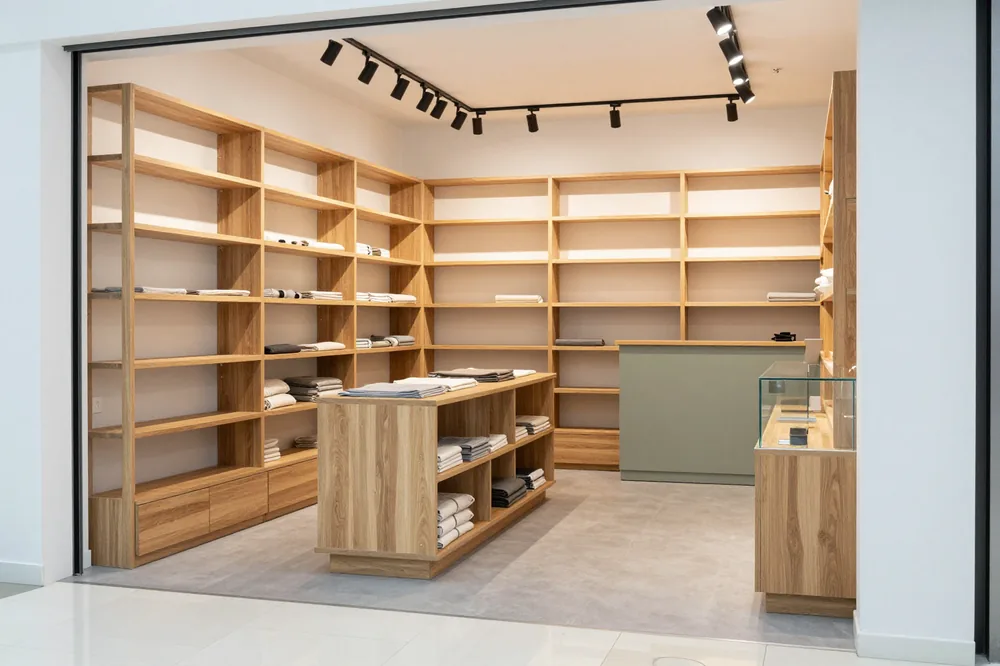
We make shelving for your goods, stockroom or niche: shelf pitch, depth and frame are calculated from the weight and size of what will go on them.
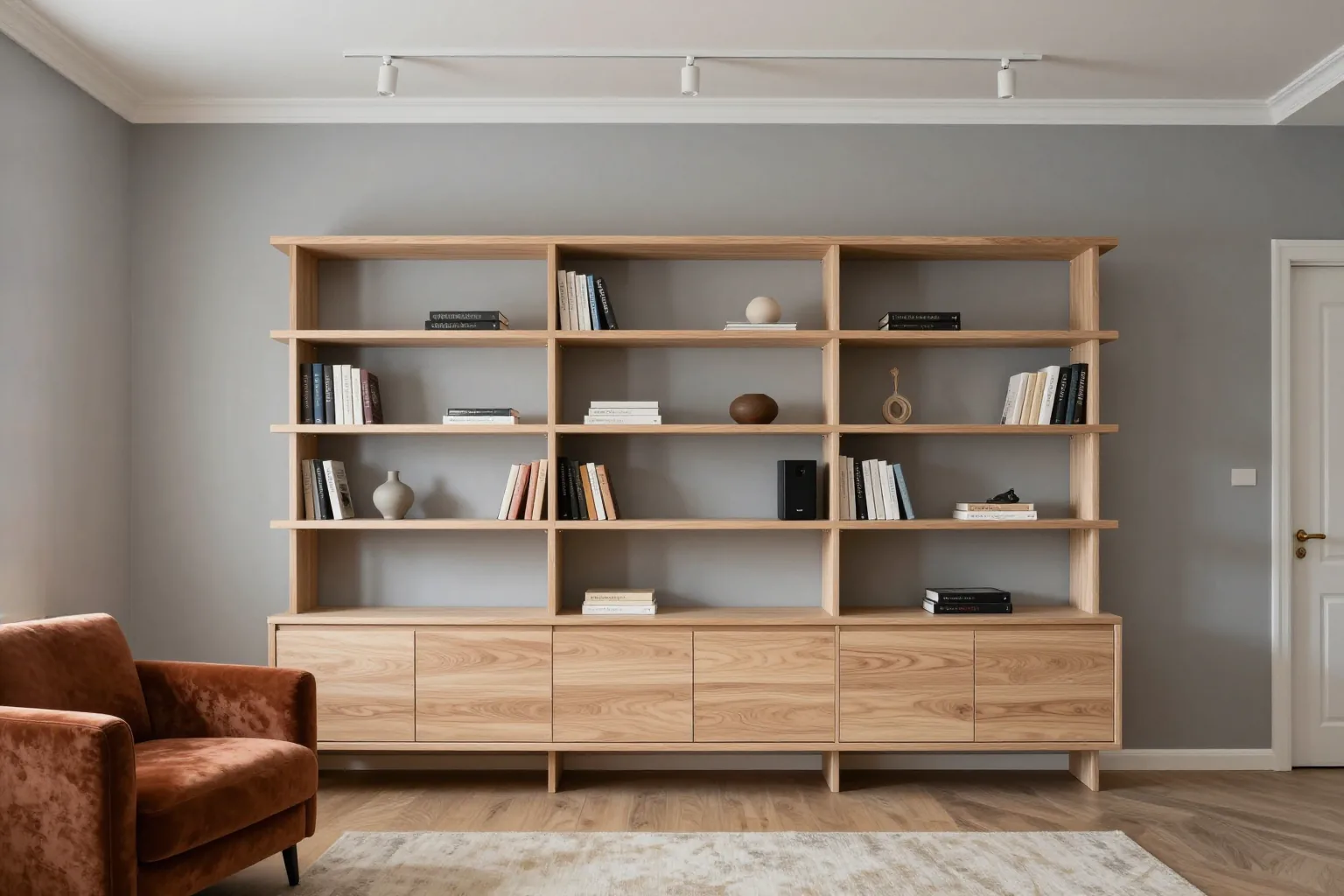
We make wooden shelving to the dimensions of the wall, niche or opening: we select the wood species, shelf thickness and finish for what will go on them.
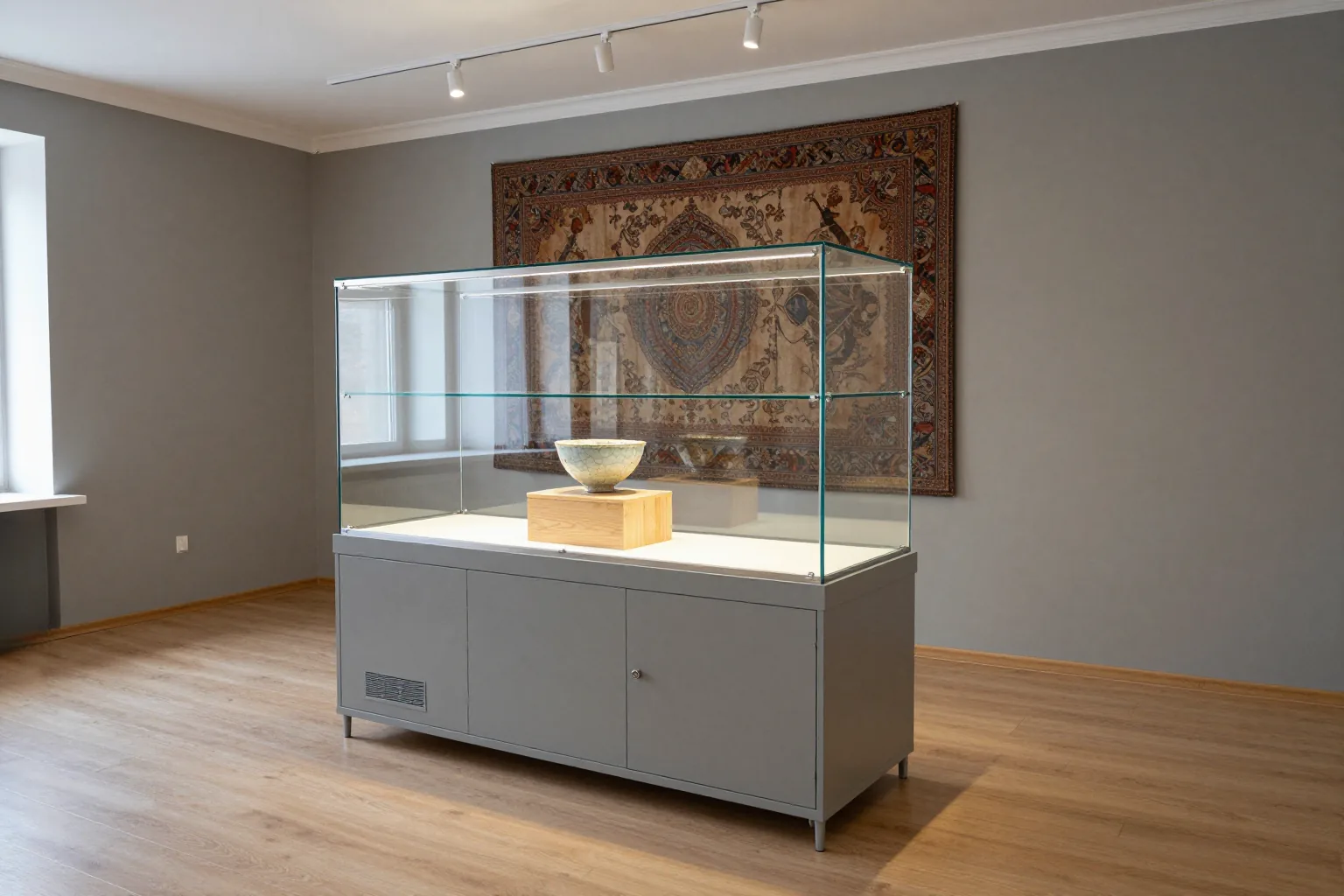
We make wall-mounted, island and tall display cases for your goods: tempered glass, locks and lighting that doesn't dazzle the customer.
We make rails, gondolas, knitwear shelving, fitting rooms and a checkout for your assortment and boutique layout, and install at night so the store never closes.
We make slanted shelving, island displays and fitting benches for your footwear assortment and floor layout, and in malls we install at night.
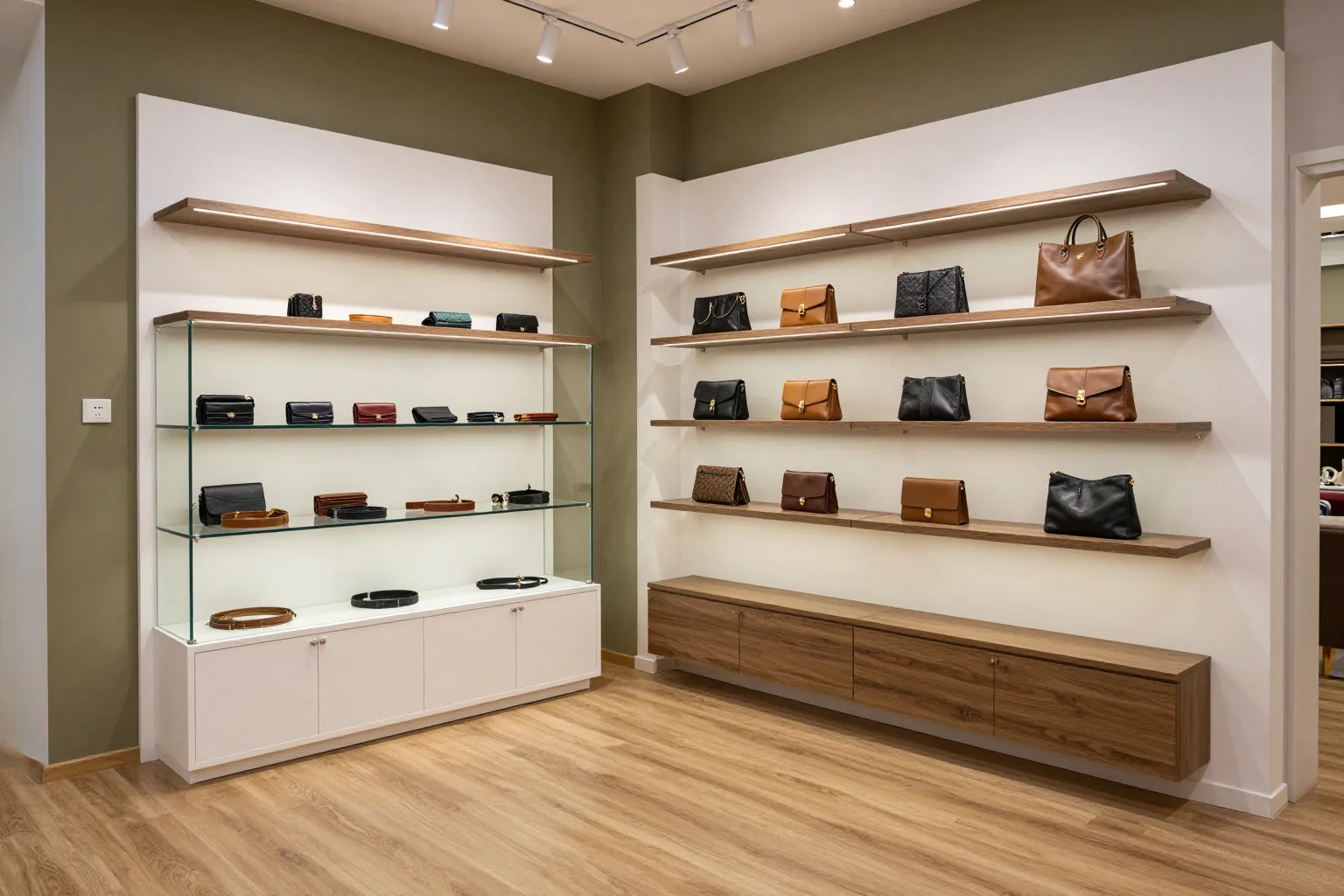
We make wall shelving with lighting, gondolas, perfume display cases and tester tables for your assortment and floor layout, and install at night per mall rules.
We make counters, island and wall display cases for jewellery: tempered glass, a lock on every door and spot lighting that makes the stones sparkle.
We make wooden shelving for the sales floor: pine, oak and ash solid wood holds displays for years, and we calculate the shelves for the weight of your goods.