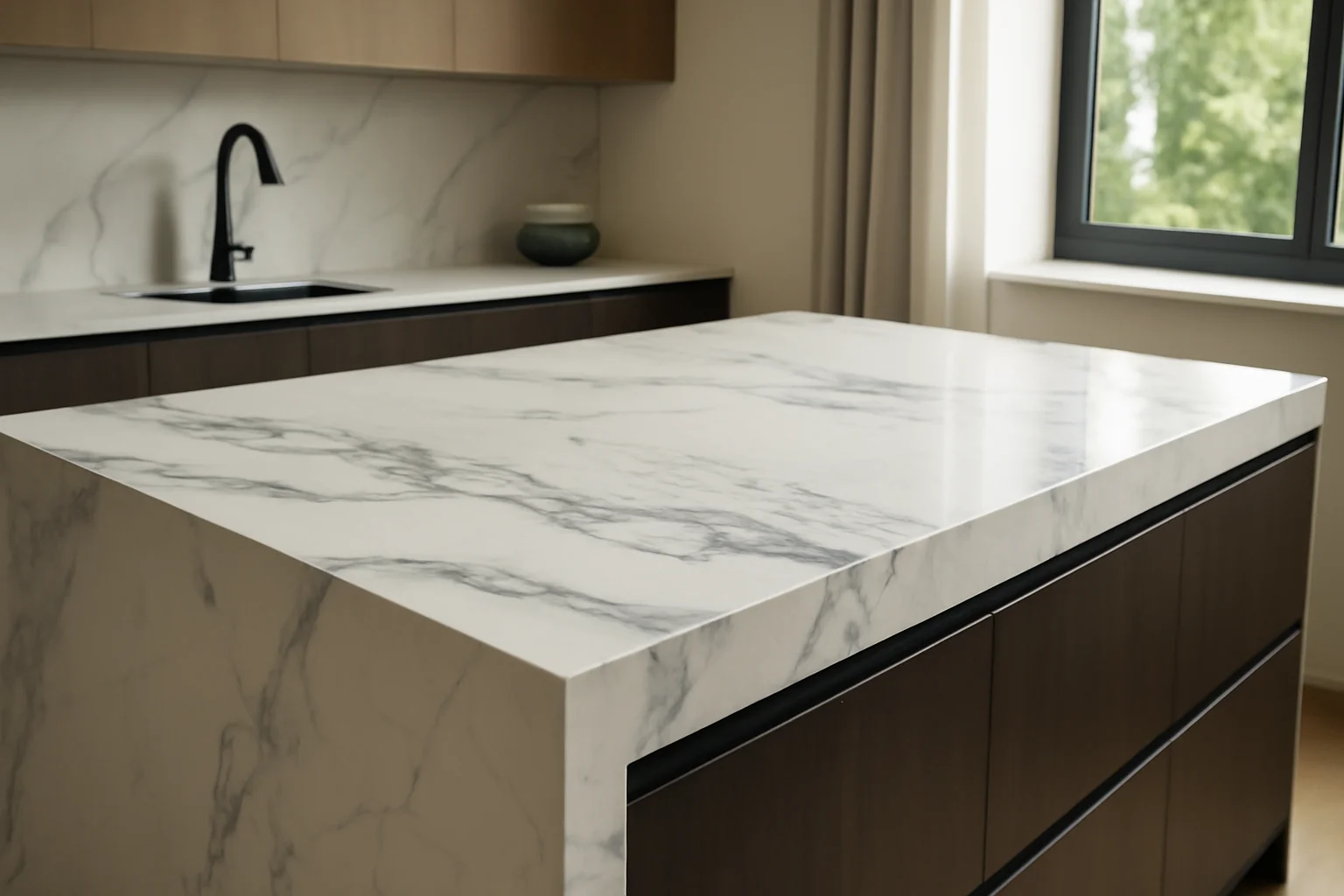
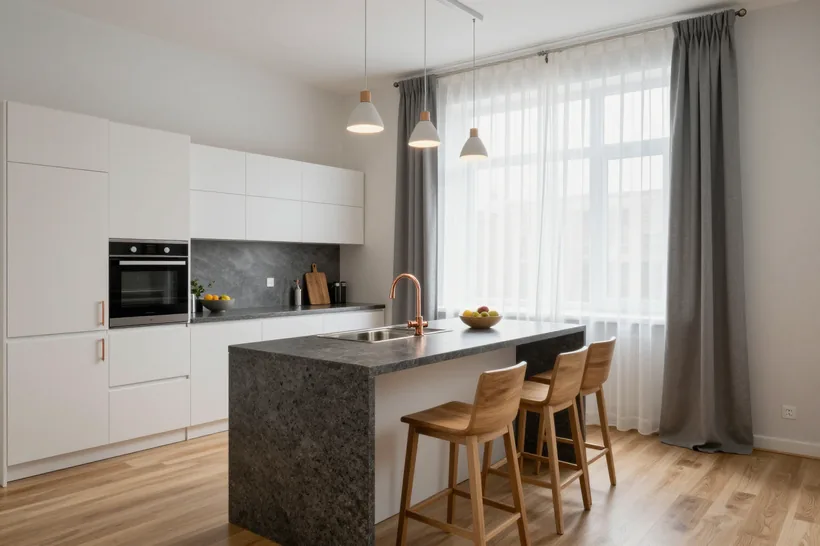
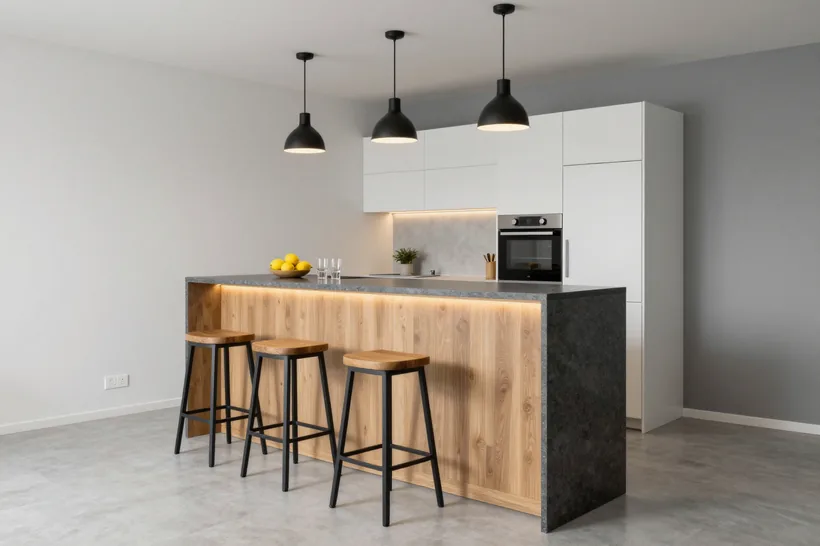
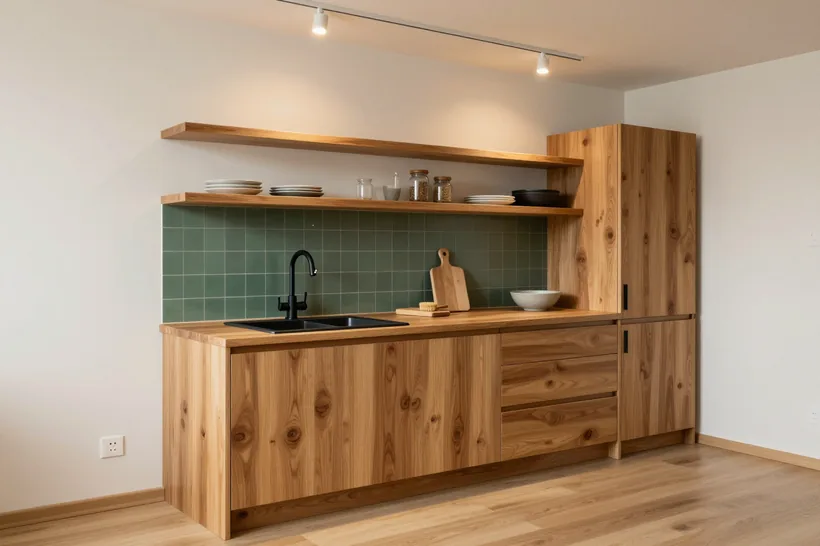
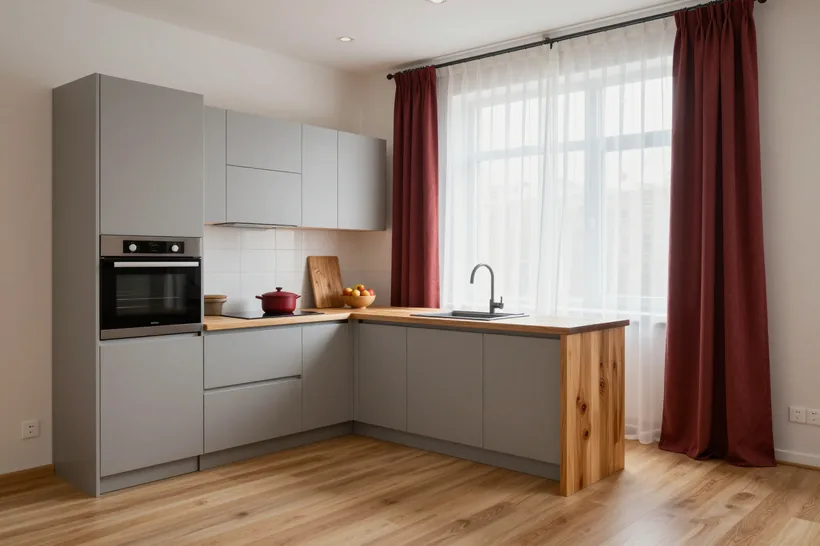
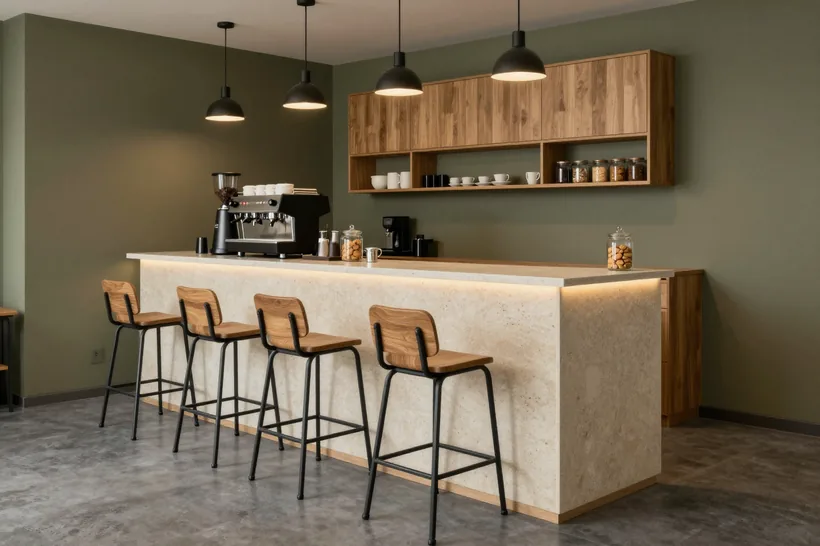
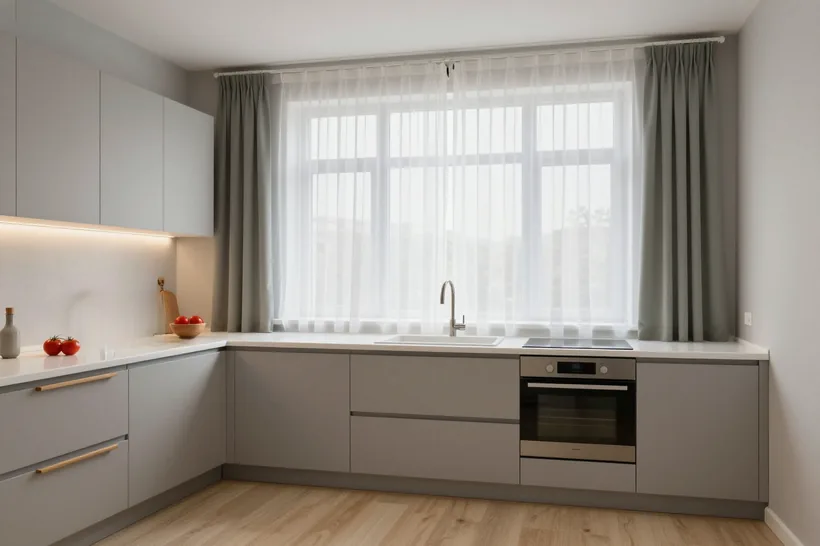
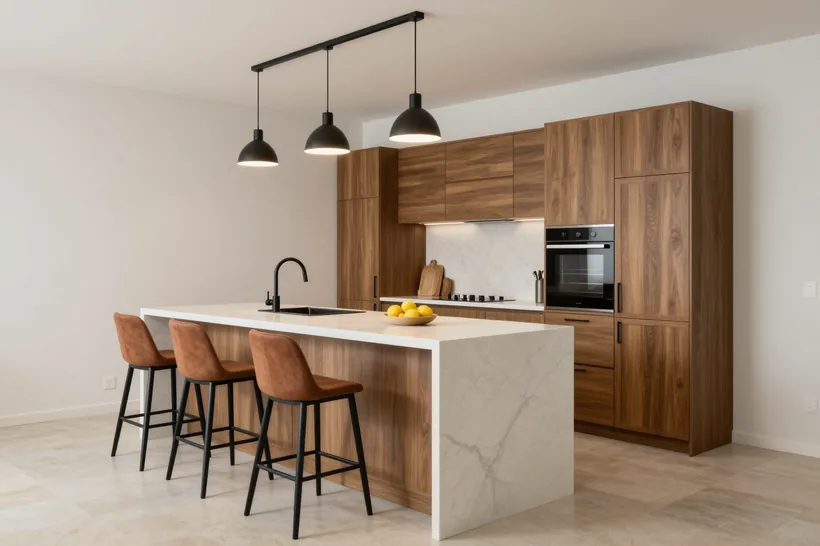
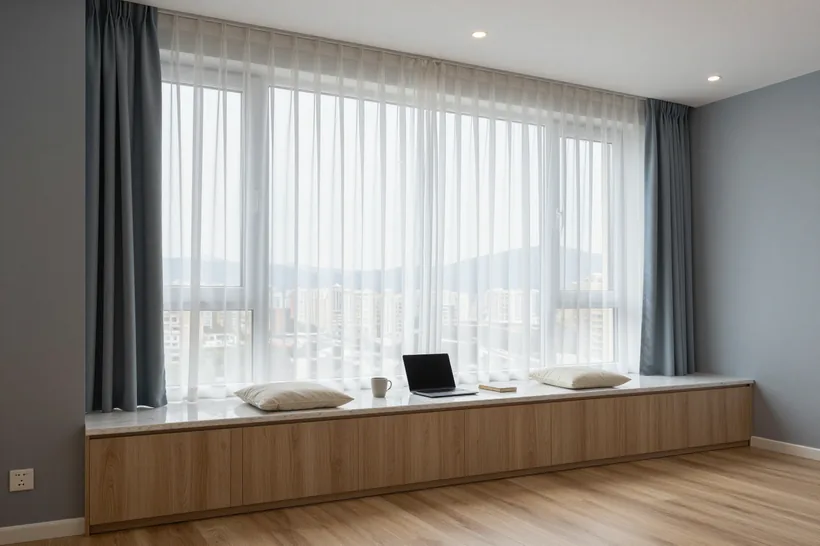
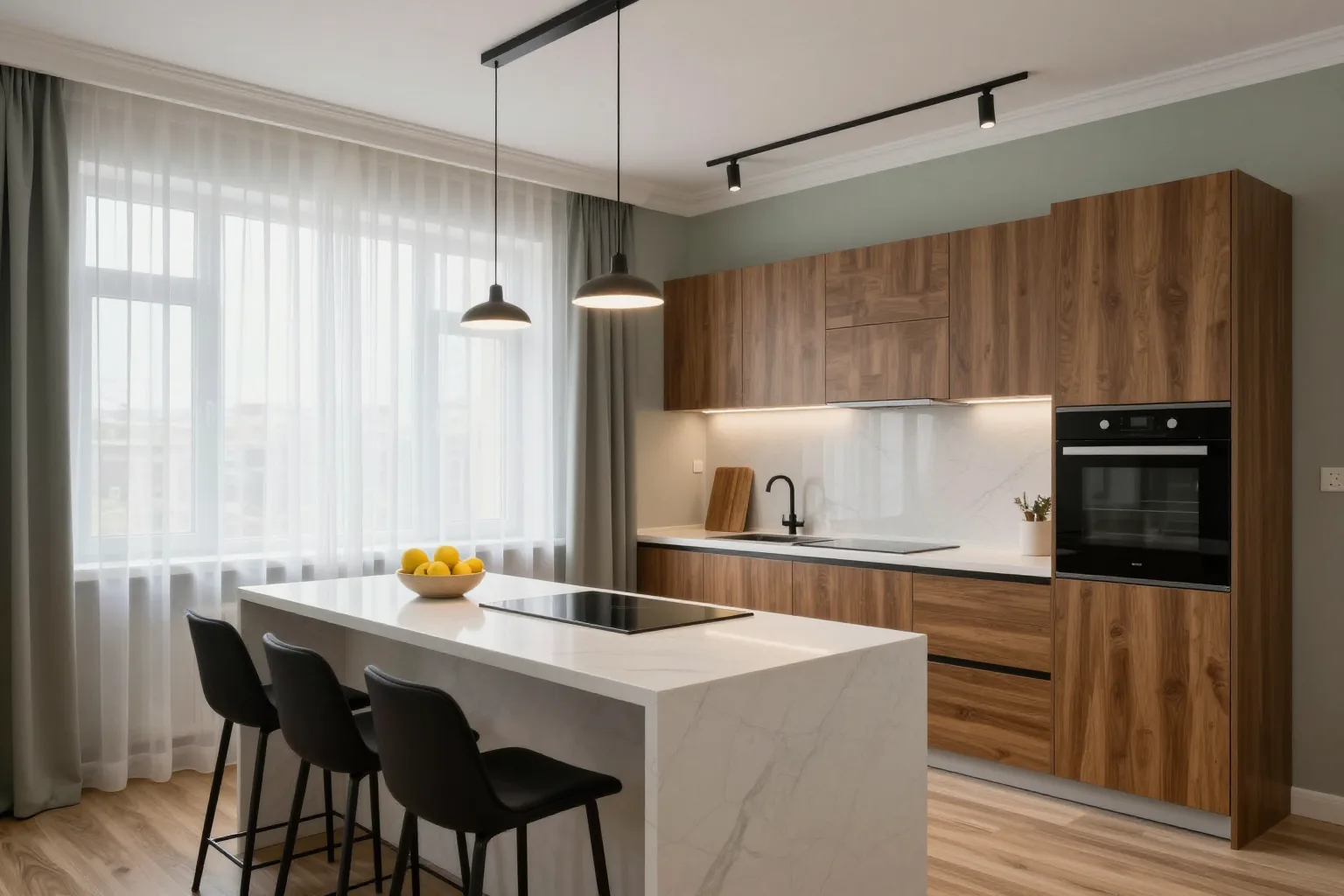
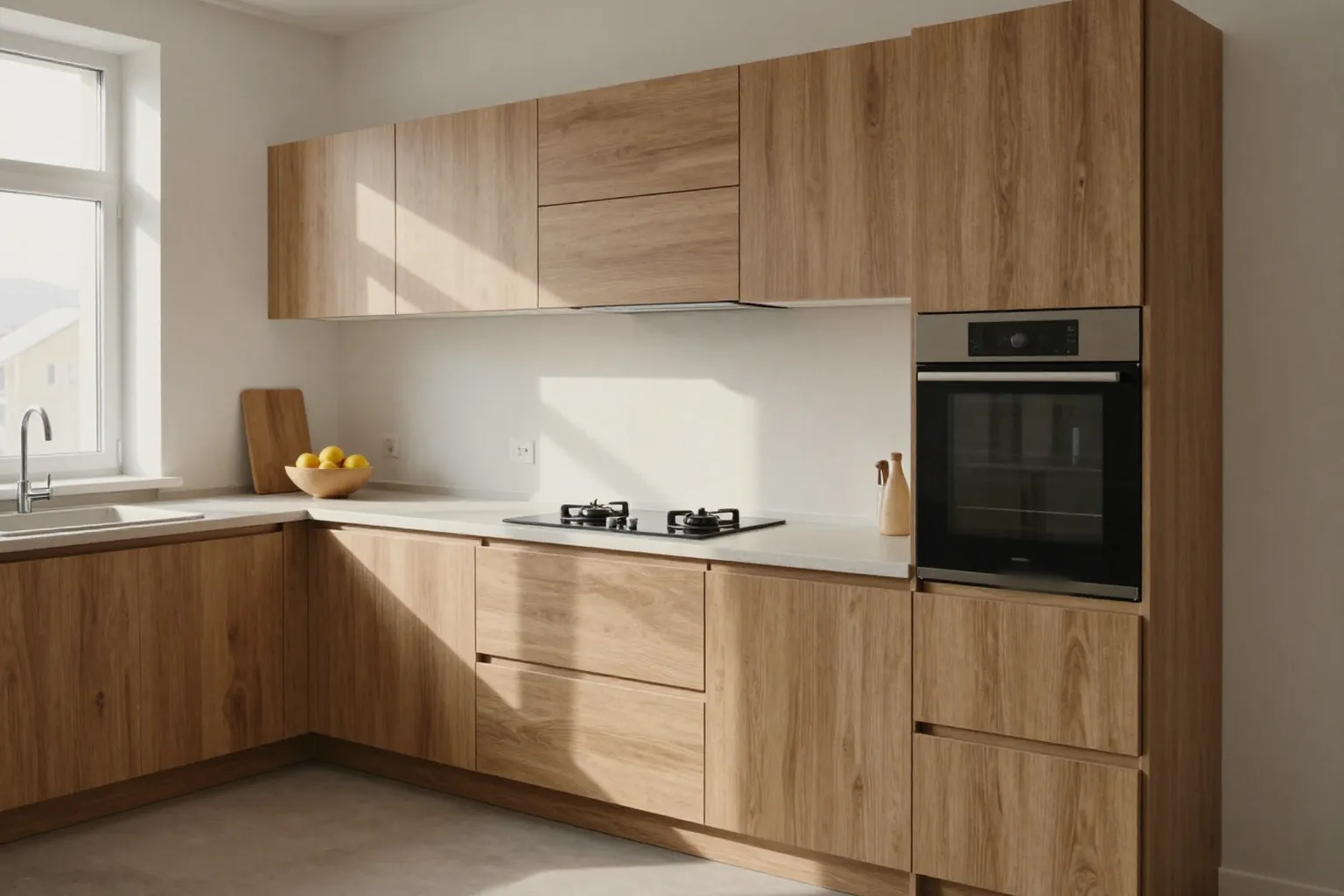
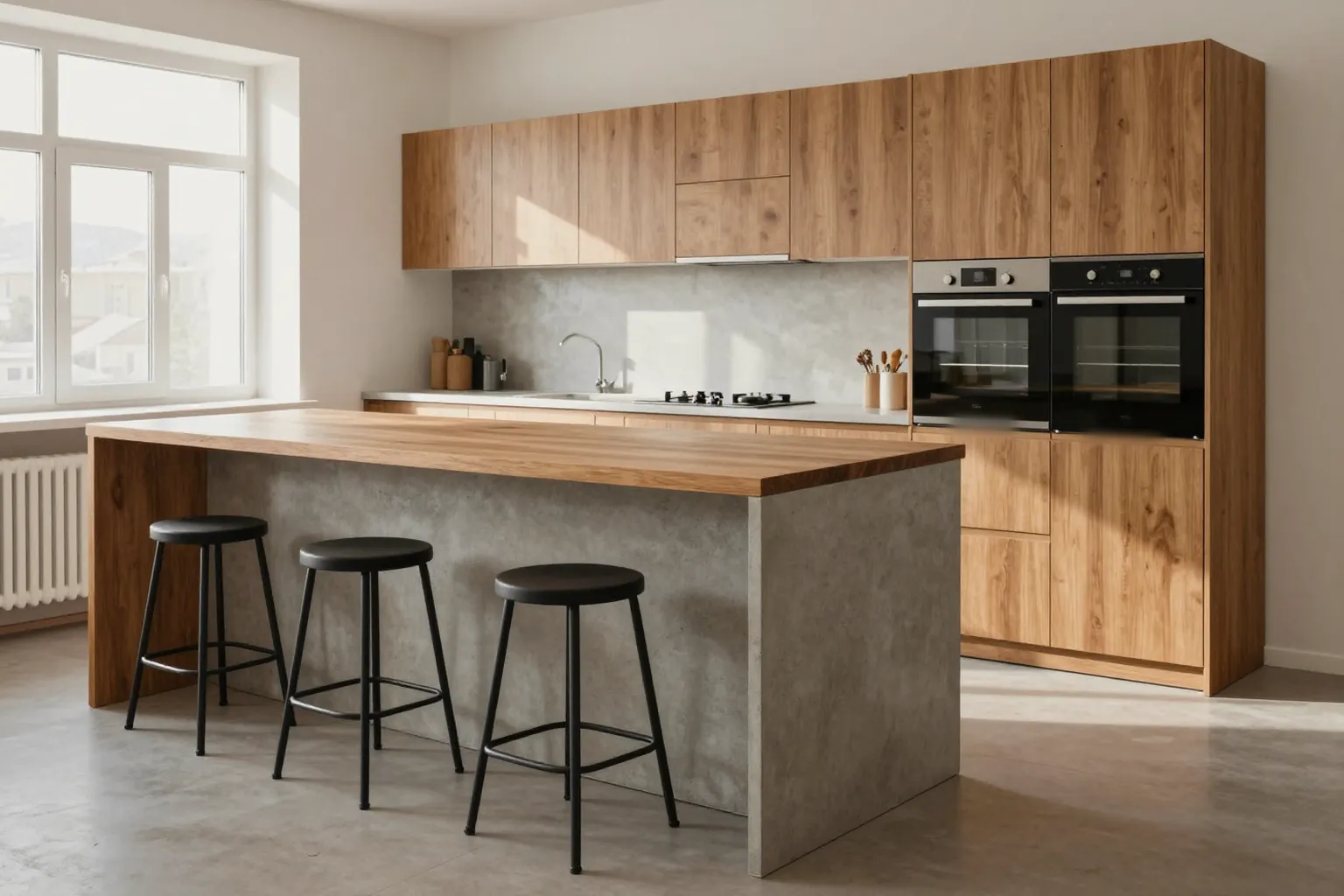
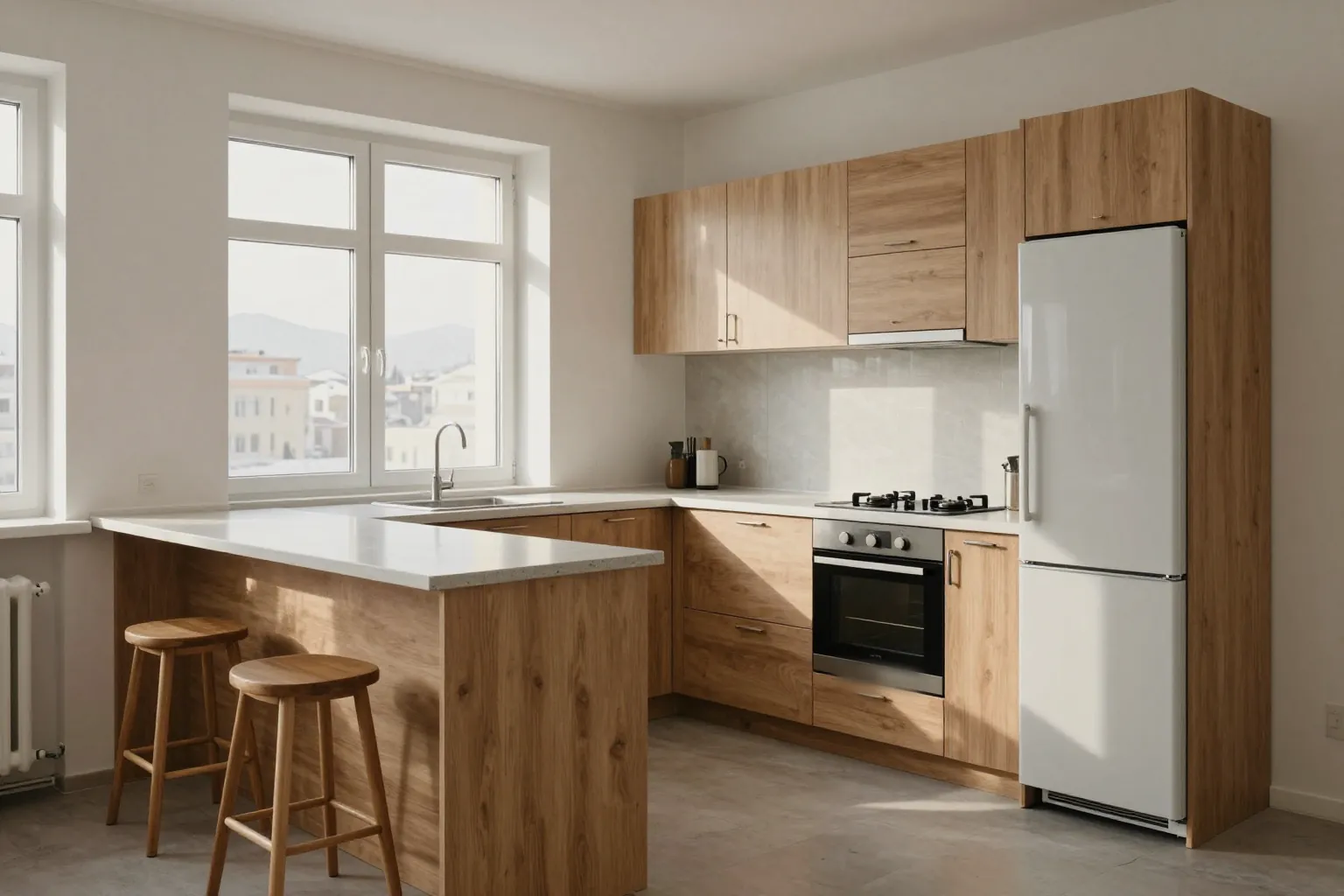
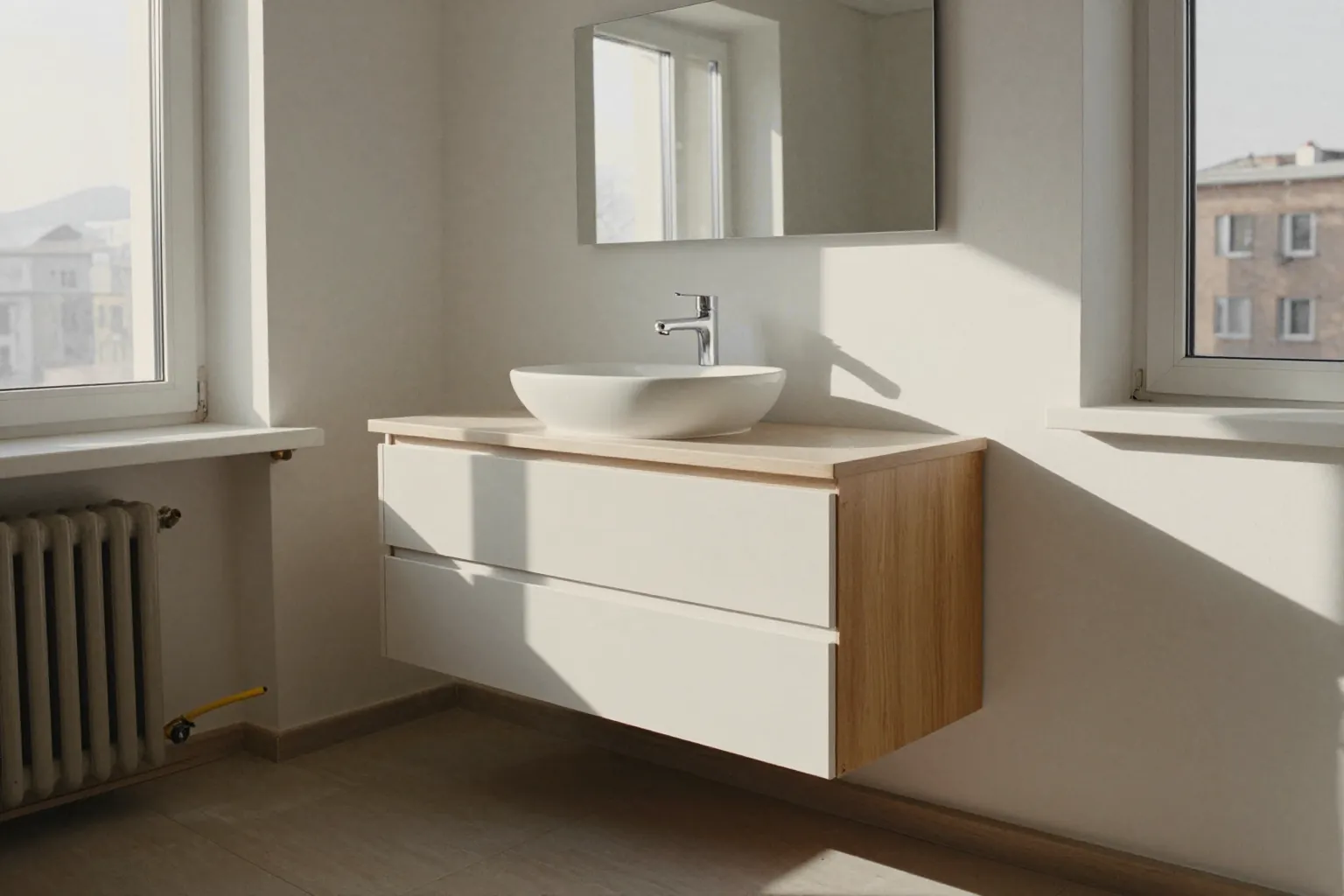
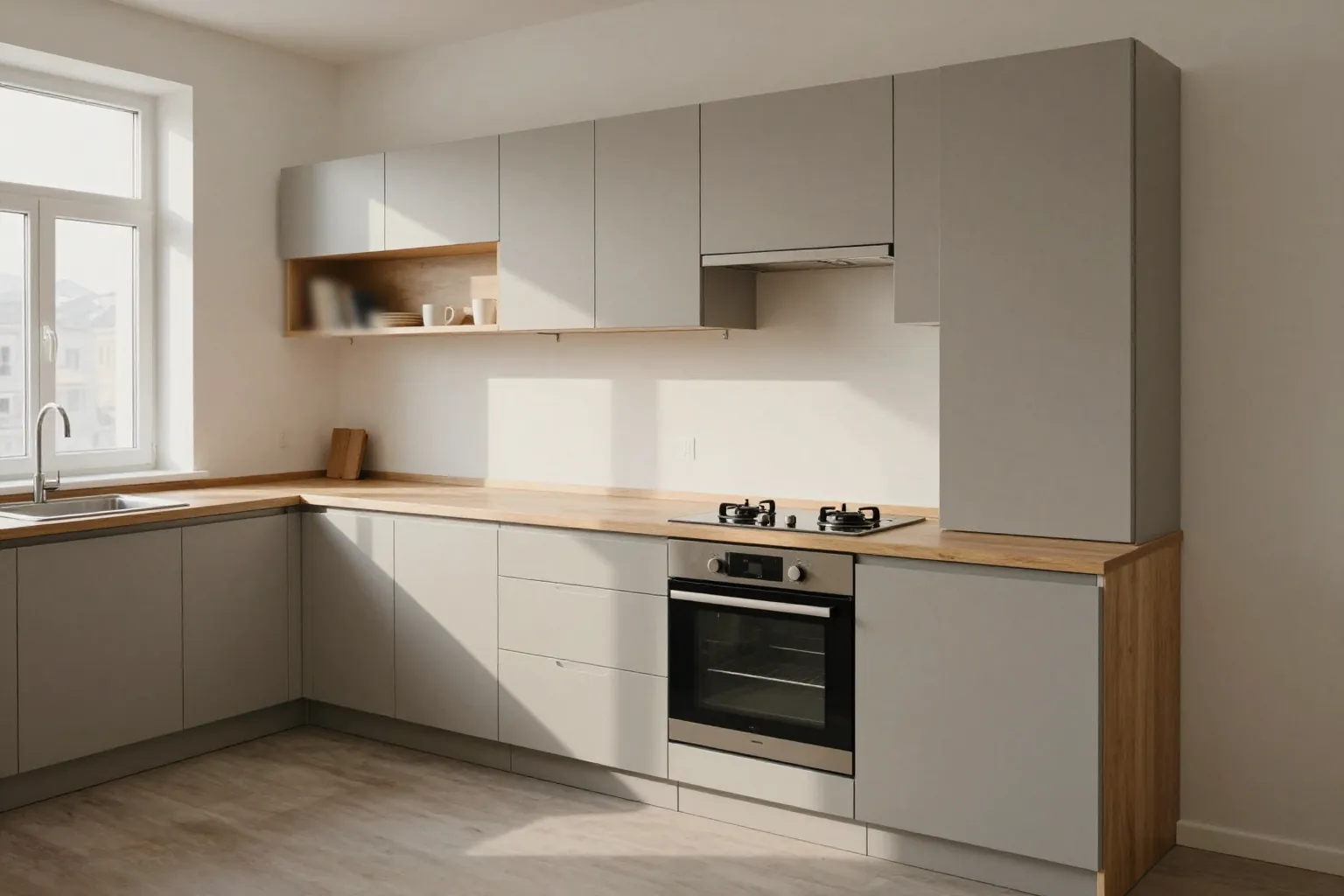
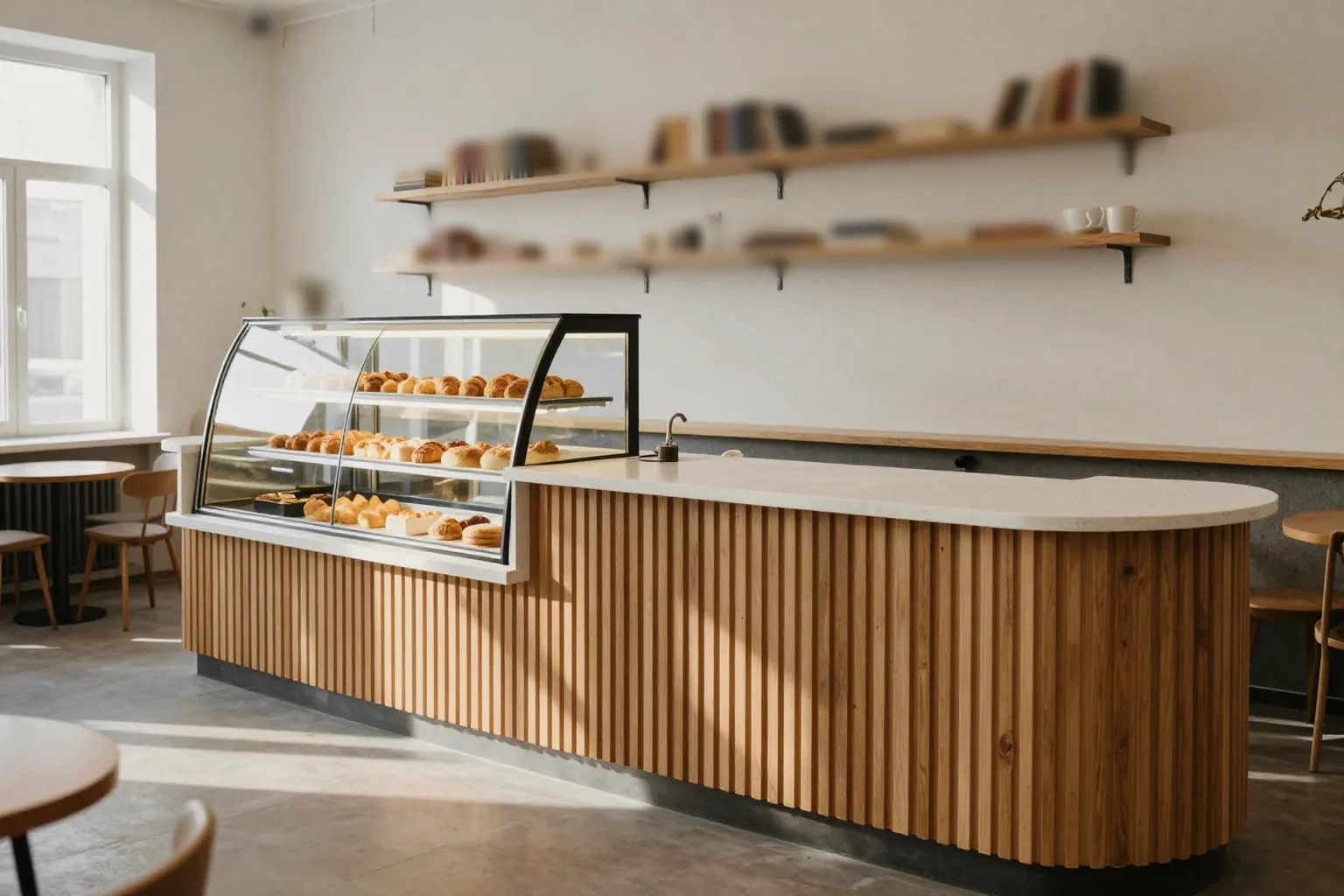
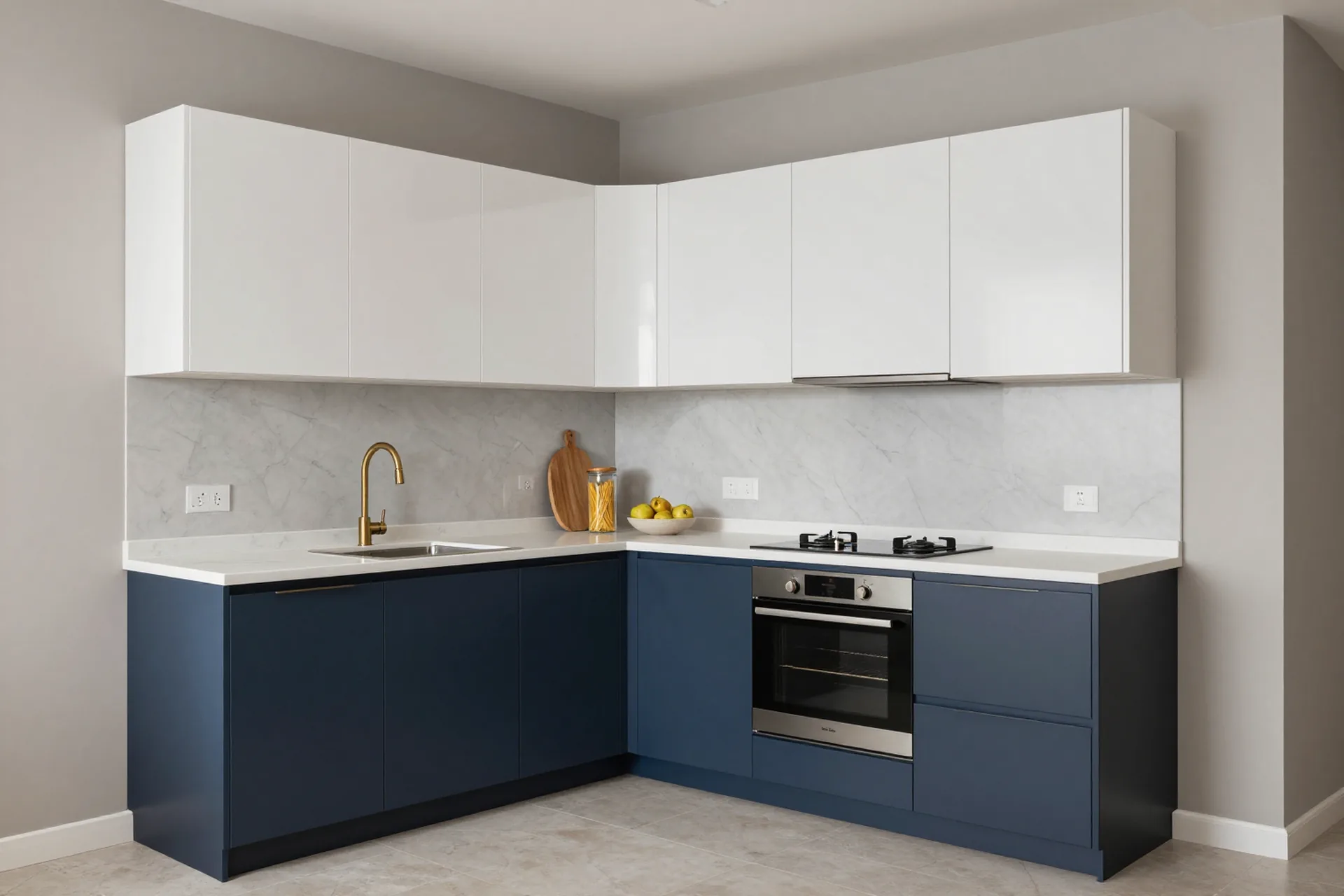
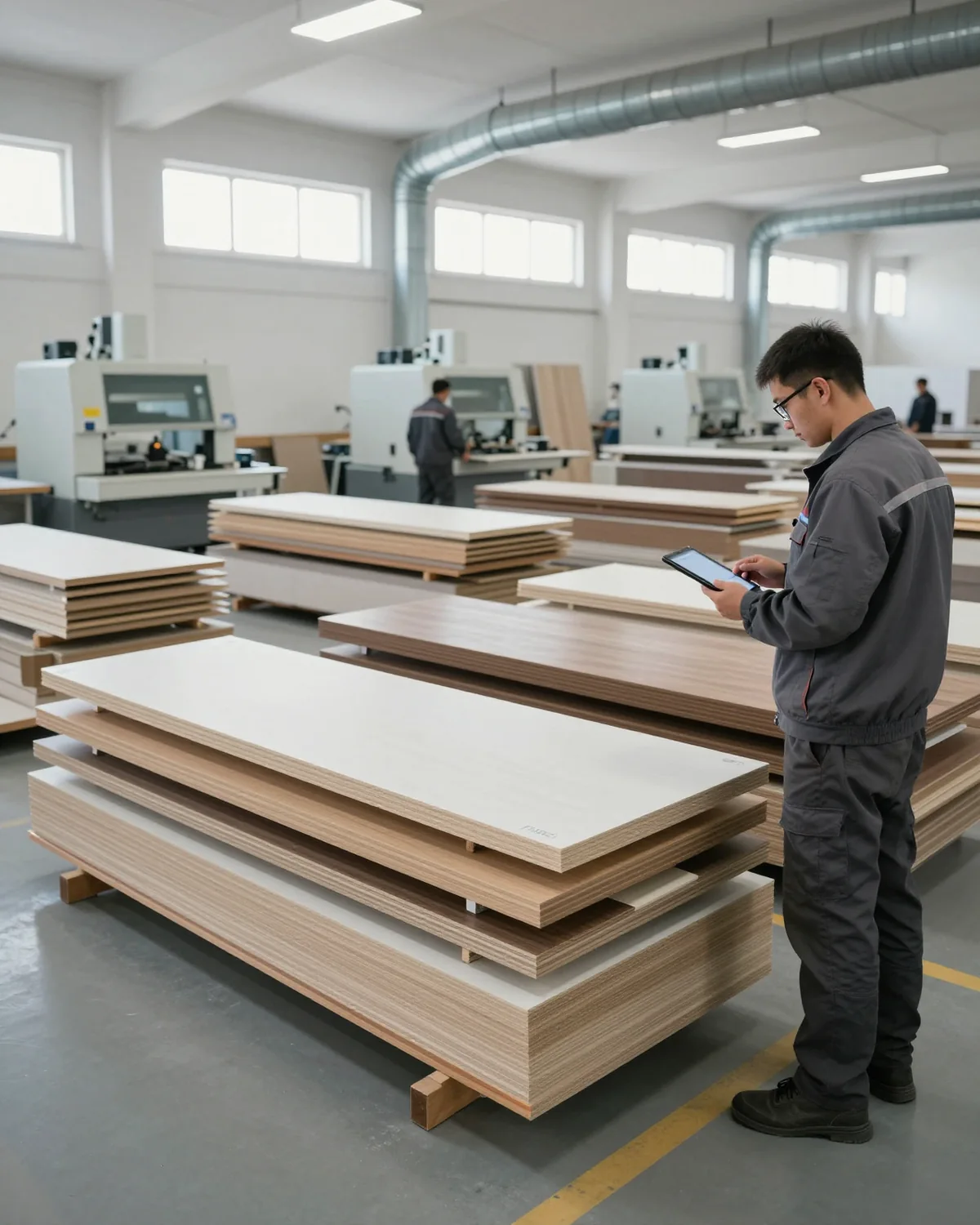
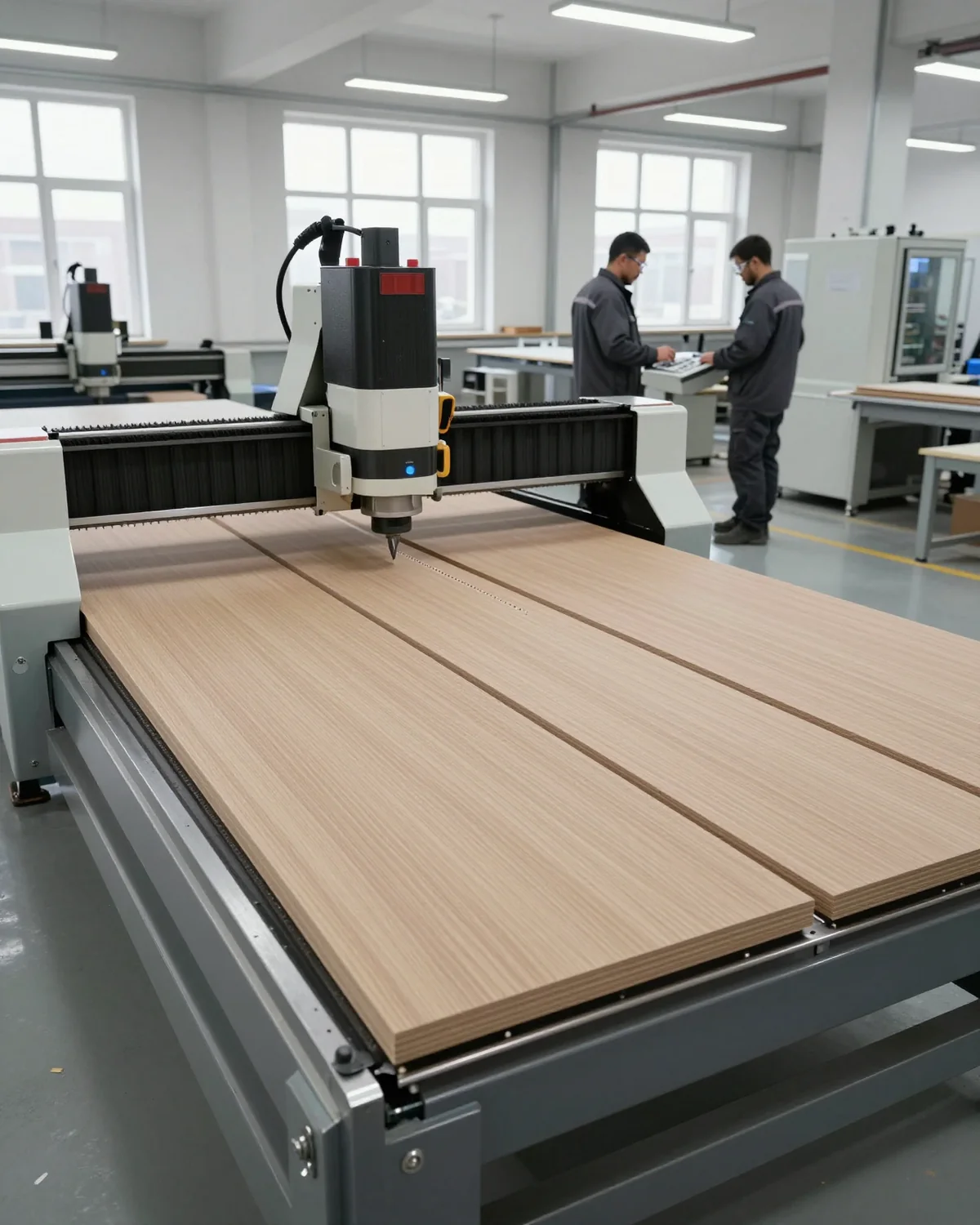
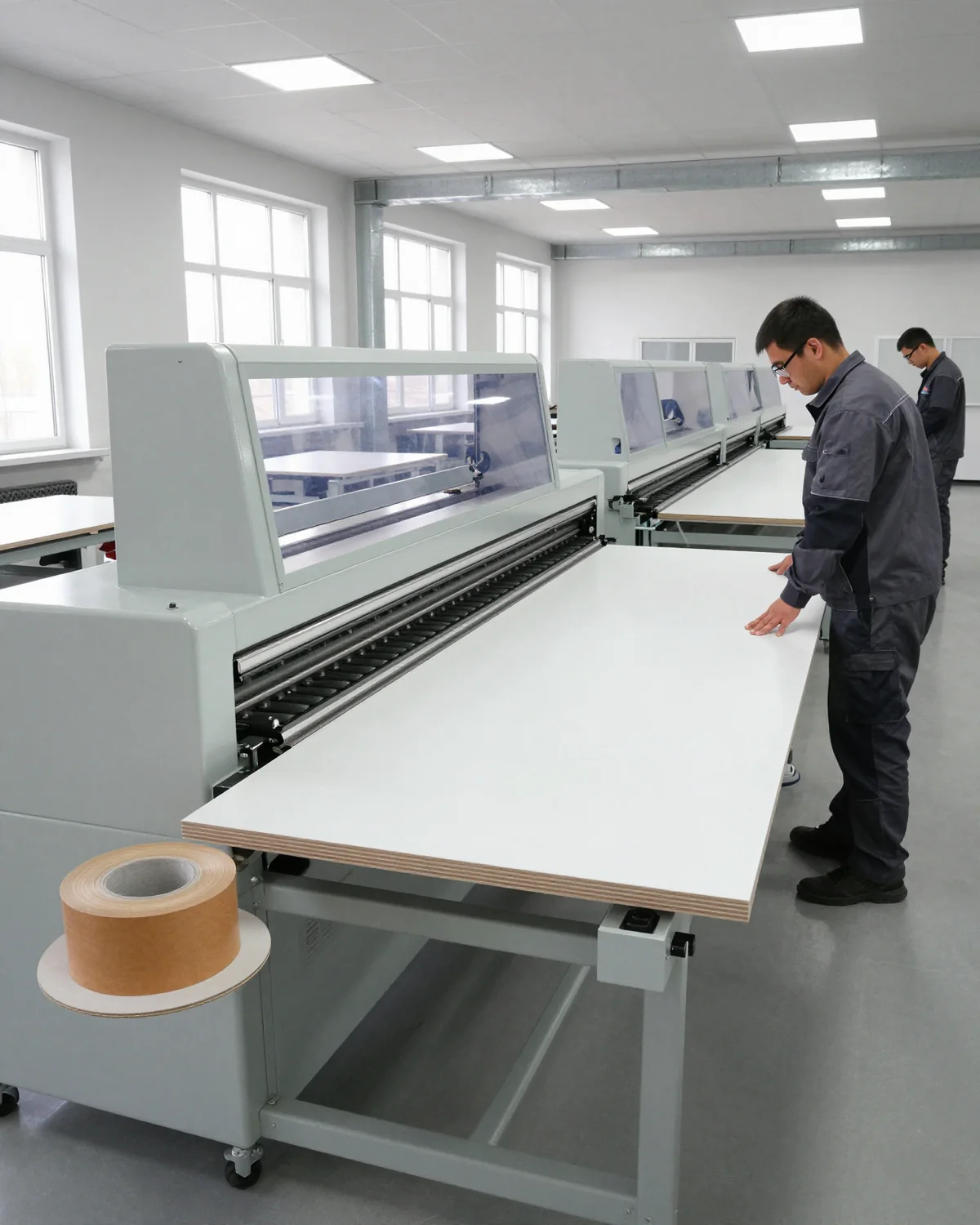
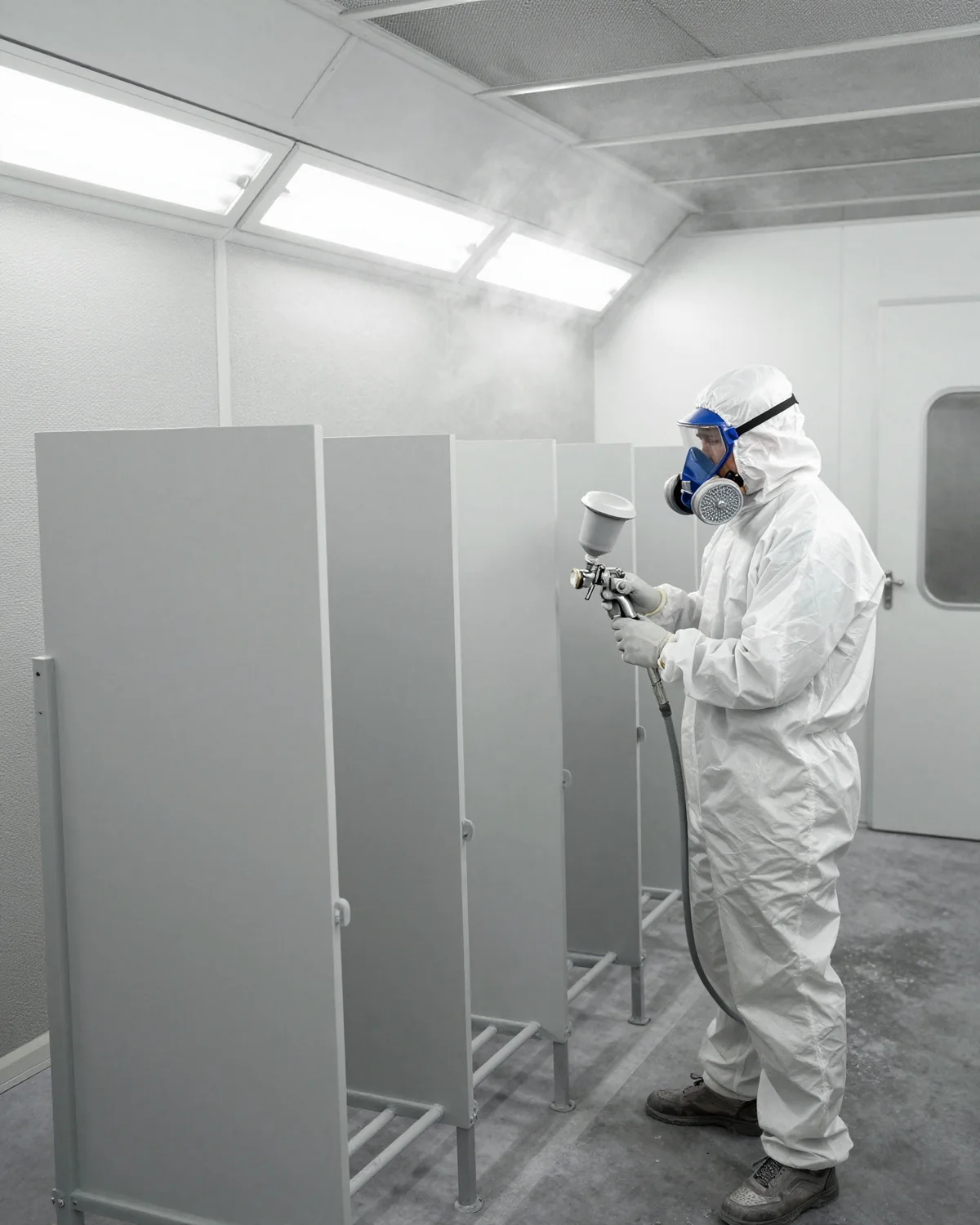
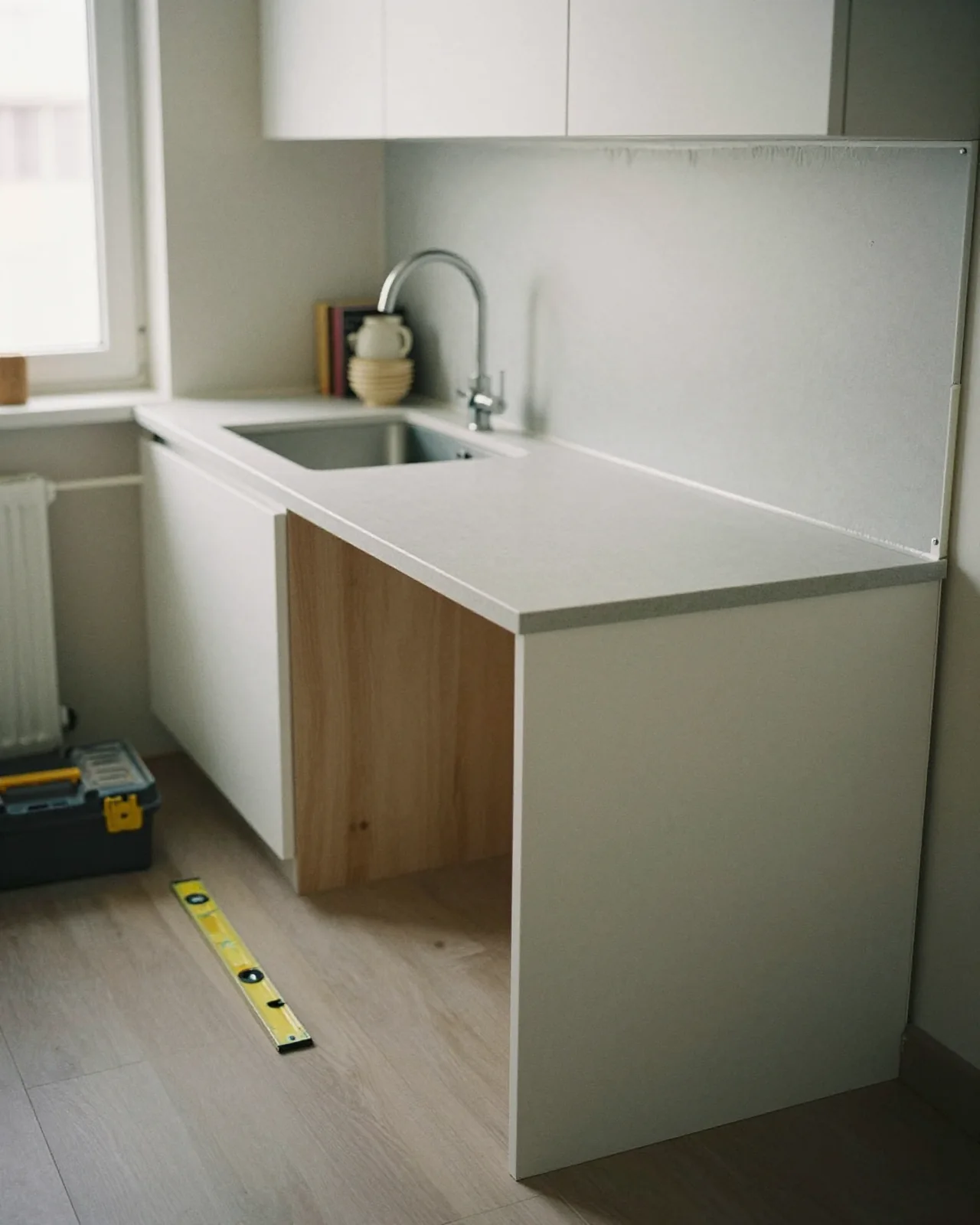
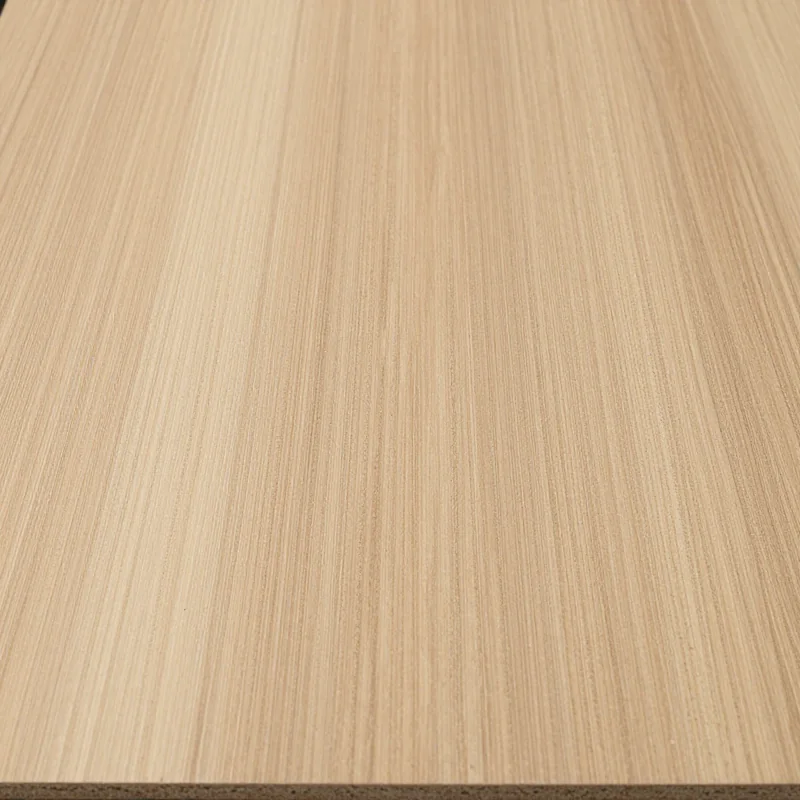
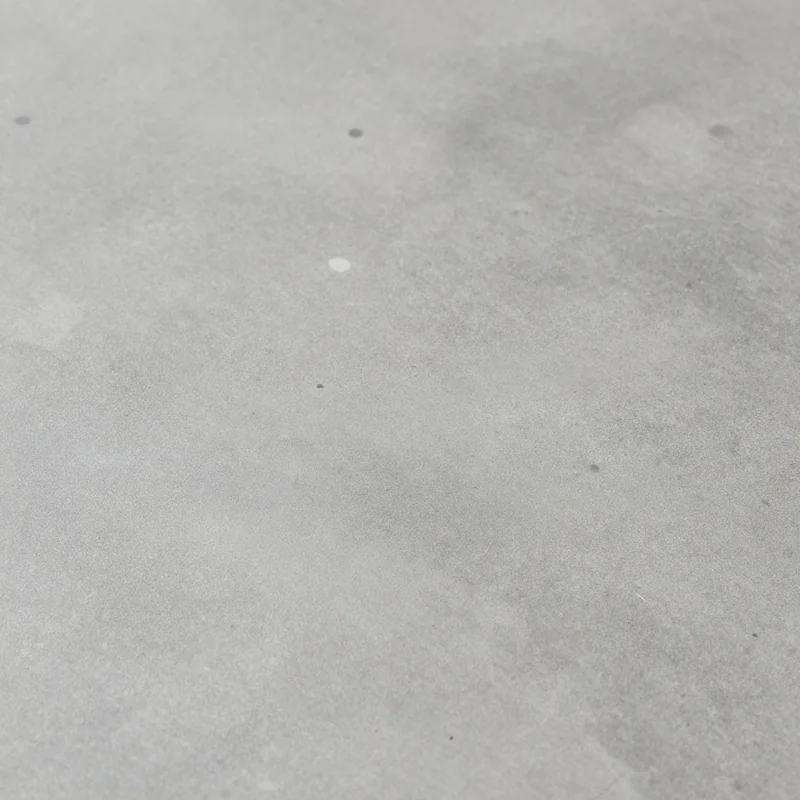
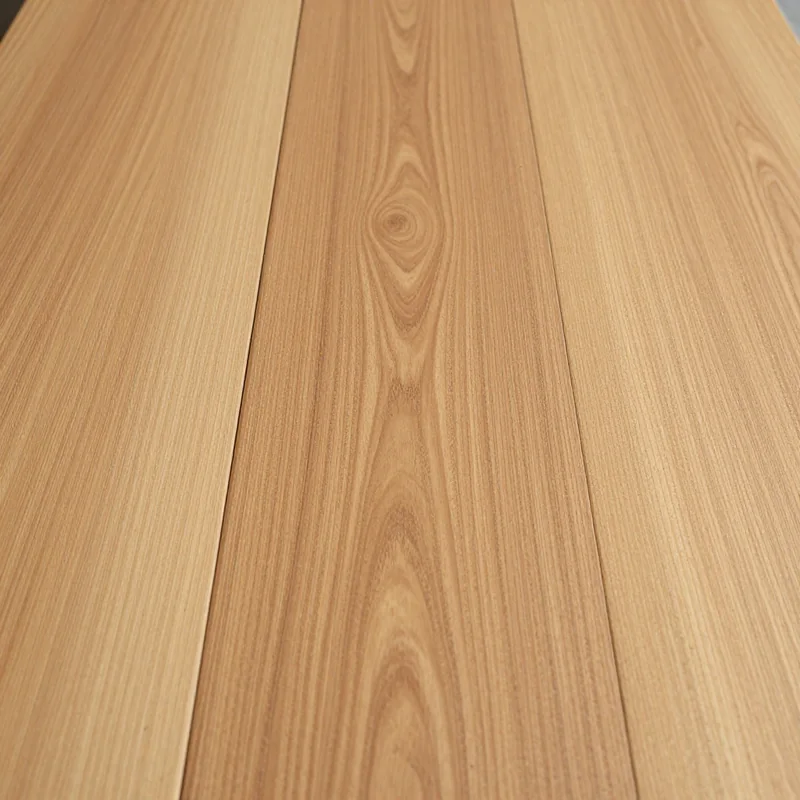
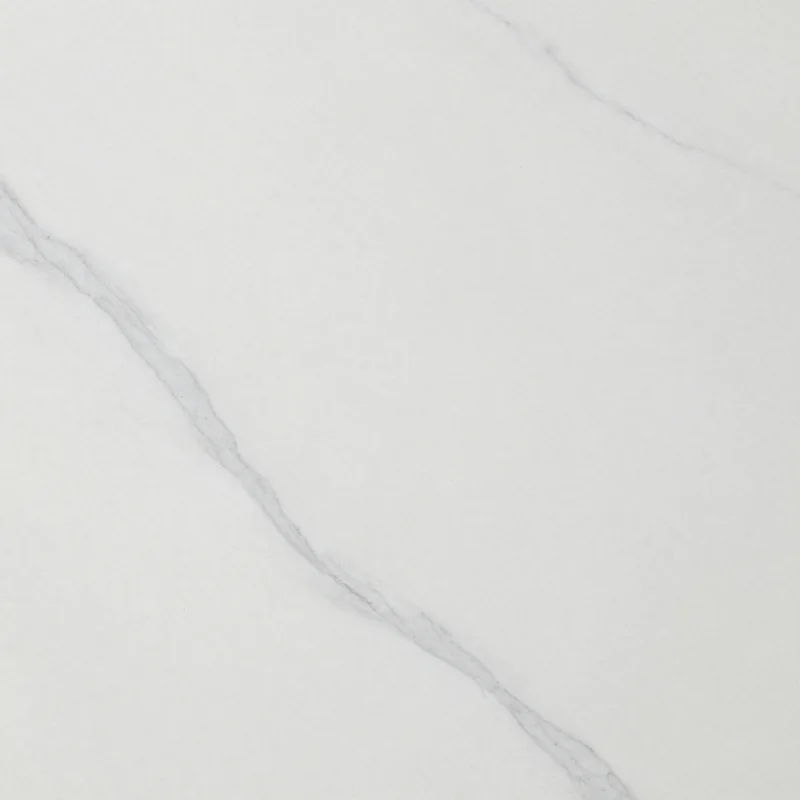
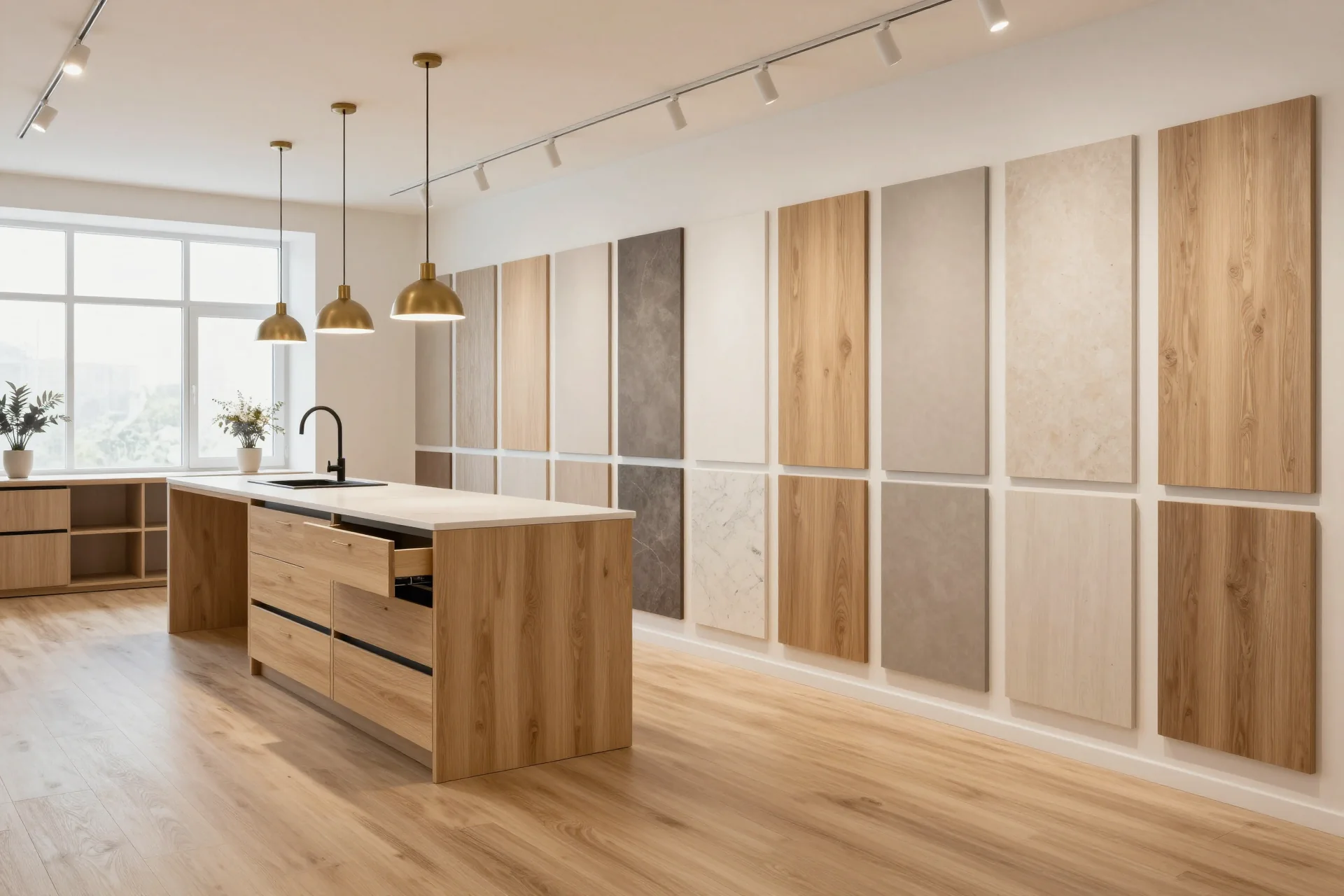
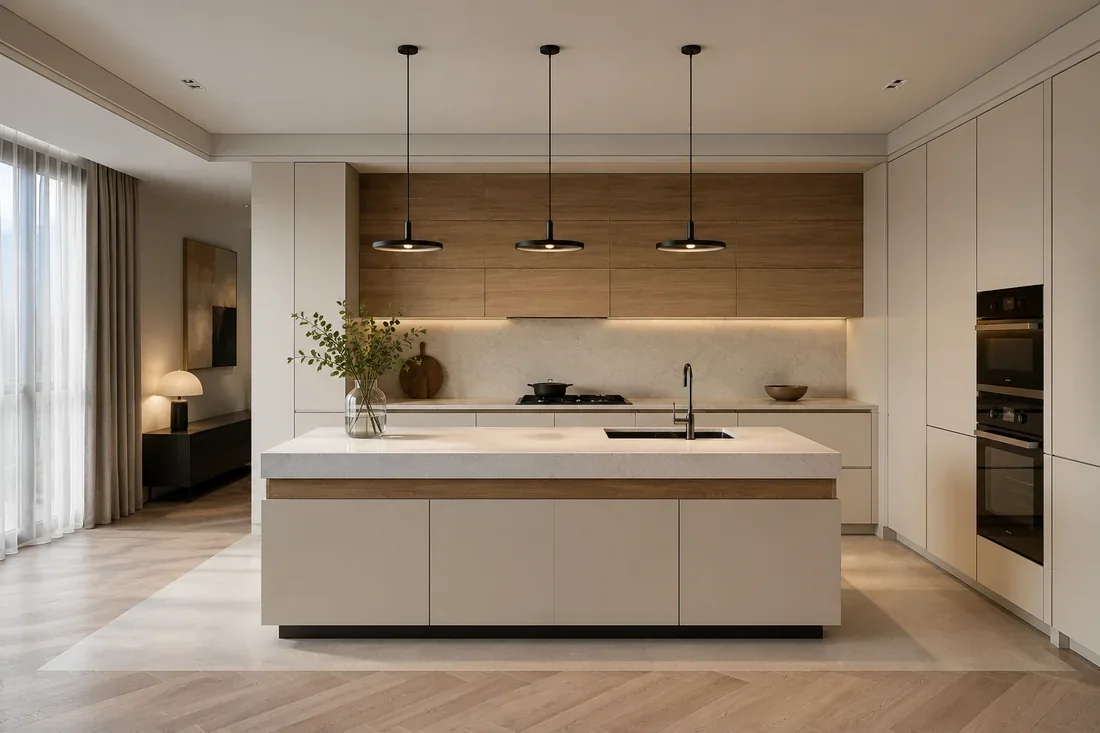
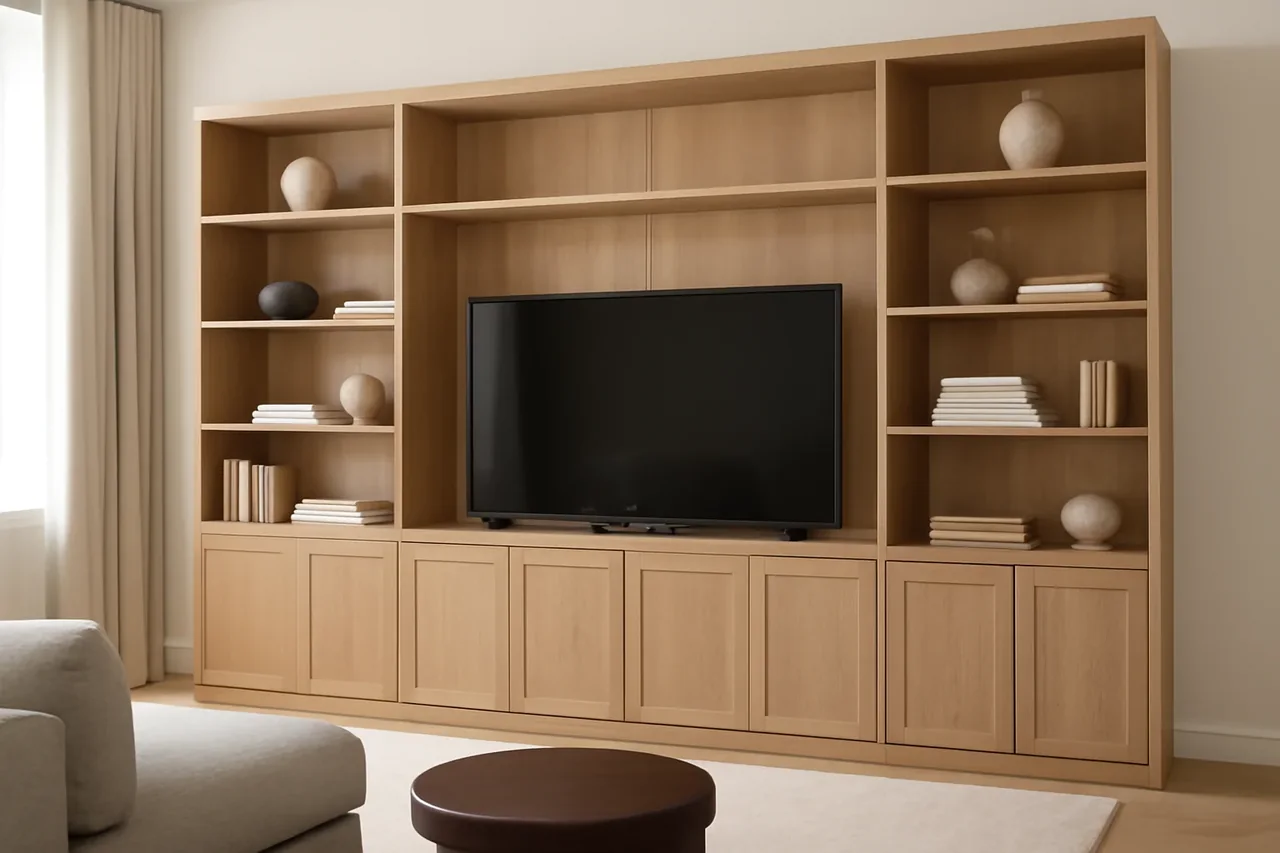
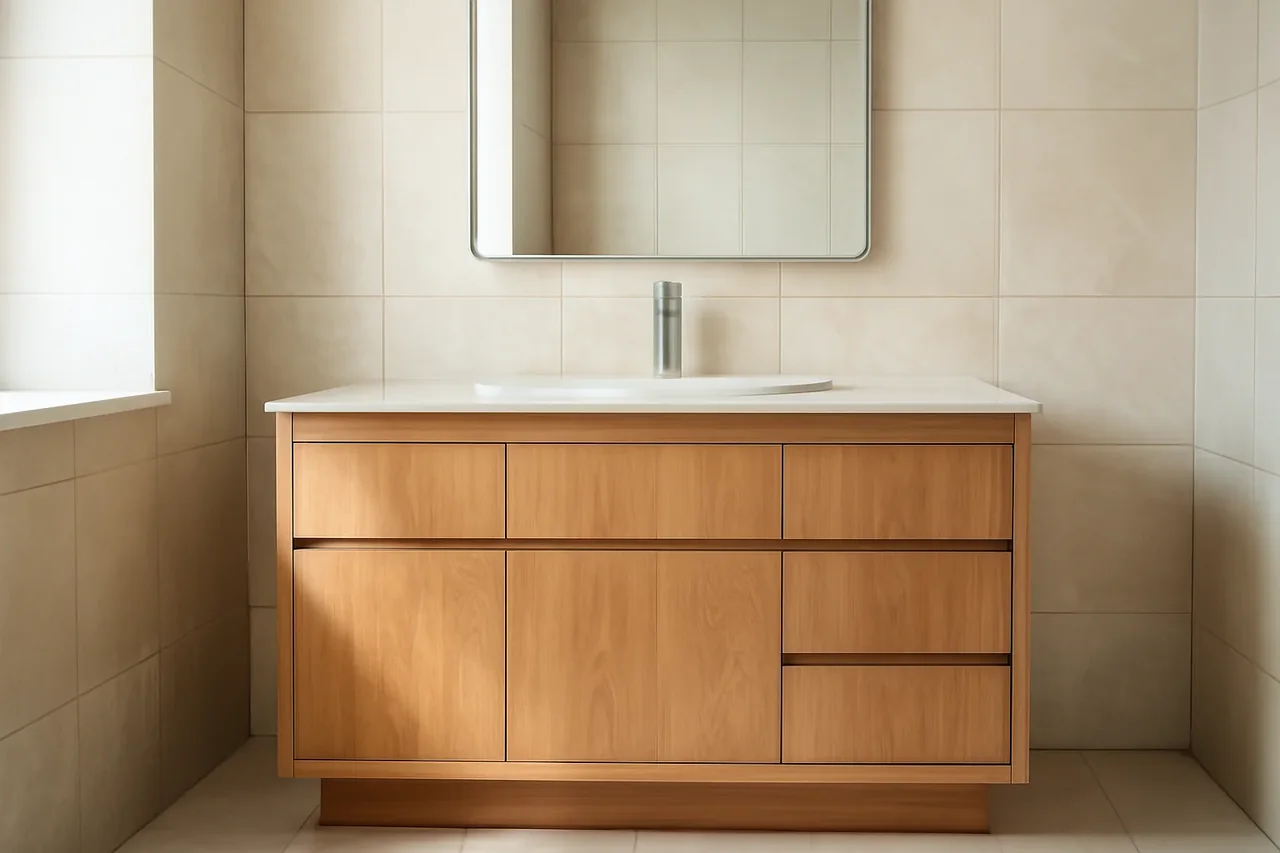
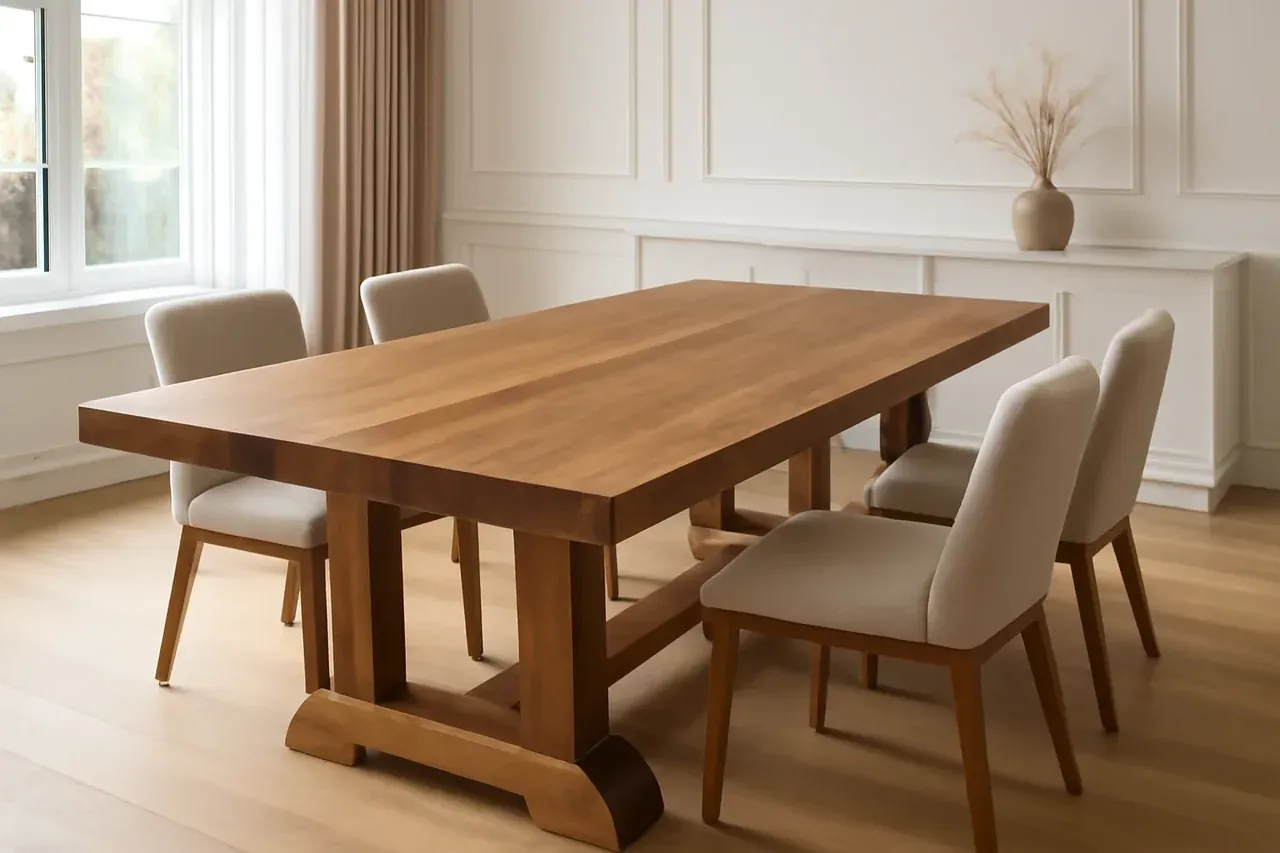
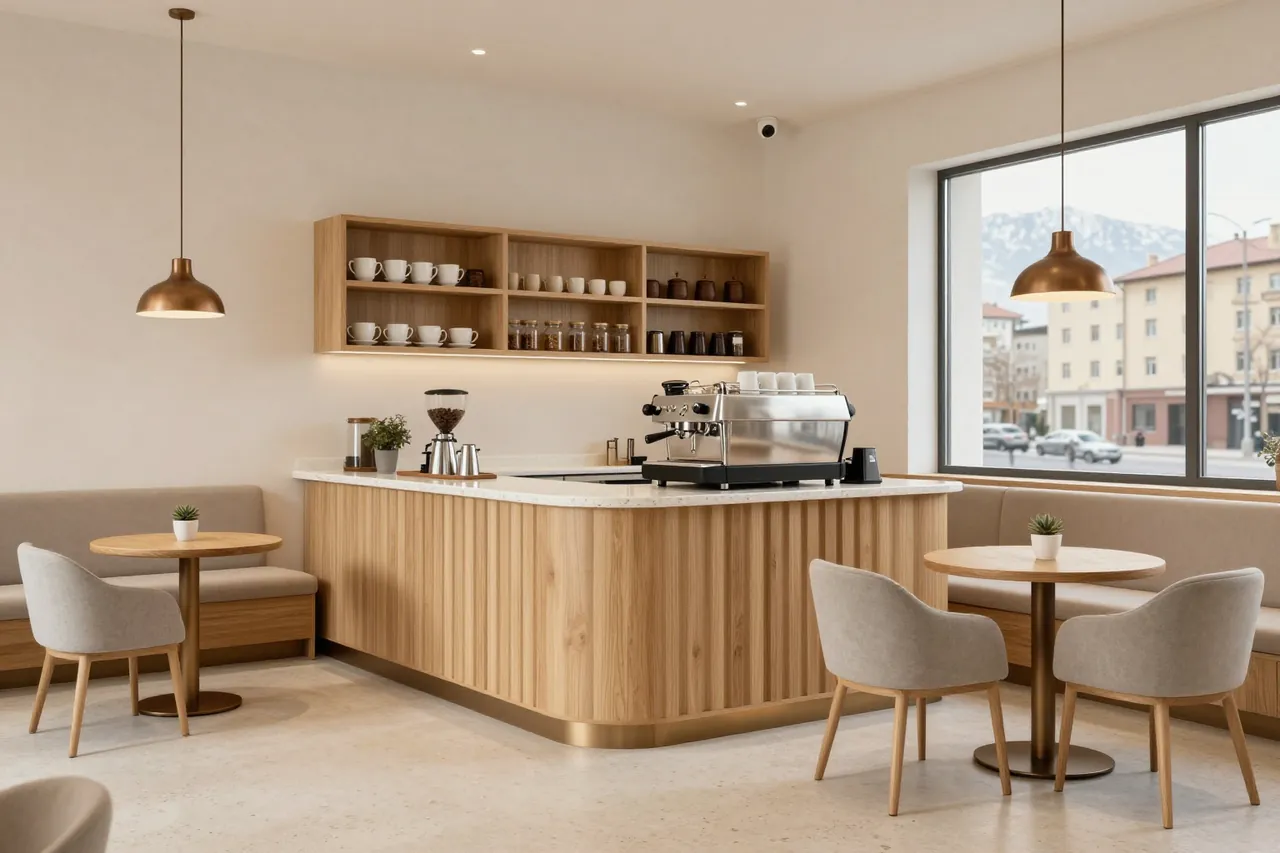
Custom countertops in Almaty are cut to fit your walls, cabinets and appliances: length, depth and cutouts for the sink and hob are taken at the measurement, not adjusted on site. At MEBLIX we make them from laminated chipboard, HPL laminate, solid wood, acrylic stone and quartz, measurement is free, warranty under contract — 24 months.
A ready-made board of standard length almost never matches the kitchen. Walls are uneven, corners are not ninety degrees, and pipes and sockets are where the developer put them.
What is measured on site
- Length along the walls: measured at the wall and along the front edge of the cabinets, because in older Almaty buildings the difference reaches a centimeter per meter.
- Angle between walls: checked with a square or laser, otherwise a wedge-shaped gap will open at the wall on corner assemblies.
- Cabinet depth: this determines the overhang above the fronts and the space for sockets and the rail at the backsplash.
- Sink and appliances: the models of the sink, faucet and hob are recorded so the holes are cut to their templates.
- Pipes, windowsill and reveals: protrusions, cutouts and the windowsill level are noted if the surface runs toward the window.
Standard height and depth and when to deviate from them
A typical kitchen cabinet gives a work height of 85–90 cm, and the standard worktop depth is 60 cm. These figures suit appliance manufacturers, but they are not always comfortable for a hostess 158 cm tall or an owner 190 cm tall. A made-to-measure countertop solves exactly this: the height is raised with adjustable cabinet legs and board thickness, and the depth is increased to 65–70 cm if a shelf is needed behind the sink or the backsplash stands off the wall because of pipes. Along the window the depth is often brought up to the reveal, and the windowsill becomes an extension of the work area. How much does it cost? Usually a little: the material is the same, only the cutting changes. Height and depth are chosen by height and by the wall, not by the catalog.
How to choose a material by load, not by picture
The material is chosen by what will be done with the surface every day. A kitchen with a sink and gas, a desk and a bathroom load it differently.
Properties of worktop materials
Properties of worktop materials| Material | Water at the sink | Hot dishes | Scratches |
|---|
| Laminated chipboard with edge banding | vulnerable at open ends | leaves a mark | visible, cannot be sanded |
|---|
| HPL laminate | resistant | withstands briefly | resistant to abrasion |
|---|
| Solid wood | needs oil care | leaves a mark | can be sanded |
|---|
| Acrylic stone | resistant | needs a trivet | sanded on site |
|---|
| Quartz agglomerate | resistant | withstands | almost never appear |
|---|
| Granite and porcelain stoneware | resistant | withstand | almost never appear |
|---|
Where the surface works hardest
The hardest zone is half a meter around the sink and half a meter at the hob. At the sink water constantly gets on the surface, and if the board has even one open cut, moisture goes inside. At the hob, heat from a pan put down "for a minute" adds to the moisture. The rest of the work area lives more calmly: a cutting board, a bowl, a kettle. So with a limited budget it makes sense to put a durable material exactly where cooking and washing happen, and a simpler option on the long straight section without a sink. For a desk and dining table the load is different — elbows, a laptop, mugs — and warm texture and resistance to scratches from dishes come first. The choice starts with a load map, not with a sample in the showroom.
How the type of material relates to care
A glossy dark surface shows every drop and crumb, a matte light one forgives almost anything. Stone with fine speckling hides marks better than a solid colour. Solid wood under oil looks alive but needs its finish refreshed every six months to a year, while under lacquer it asks for almost no attention, though lacquer is harder to touch up locally. Acrylic stone is warm to the touch and can be repaired by sanding, quartz is cold and hard, and repairs on it are more difficult. The decision here isn't about taste but about time: how many minutes a week you're willing to spend on care. If the answer is "none", your choice is matte quartz or light-toned HPL. How the surface looks a year from now depends on the texture you choose no less than on the material.
Thickness, overhang and edge decide how long the surface will last
Even the right material gives up quickly if you got the thickness wrong, forgot the overhang or left an end exposed. That's why these three parameters are checked on the drawing before cutting.
What thickness is needed
- Laminated chipboard and postforming: 38 mm for the kitchen, 26–28 mm for a windowsill and short sections without load.
- HPL laminate: a thin 12 mm sheet on its own board, or a compact board that spans without a substrate.
- Solid wood: 40 mm for the kitchen, 25–30 mm for a desk and shelves.
- Acrylic stone: a sheet of about 12 mm is glued to a moisture-resistant substrate and the edge is built up to a visible 38–40 mm.
- Quartz and natural stone: 20 or 30 mm, with heavy slabs supported on cabinets roughly every 60 cm.
Overhang above the fronts and drip groove
The front edge of the worktop projects 2–3 cm beyond the cabinet fronts. This overhang protects the handles and fronts: spilled water runs onto the floor instead of down the door into the cabinet. On stone and acrylic, a drip groove is milled underneath along the front edge — a thin channel where the drop breaks off. A small thing, but it works. A breakfast bar has a completely different overhang: 25–30 cm, so the knees of someone sitting on a stool don't press against the front. Such a projection already needs to be supported with brackets or a leg, otherwise the slab will sag over time. And if the overhang is made less than a centimetre? Then every puddle from the table goes straight onto the fronts. A side overhang at an end wall, on the contrary, is kept minimal. The overhang is chosen by the function of the edge, not by habit.
Edge and end
The end is the weakest point of a laminated chipboard slab. Postforming covers the front edge with plastic bent around a radius, and there's no seam on top at all. A straight cut is finished with a 2 mm PVC or ABS edge on hot-melt adhesive; a thin 0.4 mm paper edge doesn't survive in a kitchen. The back edge at the wall and all cuts in the sink cut-outs are treated with sealant, because the edge isn't visible there and water gets in there first. On solid wood, the ends are impregnated with oil in several coats: an end absorbs several times more than the face. If the edge has come away even by a millimetre, the slab starts to swell and there's no stopping it. A protected end extends the life of the surface more than expensive decor.
Countertops for the sink and hob
Cut-outs for the sink and appliances are made in the workshop using the manufacturer's template. These are exactly the places that decide whether the surface will be dry a few years from now.
Top-mount, inset and undermount sink
- Inset sink: the bowl is dropped into the cutout, the rim sits on top of the surface and is pressed against it through a seal; suitable for any material.
- Undermount sink: the bowl is fixed from below, the edge of the cutout stays open, so it is installed only under stone, quartz and acrylic.
- Integrated sink: the bowl is cast from the same acrylic stone and glued in so that the joint is almost invisible.
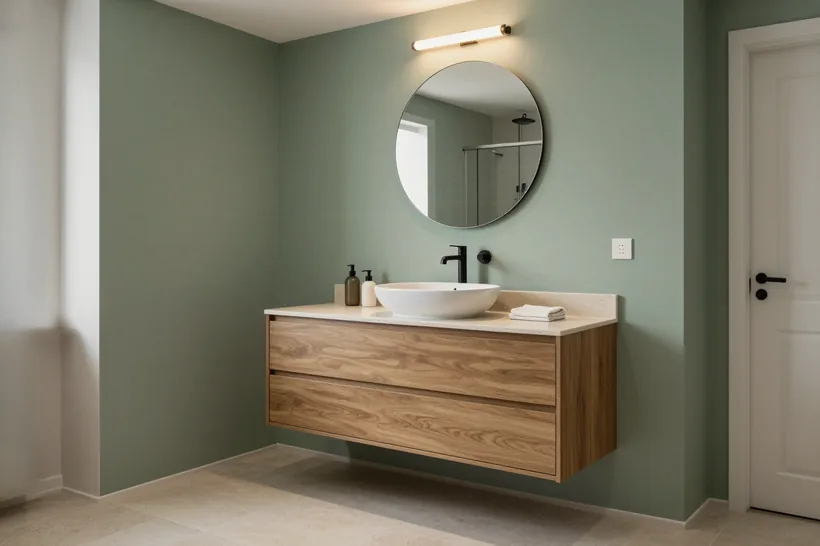
- Drop-in washbasin in the bathroom: the bowl sits on top, only a hole for the drain and faucet is drilled in the surface.
Cutout for the hob
The cutout for the hob is made strictly according to the installation diagram in the instructions: on different models, a difference of a few millimeters decides whether the frame sits evenly. Millimeters matter. The corners of the cutout are rounded, because a sharp inner corner in stone and quartz becomes the start of a crack. The cut edges in laminated chipboard must be coated with sealant or aluminum tape: from heat and steam, the exposed board dries out and crumbles. Between the sink cutout and the hob cutout, a work zone of at least 40 cm is left, otherwise there will be nowhere to cut and lay out food. Joints of the boards are not placed next to the cutout, and the panel frame is laid with the seal from the kit. A neat cutout for appliances means a template, rounded corners and edges protected from moisture.
When a cast acrylic sink is the right choice
A cast sink made of acrylic stone is a bowl of the same color as the surface, glued from below and sanded flush. Crumbs and water are swept into it in one motion, there is no rim, and dirt has nowhere to accumulate. There is also a downside. Such a bowl cannot simply be removed and replaced like a regular sink: it is part of the item. Another detail is a hot pot of boiling water that is poured directly into the bowl. Acrylic handles water from the tap, but a sharp temperature drop from boiling water is better softened by turning on cold water at the same time. A cast sink is more often chosen for small kitchens in light tones and for bathrooms where easy cleaning matters. A cast sink is convenient to clean, but it remains part of the surface forever.
Joints and corners without gaps and steps
The board is limited by the sheet length, so a long or corner surface is assembled from parts. A good joint is invisible and does not let water through.
Corner joining methods
- Euro cut: the ends of the laminated chipboard are milled at a complex angle, the boards are pulled together from below with connectors on glue and sealant, and the seam comes out thin.
- Joint on an aluminum strip: the simplest option for laminated chipboard, the strip covers the seam but remains noticeable.
- Glued seam in acrylic: the parts are glued with color-matched adhesive and sanded, after which the joint almost disappears.
- Joint in quartz and stone: the parts are joined with epoxy glue with pigment, the seam remains a thin line, which is placed in an inconspicuous spot.
Where a joint must not be placed
A joint is never placed above the sink, above the dishwasher or within the hob cutout: that is where there is the most water and heat, and the seam will start to open first. No exceptions. Under the joint there must always be support — a cabinet side or a cross bar, otherwise the two boards will work separately and a step will appear between them. Custom-made countertops from stone and quartz are produced according to a drawing where the joint locations are determined in advance, not in the kitchen on the last day. On laminated chipboard, the joint is most often hidden in the corner; on solid wood, the surface is made seamless up to the length of the blank. The joint of heavy quartz is additionally reinforced from below with a bar. A correctly placed joint matters more than the joining method.
How to check the joint on acceptance
Check the joint with your palm and by looking against the light. A palm run across the seam should not catch on a step: on a good assembly the height difference between the parts cannot be felt with your fingers. Against a window, the seam on acrylic almost disappears; on quartz and granite it shows as a thin, even line with no chips at the edges. On laminated chipboard with a euro-cut, the seam line should be straight, and the sealant should not stand out in a bead. Another check is a drop of water on the seam: it should sit on the surface rather than soak in. If anything bothers you, say so before signing the acceptance report: the fitter will fix it on the spot while the tools are still there. A good joint cannot be felt by hand and does not absorb water.
A made-to-measure tabletop for a table and a surface in the bathroom
A work surface is needed not only in the kitchen. A desk and dining table, a bathroom and a bar counter load the board differently and follow their own rules.
Dining and writing table
A made-to-measure tabletop for a table differs from a kitchen one primarily in its edge and thickness. A dining table stands in the middle of the room and is visible from all sides, so the end face is finished as carefully as the front: from solid wood, with a rounded edge or a chamfer. For a solid wood dining table, 30–40 mm is usually chosen; for a desk, 25–30 mm is enough if the base supports the board around the perimeter. The height of a dining and writing table is about 75 cm, and the depth of a desk for a monitor is from 70 cm, so the screen is not too close to the eyes. Custom-size tabletops for a table are cut right away with holes for cables and fixings. For a laptop and elbows, solid wood or laminate is especially good, rather than cold stone. For a table, what matters is not only the material but also how the board is fixed to the supports.
A surface for the bathroom
In the bathroom, the surface lives in constant humidity, but without the heat of a hob or a knife. Acrylic solid surface, quartz, moisture-resistant laminate and larch or oak solid wood under oil are suitable. For a vessel sink, a hole for the drain is enough; for an undermount one, a cutout is made, and the mixer is mounted either on the surface or in the wall. The main mistake in the bathroom is not leaving a gap for ventilation under the cabinet and sealing the joint with the wall without sealant. Then moisture builds up behind the board, and after a couple of years a dark spot appears underneath. Fixing this later is difficult. More on the options is on the bathroom countertops page, which also has examples with sinks of different shapes. In the bathroom, the most important things are a sealed joint with the wall and a moisture-resistant base.
A made-to-measure chipboard tabletop or stone, and where you can save
The most frequent question before ordering is whether stone is needed or laminated chipboard is enough. The answer depends on how many years the kitchen should last and where cooking happens in it. Prices for all options are in the price list above.
When laminated chipboard is enough
A made-to-measure chipboard tabletop is an honest choice for a rented flat, a country house, a kitchen planned to be replaced in a few years, and for a long run without a sink. A moisture-resistant 38 mm board with postforming and sealant in the cutouts lasts for years if the ends are closed and hot items are placed on a stand. There are many wood and stone decors, and at arm's length their difference from the real material is noticeable, while from a distance it is almost not. And that is fine. If you need a made-to-measure tabletop inexpensively, it is laminated chipboard and HPL laminate that give the best balance of price and service life. This option has two weak spots: an open cut and a hot bottom. Laminated chipboard is justified where the surface is protected from water at the cuts and from heat.
What is worth paying extra for
- Sink area: acrylic, quartz or HPL around the sink removes the main risk — a swollen edge.
- Islands and counters: an end face in stone or solid wood that is visible from all sides looks more expensive than any edge banding.
- Windowsill in one line: a single slab from the window to the work area is cheaper than two pieces with a joint.
- Complex shape: a radiused edge and an integrated sink are only possible in acrylic; they cannot be replicated in laminated chipboard.
How not to overpay
- Combination of materials: stone around the sink and boards, laminated chipboard or solid wood along the rest of the length in the same colour.
- Standard thickness: 38–40 mm instead of a thickened end face if a massive look is not needed.
- Straight corners: rounding every corner and a shaped end face increase workshop labour.
- Cutouts in the workshop: buying a made-to-measure worktop with cutouts straight away is cheaper than later calling a craftsman to saw on site.
Care and repair of the work surface
Care differs from material to material. The right sponge and product extend the life of the surface more than an expensive material with the wrong care.
What to wash with and what to avoid
What to wash with and what to avoid| Material | What to wash with | What to avoid |
|---|
| Laminated chipboard and HPL | soft sponge, soapy solution | water on cut edges, abrasives |
|---|
| Solid wood | damp cloth, oil once every six months | leaving wet dishes overnight |
|---|
| Acrylic stone | sponge, neutral product | solvents, hard sponge |
|---|
| Quartz and granite | sponge, stone cleaner | prolonged contact with acids |
|---|
What can be restored
Acrylic stone is restored by sanding right on site: minor scratches and marks from hot items disappear, and a small chip is filled with a compound of the same colour. Solid wood is sanded and re-coated with oil or lacquer, after which the surface looks almost like new. Quartz and natural stone are hard to scratch, and a chip on the edge is filled with a colour-matched epoxy compound, but the mark remains more noticeable than on acrylic. Laminated chipboard is trickier. Laminated chipboard and plastic are almost never repaired: a lifted edge band is re-glued, and a swollen area near the sink is replaced together with the board. Worktop production from solid wood and acrylic is therefore valued for repairability, and laminated chipboard for its price. Repairability should be considered when choosing just as much as durability.
Countertops in brief
What to remember before ordering
- Measurement: length, angles, pipes and appliance models are recorded before cutting, so the surface fits without on-site trimming.
- Material: stone, quartz or HPL are needed around the sink and hob, while a simpler option can be used along the rest of the length.
- Thickness and overhang: 38–40 mm for the kitchen, an overhang of 2–3 cm over the fronts, and 25–30 cm with support at a bar counter.
- Cutouts and joints: cutouts are made to a template in the workshop, and a joint is not placed over the sink or next to the hob.
- Care: acrylic and solid wood are restored by sanding, laminated chipboard is protected from water on cut edges.