
Temirzhan Nurpeisov
Furniture assembly carpenter11 years
★ 4.81 · 47 ratings
For business · Offices
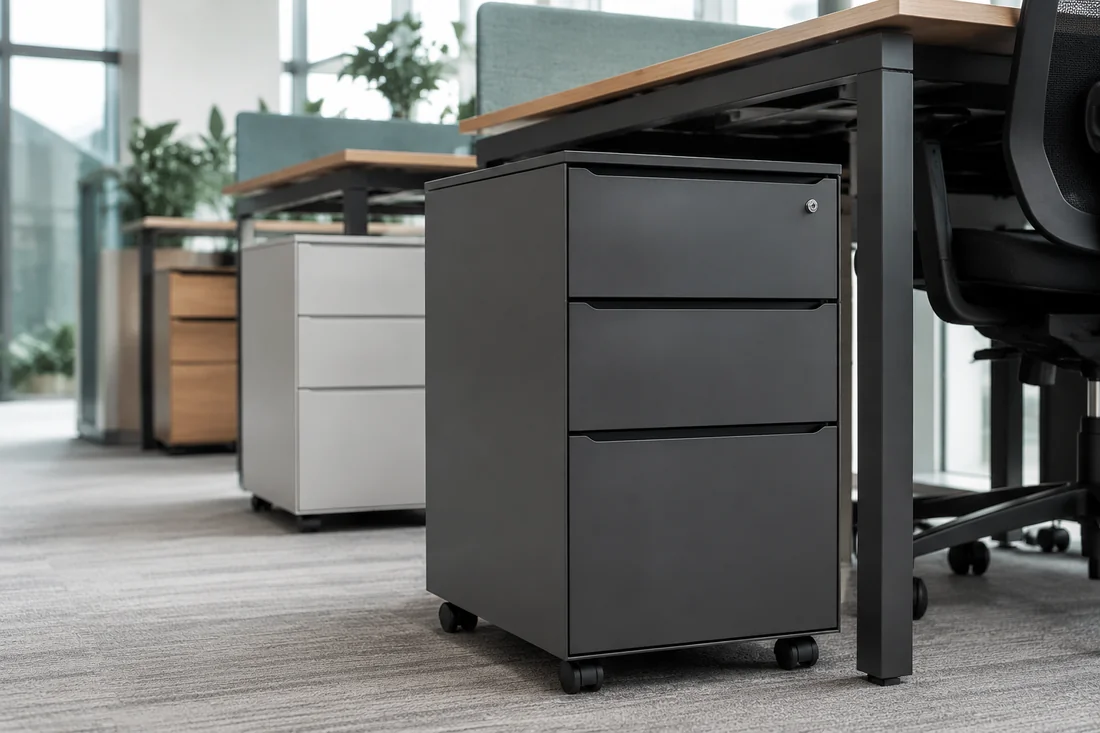
We make cabinets for your desk and tasks: with a lock, for office equipment or filing. Measurement and 3D design are free, the price is fixed in the contract, and the warranty on the item is 24 months.
Measurement and 3D design are free and carry no obligation · price fixed in the contract · Kaspi Instalments up to 24 months
01Types
 01
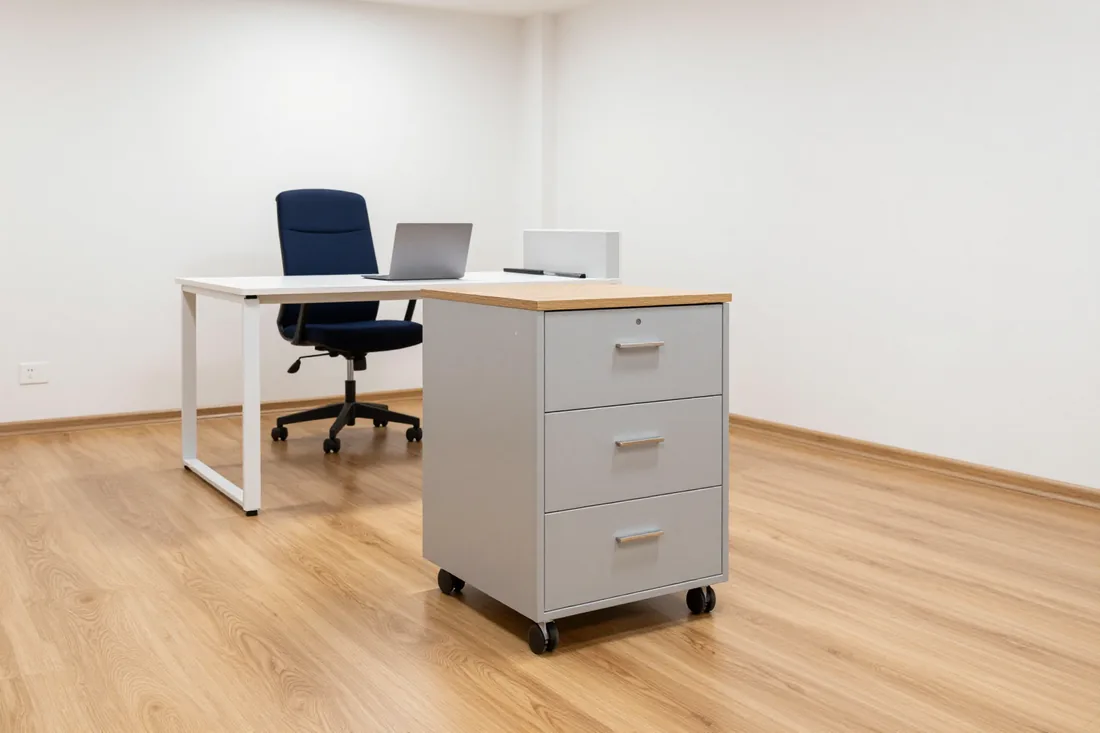
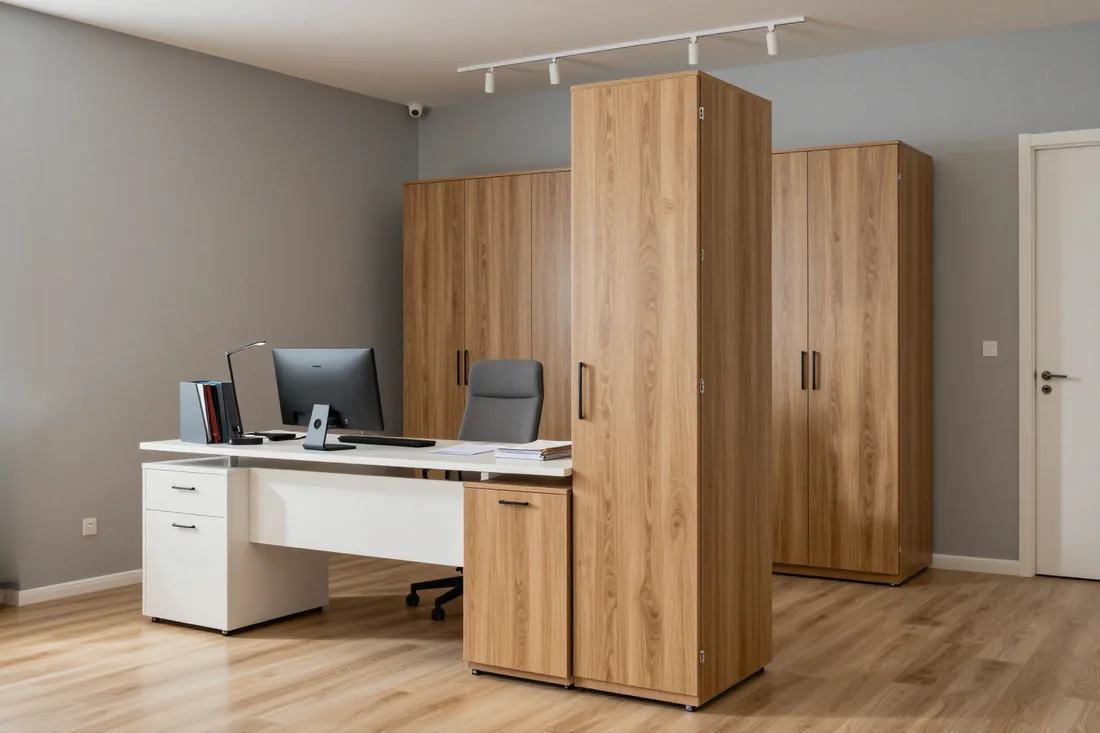
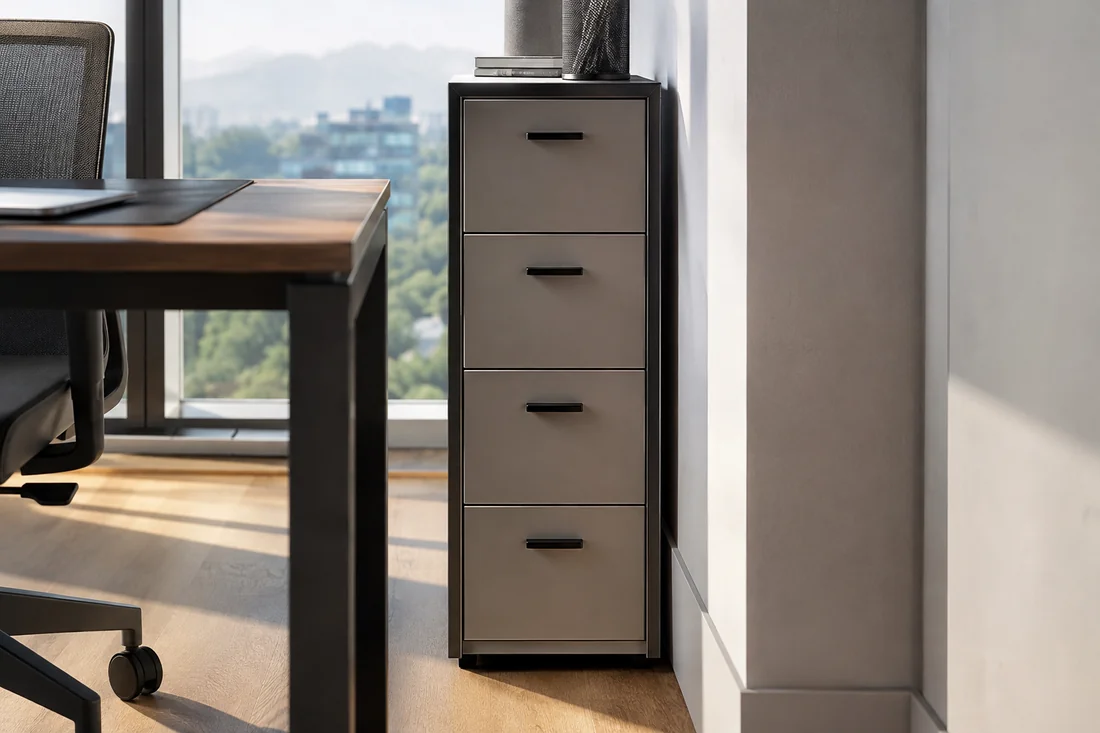
On casters, easily moves under and next to the desk. Suitable for employees who need quick access to documents throughout the day.
from 28 000 ₸
 02
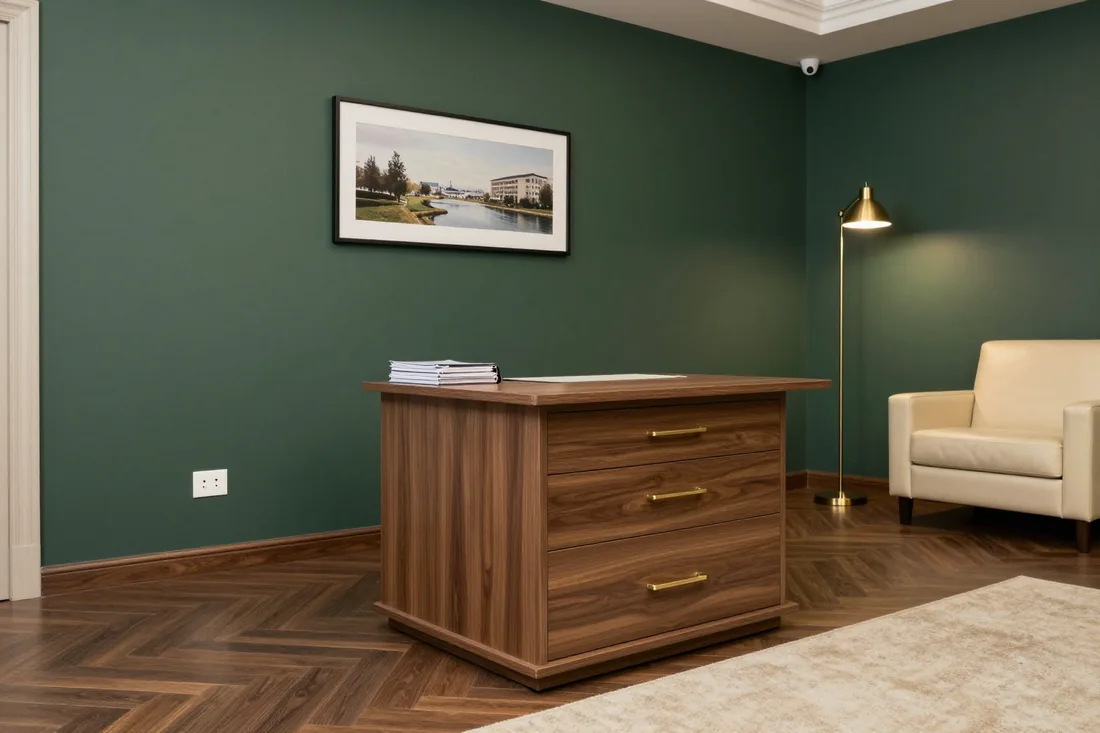
Attaches to the side of the desk and extends the work surface. Convenient when you need to increase storage without a separate wardrobe.
from 32 000 ₸
 03
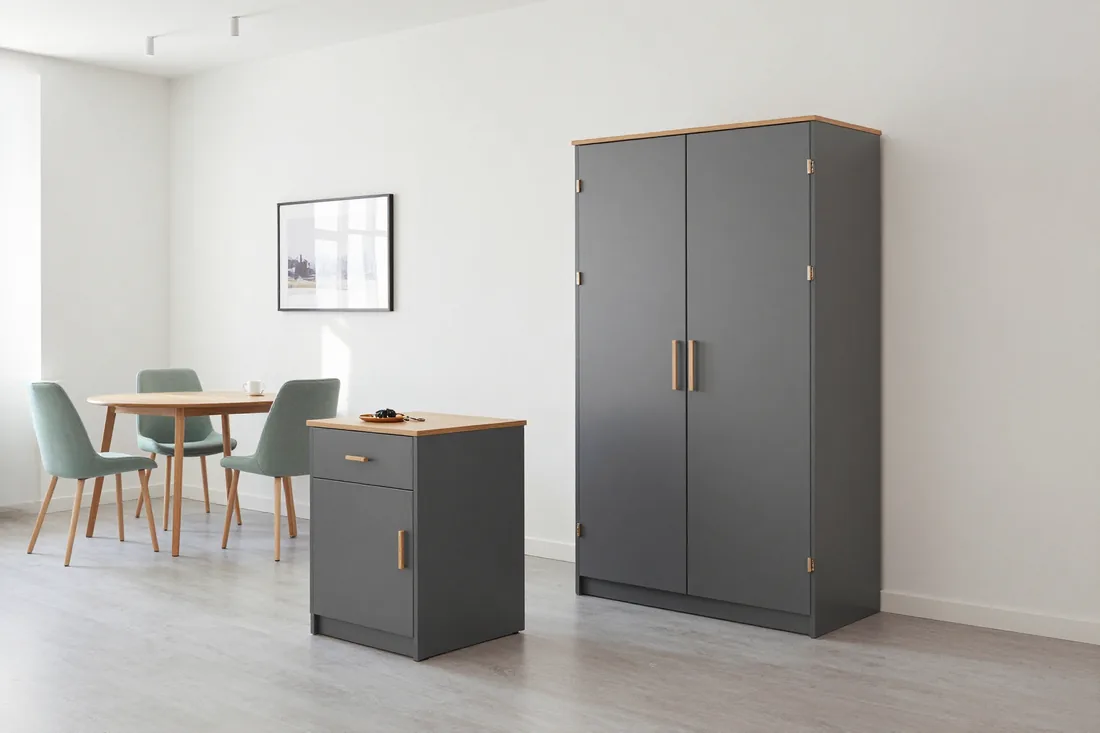
Stands on a plinth and doesn't move when drawers are used. Suitable for permanent workstations with a large volume of documents.
from 30 000 ₸
 04
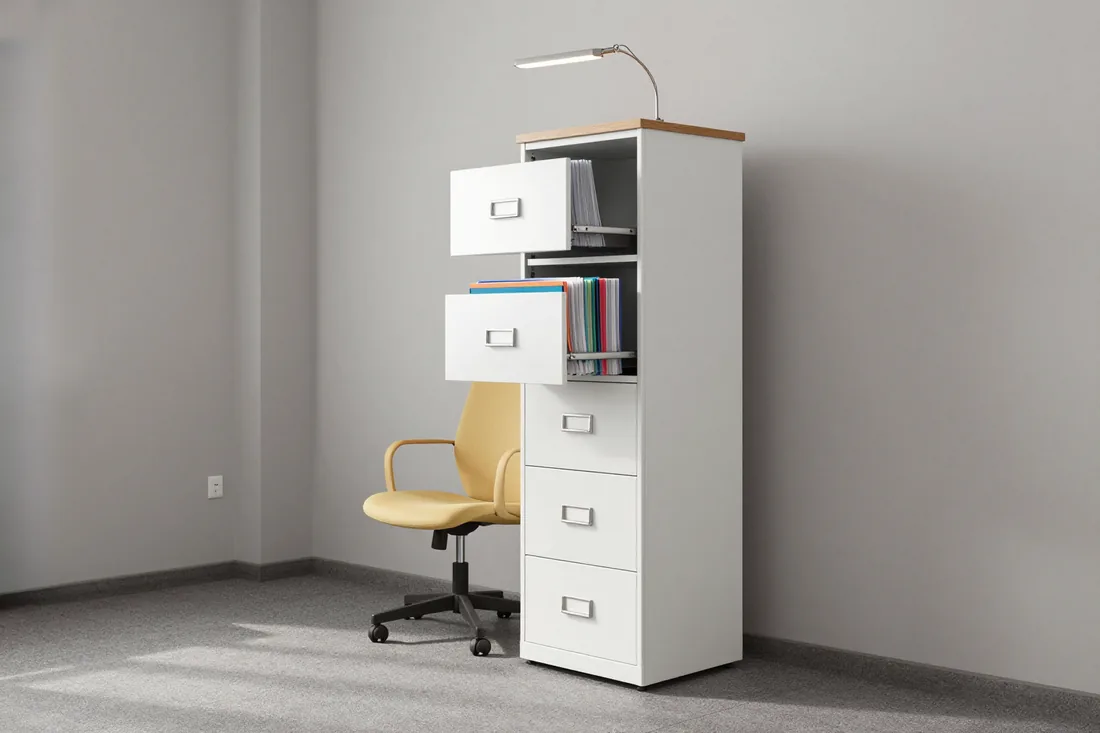
Sections with full extension for folders and hanging files. Needed where documents are stored by nomenclature and accessed frequently.
from 45 000 ₸
 05
Lockable drawer for personal belongings and confidential papers. In demand at workstations with visitors and in shared areas.
from 38 000 ₸
 06
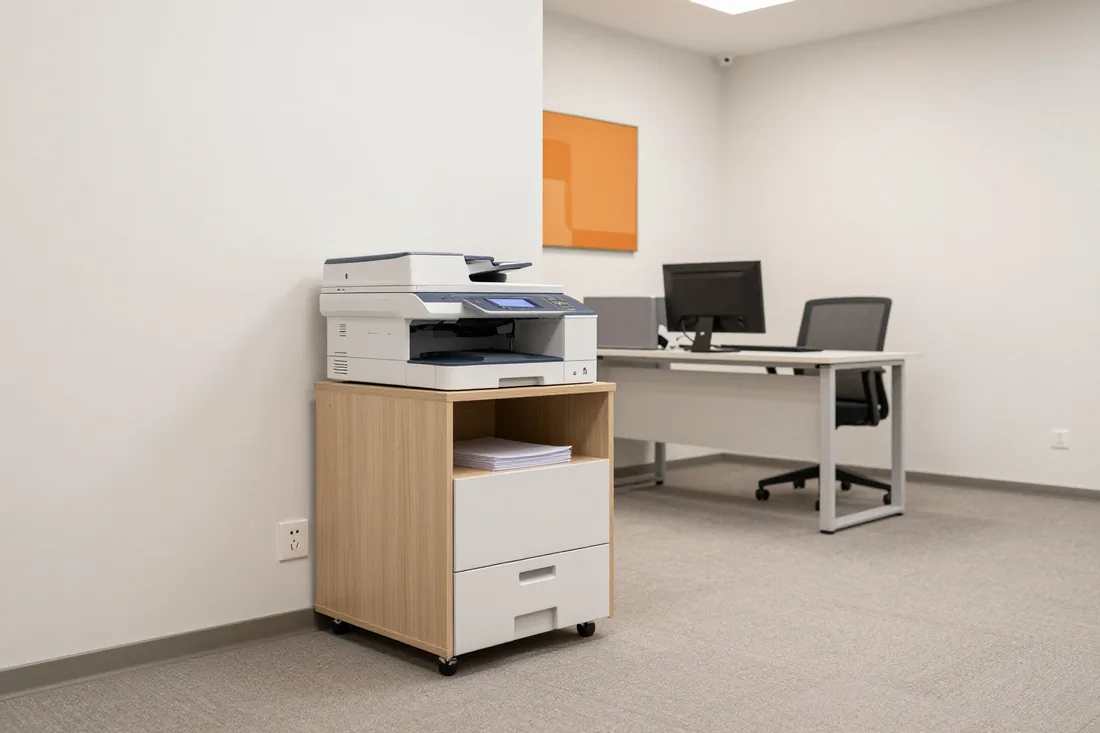
Reinforced shelf and ventilation for a printer or MFP. Frees up the desktop and removes equipment from the employee's work area.
from 34 000 ₸
02Projects
Site, volume, materials and lead time — per project.
 Office
Nurly Tau BC, Bostandyk district
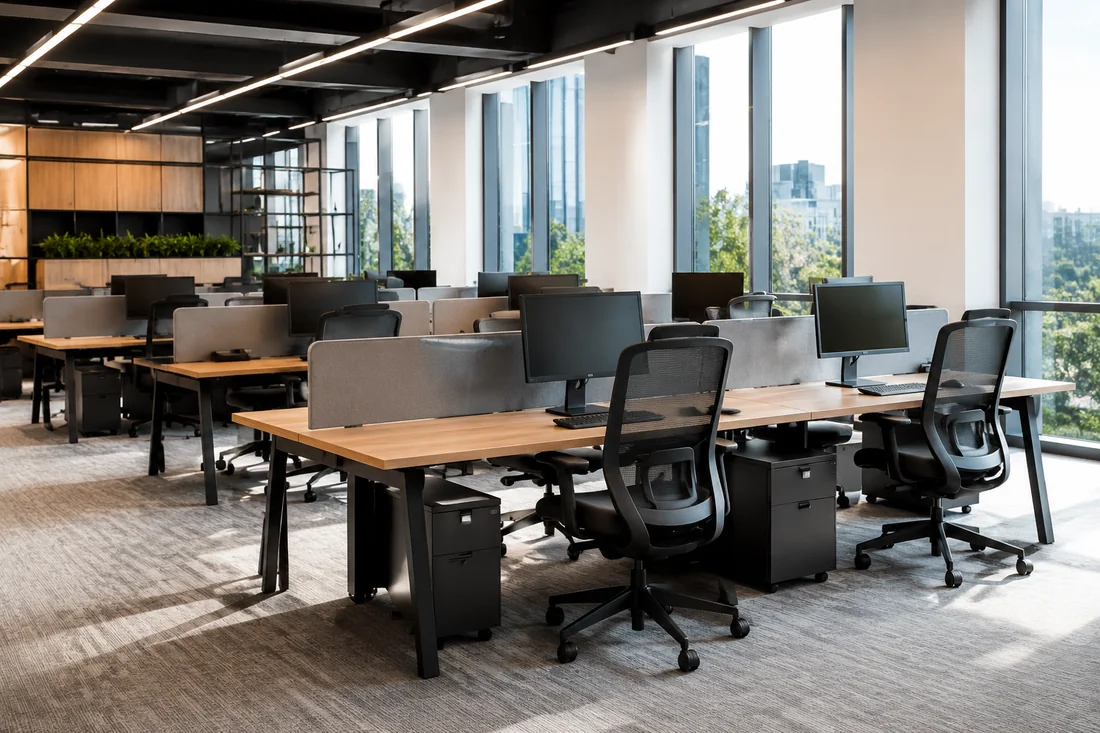
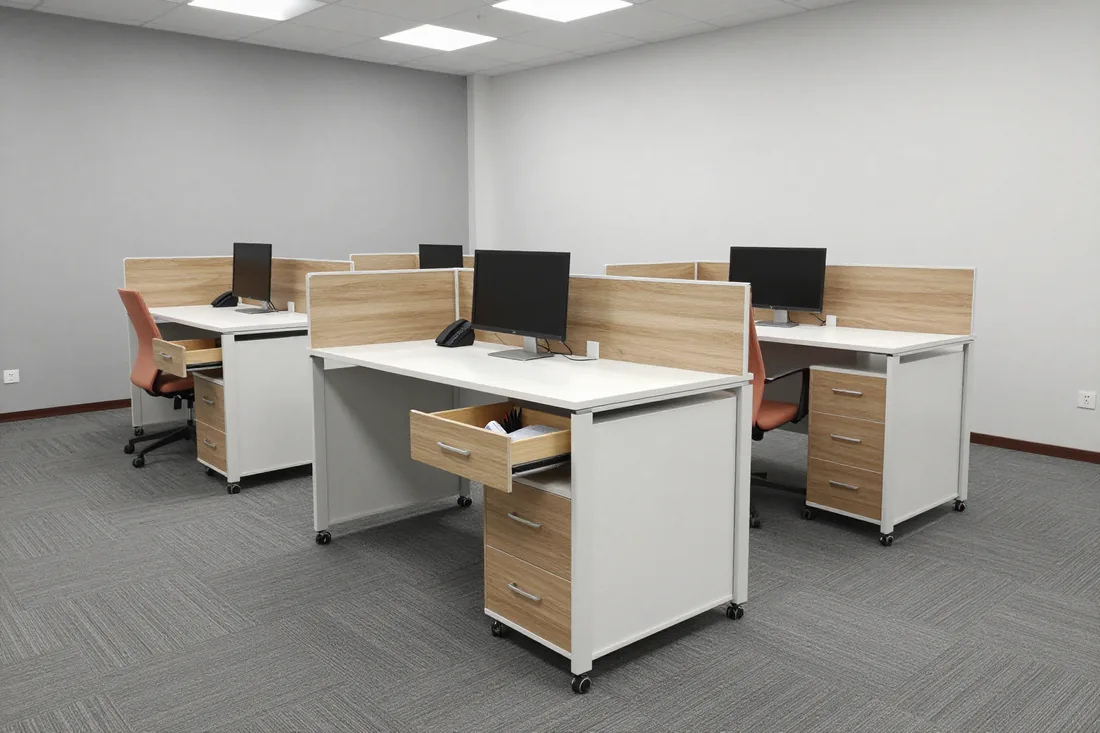
A batch of 22 mobile pedestals in a single open-space finish: same height, full-extension drawers, everything tucks under the desks. Assembled and set up in a single visit.
 Office
Esentai City, Medeu district
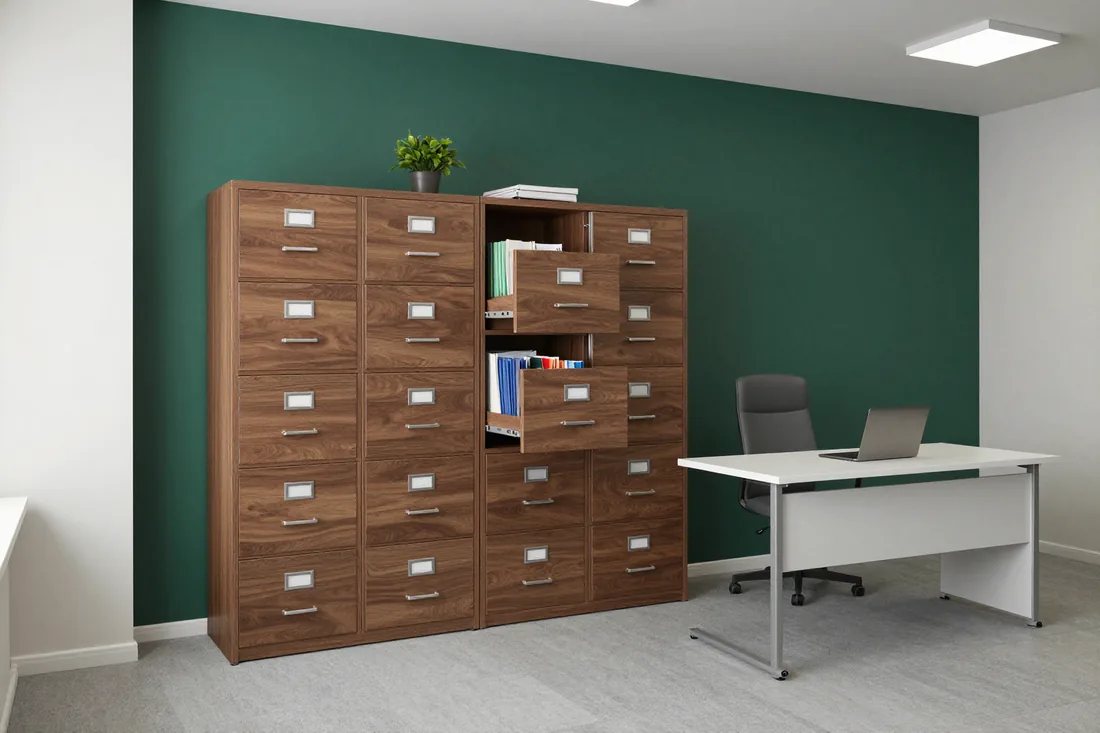
Six filing pedestals for A4 suspension files with central locks. Telescopic slides hold a fully loaded drawer, documents stay under lock and key.
 Office
Dostyk Business Center, Medeu district
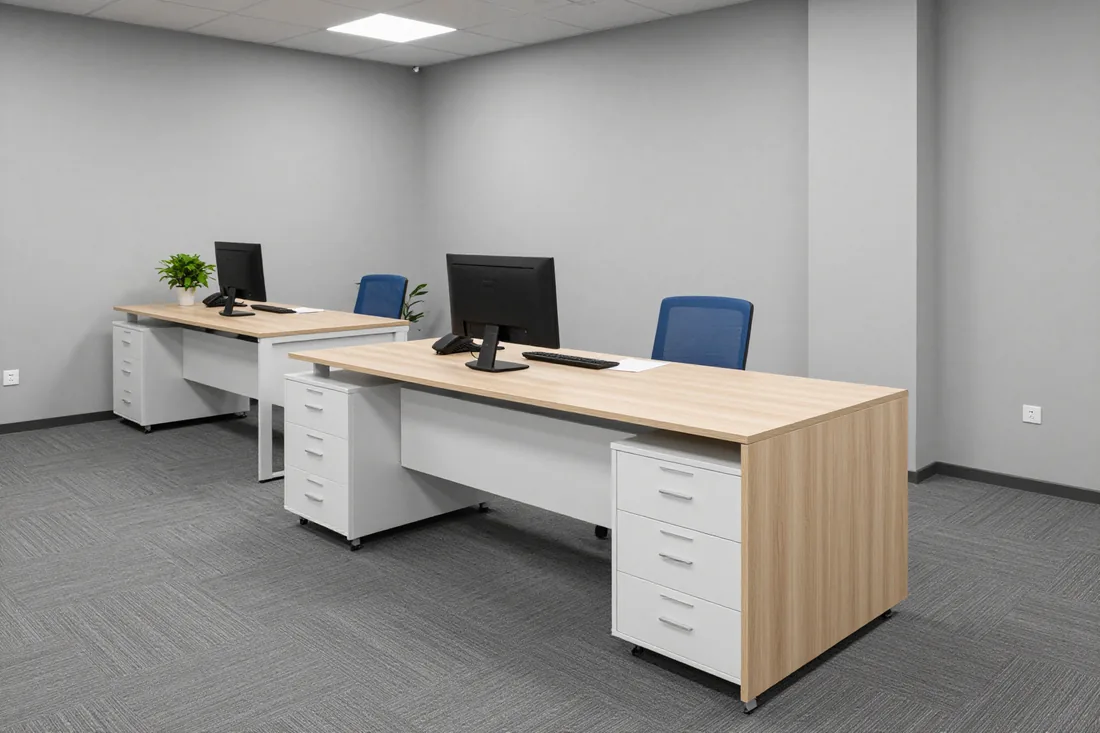
Side pedestals were joined to managers' desks flush with the worktop — creating unified L-shaped workstations. Drawers on Blum soft-close, finish matched to the desks.
 Office
Gagarinsky Business Center, Almaly district
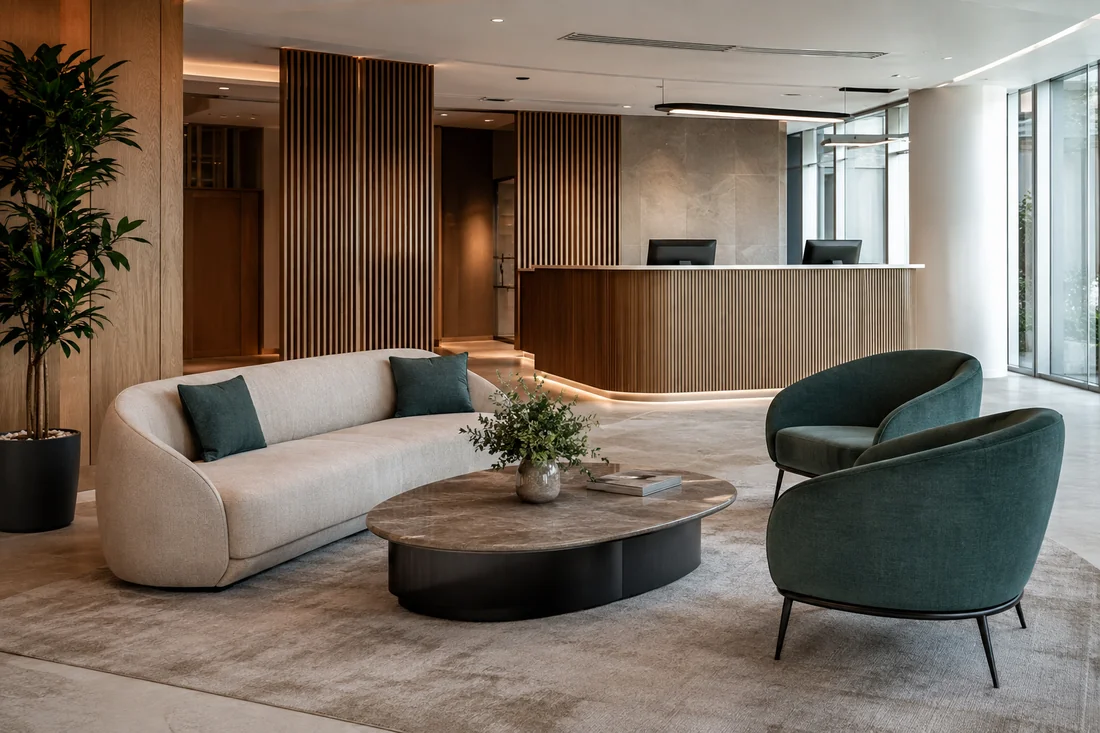
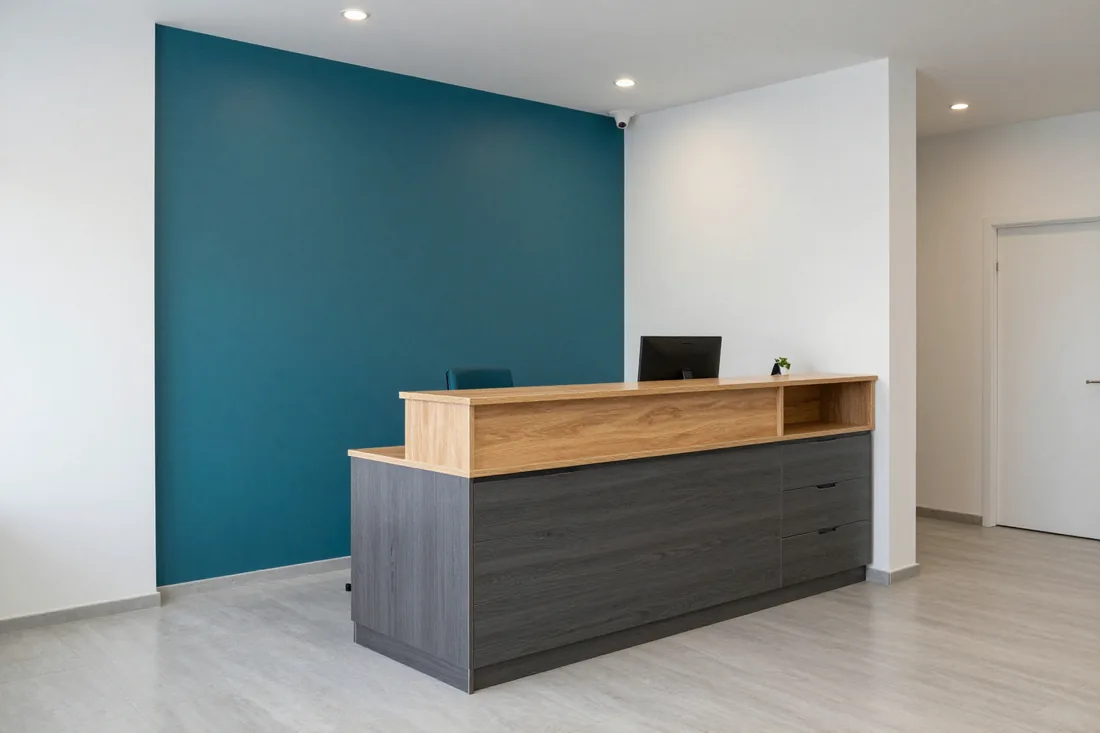
A low reception pedestal with a decorative front panel and space for a logo for a small welcome area. On the staff side — drawers and an open niche.
 Office
Mega Tower, Bostandyk district
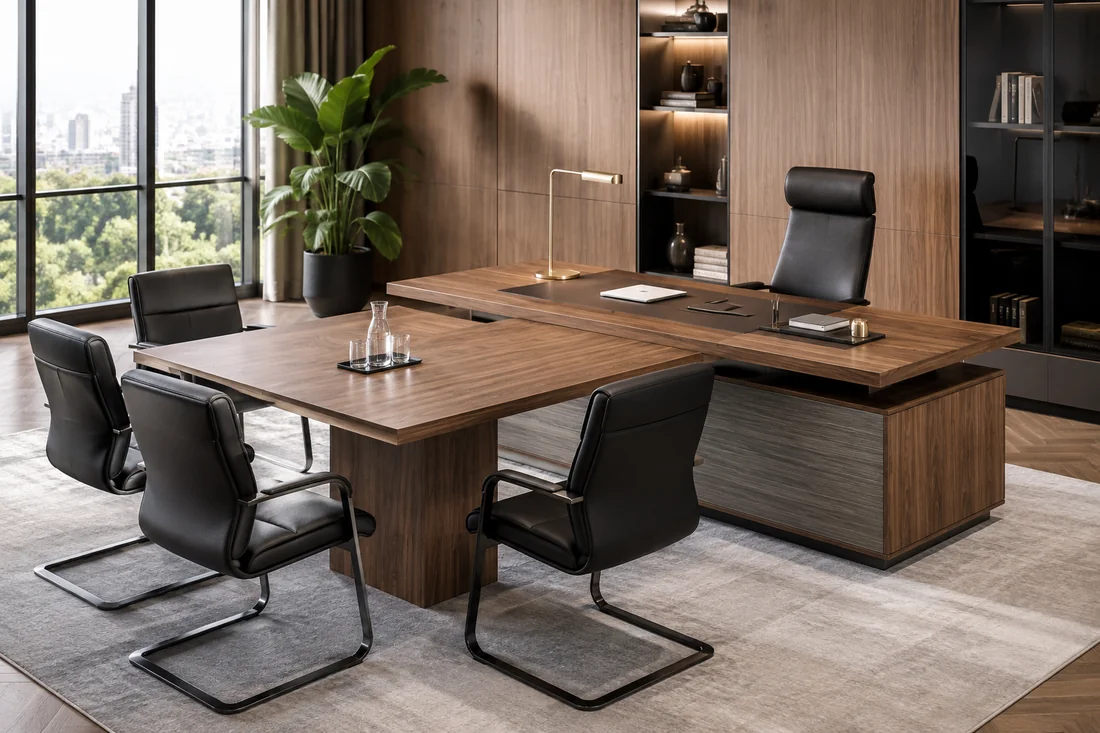
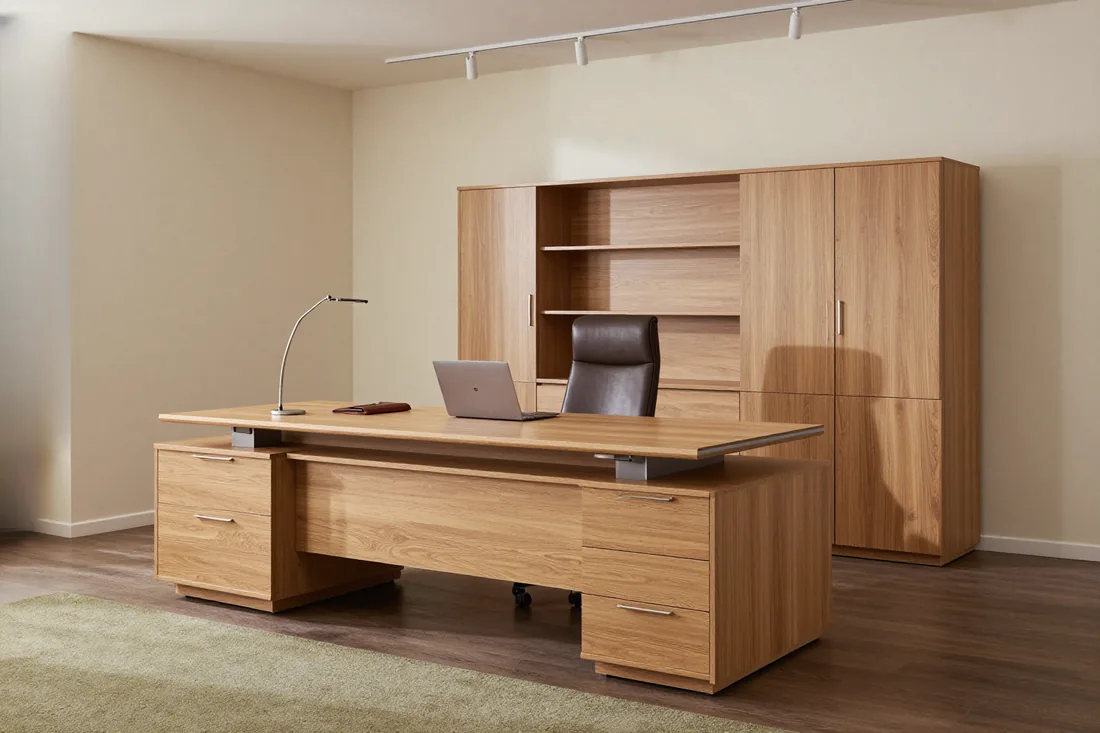
Two executive pedestals for directors' desks in oak veneer, matched to the desks. Concealed soft-close, smooth closing, fronts with no visible hardware.
 Office
Alatau Business Center, Auezov district
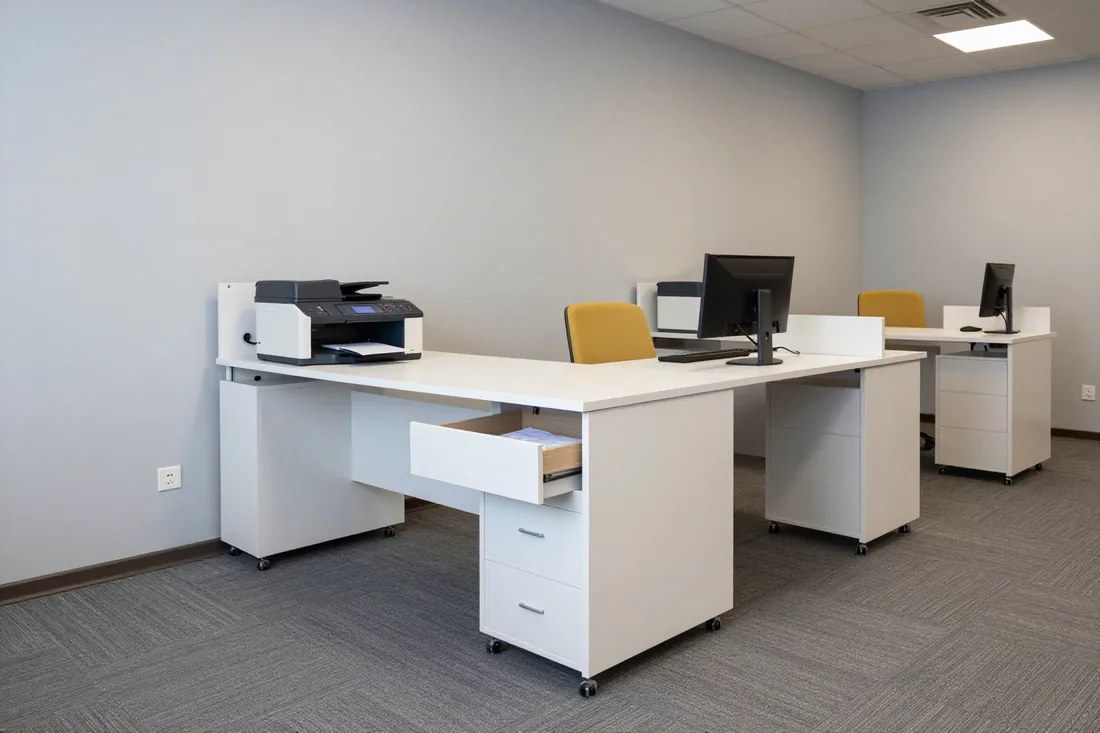
Eight pedestals for office equipment for the accounting department: an open niche for the MFP, rear cable outlet and a drawer for paper reams. Freed the desks from printers and boxes.
03How we work with offices
04Prices
The "from" price is per item in the base configuration: laminated chipboard carcass, PVC edge banding, standard hardware. The final cost is fixed in the contract after a free measurement, once dimensions, internal layout and material are known.
05For legal entities
We work with LLPs and sole traders on bank transfer. Price, materials and lead times — in the contract before production starts.
Request a contract and invoice06Principles
01 / 06
07Production
Six steps in our 600 m² workshop. You can see each of them with your own eyes: the showroom and production are under one roof.
Egger · Kronospan · E1
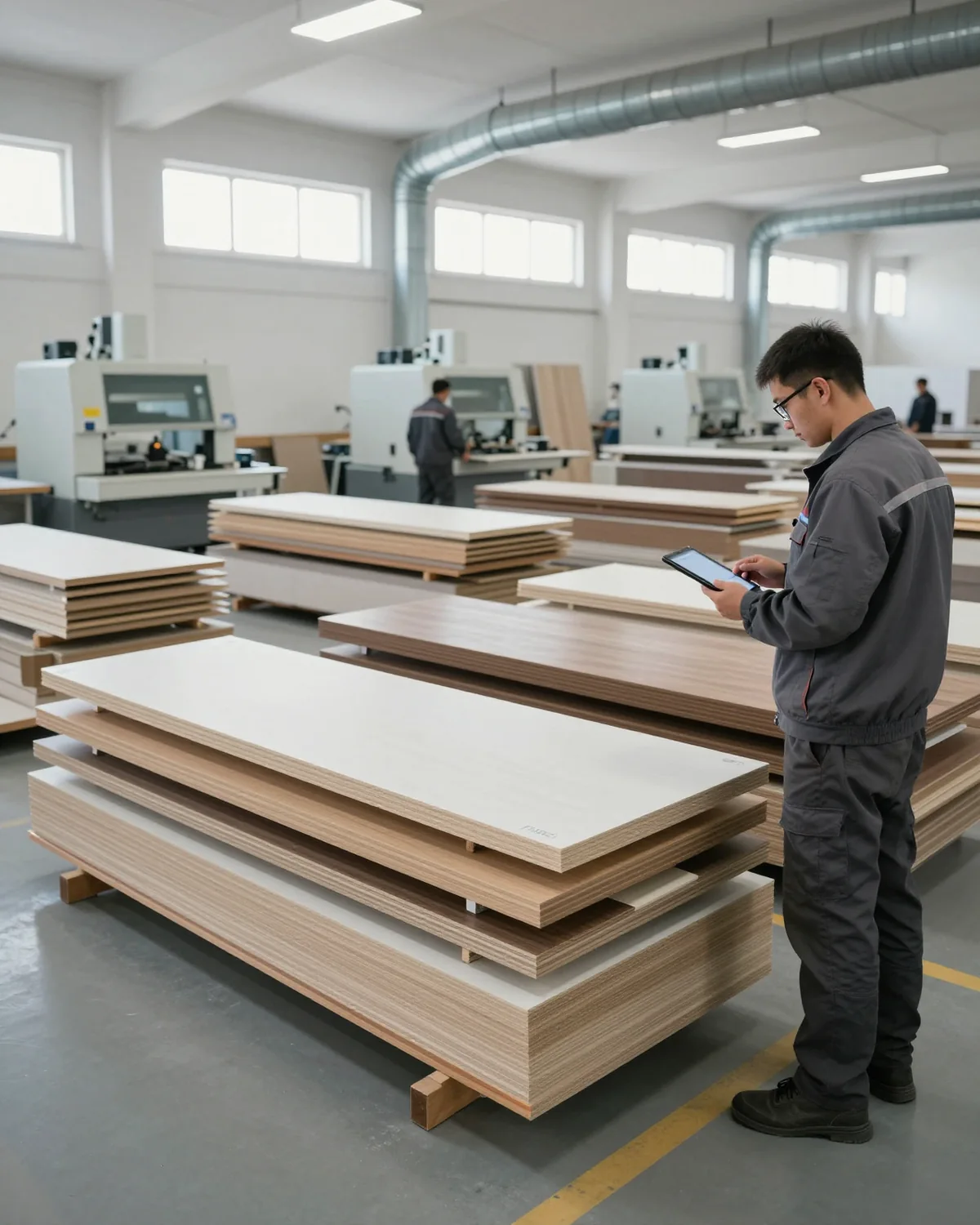
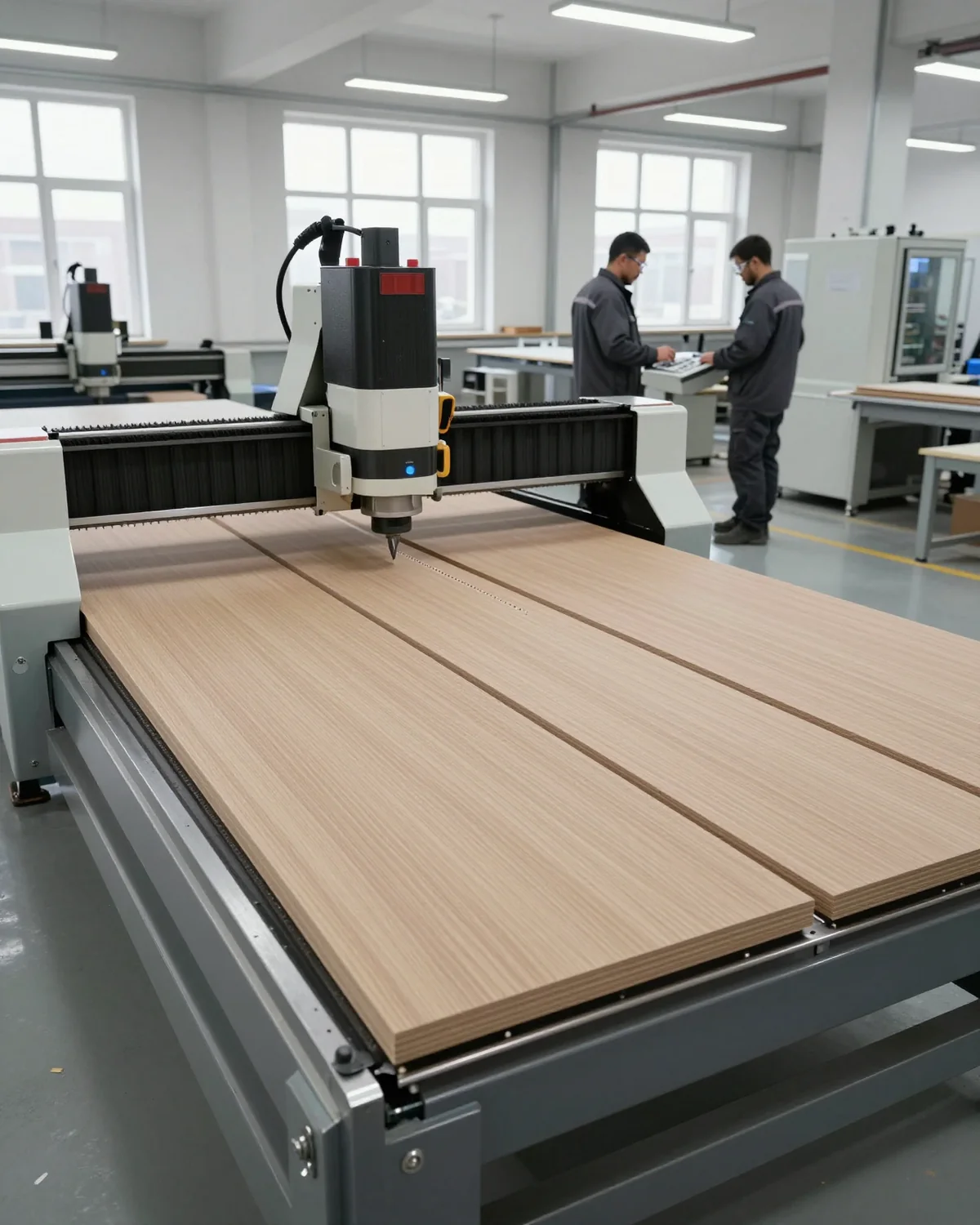
Egger and Kronospan E1 emission class boards arrive at the workshop warehouse. There are 40+ laminated chipboard decors, 16–18 mm thick. E1 class is for offices and studies.
Laser measuring to 1 mm
A design engineer prepares the drawings, and the machine cuts the board to them. Dimensions come from a laser measurement accurate to 1 mm.
Blum · Hettich · Boyard
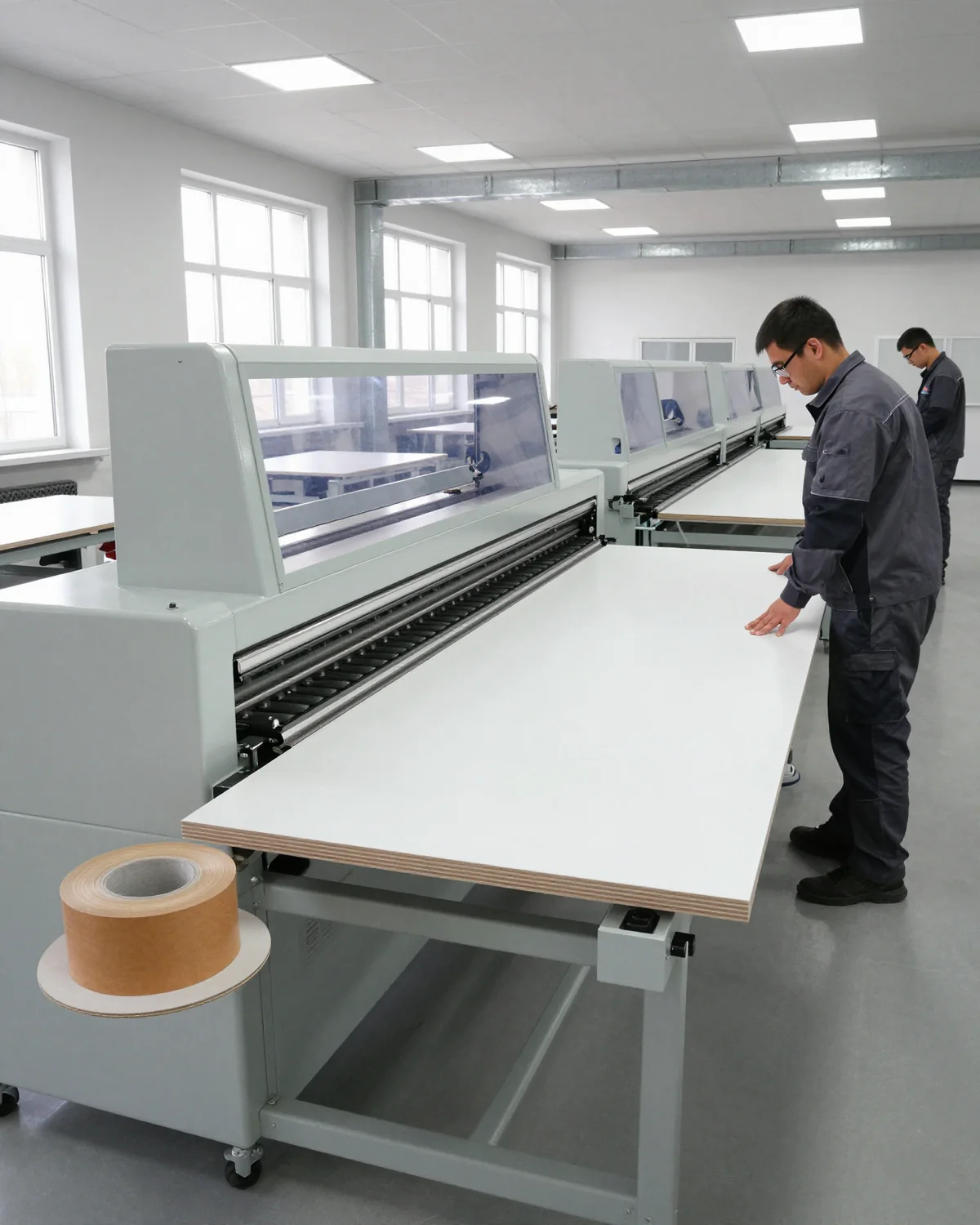
The edge-banding machine seals the edges, then we drill holes for Blum hinges and Hettich runners.
Any RAL colour
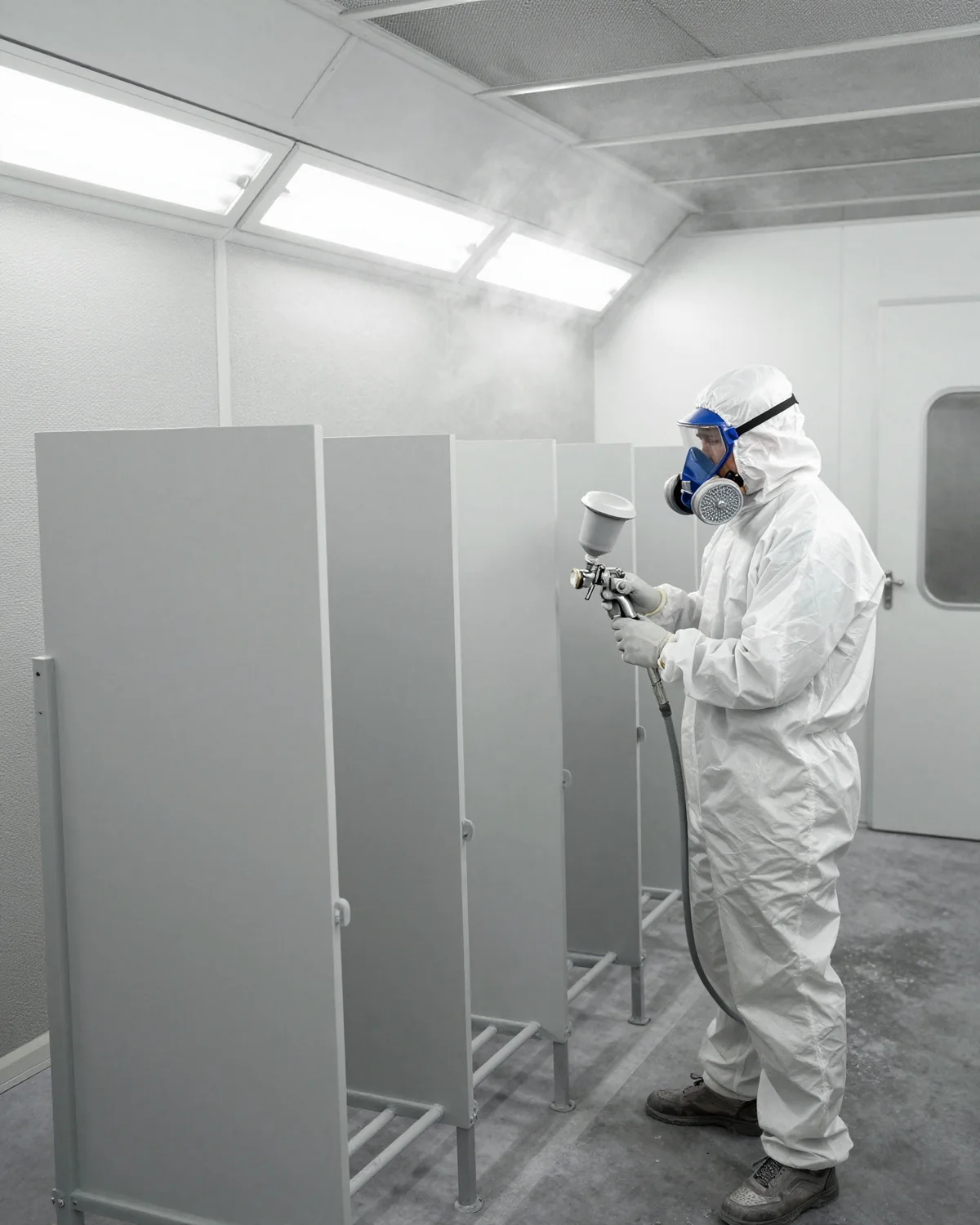
A finishing specialist paints fronts to RAL — matte and gloss. In the 600 m² workshop in Almaty, the cabinet carcass is cut and edged with 2 mm PVC, then a control cabinet is assembled before dispatch.
Pre-assembly in the workshop
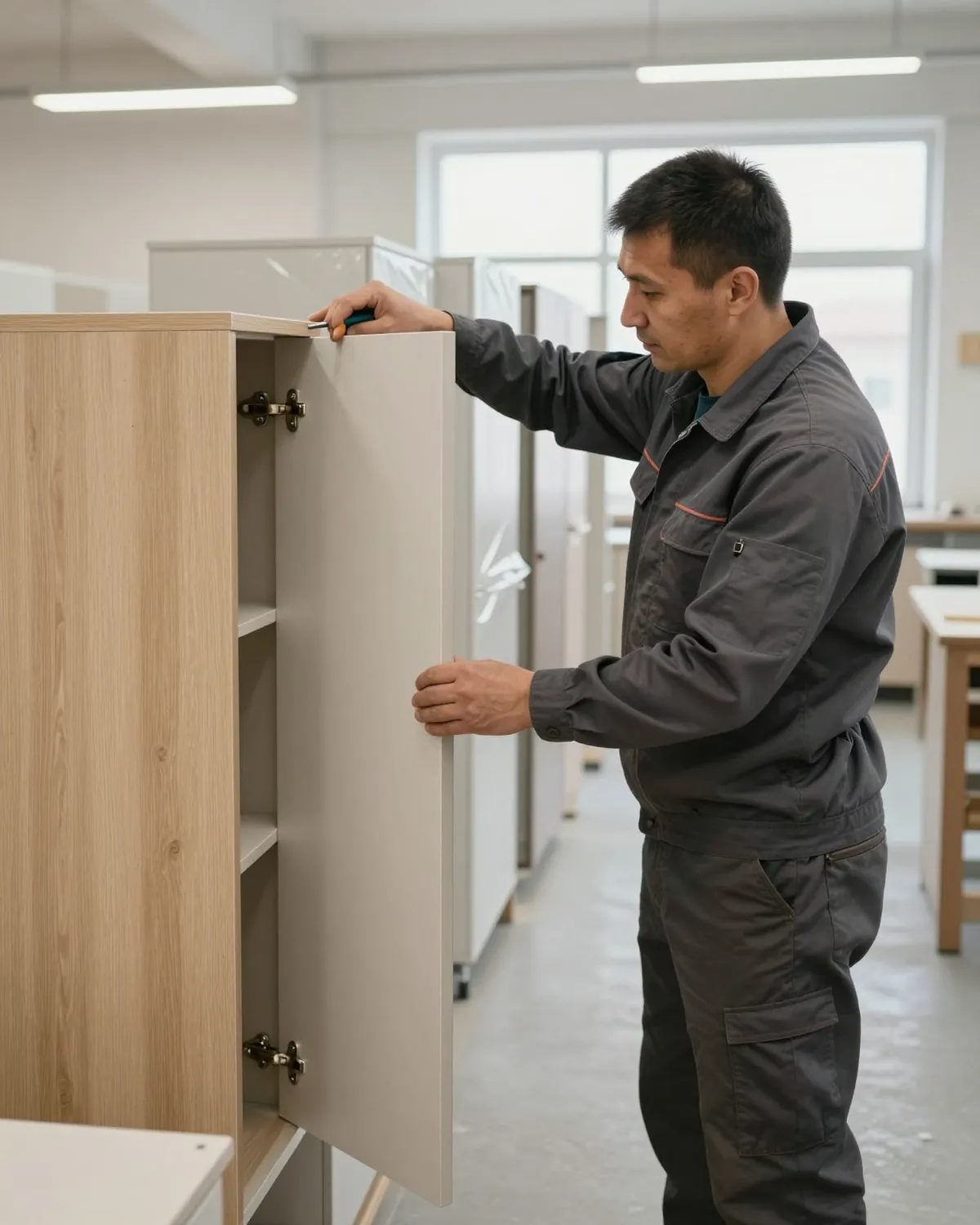
We assemble the modules in the workshop before dispatch, checking front gaps and drawer travel. The quality control department signs the item off for shipping.
Installation to fit the office schedule
We deliver, bring in, assemble in 1 day, adjust the furniture and clean up after ourselves. The 24-month warranty starts from signing the acceptance certificate.
08Team
MEBLIX workshop craftsmen who make and assemble furniture to order.
01 / 07Furniture assembly carpenter11 years
★ 4.81 · 47 ratings

Cabinet furniture repair craftsman20 years
★ 4.99 · 73 ratings

Furniture and kitchen unit assembler23 years
★ 4.97 · 300 ratings

Made-to-order furniture maker7 years
★ 4.26 · 32 ratings

Furniture maker5 years
★ 4.23 · 30 ratings

Joiner and carpenter20 years
★ 5.0 · 113 ratings

Furniture front and hardware fitter17 years
★ 4.61 · 92 ratings
09FAQ
Didn’t find the answer? Message us — a manager replies, not a bot.
Ask on WhatsAppYes, for legal entities we draw up a contract, an invoice and cashless payment. 50 % prepayment, the balance after signing the acceptance certificate. Closing documents: the acceptance certificate and the delivery note. If you need a set for a floor in one decor, we'll put everything into one estimate and one contract.
Cabinets can be ordered together with the rest of the furniture: we make the carcass and worktop from Egger or Kronospan E1 class laminated chipboard, so the decor will match the desks and wardrobes. Our own 600 m² workshop in Almaty handles cutting, 2 mm PVC edging and control assembly, and we select Blum, Hettich or Boyard hardware to suit the load of each specific model.
The delivery cost depends on the address and the order volume: within Almaty and a 30 km radius it is free for a large order, the threshold is shown on the Delivery and payment page. If the office is more than 30 km from the city, a per-kilometre surcharge applies. Lightweight cabinets can also be picked up — ask the manager which option suits you best.
Installation is carried out by our team. We agree the time around the office's working hours so as not to disturb employees. Before dispatch, the cabinets undergo control assembly in the workshop.
Yes, the price list includes a cabinet with a Safe-box lock. We also fit locks to other cabinet and wardrobe models, so let us know at ordering what internal layout you need.
Send a photo or a sample of your existing furniture — we'll match Egger or Kronospan laminated chipboard with the same colour and texture. If needed, we'll order board samples to compare under different lighting.
Yes, for this we need the dimensions and weight of the equipment — we use them to design a reinforced shelf and base. In the calculator, select the "for office equipment" type and enter the dimensions, and the manager will clarify the details.
Wipe the carcass with a soft damp cloth without abrasives and do not leave water on the edge for long. For durability, the ends are finished with 2 mm PVC edging, which protects the board from moisture.
We come to measure on site and make the carcass to the actual dimensions — no gaps or protrusions. We take into account the position of sockets and skirting boards so the cabinet fits precisely.
The most affordable option in the price list is the narrow Slim cabinet, with the mobile Mobil cabinet next to it. The final price depends on dimensions, material and internal layout. You can estimate it in the calculator, and it is fixed in the contract after measurement.
10Reviews
4,9
average rating
on Google and Zoon
Everyone can see a review on the platform: this is how other people check whom to trust with an order. If something went wrong, write to us and we will reply within 1–2 business days.
Message us on WhatsApp11Article
MEBLIX makes custom office cabinets in Almaty to fit your desk: with drawers, locks and cable channels, from E1-class Egger and Kronospan laminated chipboard or enameled MDF, with Blum, Hettich and Boyard hardware. Office measurement and a 3D workplace layout design are free and take 1–2 days.
A cabinet only works when it matches the desk in height and depth. Here's how to calculate these parameters before ordering and what we factor into the design.
We calculate cabinet height from the underside of the countertop, not from the floor, so drawers move freely when the board is 22–25 mm thick. We assemble the carcass from 16–18 mm laminated chipboard, and set the overall height so the gap to the board stays functional, not decorative. We attach drawer runners to the carcass sides, and their position determines how smoothly the top drawer slides out when fully loaded. We record all these references in the 3D workplace layout design so nothing has to be trimmed on site during installation. If the gap is less than 10 mm, the top drawer will catch the edge when fully extended — we allow for this gap in the design in advance, at the drawing stage.
We build the mobile version on casters using the same runners as the stationary one, but with a reinforced bottom for the supports so the structure doesn't loosen when rolled. The difference between versions isn't the drawer type but the rigidity of the lower carcass and how the supports are attached: on a mobile unit the bottom takes the load with every move around the office. The stationary version rests on adjustable supports and stays in place, so precise height and a tight fit to the desk matter more here. We fit Blum, Hettich or Boyard hardware — drawer runners ensure smooth movement and drawer service life, and it's not worth saving on them for the mobile version. In a mobile model, what matters more than the casters is the rigidity of the bottom and the runner attachment — with a thin bottom the drawer starts to sag after just a few months of active use.
We make a cabinet for a specific desk to your dimensions — the measurement specialist takes the desk and free space dimensions, and the designer incorporates them into the 3D workplace layout design. We provide this measurement and layout design free within 1–2 days, and we calculate not only the unit itself but also drawer travel, taking into account the adjacent chair and walkway. A cabinet under a writing desk is designed from the actual countertop height and depth, not from a standard catalog size. If the desk is already in place, we measure it as is, not according to the model's spec sheet — actual dimensions often differ by 5–10 mm due to adjustable supports. In Almaty we come for measurement at a convenient time, and for offices outside the city we agree on a day separately.
Two cabinets that look the same serve differently: the difference lies in the board, carcass thickness and edge. Here's exactly what to choose so the furniture withstands daily office use.
We work with laminated chipboard from these E1-class brands — both have a melamine finish and are suitable for the office; the difference is in the décors and density. We build the carcass from 16–18 mm board and the desktop from 22–25 mm: at that thickness a drawer doesn't sag under the weight of papers and folders. The German manufacturer offers a wide collection of solid-colour and wood-grain décors, while the Austrian one offers a dense board that holds milling and re-assembly well. Class E1 means regulated formaldehyde emission, so the material can go into closed offices without extra ventilation. In office furniture, a cabinet made from this board lasts a long time and keeps its geometry. In the reception and meeting room, where the cabinet is opened dozens of times a day, a denser board holds the runner fixings better — on re-assembly the holes don't wallow out.
We edge the ends with 2 mm PVC edging — it seals the cut against moisture and chips, while thin 0.4–1 mm edging wears out faster and does not protect the board at the corners. Edging runs along the entire perimeter: top, sides, shelves and drawer fronts. On thin edging, the exposed end absorbs moisture from a glass of tea or wet cleaning and swells, and it chips on impact — such an area cannot be restored without replacing the part. The 2 mm band withstands a hit from a chair leg and does not come loose when indoor humidity fluctuates. The most vulnerable spot is the front edge above the top drawer: that is where the band wears through first, which is why cabinets for staff rarely cut costs on it.
| Office zone | Carcass material | Finish | Edging |
|---|---|---|---|
| Staff area | Egger or Kronospan E1 laminated chipboard | melamine | PVC 2 mm |
| Reception and meeting room | Egger or Kronospan E1 laminated chipboard | melamine | PVC 2 mm |
| Executive office | MDF | enamel or natural veneer | no edging, painted |
A desk drawer is opened dozens of times per shift, and it's the running gear that decides whether the cabinet still glides smoothly a couple of years later. Let's look at the three options we fit.
We fit Blum, Hettich and Boyard hardware — all three glide smoothly; the difference is in service life, price and warranty period. Blum mechanisms come with soft-close and are designed for intensive daily use, Hettich covers universal scenarios, and Boyard goes into secondary cabinets and budget areas. A standard hinge is enough for a hinged door, but heavy enamelled MDF needs a reinforced mechanism. In our workshop, a test assembly before dispatch shows how a particular pair of mechanisms behaves in a particular carcass — on 600 m² we assemble every item before it ships. In a cabinet under daily load, what matters more than the brand name is that the running gear matches the thickness of the drawer bottom — if they don't match, even expensive hardware starts to rattle.
Blum hinges, lift mechanisms and drawer runners carry the brand's 25-year warranty, while we give 24 months on the item itself under the contract. These are two different commitments and shouldn't be confused: the first comes from the component manufacturer and covers only its mechanisms, the second comes from our workshop and covers the carcass, edge banding, assembly and installation. Both are written into the contract as separate clauses, so when you get in touch it's clear what is covered. Blum does not make table extension mechanisms — different hardware is used there, and the 25 years do not apply to it. The manufacturer's warranty does not replace the warranty on the item — if something breaks, we first check what failed: the mechanism or the fastening in the carcass.
| Brand | What we install | Brand warranty | Load scenario |
|---|---|---|---|
| Blum | hinges, lift mechanisms, drawer runners | 25 years | high daily |
| Hettich | runners, hinges | per brand terms | universal office |
| Boyard | runners, hinges | per brand terms | budget areas |
Documents and cables are the two things that most often force a finished cabinet to be redone. We show how to close both issues at the ordering stage, so you don't have to drill the front later or replace the carcass.
We install locks on cabinets — locking a document drawer or the whole unit, with the lock mortised into the front at the manufacturing stage. The mortise mechanism holds in a 16–18 mm carcass and doesn't protrude, so the front stays flush. In an office with paperwork, clients more often choose a key lock on the top drawer: it's cheaper to make and doesn't require a reinforced side panel. We fit a lock on the whole unit less often, but that is the scheme that locks all the drawers of a single cabinet with desk drawers at once. A lock on the top drawer protects only that drawer, while one on the whole unit is more secure for documents but requires a reinforced side panel so the fastening doesn't tear out under load. If the drawers hold densely packed folders, tell us at the measurement — we'll choose the side panel thickness in advance.
We install cable channels and cable hatches — cables from equipment run inside the cabinet and don't get tangled at the workplace. We fix the channel along the back panel and bring the hatch out where it's convenient to plug in a charger or power supply. Through such an opening the cable passes without tension and isn't pinched by a drawer when closing. It's more convenient to put the hatch in the back panel rather than the worktop — that way the cable can be rerouted without disassembling the cabinet when replacing equipment. In offices with several workstations, channels help route cables from each desk to a single entry point — at the measurement stage we mark these points according to the layout plan. For a printer and a power strip we leave a separate outlet near the floor so the cable doesn't run across the worktop.
We make cabinets with a compartment for the PC tower, with drawers of different depths and with open shelves — we put the configuration together for a specific workstation. An open compartment the width of the PC tower frees up the countertop, while drawers for small items stay right next to it. We choose drawer depth based on folder format: A4 needs more room, while a smaller depth is enough for stationery. We build custom cabinets in Almaty to your dimensions — from height to shelf placement. The compartment for the PC tower must have a ventilation gap at the back — without it the equipment casing overheats and the cabinet becomes a dust trap. A 5–7 cm gap and a removable back panel solve both issues when cleaning.
Ordering to your own dimensions is a sequence of steps, not a single meeting. Here is what happens at each stage and what you get at the end.
We provide a free office measurement and a 3D layout of workstations in 1–2 days — the design shows how the cabinets will sit relative to desks and walkways. The measurement specialist records the room dimensions, and the 3D designer transfers them to a plan tied to walls and columns. At the measurement it is important to show not only the desk but also the sockets and switches — their location determines where the cable channel goes and which side the drawers open from. Another point often missed when measuring on your own: skirting boards and door casings take up a few centimetres by the wall, so a mobile cabinet will no longer fit flush. We check these areas on site, so the 3D design matches reality rather than an ideal rectangle on paper.
For legal entities we prepare a contract, invoice and bank transfer: 50 % prepayment, the remaining 50 % after signing the acceptance certificate. This procedure suits accounting: the first half goes through the invoice, the second is settled once the furniture is installed. We prepare the closing documents — the acceptance certificate and the delivery note — right after installation, so the purchase falls into the same reporting period without delays. The contract records the configuration, carcass decor, hardware type and lead times per the price list, so when reordering a batch you don't have to recall the parameters from scratch. If a company is buying furniture for the first time, our technicians will advise which fields to fill in the procurement request — this saves one round of correspondence and speeds up budget approval. We also agree separately who on the customer's side accepts the item, so the certificate is signed by someone with authority and the documents don't come back for revision.
Lead times depend on the item and material — they are listed for each option in the price list on this page; rush orders are possible. We cut carcasses and countertops from Egger and Kronospan laminated chipboard, apply 2 mm PVC edge banding in the workshop, and before shipping we assemble the item in a test build — so any flaws show up before we go to the client, not on site. We schedule installation around the office's working hours — the team arrives in a convenient window so employees' work isn't interrupted. We sign the acceptance certificate after installation, once all drawers are adjusted and locks are checked. In our experience, the most frequent source of revisions is not the carcass but a mismatch between the design and the actual placement of equipment, so before assembly it's worth double-checking the plan against how employees actually sit.
When furniture is needed not for a single workstation but for a whole floor, a unified décor and a single budget are what decide it. We break down how a complete order works and what to do when the headcount grows.
We handle complete orders from a single workstation to a whole office floor in one décor — with one budget and one contract for the whole set. The scope covers a cabinet for every workstation, tables, wardrobes and meeting groups where needed: all of it is built from board of the same line and the same carcass thickness of 16–18 mm. One contract covers the entire volume rather than individual items from different suppliers, so acceptance is done under a single act after installation. A unified décor is easier to lock in at the project stage: if you buy board later, the shade in another batch may differ even with the same manufacturer. At the measurement stage we record the article number of the board and edge banding for the whole set — that way the entire floor stays visually consistent.
We handle reorders in the same décor later — when the headcount grows, the new cabinets match the existing ones in board and edge banding. We take reorders for any number of workstations: from a single unit to a new office wing, with the carcass composition and hardware repeating the first order. If the first set was built from Egger or Kronospan laminated chipboard, we match the new batch from the same décor line. It is best to keep the décor article number from the first order — with it we will match board from the same line even if the batch has changed. That way, a year later the added cabinets stand out from the earlier ones neither in shade nor in edge banding pattern, and the expansion budget is calculated against a familiar specification.
In staff areas we make cabinets from laminated chipboard, in the executive office from MDF in enamel or veneer, and in the reception and meeting room we choose the configuration based on the scenario. In open-plan work areas mobility and a document lock matter, so models on castors with standard-depth drawers are used there. In the executive office board gives way to painted MDF and veneer: this material holds the shape of the front and underscores the status of the space. The reception usually needs a compact cabinet with an open niche, while the meeting room needs a support for equipment with access to sockets. In the meeting room such furniture more often serves as a stand for equipment, so a cable channel and ventilation matter more there than the number of drawers. On this principle we build the configuration for each zone separately, within the unified décor of the set.
We have gathered in one place what most often decides the fate of an order: what the fit of a cabinet, its service life and its convenience in daily work depend on.
12Calculation
Choose the cabinet type, width and filling in the calculator — the calculation will go to the manager on WhatsApp, and they'll clarify the details for your office.
13Office furniture
We design and make cabinet furniture for offices with a precise fit to the space and a unified decor per floor.
We design workstations around the office layout and employees' tasks: measurement and a 3D placement design are free, and the price is fixed in the contract before work starts.
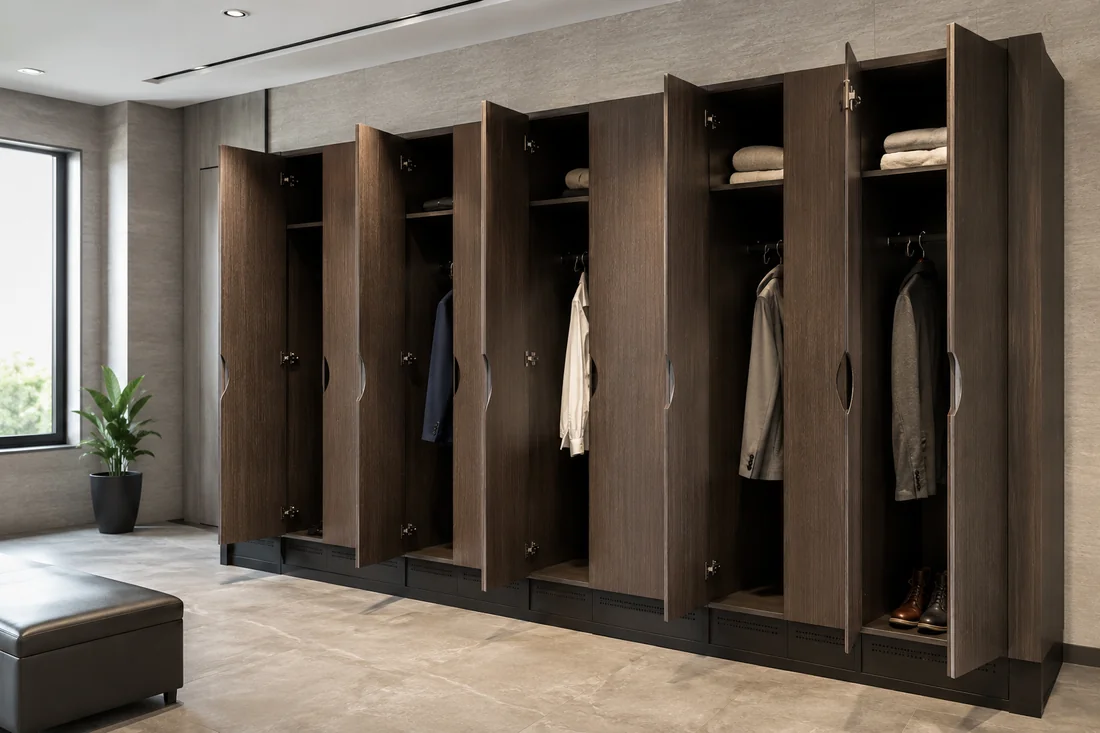
We design and make office wardrobes for your documents, equipment and clothing, fitted into a niche with the required number of sections.
We will make a wardrobe to the dimensions of your archive or office: free office measurement and a 3D layout design in 1–2 days, the price is fixed in the contract.
A wardrobe for the niche of a reception or changing room keeps things tidy and protects employees' clothing from dust.
We design and make sofas for receptions, waiting areas and meeting rooms: free measurement with fabric samples and a 3D design in 1–2 days, the price is fixed in the contract.
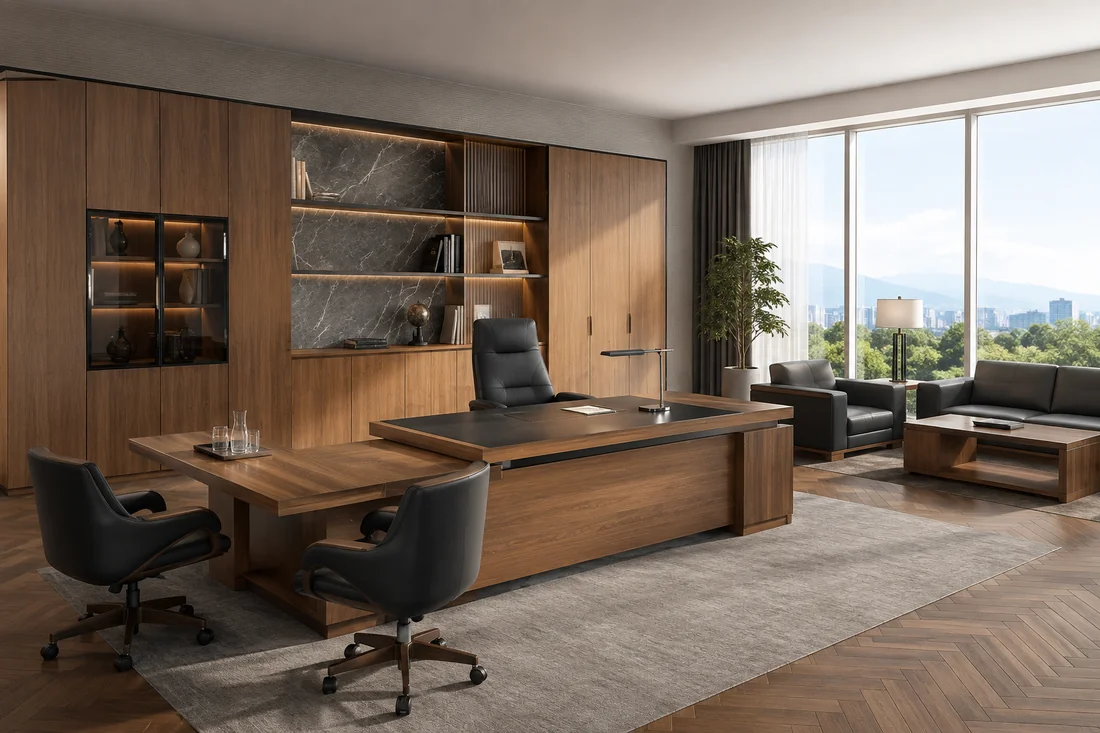
We design and manufacture an executive office to suit the manager's tasks: meetings, document storage, a rest area.
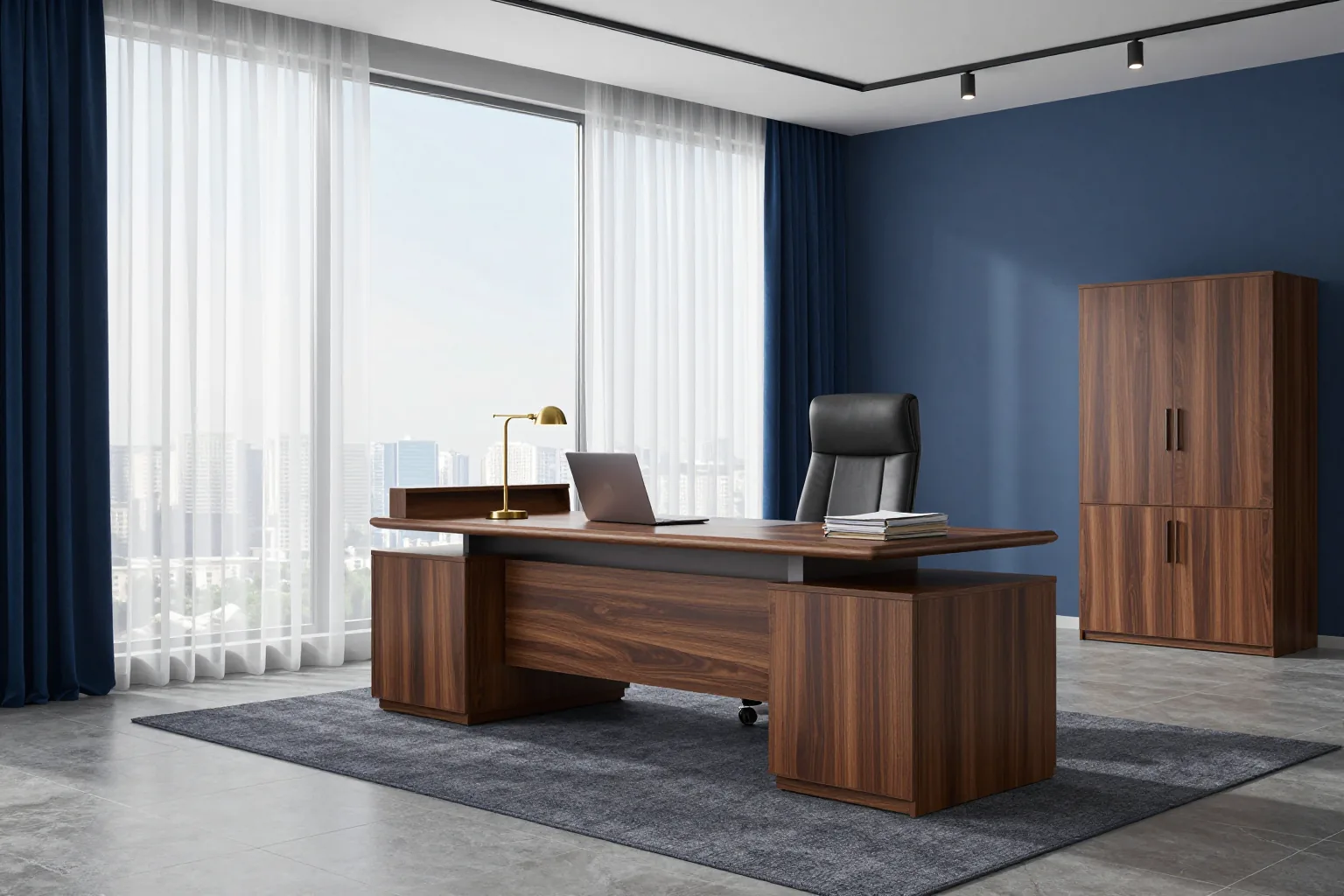
We design and make a desk for the director's office with free measurement and a 3D layout design in 1–2 days.
An executive desk with a briefing extension brings a meeting and a workplace into one line without taking up extra metres.
We design and make meeting tables to the dimensions of your room.
We furnish a reception to the dimensions of your office: a desk, sofas, tables and a wardrobe in one decor.
We design workstations to suit the office layout: free measurement and a 3D layout design in 1–2 days, the price is fixed in the contract.
We furnish an office in one decor: workstations, meeting rooms, reception and rest areas.
A loft table on a steel frame with a wooden or laminated chipboard top solves the workplace task without losing the office style.