
Short answer
Blum and Hettich hardware means hinges, runners, lift mechanisms and soft-close dampers that determine how doors and drawers work for years. We fit Blum, Hettich and Boyard components into kitchens and wardrobes, match them to the weight and size of every door in the 3D design, and check them on a test assembly in the workshop.
What makes up Blum and Hettich hardware in a piece of furniture
The carcass and fronts form the fixed part of a piece, while everything that opens and slides rests on a few metal components. Here is what groups they fall into and how the manufacturers' brands differ.
Which components move doors and drawers
- Composition: kitchen or wardrobe furniture hardware is five groups of components, and each is responsible for its own movement of a door or drawer.
- Hinges: hold hinged doors, set the opening angle and let you set even gaps between neighbouring doors along the full height.
- Runners: carry the drawer and determine how far it pulls out, how much weight it holds and how smoothly it runs under load.
- Lift mechanisms: open upper cabinet fronts upwards and hold them open while you take out dishes with both hands.
- Soft-close and push-to-open: absorb the impact at the end of travel or open a door with a press when there are no handles on the front at all.
- Count: an ordinary kitchen has dozens of such components, so the brand is worth discussing per design and per module, not by eye.
Why the brand of components matters more than it seems
Blum and Hettich hardware keeps its adjustment and smooth action for years, which is why it is most often chosen for doors and drawers used every day. The difference from unbranded components shows not on the first day but after hundreds of openings: a cheap hinge works loose in the cup, the spring weakens and the door starts to sag. Unbranded runners develop play over time, the drawer skews and closes with a bang, and rust appears on the metal by the sink that you see every time you open it. Components from the Austrian and German manufacturers are built for long service and are adjusted with screws without removing the front. We work with three brands, including Boyard, and show directly in the design where the brand matters and where it does not. It makes most sense to save on components where the cabinet is opened rarely, for example a top cupboard or a compartment for seasonal items, while in the kitchen and hallway it is better to fit branded mechanisms.
Three brands and their strengths
| Brand | What it is strongest at | Where it is chosen most often | Warranty |
|---|---|---|---|
| Blum | lift mechanisms, drawers, push-to-open | kitchens with heavily loaded drawers and upper cabinets | 25 years from the manufacturer |
| Hettich | drawer systems, sliding doors, push-to-open | kitchens, walk-in closets, sliding wardrobes | manufacturer's terms |
| Boyard | basic components for wardrobes, cabinets and chests of drawers | wardrobes and cabinets with light loads | manufacturer's terms |
Hinges that hold the door level
A wardrobe door weighs little, but over the years it opens thousands of times. The hinge determines the gaps between doors, the opening angle and whether the front will sag under its own weight over time.
How a hinge is built and how the series differ
Blum hinges, like those from other manufacturers, consist of a cup that is recessed into a drilled hole in the door front and a mounting plate on the side of the carcass. We select the type and angle of each hinge at the design stage, and the holes for the cups are drilled when the door is manufactured, so on site it is simply hung and adjusted. The series differ in opening angle: a standard hinge gives the usual angle, while a wide-angle hinge opens the door almost to the plane of the wall, which is convenient for a tall cabinet with pull-out baskets inside. There are separate versions for thick and glass doors, for corner modules, for fronts next to the refrigerator and for built-in appliances behind a furniture door. On many models the mounting plate snaps on without tools, and the door can be removed in seconds, for example before painting the walls. If the wardrobe stands against a wall, ask for a hinge with an increased angle in the design, otherwise the handle will hit the wall and the inner drawers will not pull out.
Door position and hinge type
| Hinge type | How the door sits | Where it is used |
|---|---|---|
| Full overlay | covers the end of the side panel completely | single wardrobe, end module |
| Half overlay | covers half of the end | two doors on one side panel |
| Inset | recessed inside the carcass | classic wardrobes with an exposed end |
| Corner | opens at an angle to the adjacent door | corner kitchen module |
| For glass | holds the glass with a special fixing | display cases and glass doors |
| For dummy panel | swings the door next to a fixed panel | corner kitchen with a blank insert |
How many hinges a tall door needs
We calculate the number of hinges by the height and weight of the door, not by the habit of putting two on anything. A low, light door is fine with two hinges, but a tall front for a tall cabinet or wardrobe needs more, otherwise it warps diagonally and stops sitting flush against the carcass. The spacing between hinges matters too: the outer ones are placed closer to the corners so the door does not twist when opened. A mirror, glass or a massive milled front adds weight, so hinges are placed more often, and sometimes a model with a reinforced spring is chosen. Manufacturers provide tables showing how many hinges are needed for a door of a given size and weight, and in the design we rely on them. A branded hinge has three-way adjustment — height, depth and sideways — so gaps are set with screws without removing the front. If the door has started to sag over time, first tighten the adjustment screw, and only replace the hinge when the cup has worked loose in the hole.
Runners and drawers for heavy dishes
A drawer is loaded more heavily than a hinged door, because it holds pots, bottles and stacks of plates. The runners determine how smoothly it moves, access to the far corner and how long the drawer will last without skewing.
Which runners are used on kitchen drawers
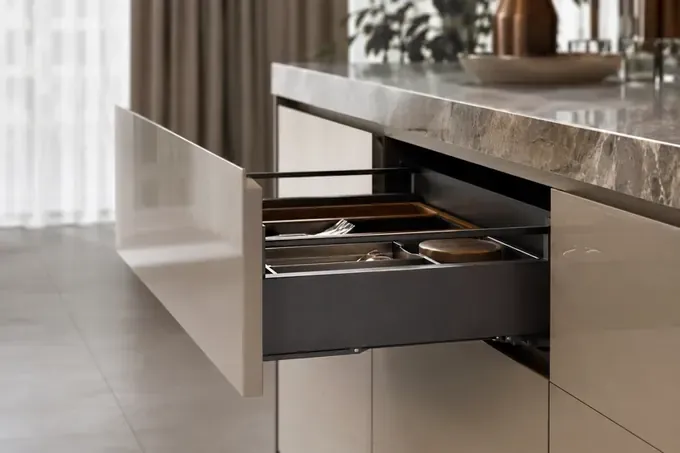
For kitchen drawers we install full-extension systems: the drawer slides out completely, and the far corner is accessible without bending. Hettich Quadro series runners are mounted under the bottom and are not visible from the side, while the Austrian brand's hidden MOVENTO and TANDEM systems solve a similar task. The second option is ready-made drawers with metal sides, such as TANDEMBOX or LEGRABOX from Blum and InnoTech Atira or ArciTech from the German manufacturer. In such systems the sides and the running mechanism are already assembled together, and all that remains is to make the bottom, back panel and drawer front, and rails and dividers can be added to the sides. A metal side does not swell from moisture and does not loosen, so such drawers hold heavy dishes without sagging and close smoothly. For pots, bottles and household chemicals, choose drawers with metal sides, while light drawers for cutlery can be made on hidden systems with wooden sides.
Types of runners and where they are appropriate
| Type | Extension | Where appropriate |
|---|---|---|
| Roller | partial, the drawer does not come out all the way | light drawers of cabinets and tables |
| Ball-bearing | full or partial, smooth travel | office cabinets, wardrobe drawers |
| Concealed mounting | full, mounted under the bottom | kitchen, drawers with wooden sides |
| Drawers with metal sides | full, sides and travel in one system | pots, bottles, heavy dishes |
| Drawer within a drawer | full, inner drawer behind a common front | cutlery and small items in a deep drawer |
What to consider when choosing a drawer
- Full extension: in the kitchen the drawer must slide out completely, otherwise the far corner turns into a storage of forgotten items and expired spices.
- Load capacity: each system has a permissible weight, and for dishes we choose a running mechanism with a reserve, not at the minimum.
- Smoothness: a built-in damper absorbs the impact, so a drawer with a full stack of plates closes quietly and without clatter.
- Length: the mechanism is selected to match the carcass depth so that the drawer uses all the space up to the back panel of the module.
- Inner drawers: a drawer behind a hinged door requires hinges with a large opening angle, otherwise it will hit the front.
- High sides: for bottles and large jars, ask for a drawer with a high side or a rail, then nothing will tip over when opening.
Lift mechanisms for upper kitchen cabinets
Opening an upper kitchen cabinet upwards is more convenient than pulling a hinged door towards you above your head. We explain how such fronts move, how the mechanism differs from a gas lift, and why it is selected by weight.
Why an upper cabinet needs a lift mechanism
The upper cabinet needs a lift mechanism so the door swings up and stays open while both hands are busy with dishes. A hinged door above the countertop gets in the way: it is easy to hit your head on its corner, and a wide front blocks the neighbouring cabinet and the light from the lighting. We include lifts in the design for the upper kitchen modules that are reached for most often — above the work area, above the sink and above the extractor hood. The best-known line of such mechanisms is AVENTOS by Blum, and Hettich has its own lift system too. Many mechanisms hold the door at any point of travel, so a shorter person does not need to raise it all the way. Above a dish rack a lift is especially convenient: the cabinet stays open while you put away washed plates and cups. If the cabinet hangs high and you are not tall, ask for a lift with a stop at any height or an electric drive that opens the front at a light touch.
How lift-up fronts open
- Swing-up: the door rises as a whole, pivoting on the top axis, and suits low cabinets above the countertop.
- Folding: the two halves fold like an accordion and go up, so a tall cabinet opens without the door swinging forward.
- Parallel lift: the front rises vertically and sits above the carcass, which is convenient when there is free space above the cabinet.
- Lift above the carcass: the door goes up and back over the cabinet, freeing the opening entirely, and suits high ceilings.
- Gas lift: a simple gas strut holds a light door open, but usually without stopping at any point of travel.
- Choice: the type of movement depends on the cabinet height and the distance to the ceiling, so it is determined at the measurement, not after installation.
Why a lift is chosen by door weight
A lift is chosen by the weight and height of the door because the mechanism's spring must precisely balance the front. A weak mechanism will not hold the door up and it will slide down, while too strong a one will toss it up and make it hard to close. Weight depends on the material: a painted front with milling, a frame with glass or a mirror weighs noticeably more than a flat laminated door of the same size, and a handle and lighting add a little more. Manufacturers have tables and calculation programs where the model and mechanism force are chosen by the size and mass of the front, and we calculate lifts at the design stage, not on site. Many mechanisms are additionally adjustable for force, so during installation they are fine-tuned to the actual door and its handle. If after ordering you decide to replace the front with a glass or heavier one, tell us before manufacturing, because the mechanism will have to be recalculated.
Soft-close and handleless opening
Quiet closing and handleless fronts are made by different mechanisms, and not all of them work together. We break down the types of soft-close, push-to-open and the places where smooth movement is needed most.
What types of soft-close there are
Soft-close mechanisms for furniture come in three types: built into the hinge, built into the drawer runners, and standalone units that are mounted on the carcass next to the door. A built-in damper works at the end of the travel — it catches the door a few centimetres before the carcass and pulls it gently shut without a slam. In hinges and drawer systems from brand-name manufacturers it is already integrated, so no separate parts are needed on the carcass and nothing sticks out inside the wardrobe. For kitchen fronts and drawers we offer soft closing as standard unless the project specifies push-to-open. The same unit also protects the carcass: the door doesn't slam against the side panel, and the hinge fixings keep their seating longer. A surface-mounted damper comes in handy on an old or non-standard door where replacing the hinge without soft-close is inconvenient. If the old wardrobes at home close loudly, a standalone damper on the carcass solves this without replacing hinges or drilling new holes.
How push-to-open works
Push-to-open lets you do without handles: just press the front or drawer and the pusher extends it a few centimetres. At Blum this mechanism is called TIP-ON, at Hettich — Push to open, and for heavy drawers there is the electric SERVO-DRIVE drive that responds to a light touch. A mechanical pusher and a standard damper pull the door in opposite directions, so hinged doors with a pusher get hinges without a built-in soft-close. For drawers, manufacturers offer systems where push-to-open and soft-close are combined in one unit, and a handle-less drawer closes as gently as a regular one. The downside of a handle-less system is fingerprints at the push point, especially on dark gloss, and such fronts can easily open by accident when you brush against them with your hip. If you choose a handle-less kitchen, go for a matte finish or order an integrated profile along the top edge, then it will be easy to open even with your hands full.
Where soft closing is needed first
- Kitchen drawers: they hold dishes and glass, and the bang when closing is heard throughout the flat, especially in the evening.
- Bedroom: a wardrobe in the bedroom closes quietly and doesn't wake the person sleeping nearby, even if things are taken out early in the morning.
- Tall larder units: a heavy door without a damper hits the carcass harder, and the hinge mounting loosens faster.
- Bin drawer: the pull-out module under the sink is often opened with a knee, and the soft motion protects both the drawer and its contents.
- Hallway: the shoe cabinet and the console by the entrance are closed on the go, often with a push, and the damper takes that impact.
- Kids' room: soft closing reduces the risk of pinching fingers, so it's worth including it for wardrobes and chests of drawers in the kids' room from the start.
How we select the units and what the warranty covers
Hardware is chosen at the design stage, checked in the workshop and adjusted on site. Here's where it appears in the documents, how it's checked before delivery and who is responsible for it under warranty.
Where hardware appears in the project
The hardware appears in the 3D design we prepare within 1–2 days after a free measurement: it shows where the hinges sit, which fronts are on lift mechanisms and which drawers pull out fully. The brand and series of the components are recorded in the specification, so the contract makes clear what will arrive on site and what will be inside each module. One item can combine brands, for example lift mechanisms from one and drawers from another, if that gives the right motion and fits the budget. Before dispatch, the item goes through a test assembly in our workshop: a craftsman hangs the doors, checks the drawer travel and the operation of the lift mechanisms, and only then is the item disassembled for delivery. Lead times for each item are shown in the price list on the item page, and a rush order is also possible. Go through the design and mentally open every wardrobe: if a soft-close, a push-to-open or a wider angle is needed somewhere, it is easier to add it before ordering.
Item warranty and manufacturer warranty
We give a 24-month warranty on the item, and its terms are written into the contract together with the specification. Separately from it, the manufacturer gives a 25-year warranty on Blum components, and this condition applies to that brand only. Hettich and Boyard have their own warranty terms, which are clarified for a specific series and the Austrian brand's term is not carried over to them. The difference matters when something breaks: the furniture maker is responsible for the manufacture and assembly of the item during the term, while the manufacturer is responsible for the mechanism itself on its own terms. That is why the specification lists not just "hinges with soft-close" but the brand and series, which show whose warranty applies. We sign the acceptance report after installation, and the second half of the payment is made after signing, so the doors and drawers can be checked at ease. Keep the specification with the brand and series of the components, as it makes it easier to order the same hinge or drawer a few years later.
What is adjusted in the hardware after installation
- Gaps: during installation we set the hinges with adjustment screws so the gaps between the fronts are even along the full height.
- Height and depth: the door is raised or pressed against the carcass if the floor or wall in the apartment is uneven.
- Drawers: on many systems the drawer front panel is adjustable in height and tilt, and the line of drawers is aligned into a single row.
- Lift mechanisms: the force of the mechanism is tuned to the actual front so it neither drops nor springs up when opened.
- Push-to-open: the actuation depth of the push mechanism is adjusted so the front opens with a light touch but not by accident.
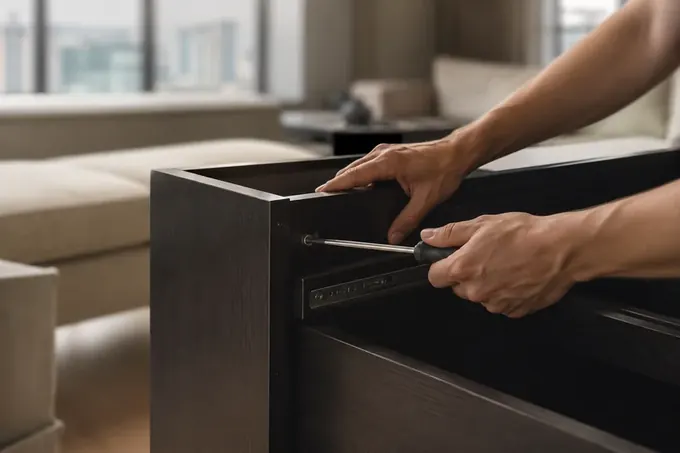
- Re-adjustment: over time the hinges sometimes need tightening, and this is done with a single Phillips screwdriver without removing the door.
Summary: which hardware to choose and put in the spec
A short guide for those discussing a kitchen or wardrobe in a project and wanting to understand which components will work every day.
- Components: hinges, runners, lift mechanisms, soft-close and push-to-open make up the moving part of an item, and it is best to save on them where the cabinet is opened rarely.
- Hinges: the hinge type is chosen by the door position, and their number by the height and weight of the front, with an angle allowance at the wall.
- Drawers: the kitchen needs full-extension systems, and for heavy dishes, drawers with metal sides.
- Lift mechanisms: the mechanism for an upper cabinet is calculated by the weight and height of the front, so replacing the door with a glass one is discussed before manufacturing.
- Handle-free: the push-to-open mechanism and a standard soft-close on a hinged door do not combine, so the choice between them is made at the project stage.
- Warranty: not every brand offers a long manufacturer's warranty, so the brand and series of components are worth recording in the specification.
Article updated 15 September 2026Calculate kitchen price All blog articles