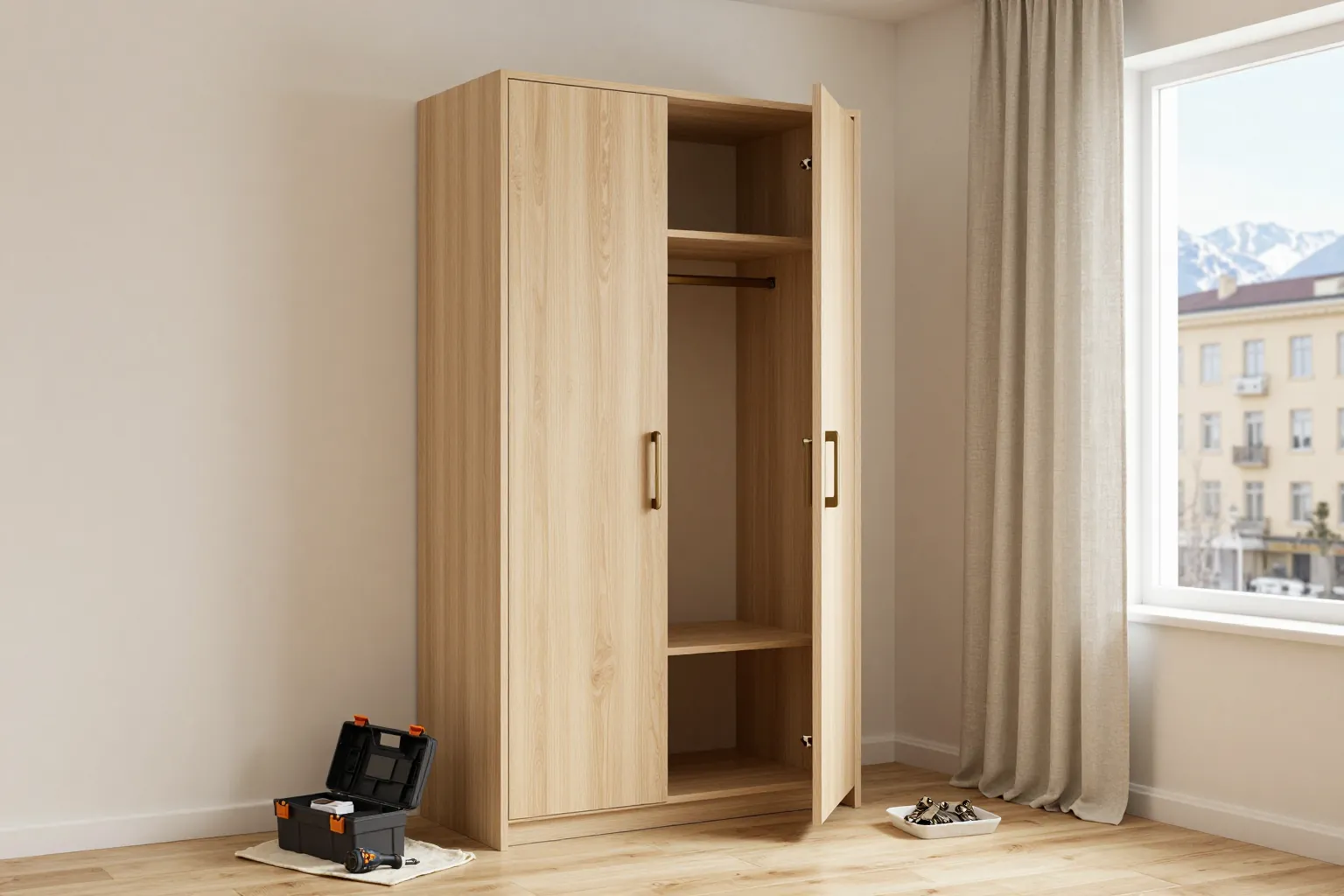
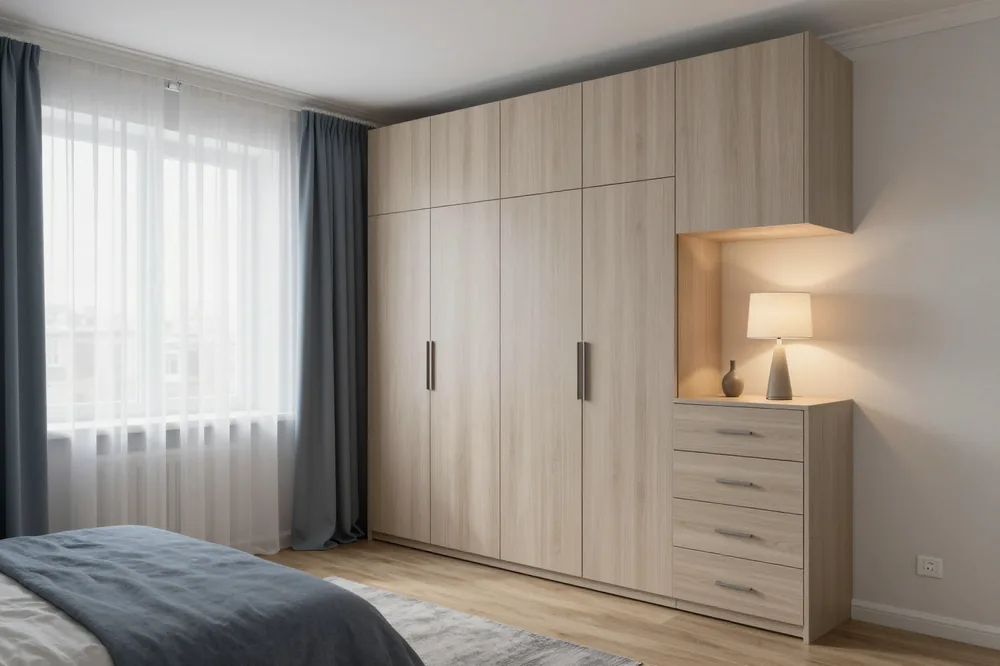
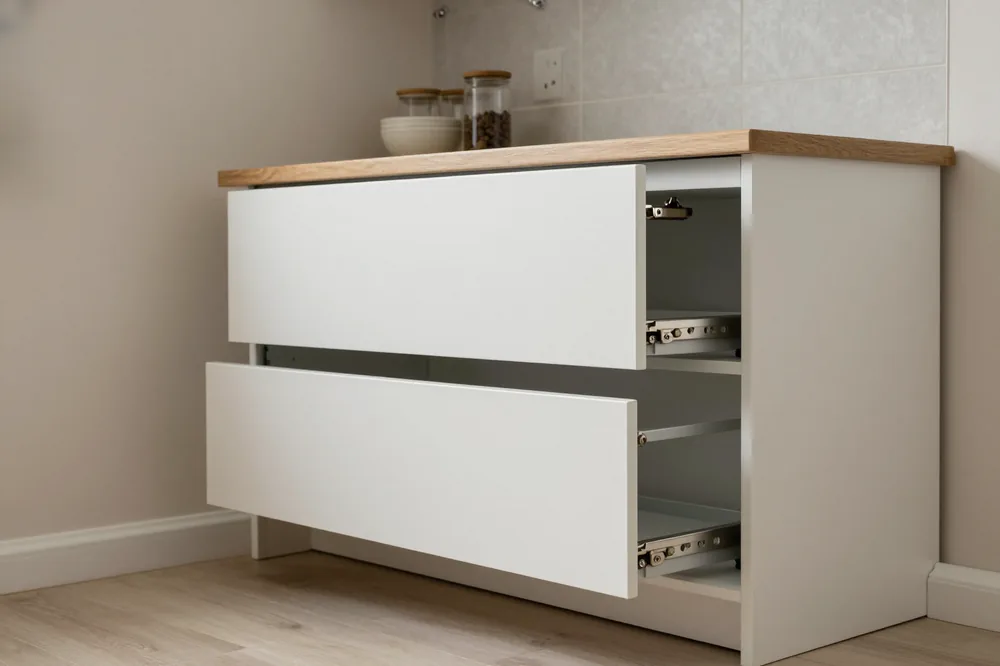
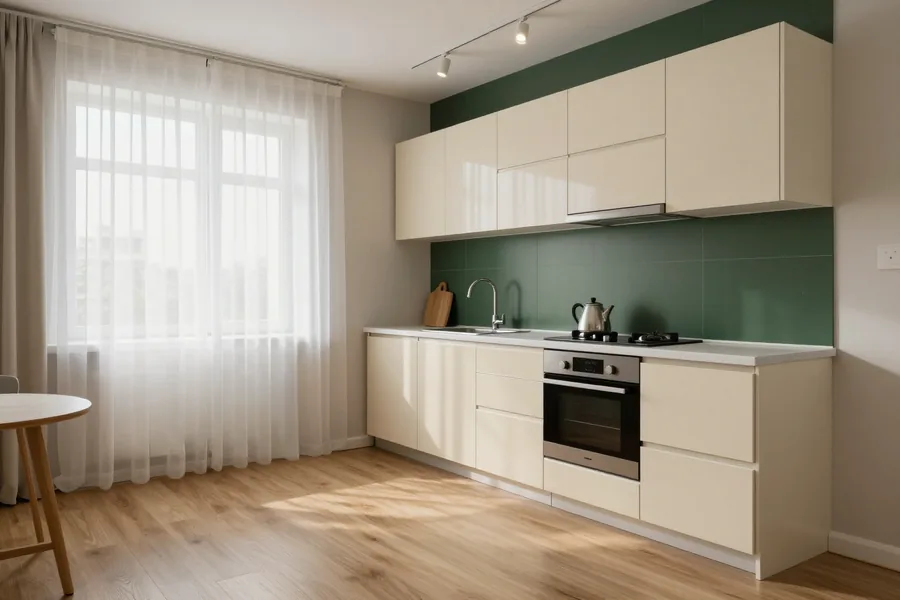


We repair furniture by component: we replace hinges, runners, soft-close mechanisms and gas lifts, fix the folding mechanisms of sofas, reglue wobbly chairs, restore torn-out fasteners and replace fronts swollen from water with new ones. We carry out small jobs at your home in a single visit, and we give a 12-month warranty on fasteners, hardware and mechanisms.
Why wardrobe doors sag and drawers stick
Doors and drawers are opened many times a day, so their parts wear out before the carcass does. We break down hinges and gaps, runners with soft-close, and the choice of replacement parts.
Hinges, gaps and torn-out fasteners
We first adjust a sagging door, and if the hinge is worn out or torn out of the board together with its fasteners, we replace it and restore the mounting hole. A modern hinge has three adjustment screws: they move the front up and down, in and out, and sideways, and most misalignments are fixed without replacing parts. It is worse when the laminated chipboard around the screw has crumbled under a heavy mirrored door: then the hole is drilled out, a dowel is glued in and the hinge is refitted, and sometimes the cup is moved to a neighbouring spot. Tall doors often lack one hinge in the middle, and adding it takes the load off the others. After the work the technician sets the gaps between the fronts and checks that every leaf closes, and on a kitchen also that the lines of the upper and lower doors match. Do not overtighten a screw in a worn hole: the board crumbles further and the mounting will then have to be moved.
Drawer runners and soft-close
A drawer that sticks, drops and does not close all the way almost always means worn runners. Replacing furniture hardware in that case starts with choosing the type: roller runners are simpler and quieter in light drawers, ball-bearing runners hold more weight and pull the drawer out almost fully. We fit both, and on request add a soft-close mechanism that pulls the drawer in smoothly and stops it from banging. The same soft-close can be fitted to a hinged door if the hinge supports it. Before replacing, the technician checks whether the drawer itself is warped: a skewed bottom and split sides will break new runners too, so the drawer box is first reglued. If you buy the runners yourself, measure the internal depth of the carcass, not the length of the old part — the fit differs between models.
Which hardware we fit as replacements
| Option | What we fit | When it is chosen | Manufacturer warranty |
|---|---|---|---|
| Blum | hinges, lift mechanisms, drawer runners | kitchens and wardrobes with daily use | 25 years |
| Hettich | hinges, runners, soft-close | wardrobes and kitchens with smooth movement | per manufacturer |
| Boyard | hinges, runners, handles | cabinet furniture for home | per manufacturer |
| Budget alternative | hinges and runners to suit the job | doors opened rarely | per supplier terms |
What breaks in sofa and office chair mechanisms
A mechanism works under a person's weight and sudden jerks, so it wears in its own way and often suddenly. We break down sofa folding mechanisms, office chair parts and the causes of squeaking.
Eurobook, dolphin and accordion
Repairing a sofa mechanism starts with removing the load from it and inspecting the axles, levers, springs of the mechanism and the attachment to the frame. In a eurobook, the rollers and seat guides most often wear out; in a dolphin, the tie rods and the attachment of the pull-out block; in an accordion, the hinges of the folding frame. A bent lever and a cracked welded seam of metal are not straightened: such a part is replaced, otherwise it will break again in the same place. If the original mechanism has been discontinued, we select an analogue based on the old sample so that the sofa unfolds as before and does not change the height of the sleeping area. After installation, we unfold and fold the sofa with weight several times in a row and check whether the seat and back align evenly when unfolded. If new upholstery is also needed, that is reupholstery, done as a separate job.
Gas lift, base and rocking mechanism
An office chair that sinks under weight on its own requires a gas lift replacement: its cartridge has lost pressure, and adjustment no longer restores it. We replace the gas lift and, if necessary, the base — a plastic one with a crack at the spoke, a metal one with a broken socket — along with the casters that have stopped spinning. A chair that rocks in jerks and does not lock the back usually suffers from wear of the rocking mechanism under the seat; we repair this unit and, in case of severe wear, replace it entirely. The same approach works for a rocking chair, where the mechanism and attachments to the base wear out. All work with the gas lift and base is done by the technician at your place, without taking the chair away, and before replacement he checks the cartridge's seat size and stroke length. For offices, it is convenient to replace gas lifts in batches: chairs of the same series wear out almost simultaneously, and for legal entities we work under a contract and invoice.
Where creaking and play come from
- Loose fasteners: bolts and ties of a sofa or bed frame loosen under daily load, parts rub and creak.
- Metal on metal: dry hinges of the folding mechanism creak with every movement and need cleaning and lubrication.
- Slats: a cracked slat or one that has fallen out of the holder of a bed clicks under weight and bends the base.
- Floor: an uneven floor makes the frame rock, and the creak comes from the leg, not the mechanism.
- Dry joints: wooden dowels of the frame dry out from the radiator and dry air and begin to creak with every turn in sleep.
- Prevention: tighten the frame bolts once a season while the holes are intact and the threads are not stripped.
How to restore rigidity to chairs, beds and wardrobes
Furniture loosens from dried glue, torn fasteners, moves and overload. Here is what is done with chairs, wardrobe carcasses, shelves and bed bases so that the structure holds the load again.
Why a chair wobbles and how it is reglued
We disassemble a wobbly chair at the joints, clean old glue down to bare wood, and reassemble the joints with fresh glue. A wooden chair is held together by the tenons of the legs and rails, and over time the glue in them dries out and crumbles: the chair starts to squeak and then to wobble. Tightening the bolts in this case is not enough — without fresh glue the joint will quickly loosen again. The craftsman adjusts the tenon if it is worn, applies glue to the socket, and holds the joint in clamps until it sets, wiping off excess glue immediately. Metal chairs with bolted connections are repaired differently: loose fasteners and bushings are replaced, and a cracked plastic leg cap is replaced so the chair does not scratch the floor. After assembly, the chair is placed on a level floor and checked with weight: it should not wobble or squeak. Do not hammer a nail into a loose tenon or drive in a screw: metal splits the part, and regluing turns into replacing the rail.
Stripped confirmats and carcass reassembly
Repairing cabinet furniture most often comes down to restoring stripped holes for confirmats and connectors. A wardrobe made of laminated chipboard and MDF is held together by screw fasteners, and after moving, rearranging, or overloading the shelves, the board around the screw crumbles, the carcass skews, and the doors stop closing. We reassemble such a carcass: we unscrew it, drill out the damaged holes, glue in dowels, and where this is impossible, install larger-diameter fasteners, replace broken connectors, and reassemble the wardrobe checking the diagonals. After reassembly, the doors are hung and adjusted on the already level carcass. The hardboard back panel is reattached at the same time — it maintains the geometry of the carcass. Solid wood wardrobes are reassembled in the workshop's joinery area, where joints are glued, not just pulled together with screws. After moving, tighten the wardrobe connectors immediately while the holes are intact: stripped threads in the board already require a full reassembly.
Sagging shelves and bed base
- Long span: a laminated chipboard shelf longer than a meter sags under books and needs an additional support in the middle.
- Reinforcement: a metal profile is placed under a sagging shelf, and a too-thin part is replaced with a thicker one.
- Shelf supports: fallen-out and broken supports are replaced, and damaged sockets are drilled out and restored.
- Bed frame: loose bed rails are tightened, and broken slat holders and the slats themselves are replaced.
- Base squeak: a squeaking bed is disassembled, all connectors are tightened, and cracked plastic slat holders are replaced.
- Load: place heavy books and dishes closer to the side walls and supports, not in the middle of the span.
Swollen kitchen front and what to do about it
Water by the sink, steam from the dishwasher, and leaks are the main enemies of board fronts and kitchen plinths. We break down the cause of swelling, replacing a single part to match, and a summary of common breakdowns.
Why laminated chipboard and MDF swell by the sink
The board swells when water gets into its edge through damaged edging, a joint, or a hinge hole. The laminated surface of laminated chipboard does not let water through by itself, but the pressed chips inside absorb it like a sponge, and the edge of the front bulges while the film and edging peel away. MDF holds up longer, but water at its edge also raises the fibers. Most often affected are the front under the sink, the door next to the dishwasher, and the plinth where water runs when the floor is washed. Steam from a dishwasher opened right after washing hits the lower edge of the countertop and adjacent fronts. Intact edging and silicone sealant along the countertop seam at the sink help protect the edges. A swollen board cannot be dried back: after drying it stays loose, holds hinge screws poorly, and swells even more with the next moisture.
A new front instead of a swollen one
We do not try to repair a swollen front; instead, we make a new one to the size of the old and match the decor so it does not stand out among the others. Kitchen furniture repair often comes down to one or two parts: replacing the front under the sink makes more sense than replacing the entire set if the other doors are intact. The new front is made of laminated chipboard or MDF with edging on all edges, drilled for hinges in the same places, and hung on the kitchen with gap adjustment. If the old hinges are damaged by moisture, we replace them too. When the decor has been discontinued, the closest shade is matched, and sometimes the entire line of fronts on one level is replaced so the difference is not noticeable. Remove the old front together with the handle: it is used to match the same handle, or a new set for the whole kitchen if desired.
Breakdown, cause, and where it is fixed
| Fault | Common cause | Where we fix it |
|---|---|---|
| Cabinet door sagging | loose hinge | at your home |
| Drawer sticking | worn runners | at your home |
| Chair sinking | gas lift lost pressure | at your home |
| Sofa won't unfold | bent mechanism lever | at home or in the workshop |
| Wobbly chair | dried glue in the joints | in the workshop |
| Warped cabinet carcass | stripped confirmats | at home or in the workshop |
| Swollen kitchen front | water in the board edge | new front from the workshop |
When furniture repair needs a workshop and when a home visit is enough
The place of work depends on the breakdown, the size of the item, and the tools required. Below is what the technician can do in one visit, what goes to the workshop, and how the price and warranty are fixed.
What the technician does in one visit
- Adjustment: fixes sagging doors on wardrobes and kitchens, tightens fronts and gaps, checks that every leaf closes properly.
- Hardware: replaces hinges, runners, soft-close mechanisms and handles, and restores stripped mounting holes when needed.
- Armchairs: replaces the gas lift and base of an office chair on site, with no removal and no long breaks in work.
- Squeaks and play: tightens and replaces the frame fasteners of sofas and beds, and replaces broken base slats.
- Assembly when moving: disassembles and reassembles wardrobes and beds, replacing stripped fasteners and aligning the doors along the way.
- Preparation: clear access to the wardrobe and drawers and send photos in advance, so furniture repair at home is done in a single visit.
What we take to the workshop
Large furniture that needs a machine or lengthy work is taken to our workshop and brought back free of charge. The 600 m² workshop has a joinery area for rebuilding carcasses, solid wood inserts and regluing chairs, and a hardware area for sofa and armchair mechanisms. Chairs for regluing, bed frames with broken joints, solid wood wardrobes and sofas with mechanisms that need to be stripped down to the frame all go there. Replacement fronts for swollen ones are also made there — they are delivered ready and hung on site. For offices, cafés and salons we work in batches under a contract and invoice with bank transfer. If the damage is mixed, part of the work is done at home and part in the workshop, so the whole piece does not have to be taken away. Before removal, empty the wardrobe, drawers and shelves and take the cushions off the sofa — this makes loading faster and damage-free.
Price, handover and warranty
We give a 12-month warranty on fasteners, replaced hardware and mechanisms, and Blum parts additionally carry the manufacturer's 25-year warranty. Work starts with a photo of the damage on WhatsApp: from it we give a price guide within 5 minutes, and the exact price and lead time after the technician's inspection. We agree the price and lead time before work begins, and lead times for each job are in the price list on this page. Over 13 years we have repaired more than 2 000 items, and furniture repair in Almaty always ends with a check under load and in use: the technician opens doors and drawers, unfolds the sofa and sits in the armchair. If something loosens during the warranty period through our fault, we will fix it. The warranty covers both the parts we supplied and the work of installing them. At handover, open every door and every drawer yourself — that way any remarks are visible right away.
The bottom line on furniture repair
A short guide for those whose door has sagged, drawer has jammed, sofa no longer unfolds, or favourite chair has started to wobble, but who do not want to replace the furniture entirely.
- Hardware: most door misalignments are fixed by adjusting the hinges, and worn runners are solved by replacing them with soft-close ones.
- Mechanisms: bent levers and a gas lift that has lost pressure are replaced, and a discontinued unit is matched from a sample.
- Joints: a wobbly chair is reglued with fresh glue, and stripped holes in the board are restored with dowels.
- Fronts: a board swollen by water is not dried but replaced with a new part edged on all sides.
- Prevention: tighten the connectors after moving and once a season, while the threads and holes are still intact.