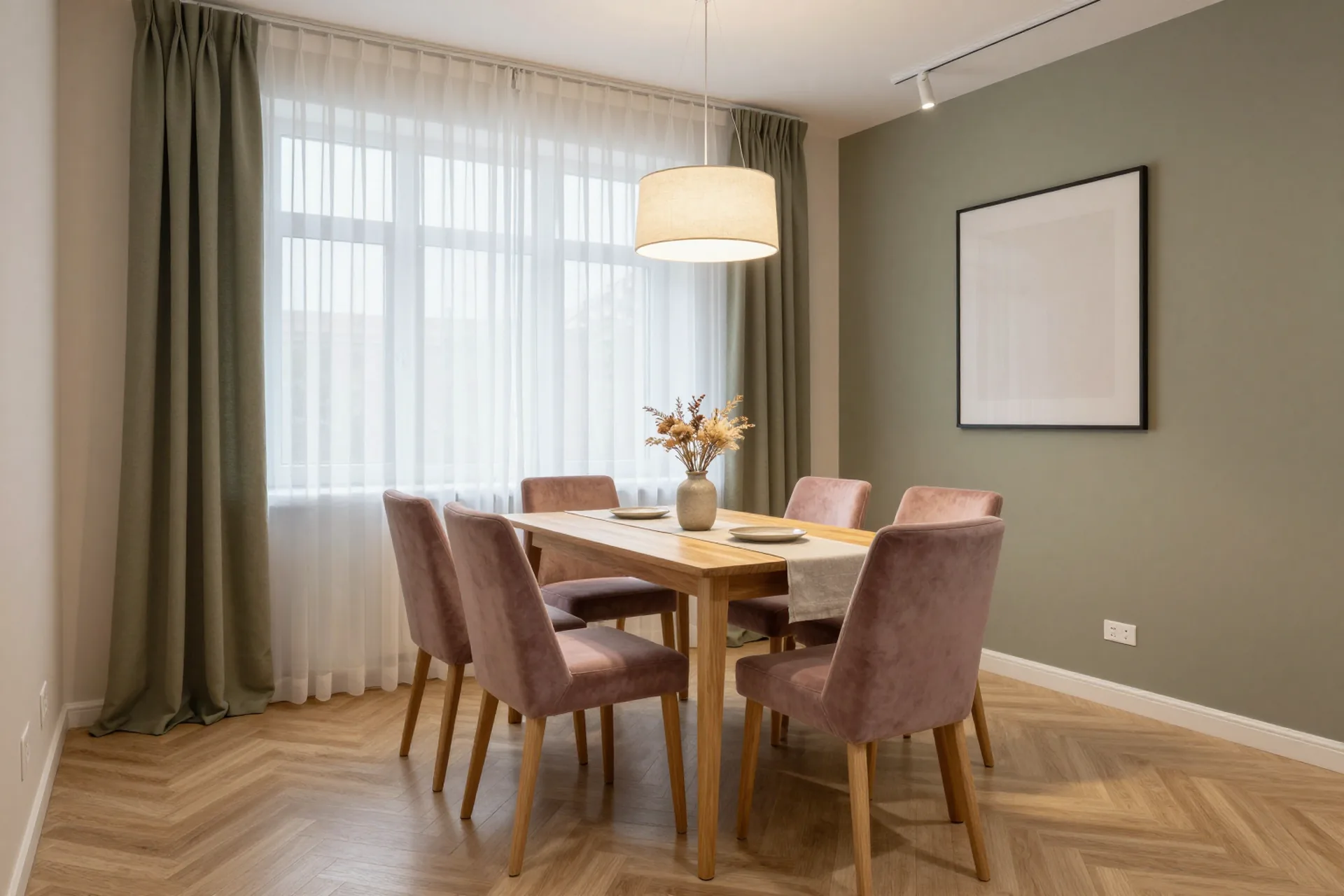
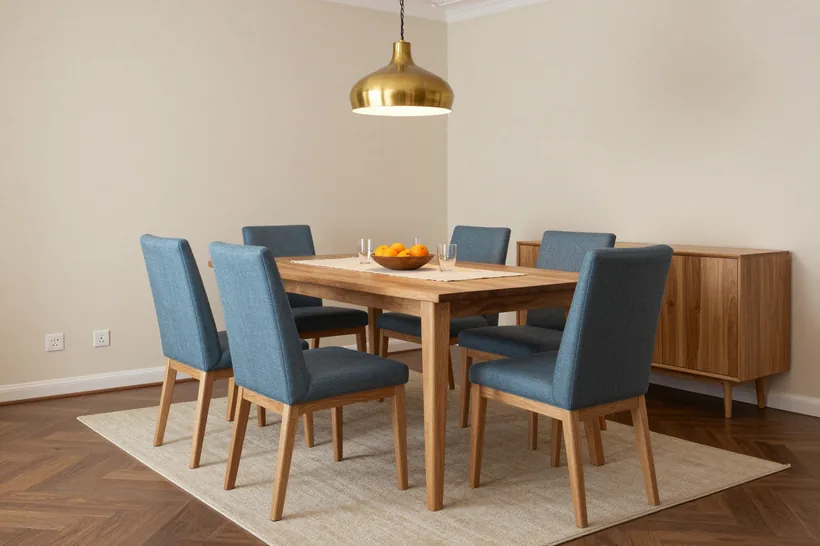
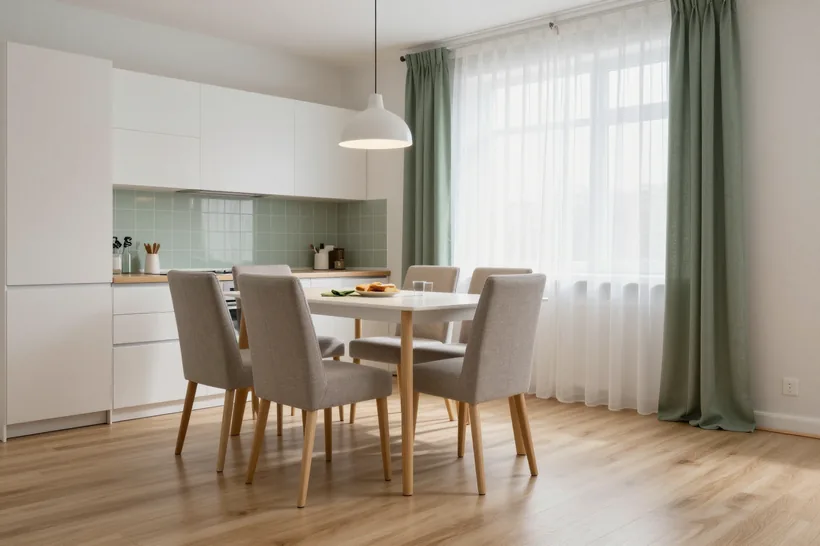
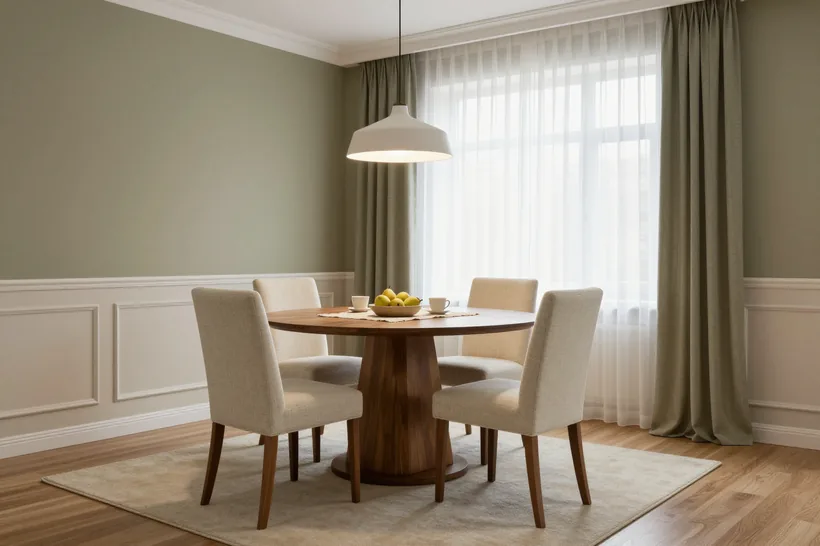
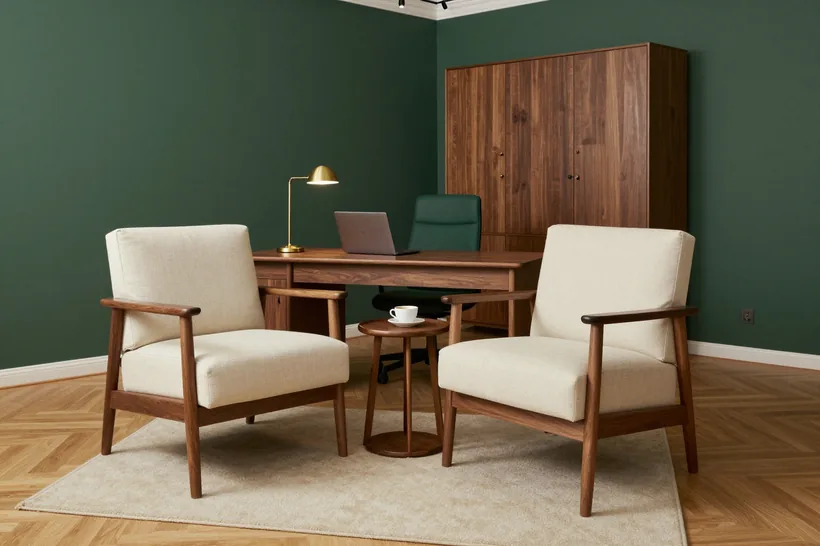
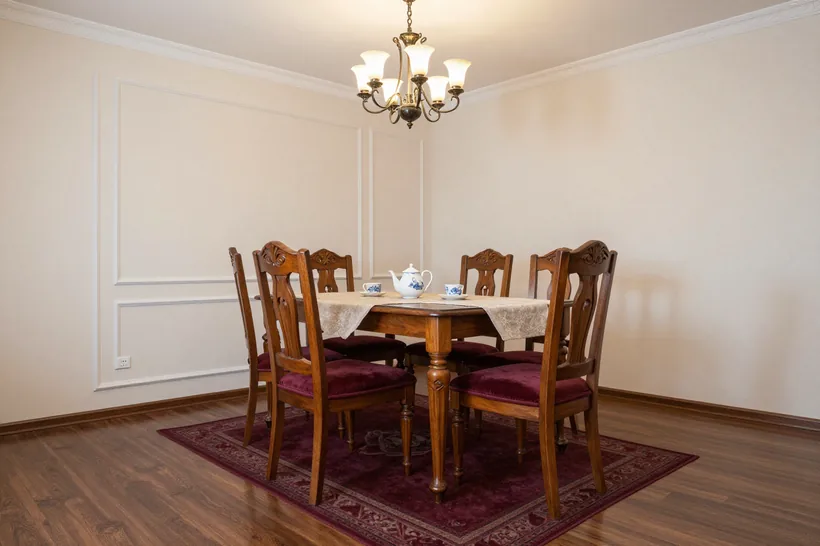
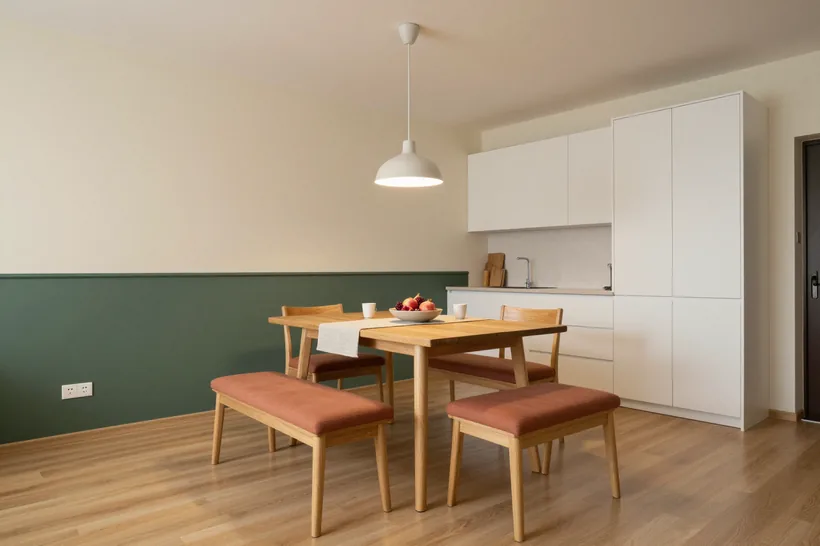
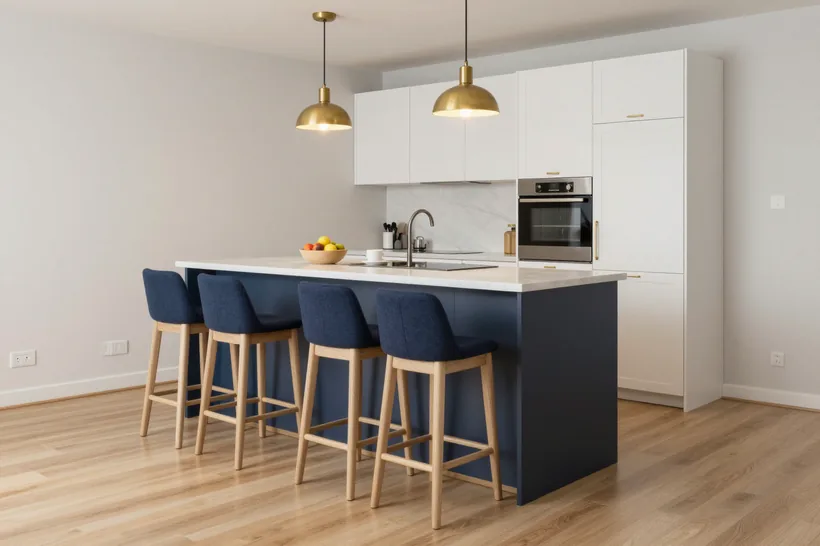
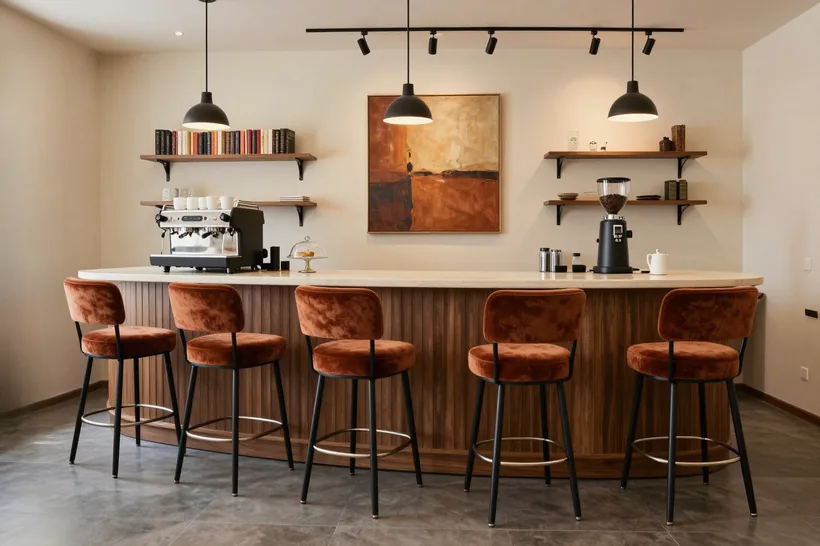
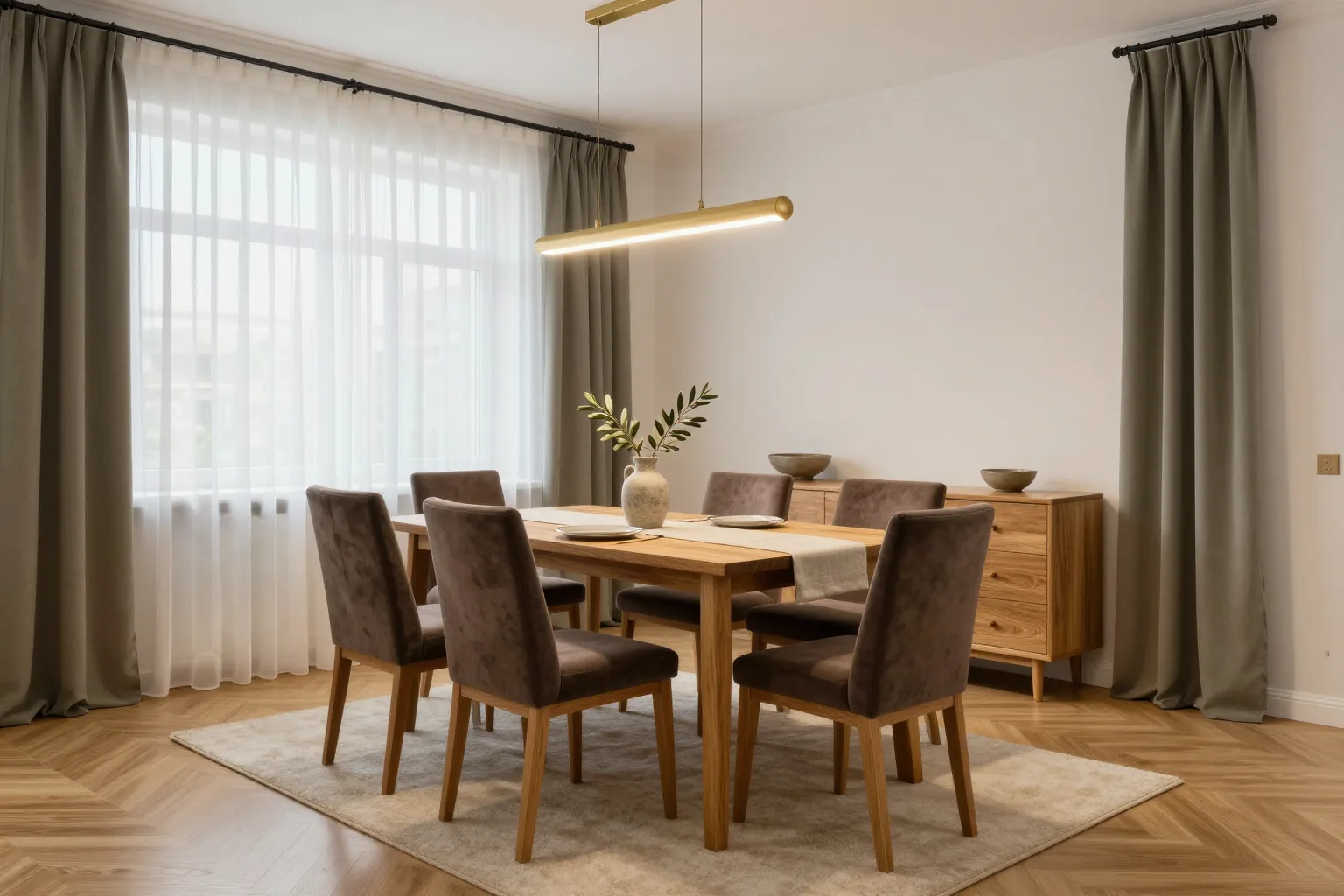
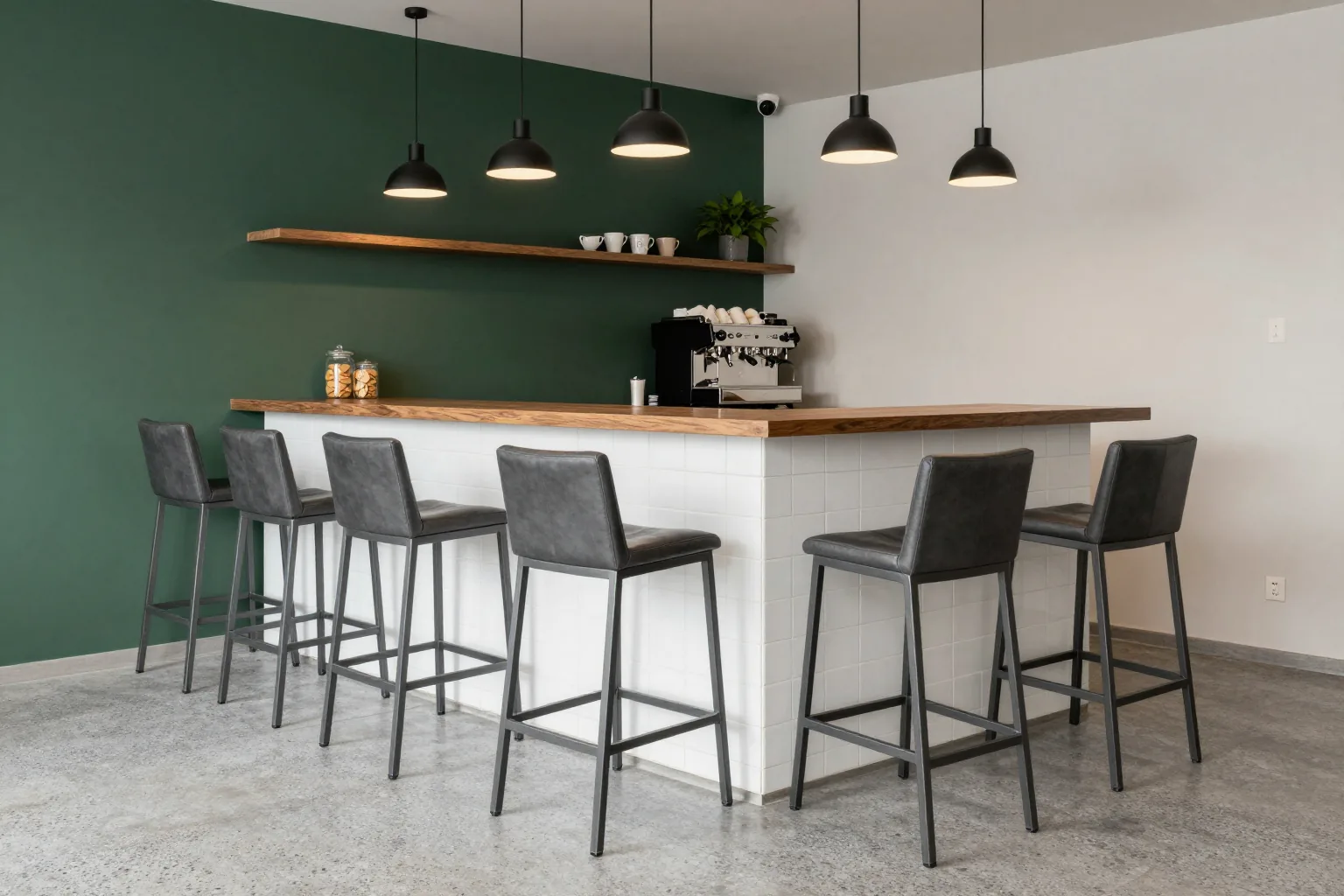
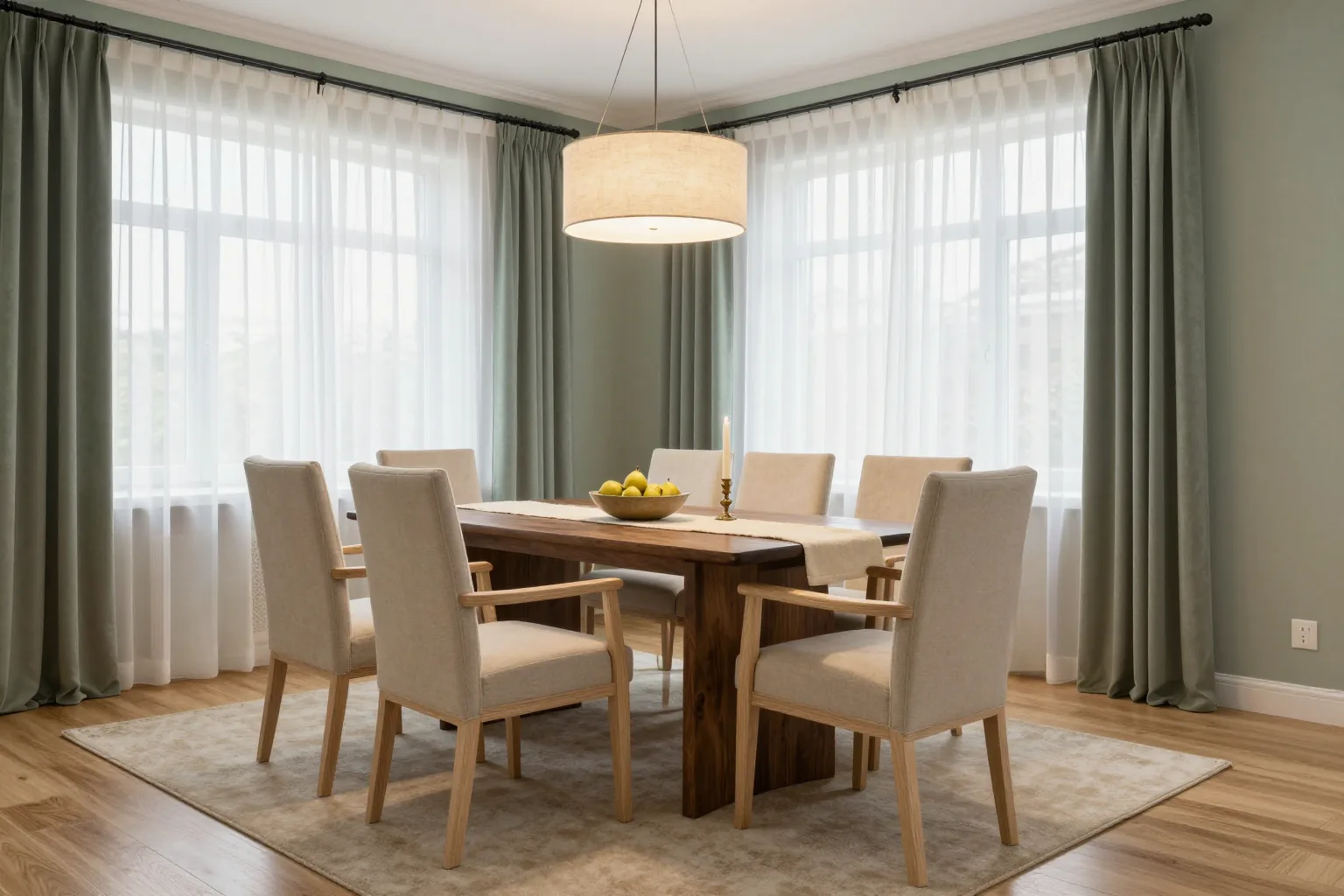
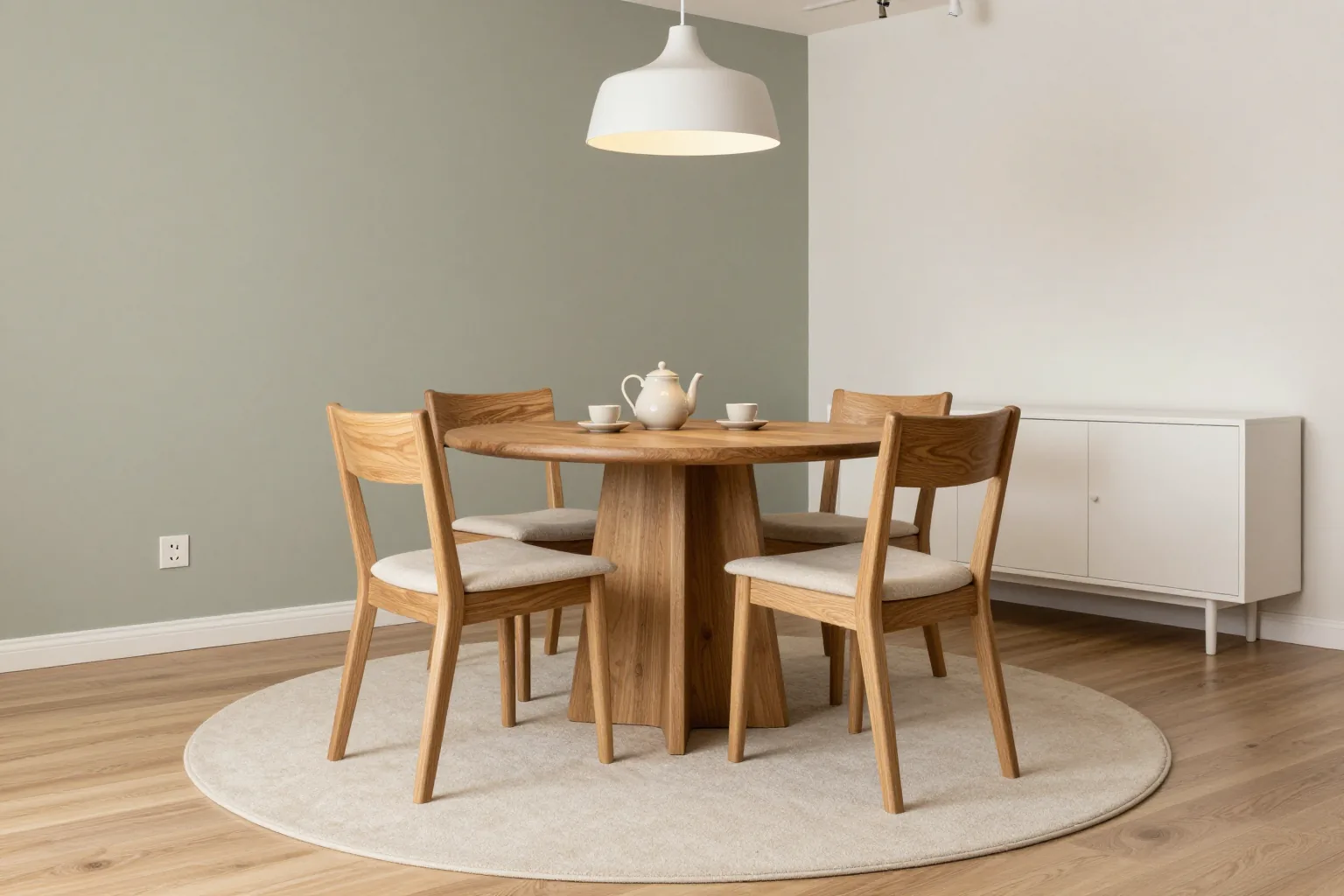
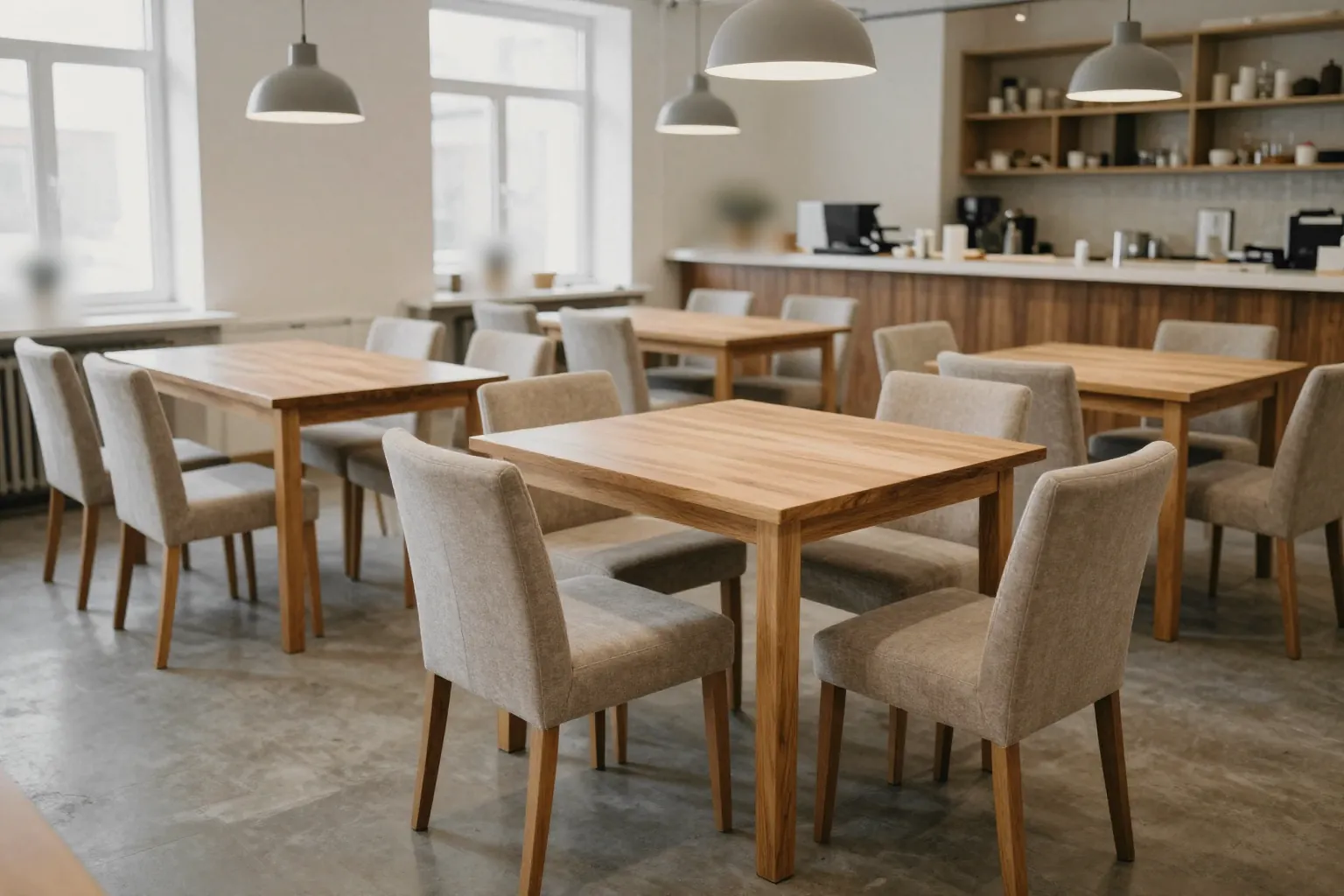
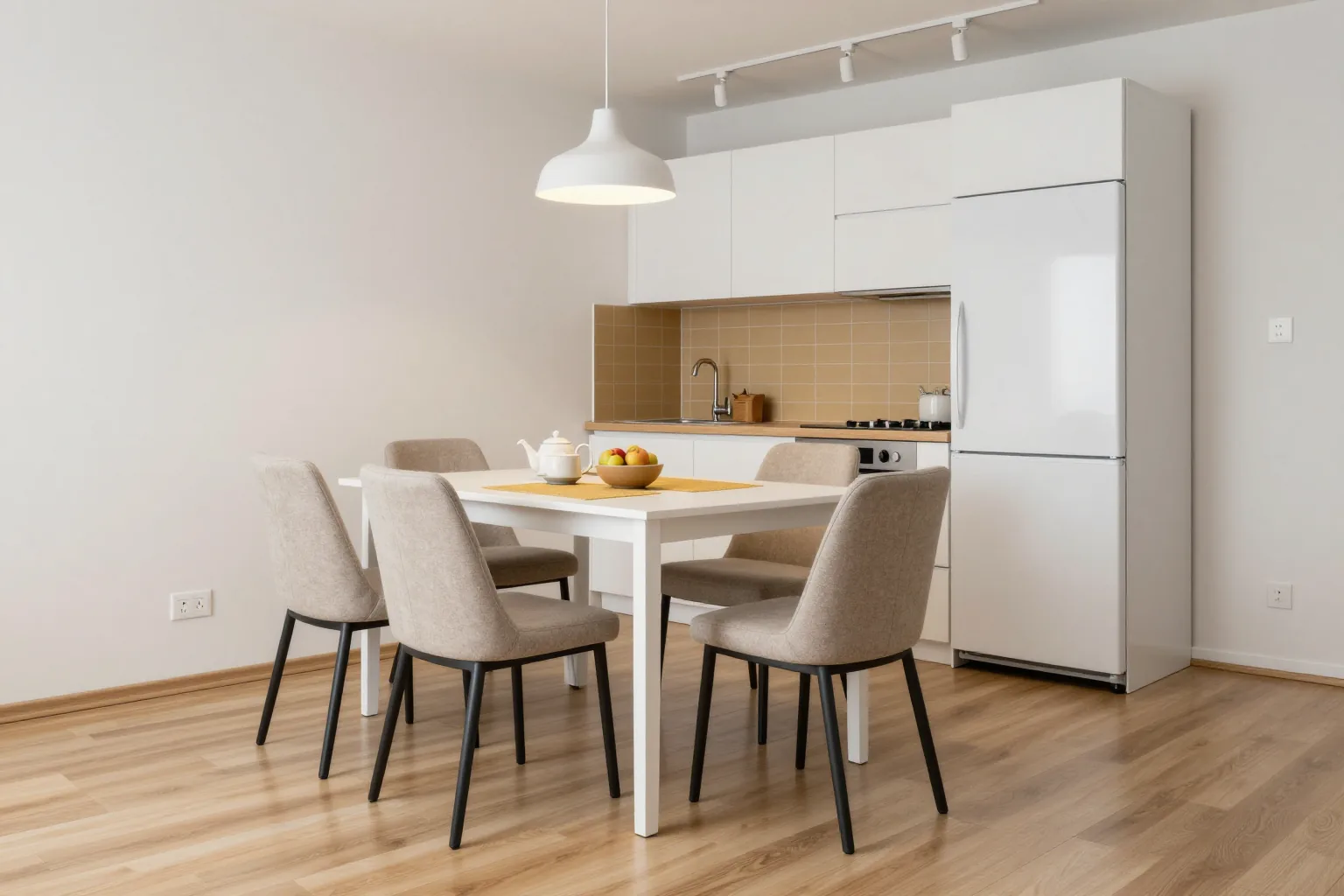
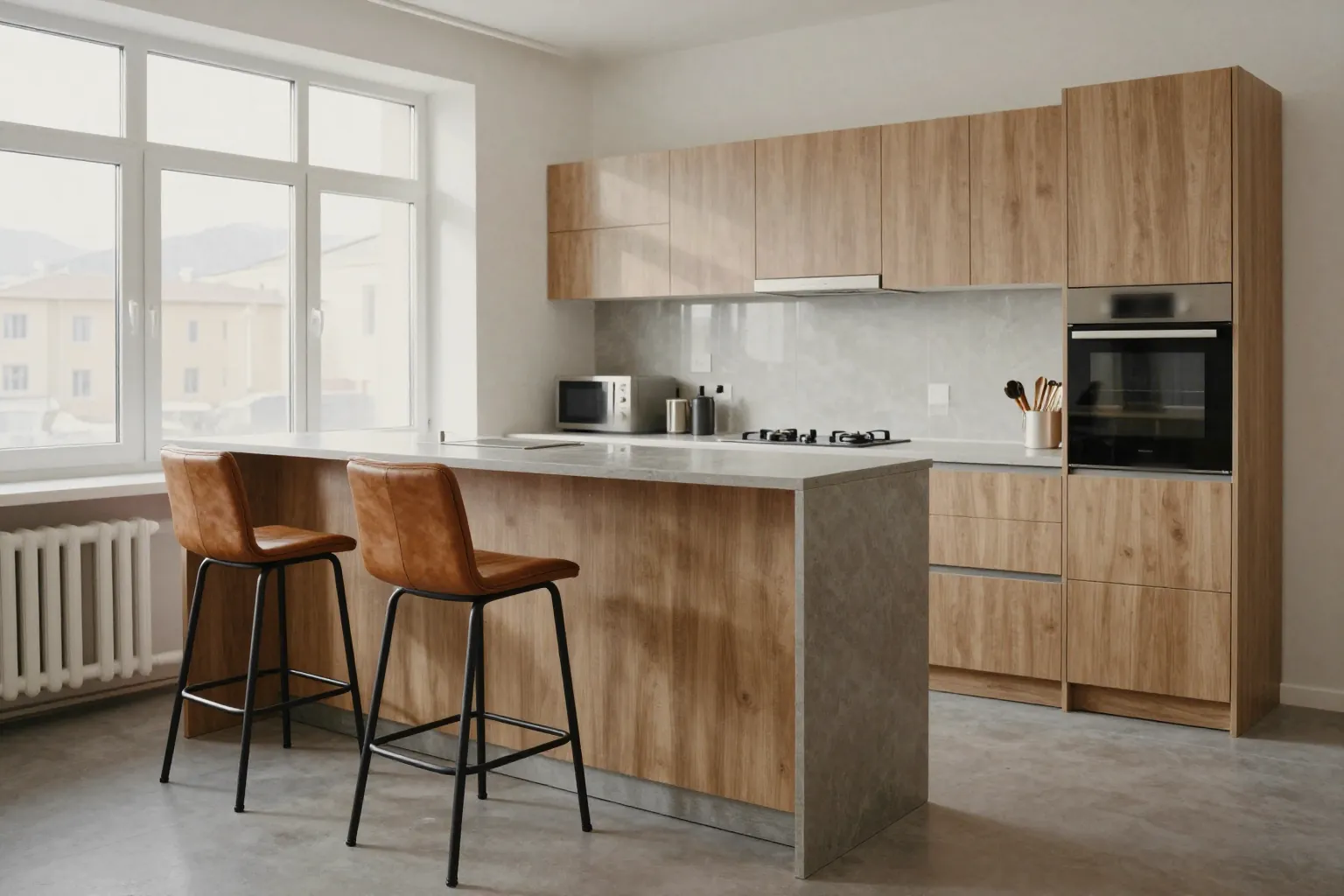
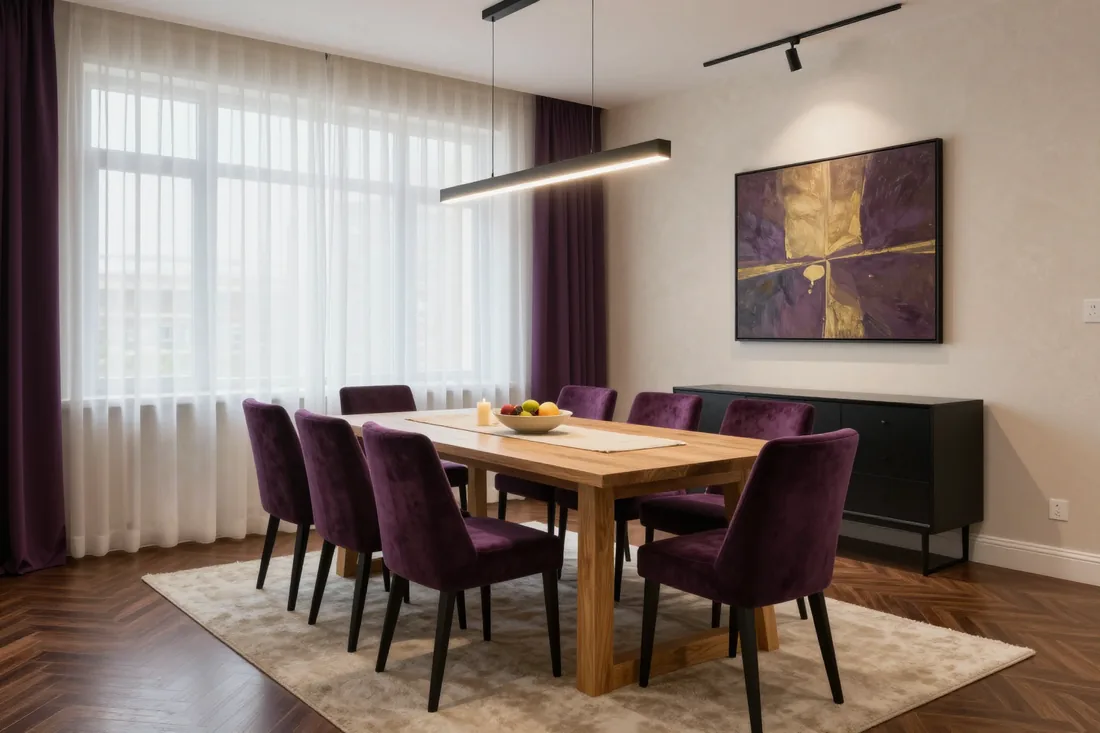
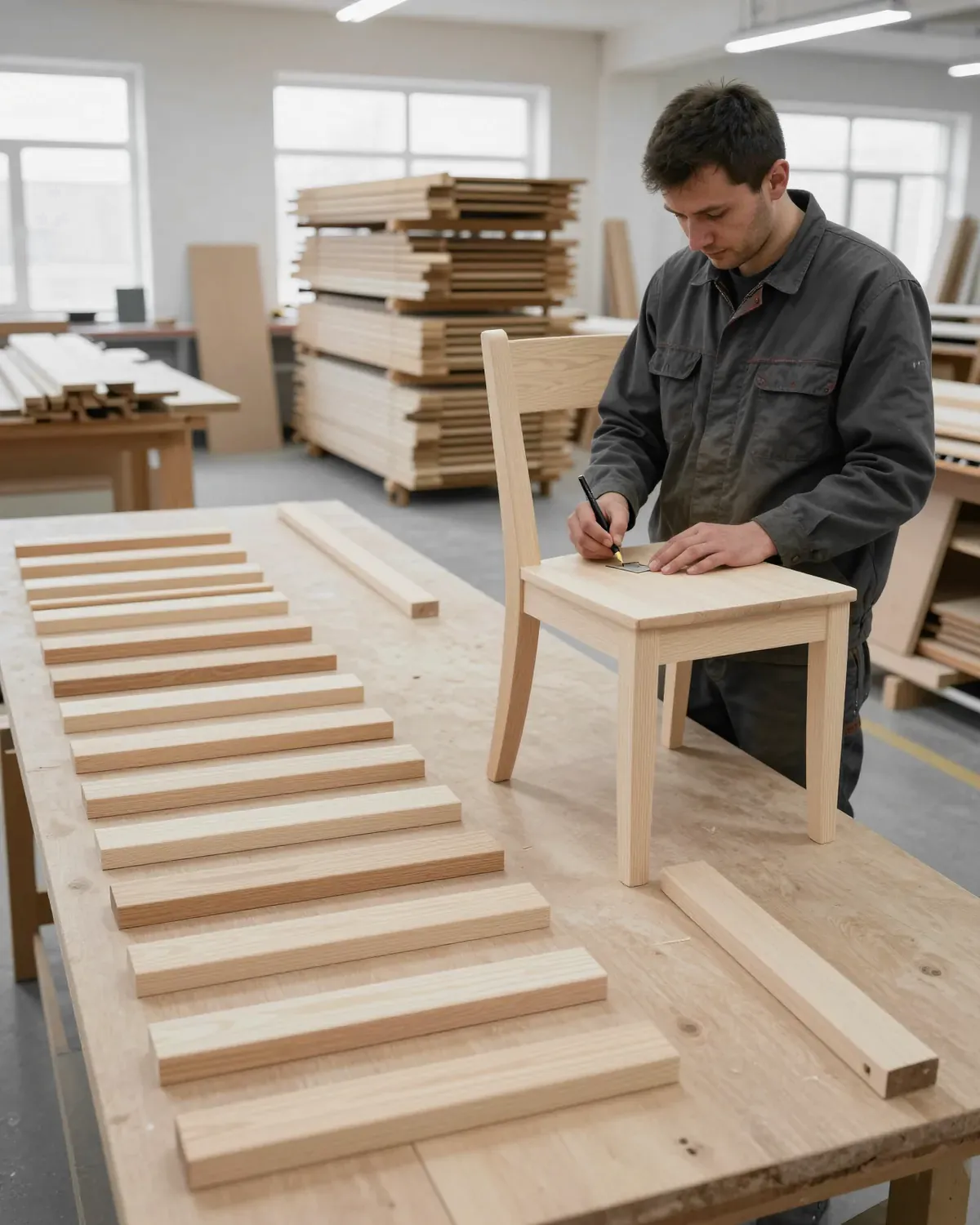
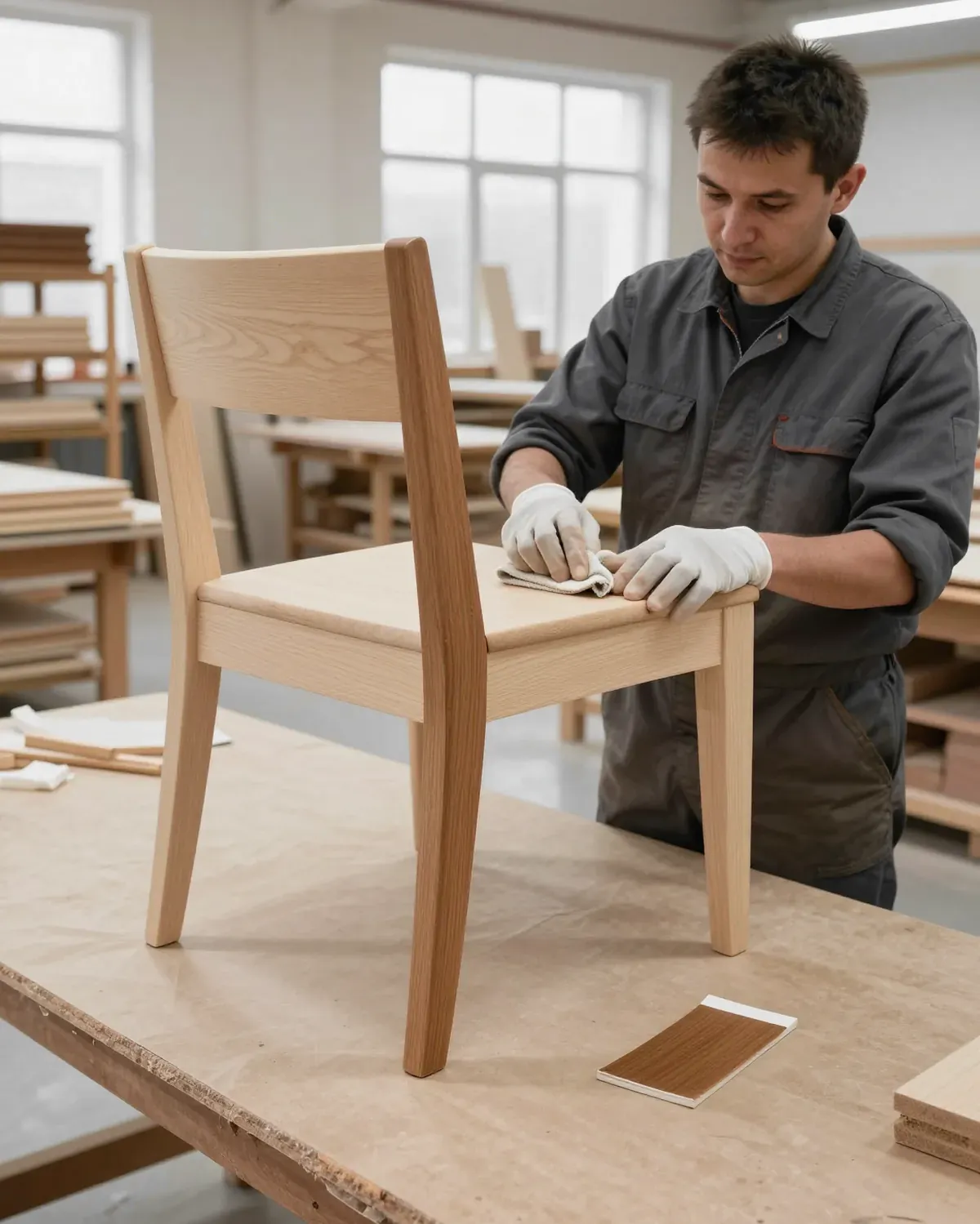
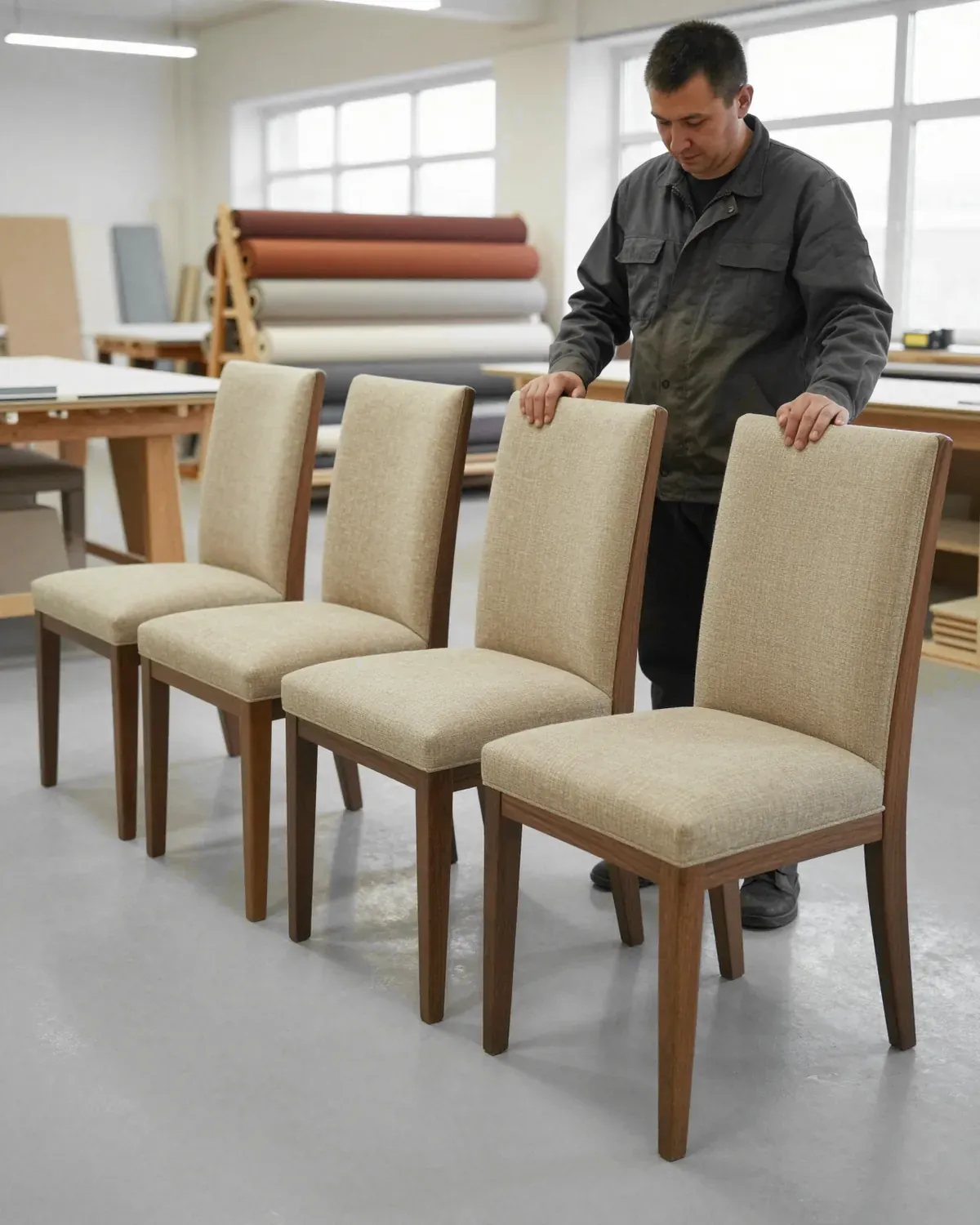
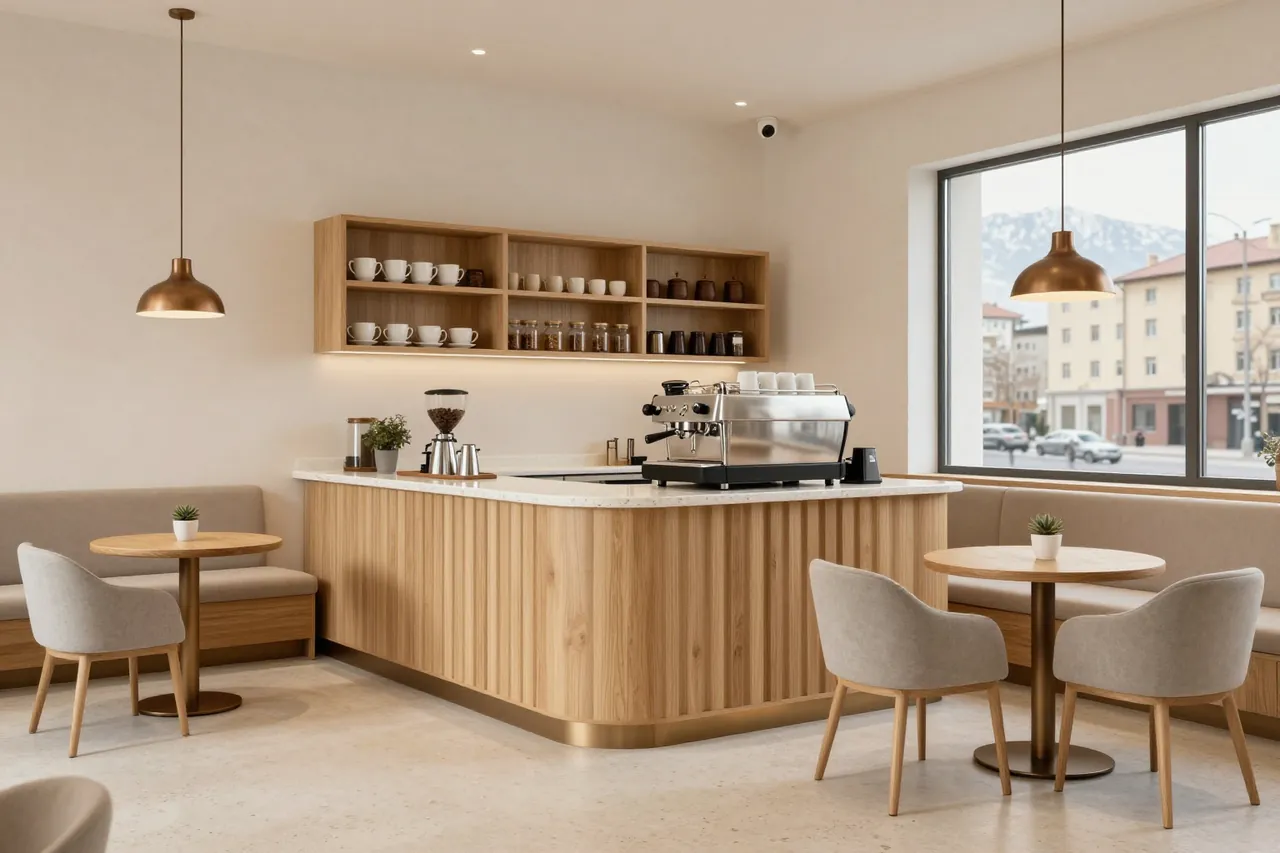
We make custom chairs in Almaty to match your table height, your family's height, and the way you live at the table — with children, guests, or work. The frame is made of solid beech, oak, ash, or metal, the seat is dense PU foam, and the fabric has the right wear resistance. Free measurement, warranty under contract — 24 months.
A comfortable chair starts not with a picture but with a tape measure. First, measure the table people will sit at, and only then design the seat, back, and legs.
Seat height from table height
Table height determines seat height. There should be 25–30 cm between the seat and the bottom edge of the tabletop; otherwise, knees hit the table apron, and elbows rest on the table with shoulders raised. A standard dining table is 75 cm high, and a seat of about 45 cm suits it. But tables can also be 72 or 78 cm. Many tables also have a wide apron that takes up 8–10 cm under the tabletop (this is exactly what people most often forget to measure). That's why we calculate custom chairs from the actual table: top height, tabletop thickness, apron height. If the table hasn't been purchased yet, take its drawing or dimensions from the store listing. A soft seat compresses under weight by 1–2 cm, and this allowance is also included. Table first, chair second.
Depth, width, and backrest
- Seat depth: 38–45 cm, so that 3–5 cm remains between the front edge of the seat and the hollow behind the knee, and the edge doesn't press on blood vessels.
- Seat width: 40–50 cm; for a small armchair with armrests, the width between them should be at least 46 cm, otherwise it will be tight in winter clothing.
- Backrest angle: 5–8° back from vertical, enough to lean back during dinner without sliding forward.
- Backrest height: lumbar support at 20–25 cm above the seat; for taller people, the backrest is raised higher.
Dimensions for a 75 cm high table
Dimensions for a 75 cm high table| Dimension | Standard chair | Small armchair |
|---|
| Seat height | 44–46 cm | 45–47 cm |
|---|
| Seat depth | 40–43 cm | 43–45 cm |
|---|
| Seat width | 42–46 cm | 46–50 cm |
|---|
Dimensions for a 75 cm high table
The figures in the table are a starting point. There should be 25–30 cm between the seat and the tabletop, and all other chair dimensions are adjusted from this gap.
Why some chairs wobble and others don't
A chair wobbles at the joints, not in the legs. A thick leg won't help if its connection to the seat frame is assembled with screws and no glue.
Where a chair's weak point is
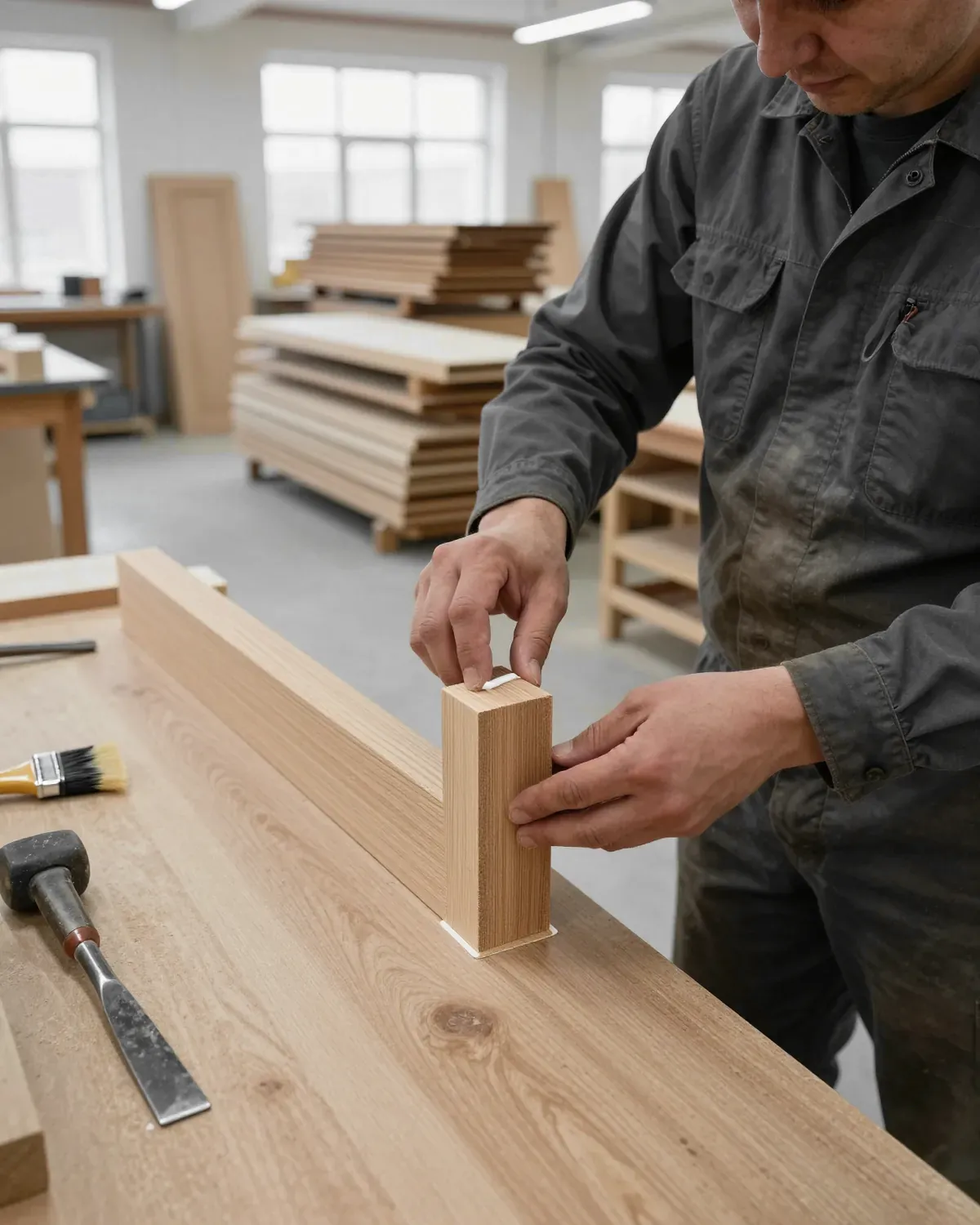
The leg-to-apron joint takes the main load when a person sits sideways, leans back on the backrest, or rocks on two legs. A screw connection enlarges the hole within a few months: first a slight creak appears, then play, then the leg starts to wobble. A mortise-and-tenon joint with glue works differently — the tenon fits tightly into the mortise, the glue bonds the wood over the entire area, and the joint becomes a single piece. Stretchers, the crossbars between the legs at the bottom, take part of the load off this joint. Our custom wooden chairs are made exactly this way, so the frame holds up to 150 kg and doesn't start to wobble after a season. So why are there so many screw-assembled chairs in stores? They are easier to ship in a box and assemble at home. A chair relies on the leg-to-apron joint, and strength is determined by the connection, not the thickness of the legs.
Solid wood or metal
Solid wood or metal| Frame | Strength | Where it fits |
|---|
| Solid beech | dense, takes stain well | dining set matched to the table color |
|---|
| Solid oak | hard, expressive grain | heavy oak table, classic style |
|---|
| Solid ash | light, springy | Scandi, armchairs with bent parts |
|---|
| Metal frame | slim silhouette, large strength margin | loft, kitchen-living room, cafe |
|---|
Dry air and solid wood
Solid wood lives together with air humidity. In Almaty the heating runs in winter, the air in apartments is dry, and in such a room raw wood dries out: gaps appear at the joints, and the glue line can crack. That is why solid wood for the frame is kiln-dried to 8–10 % moisture before cutting, and after assembly the wood barely changes size. A frame made from over-dried or under-dried stock is a common cause of creaking in the first winter. A metal frame does not care about humidity, but it has its own rule: the wooden seat is attached to the metal through soft pads, otherwise you get metal-on-wood creaking. Dry stock is half the strength of a wooden chair.
Custom upholstered chairs and choosing the upholstery
An upholstered seat comes down to two decisions: what to fill it with and what to cover it with. A mistake in either shows within a year — a dip in the seat or a worn corner.
Filler that does not sag
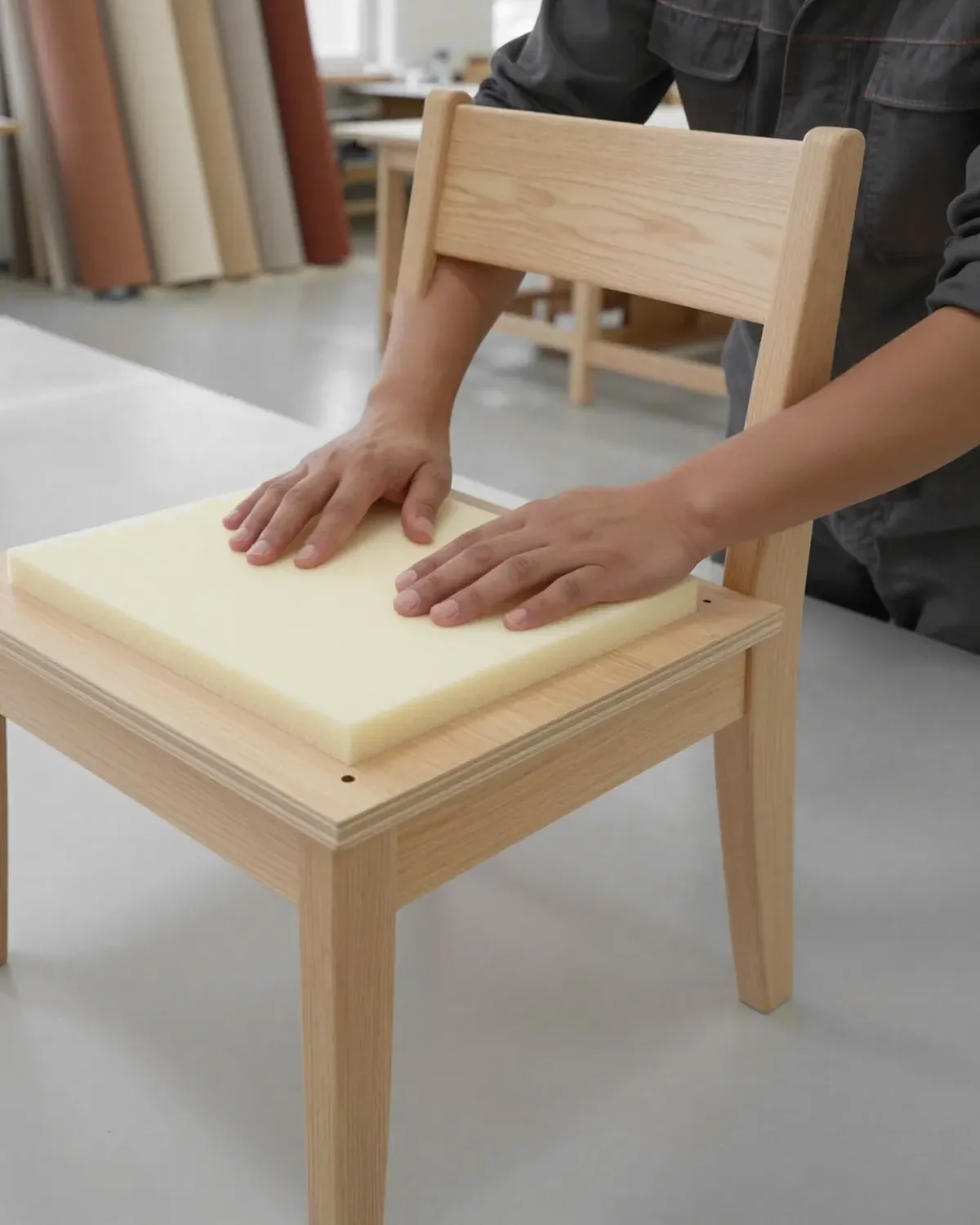
The seat filler is polyurethane foam, or PU foam. Its density is what matters. Low-density furniture foam feels soft in the store, but after six months of daily dinners it compresses under weight and a dip appears in the seat. PU foam with a density of 30–35 kg/m³ holds its shape for years, so that is what we fill seats with. Thickness is chosen for the scenario: in the kitchen the seat is thinner and denser, easier to wipe; in the dining room, where people sit for hours, it is thicker and softer, sometimes with a layer of polyester wadding on top (it softens the first touch). The back is often made softer than the seat. And a seat on a removable base is bolted on, so it can be removed for re-upholstery without taking the frame apart. Filler density matters more than its thickness.
Fabric by number of cycles
Fabric by number of cycles| Wear resistance | Martindale cycles | Where it fits |
|---|
| Low | up to 15 000 | chair at a dressing table |
|---|
| Residential | 20 000–40 000 | dining room, living room |
|---|
| High | from 40 000 | kitchen, kids, a cat |
|---|
| Commercial | from 50 000 | cafe, restaurant |
|---|
Which upholstery for which room
- Faux leather: wipes clean with a damp cloth and does not absorb spills, so it is most often chosen for the kitchen and cafes.
- Coated basketweave: tight weave and a stain-resistant finish, spilled tea is blotted with a napkin before it soaks in.
- Velvet and chenille: soft pile and deep color for the dining room and living room, but they need dry cleaning and gentle care.
- Anti-scratch fabric: no loops for claws to catch on, suitable for a home with a cat or dog.
Which upholstery for which room
Fabric wear resistance is measured by the Martindale test — the number of abrasion cycles before the first signs of wear. For a home with children and pets, choose fabric rated from 40 000 cycles.
Custom-made kitchen chairs for a family with children
A kitchen chair takes more wear than anything else: every day food, spilled juice and rocking back on two legs. That is why it is chosen by how well it washes clean and takes a hit.
Five details for a child-friendly kitchen
- Wipe-clean upholstery: faux leather or fabric rated for 40 000 cycles with a protective finish, so a porridge stain does not stay forever.
- Removable seat: bolted on, so worn upholstery can be replaced on its own without buying a new chair.
- Rounded edges: the corners of the seat and backrest are sanded, so a child does not hit a sharp edge or snag their tights.
- Stable legs: the legs splay slightly outward, so the chair does not tip over when someone fidgets on it.
- Even height: all chairs in a set are the same height, and a child gets a separate seat made higher.
Floor, tiles and legs
In new residential complexes in Almaty the kitchen floor is usually porcelain stoneware or laminate, and the floor suffers from chairs no less than the chairs suffer from children. A bare solid wood leg scratches laminate and clatters on tiles with every movement. A metal frame makes it worse, since a thin leg presses on the floor over a small area. That is why our custom-made kitchen chairs come with glides: felt for laminate and parquet, silicone for tiles, where felt quickly fills with sand. A glide is replaced in a minute, while a floor without one will have to be sanded or replaced. One more small thing: the chairs should slide fully under the kitchen table, so the passage around the table stays clear. A kitchen chair is chosen by how it washes clean and how it behaves on the floor, not by how it looks in the showroom.
A chair for a child at the family table
At a regular table a child sits too low: their elbows end up at countertop level and they eat with their neck stretched. A child's chair solves this with seat height, not with a cushion that keeps sliding off. For a school-age child the seat is raised 5–8 cm above an adult's and a footrest is added so the feet do not dangle in the air. For a toddler, a chair is made with a high seat and a footrest that can later be lowered. Custom wooden chairs for children are built the same way as adult ones, from solid wood with mortise-and-tenon joints and glue, because that is exactly where the most rocking happens. The upholstery is wipe-clean, and the colour and wood tone match the rest of the set, so the chair does not look out of place at the family table. A child's chair is made higher than an adult's and with a footrest, rather than putting a cushion under them.
How many chairs to put at the table
The number of chairs is calculated from the length of the table, not the number of family members. Each person needs about 60 cm of tabletop edge, and more with armrests.
Seats along the length of the table
Seats along the length of the table| Table length | Seats without armrests |
|---|
| 120 cm | 4 |
|---|
| 140–160 cm | 6 |
|---|
| 180–200 cm | 8 |
|---|
| 220–240 cm | 10 |
|---|
Passage behind the backrests
A chair takes up space both at the table and behind itself. To stand up and step out, a chair is pushed back 25–30 cm, so from the table edge to the wall you need 55–70 cm, and even more if people walk behind the backrests. In a tight kitchen, this calculation decides whether small armchairs will fit or if there's only room for chairs without armrests. Armrests add 6–8 cm to the width on each side, and at a 160 cm table you'll get four seats instead of six. Before buying custom chairs, it's worth counting seats with a margin for guests: if four people sit at the table daily and six on holidays, it's wiser to order six chairs in one batch right away. Adding a couple later is risky — solid wood is tinted in batches, and the shade may not match. One person needs about 60 cm of tabletop edge, and behind the chair — 55–70 cm to the wall.
Small armchairs at the head of the table
Small armchairs with armrests are more comfortable for a long dinner: you lean on the armrests when getting up, and your hands rest on them. But along the long side of the table they eat up space, and the armrest bumps into the apron if its height isn't taken into account. That's why a common option is two small armchairs at the ends of the table and regular chairs on the sides. This way the group looks cohesive, the hosts sit more comfortably, and the seating capacity doesn't decrease. The armrest should go under the tabletop by at least half, otherwise the small armchair can't be pushed in and stands in the walkway. The armrest height is checked against the same apron as the seat height. Small armchairs are placed at the ends of the table, and armrests are calculated based on the apron height.
Custom chair making to match the table and room
A chair almost never stands alone; it works as a pair with the table. That's why the wood tone, leg shape, and upholstery are coordinated so the group reads as a single piece.
Wood tone by samples
The wood tone is approved on a sample, not from a photo on a screen. The same walnut looks warm by the window, but under a cool lamp in the evening — almost gray. That's why the craftsman brings stain samples to the measurement and applies them right to the tabletop in your lighting, both during the day and with the chandelier on. Beech solid wood takes tinting well and is suitable when chairs need to match an already purchased table. Oak and ash with a vivid grain are tinted more carefully; the grain pattern should match in character. And one more thing: custom chair making together with the table in one project almost always gives a better result than matching chairs to a table bought a year ago (the lacquer on an old table has time to darken). The wood tone is chosen by sample in your lighting, not from a picture.
Shape to match the room's style
- Classic: shaped back, turned legs, soft seat in patterned fabric, and walnut-tone tinting with patina.
- Scandi: light beech or ash, rounded back, fabric seat in a calm color, light silhouette.
- Loft: black metal frame, solid wood or faux leather seat, exposed fasteners as part of the look.
- Modern style: one-piece wrap-around back, thin legs, solid upholstery in the color of curtains or sofa.
Upholstery in the color of the room
Upholstery ties chairs to the rest of the room. The calmest move is to repeat the color of the curtains, sofa or rug, so the dining set looks like part of the interior rather than a separate purchase. If the table and kitchen are already bright, choose neutral upholstery, sandy or grey, so the chairs don't clash with the fronts. And if the table is understated, the chairs can become the accent — terracotta, deep blue, graphite. It's best to look at fabric samples next to a wood sample, because warm walnut and cool grey velvet look different together than they do on their own. The fabric on the seat and backrest can differ: the backrest is covered in a decorative fabric, while the seat gets a more durable one. Choose upholstery next to a wood sample and the room's textiles, not from a catalog.
Chairs from the manufacturer or a chair from a store
A mass-produced chair is made for the average buyer and the average table. A custom chair is made for a specific table, people and floor, and the difference shows after a year, not on the day of purchase.
How a custom chair differs from a mass-produced one
How a custom chair differs from a mass-produced one| What we compare | Mass-produced chair | Custom chair |
|---|
| Height | one for all tables | matched to your table |
|---|
| Joints | often screws, assembled at home | mortise and glue, assembled in the workshop |
|---|
| Upholstery | from the store's collection | from 60+ fabrics, by number of cycles |
|---|
| Frame color | from 2–3 options | tinted to match the table |
|---|
| Repair | upholstery often not removable | removable seat, reupholstery |
|---|
What makes up the price
- Frame: solid oak costs more than beech and metal, while carving and bent parts add handwork.
- Upholstery: genuine leather and velvet cost more than matting and faux leather, and fabric is calculated by the meter per set.
- Construction: armrests, a high backrest and a soft backrest add material and upholsterer's time.
- Quantity: a set from a single batch works out cheaper than adding chairs one at a time; guidelines for each type are in the price list on this page.
How to extend a chair's life
A solid wood chair lasts for decades if you look after it a little. Once a year, check the fasteners under the seat and tighten them — five minutes of work. Wipe wooden parts with a damp cloth and then a dry one, without abrasive products. Wash faux leather with soapy water, vacuum fabric and blot up stains right away. And when the upholstery wears through, don't throw the frame away: custom chair production is designed for reupholstery from the start, the seat is removed and covered in new fabric. That's why a solid wood chair pays for itself over years, not a season. A solid wood frame outlasts several upholsteries, and the chair is refreshed by reupholstery rather than replacement.
Chairs in brief
What to remember before ordering
- Dimensions: measure the table first, leave 25–30 cm between the seat and the tabletop, seat depth 38–45 cm.
- Frame: strength is decided by the leg–apron joint with a tenon and glue, and the solid wood must be dried to 8–10 %.
- Seat: foam with a density of 30–35 kg/m³ does not sag, and fabric for the kitchen should be rated from 40 000 Martindale cycles.
- Space: a person needs about 60 cm of table edge and 55–70 cm behind the backrest to the wall.
- Set: chairs are ordered in one batch together with the table, and the wood tone is chosen from a sample in your own light.