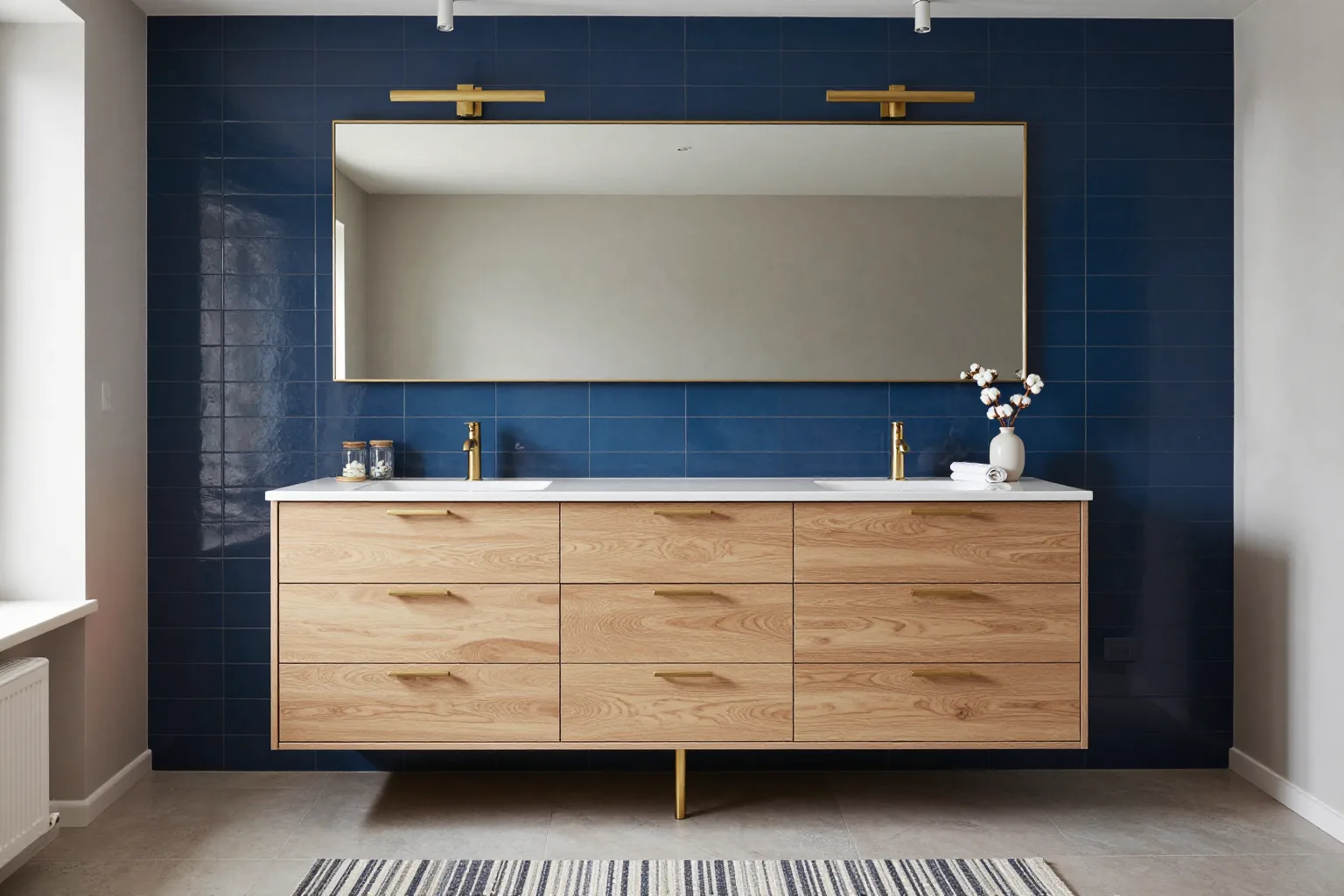
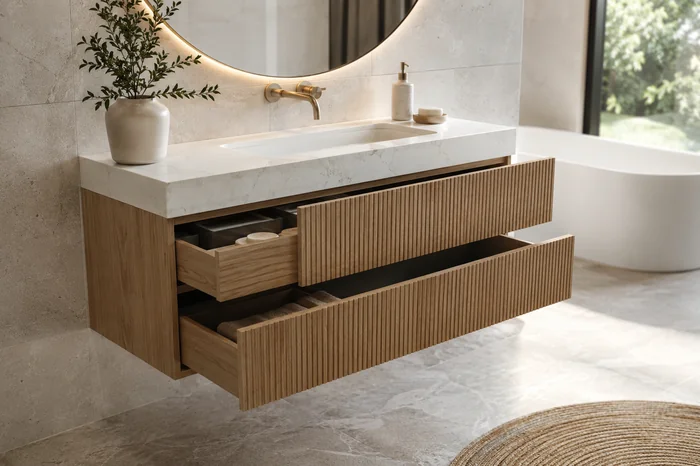
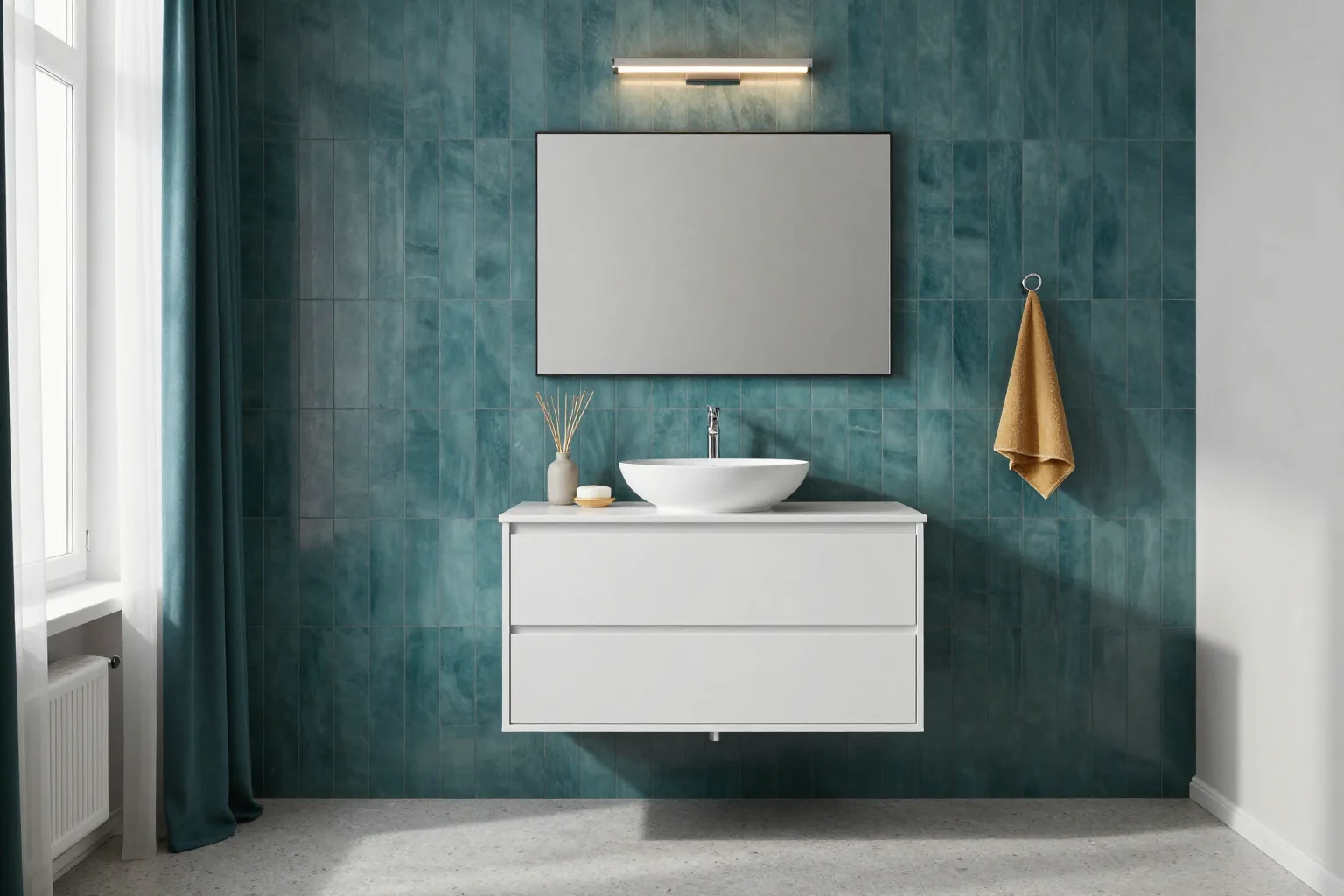
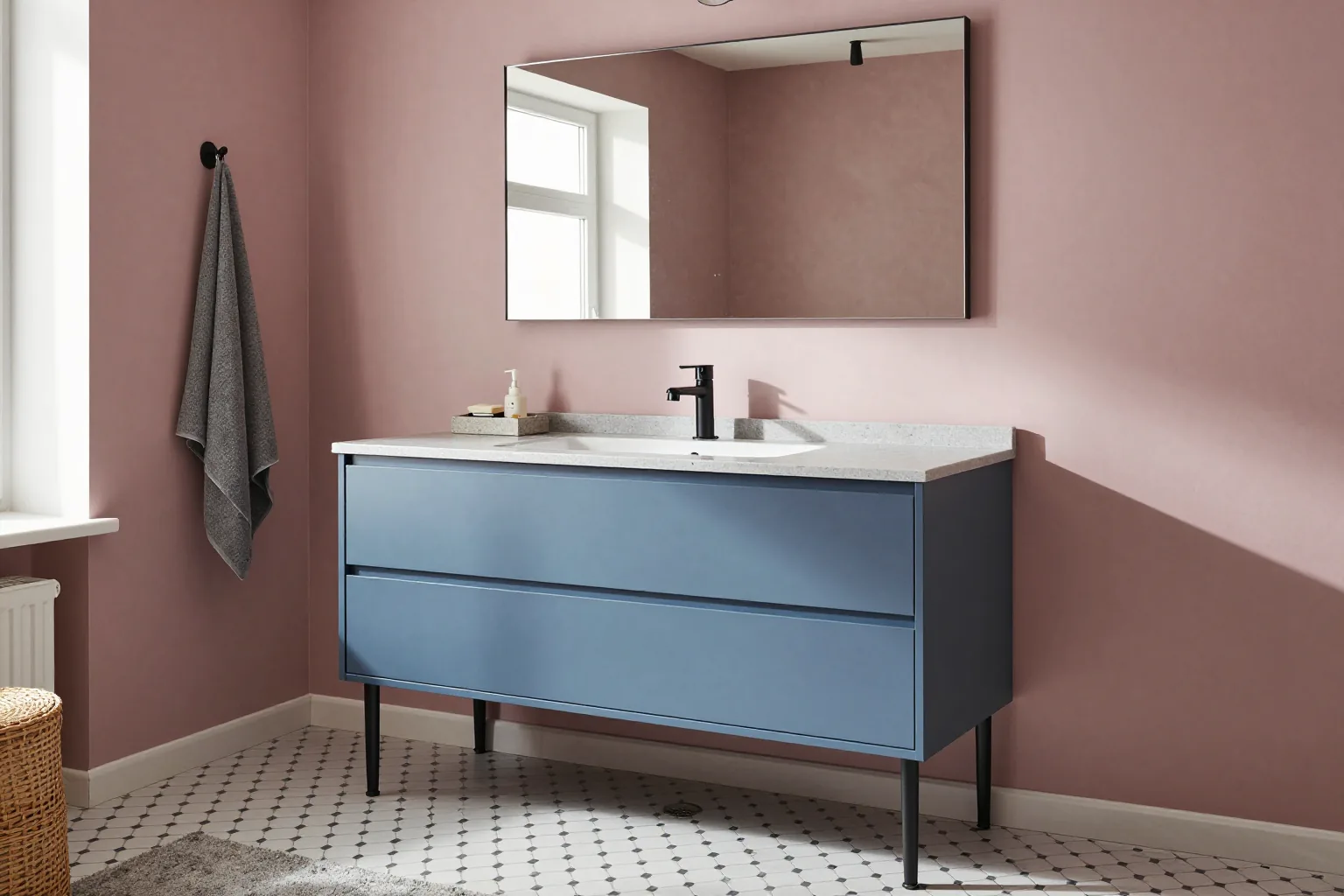
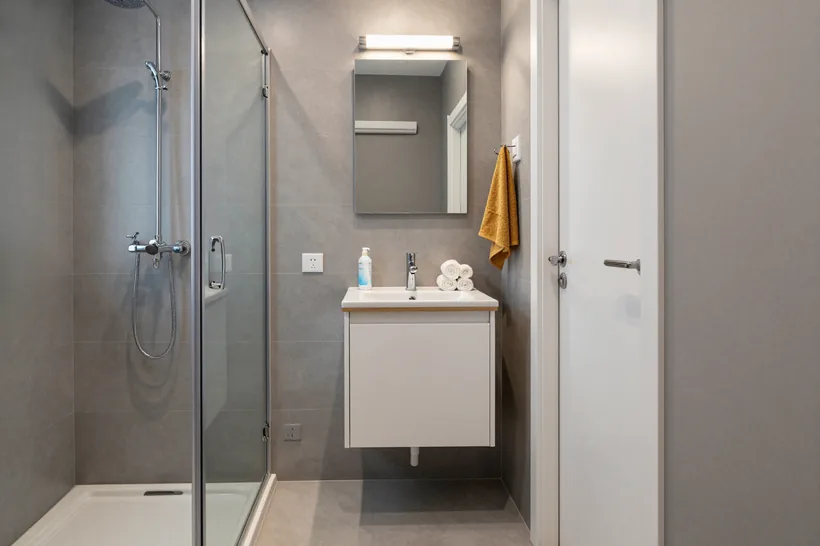
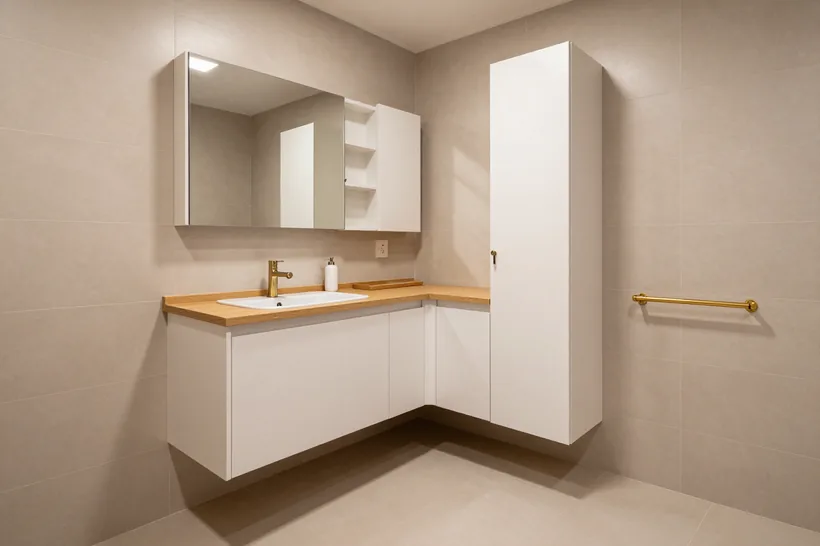
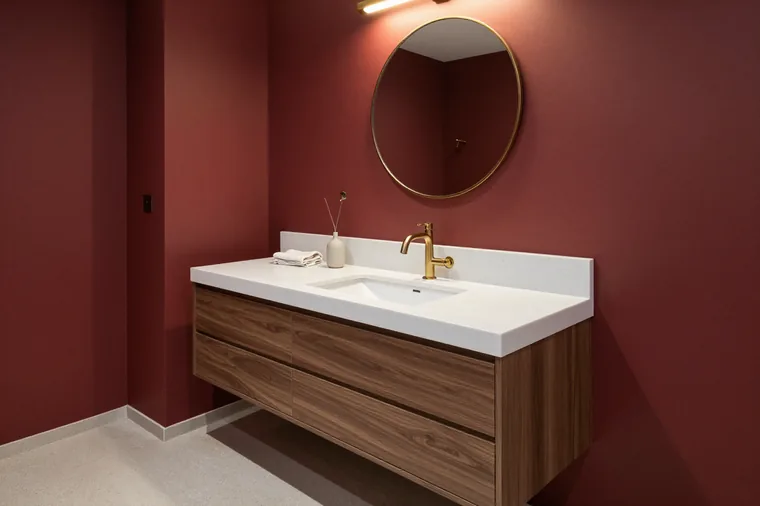
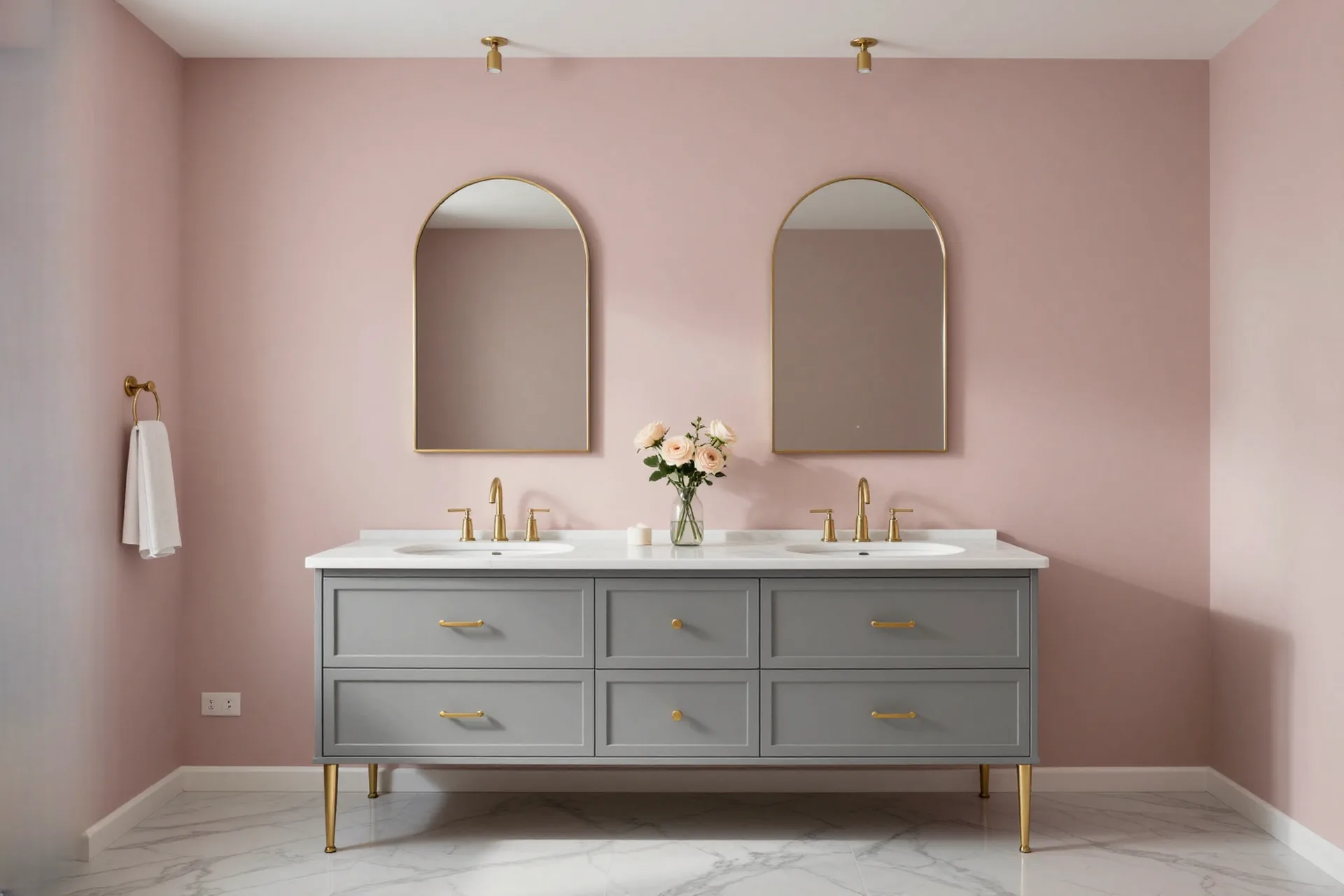
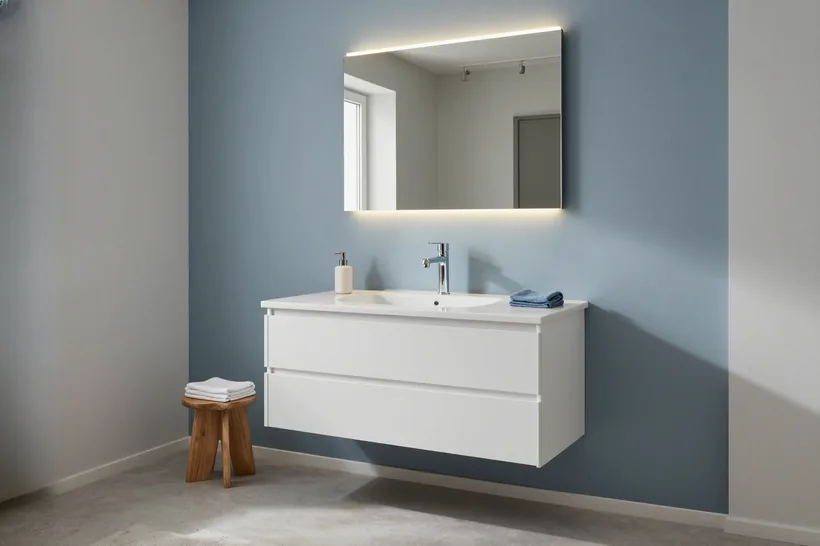
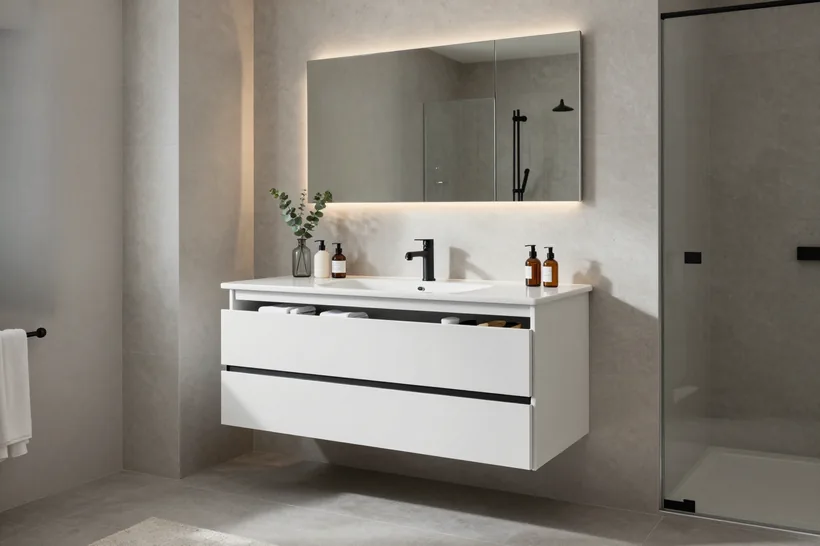
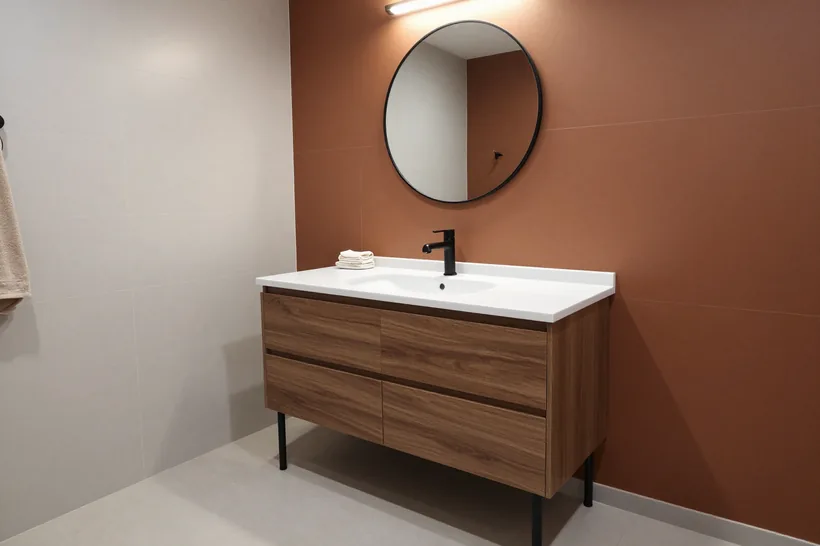
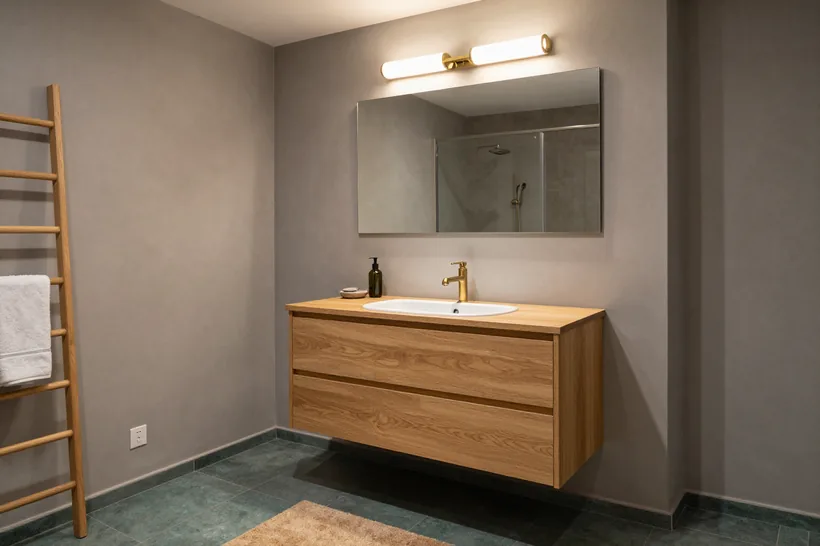
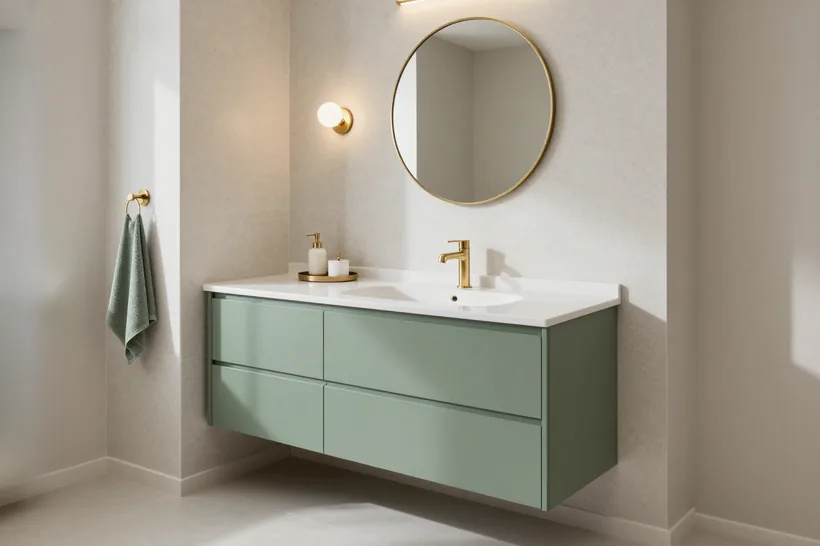
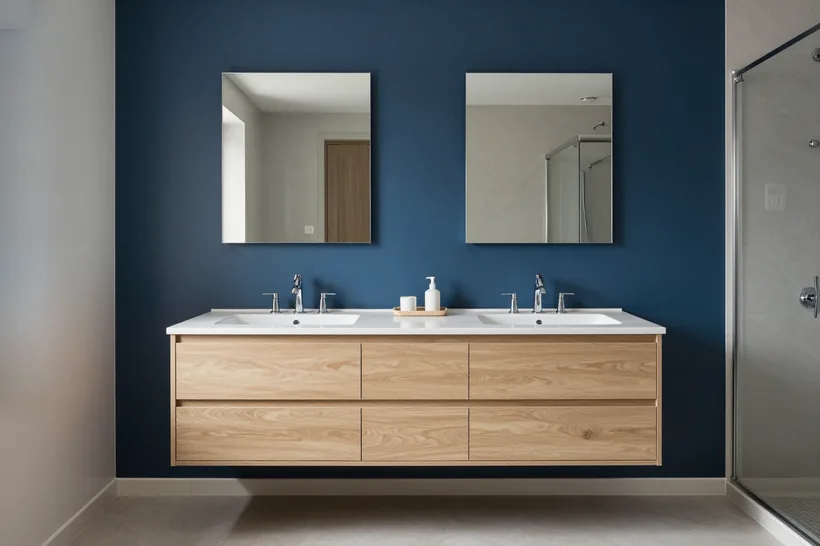
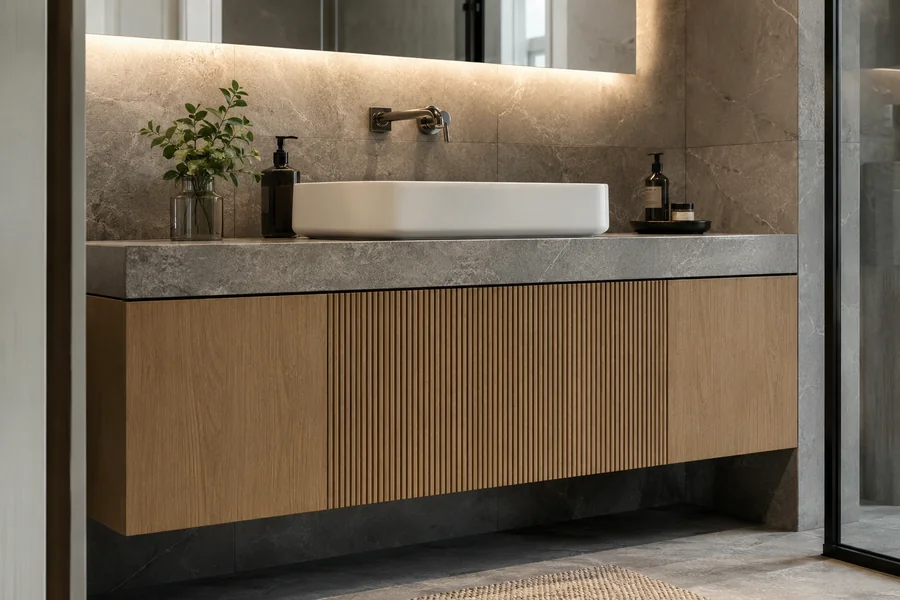
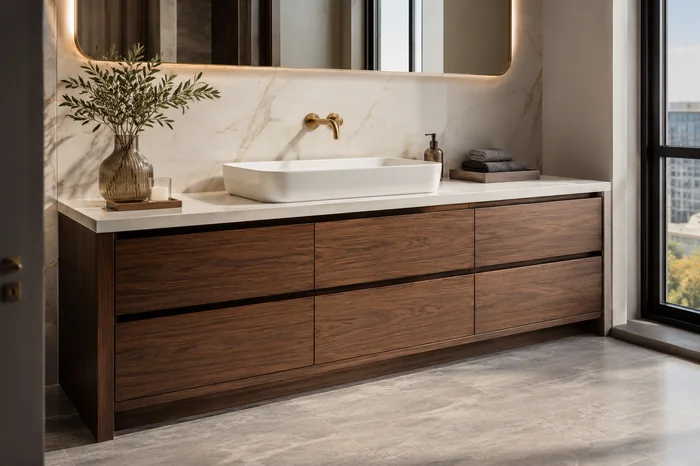
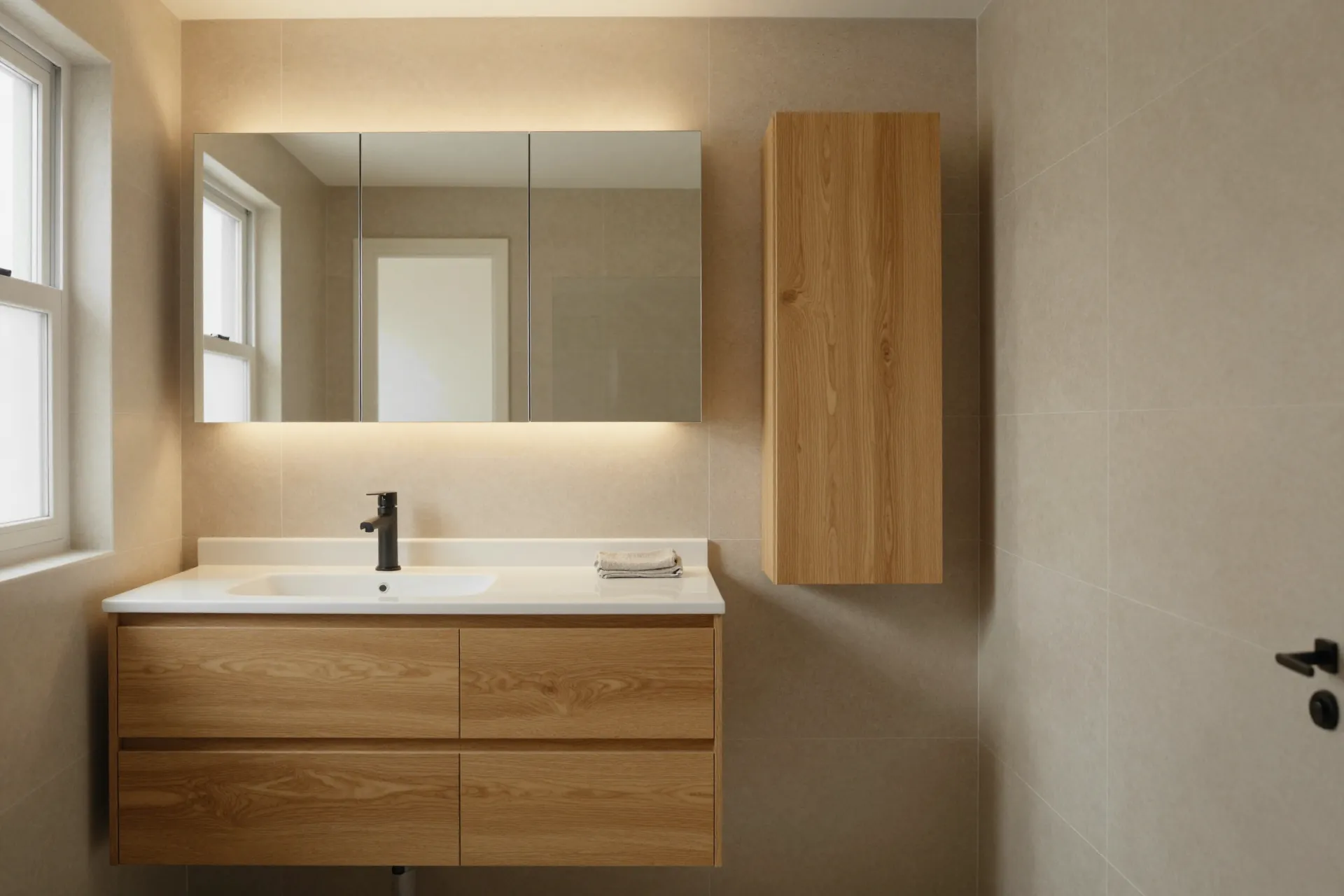
MEBLIX makes made-to-measure bathroom vanity units in its own 600 m² workshop in Almaty, fitted to out-of-square walls so no gaps are left. The measuring visit and 3D design are free and take 1–2 days, the lead time depends on the material and is listed in the price table on this page, our own crews do the installation, and every vanity comes with a 24-month warranty under the contract.
In a bathroom the carcass lives in constant humidity, so the material and the way the edges are sealed matter more than how the front looks. Here is what we build the carcass from and why.
The boards we use for the carcass
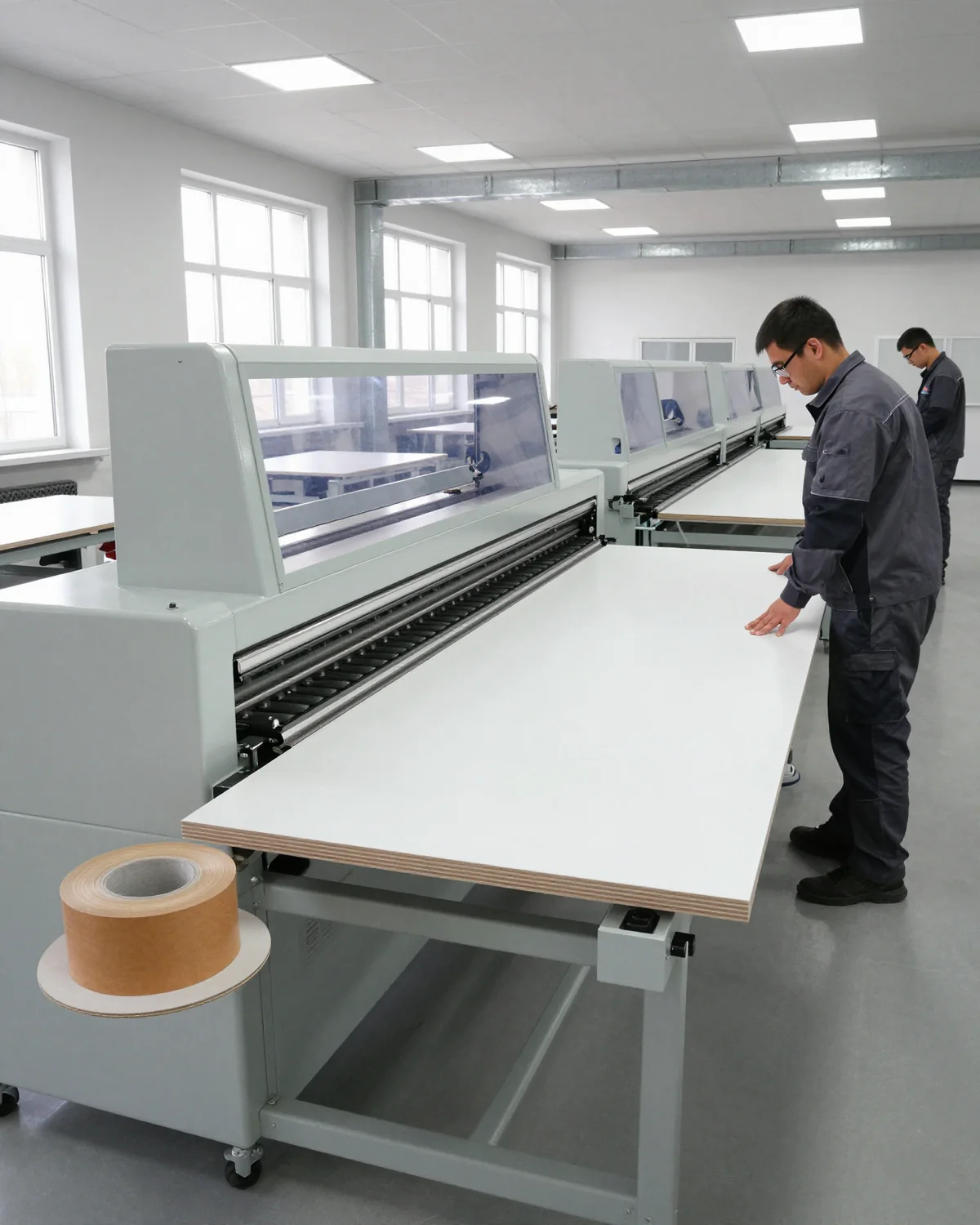
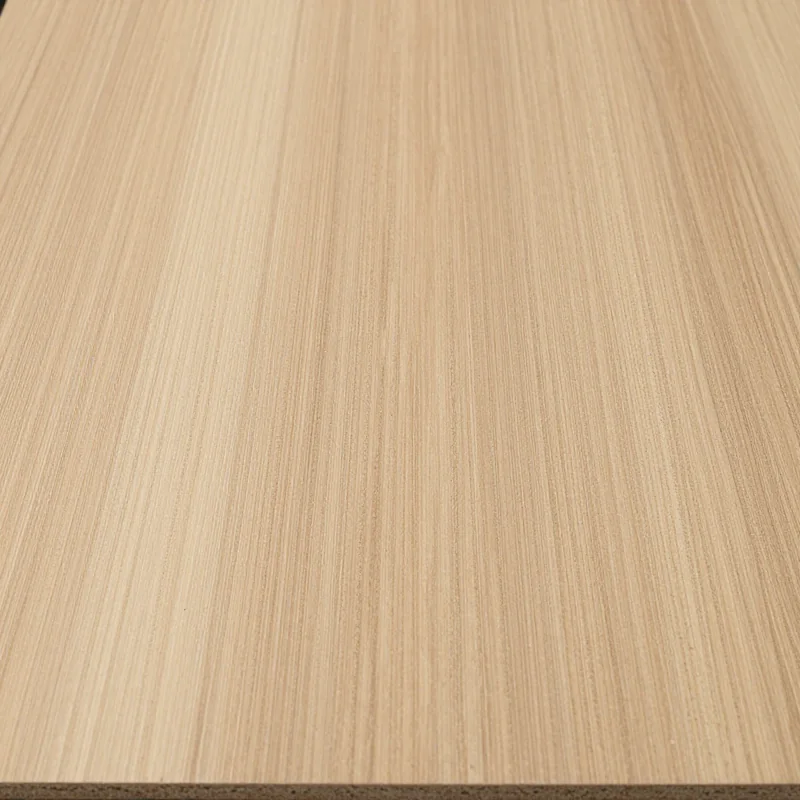
For bathroom carcasses we use moisture-resistant Egger and Kronospan chipboard, and we make the fronts from foil-wrapped MDF or MDF prepared for enamel. This board is denser and carries a special impregnation, so it absorbs moisture from the air more slowly than ordinary furniture board. We apply the edging in our own workshop on the same equipment we cut on, so each edge is sealed along its full length with no gaps or chips. Moisture resistance only works together with a sealed edge — an open cut soaks up water faster than the board itself — which is why we never outsource edge-banding.
Carcass and front materials compared
| Material | Where we use it | How it copes with damp |
|---|
| Egger / Kronospan chipboard | carcass, shelves, side panels | resists moisture when the edges are sealed |
|---|
| Foil-wrapped MDF | fronts | the foil protects against splashes |
|---|
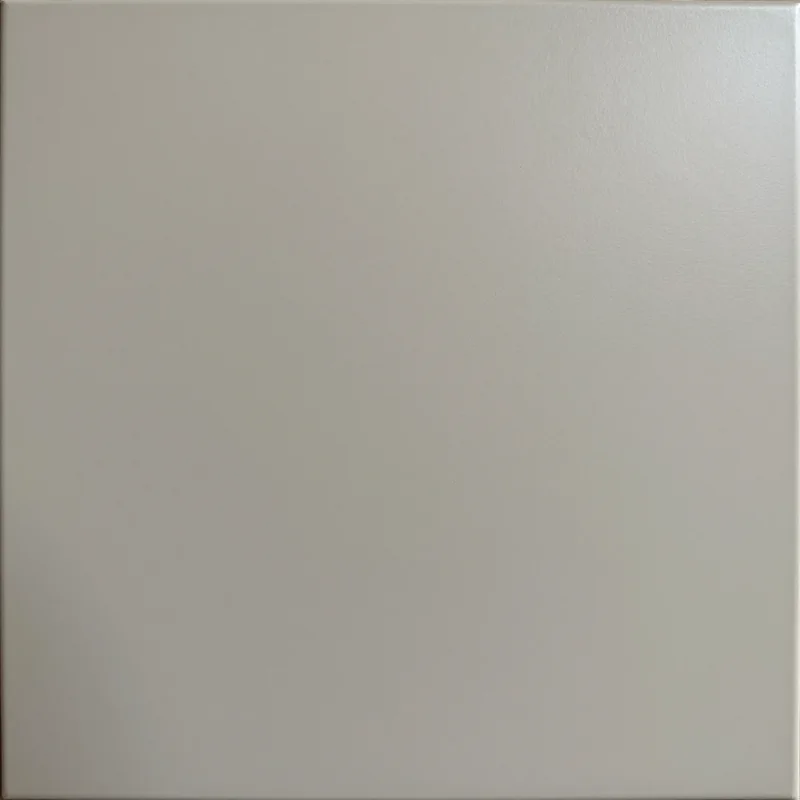
| MDF with enamel | fronts, worktop | enamel is washable and handles steam |
|---|
| Solid wood | individual details | needs care and stable humidity |
|---|
Hardware that won't swell or rust
- Blum hinges: fitted to every hinged front; the soft-close mechanism carries the weight of the door and doesn't work loose with frequent use.
- Blum runners: used on the drawers, full-extension and soft-closing, so a drawer never slams into the carcass.
- 25-year manufacturer's warranty: applies to Blum hardware only; other items have their own terms.
How we fit a vanity to the room and to crooked walls
An off-the-shelf unit rarely fits a bathroom without gaps, because walls and corners are almost never true. This is how we deal with that at the measuring stage and in the design.
Why the measuring visit and 3D design come first
The measuring visit and the 3D design are free and take 1–2 days, and nothing goes into production before them. On site our technologist measures the room at three levels — by the floor, at mid-height and just below the ceiling — because walls are often several centimetres out of plumb. The 3D design shows how the vanity will sit between the walls, where the pipes will run and whether you will still be able to reach the stopcocks. If a socket or trap needs moving, we build that into the design before cutting, not after installation.
Fitting to crooked walls without gaps
Where the walls lean, we design compensating gaps and a filler panel, so the carcass sits tight with no visible gaps. If a wall is 2–3 cm out of plumb, we make the side panel tapered or add a decorative strip to cover the joint. In a narrow bathroom where the opposite wall is less than a metre away, we reduce the depth of the carcass and move the bowl towards the centre so there is still room to walk past.
How high to hang a vanity and how much floor clearance to leave
- Top of the carcass: set it 80–85 cm from the floor — the comfortable height for using a basin standing up.
- Floor clearance: lift a wall-hung model 15–20 cm so a mop and bucket pass underneath.
- Users' height: if you are over 180 cm, raise the top to 88–90 cm, or you will have to stoop over the bowl.
- Floor-standing option: no clearance needed, but choose adjustable legs — they take up any unevenness in the tiles.
Fixing and installing a wall-hung vanity
A wall-hung vanity is held up not by the fixings alone but by a load calculation matched to the wall type. Here is how we secure this part of the job and what we check before installation.
How we fix a wall-hung vanity to the wall
We fix a wall-hung vanity with a load calculation for your actual wall, not with the universal plug from the box. We add up the weight of the carcass, the worktop, the bowl and the water in it, then allow a margin for whatever goes on the shelves — for a unit with a basin this usually means tens of kilograms per fixing point. For concrete and solid brick we use anchor bolts, for aerated block a chemical anchor with a mesh sleeve, and for plasterboard a fixing plate or a frame stud. We design the unit so the fixing points land on a load-bearing part of the wall rather than on a hollow block.
What we check during test assembly in the workshop
- Gaps around the fronts: we set even gaps between the doors and the carcass so they don't drift apart after transport.
- Door and drawer action: we open and close every door and check that the Blum soft-close works smoothly and nothing catches on the carcass.
- Worktop fit: we put the worktop in place and check that it sits flat along its full length with no play or step at the joint.
- Fixing points: we check the bracket positions against the design so the wall doesn't need drilling twice on site.
Who installs the vanity on site
Your vanity is installed by our own crews, not by outside contractors. The crew brings the unit assembled, levels the carcass, fixes it to the wall with the fixings specified in the design for that wall type and connects the bowl and tap. The acceptance certificate is signed after installation, once you have checked the doors and the fit of the worktop yourself.
How an order works
How long a vanity takes depends on the finish, not on the size of the carcass. Below we explain each stage, how payment under the contract works and what happens to the unit from the first measuring visit to the signed certificate.
How the material affects the lead time
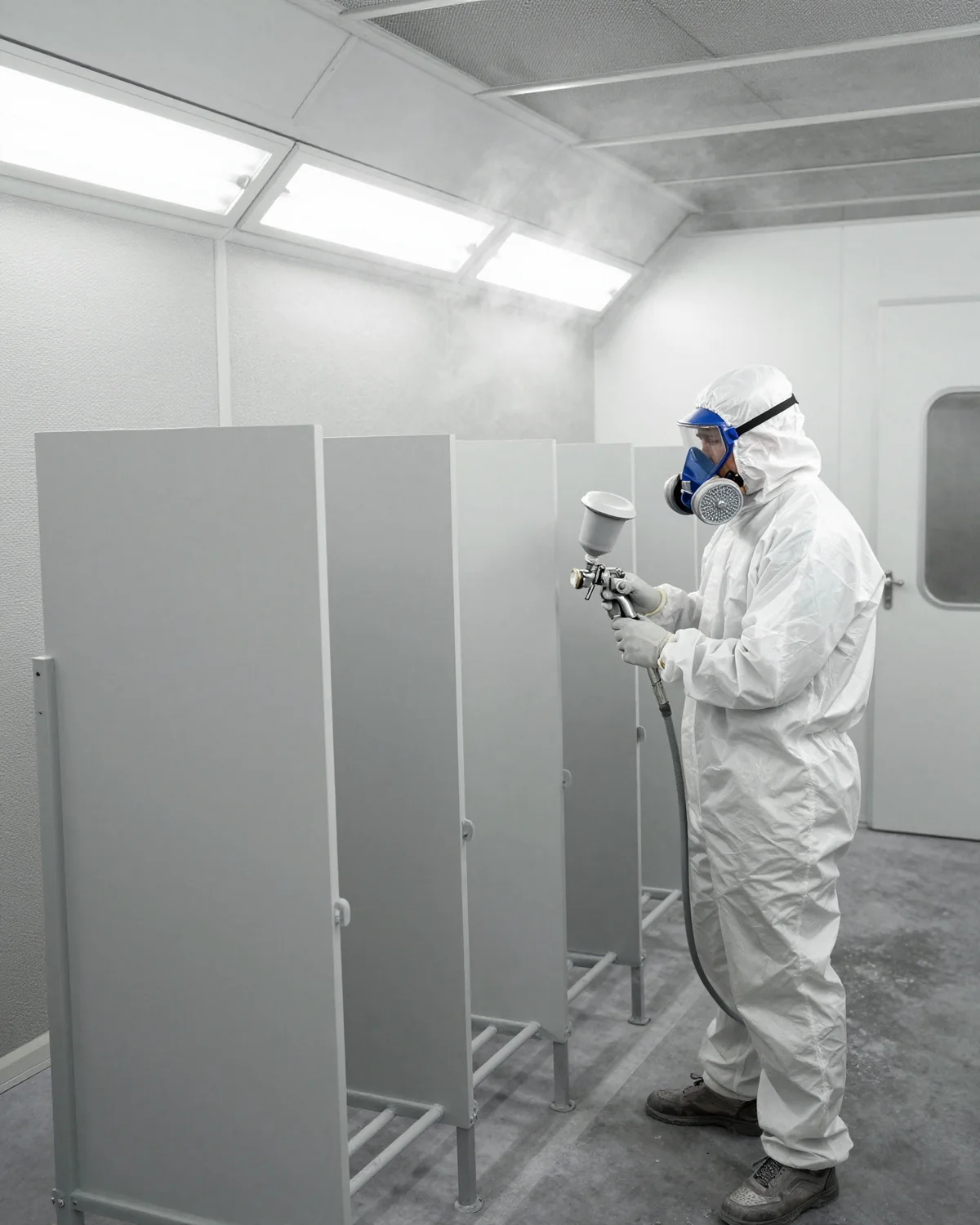
The exact lead times are in the price table on this page; the difference comes from the finish. Chipboard is the quickest option, chosen when you want a practical carcass. Foil-wrapped MDF needs no painting and suits matt colours. MDF with enamel takes longer, because gloss and complex shades dry layer by layer. If you need the vanity by a particular date, go for chipboard or foil-wrapped MDF.
From measuring visit to acceptance certificate
- Measuring: the technologist visits, measures the opening and checks the wall geometry and the water and waste connection points.
- 3D design: we prepare the visualisation in 1–2 days and agree the height, depth and bowl position before any board is cut.
- Workshop: the carcass and fronts are made in our own 600 m² workshop, where the test assembly also takes place before dispatch.
- Installation: the crew fits the unit on site, connects the bowl and checks the doors and drawers under load.
- Acceptance certificate: signed after installation, once you have inspected the unit and every comment has been dealt with.
Payment and delivery in Almaty
Payment is made in two stages: a 50 % deposit and the balance after the acceptance certificate is signed; we work by bank transfer. Delivery within the city and up to 30 km is free for larger orders — the threshold is on the Delivery and Payment page — and beyond 30 km there is an extra charge. In our experience customers rarely argue about the amount; they argue about when the second payment is due. Write into the contract that you pay the balance after inspection and signing the certificate, not on the day of delivery.
Vanity, worktop and basin as one design
The carcass, worktop and basin work as a single unit. Ordered separately, their joints and dimensions often don't match. Here is how we bring them together in one design.
Inset or countertop basin, and what it means for the worktop
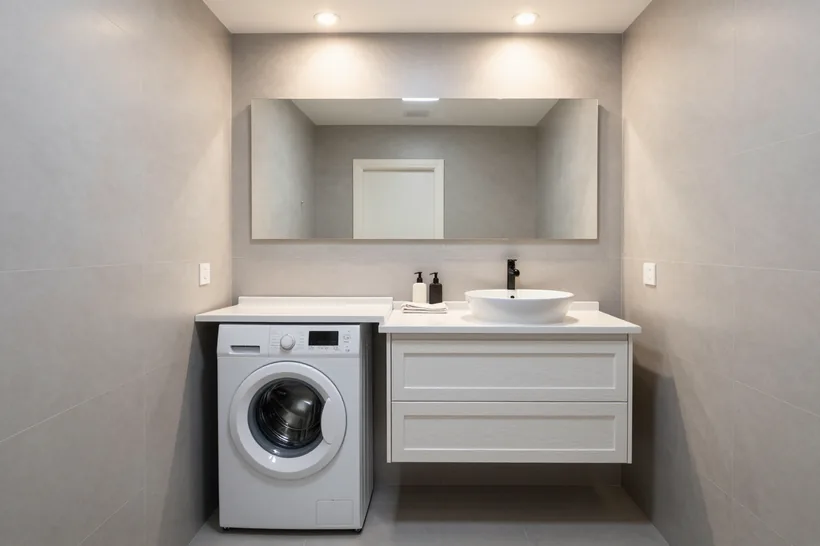
An inset bowl sits down into the worktop and needs a precise cut-out, while a countertop bowl sits on top and is easier to install. For an inset model the worktop is made with extra thickness and reinforced around the cut-out — thin board flexes under the weight of the water and the bowl, and over time the edge starts letting moisture in. For an inset basin we machine the cut-out on a CNC router to the bowl's drawing, chamfer it and seal the edge with moisture-resistant edging. Under an inset bowl the worktop should be at least 38 mm thick or made as a double board — saving on thickness soon turns into sagging.
Ordering from a maker versus buying ready-made
- Standard versus design: a ready-made unit comes in a standard size, while we build it for your bathroom as one piece — carcass, worktop and basin.
- Sized to the niche: custom dimensions follow the niche and work around pipes and boxing instead of being trimmed to fit on site.
- One drawing: worktop, basin and carcass are made to one drawing, so the tap hole and the bowl rim line up without adjustment.
- One point of responsibility: as the direct manufacturer we answer for the whole unit, not just the carcass, so the worktop-to-basin joint is never someone else's problem.
The bottom line on bathroom vanity units
A short summary of the whole guide, so you can keep the essentials in mind before you order: what decides how long the vanity lasts, how well it fits and how soon it is ready.
- Carcass: how long the unit lasts depends on moisture-resistant board and sealed edges, not on how the front looks.
- Dimensions: custom sizing and fitting to leaning walls remove the gaps that off-the-shelf furniture always leaves.
- Fixings: a wall-hung model is secured by a load calculation for your actual wall, not by the universal plug from the box.
- Lead time: production time depends on the finish — chipboard is the quickest, solid wood the longest.
- One design: a carcass, worktop and basin made together match in size and at every joint, with no trimming on site.