
Temirzhan Nurpeisov
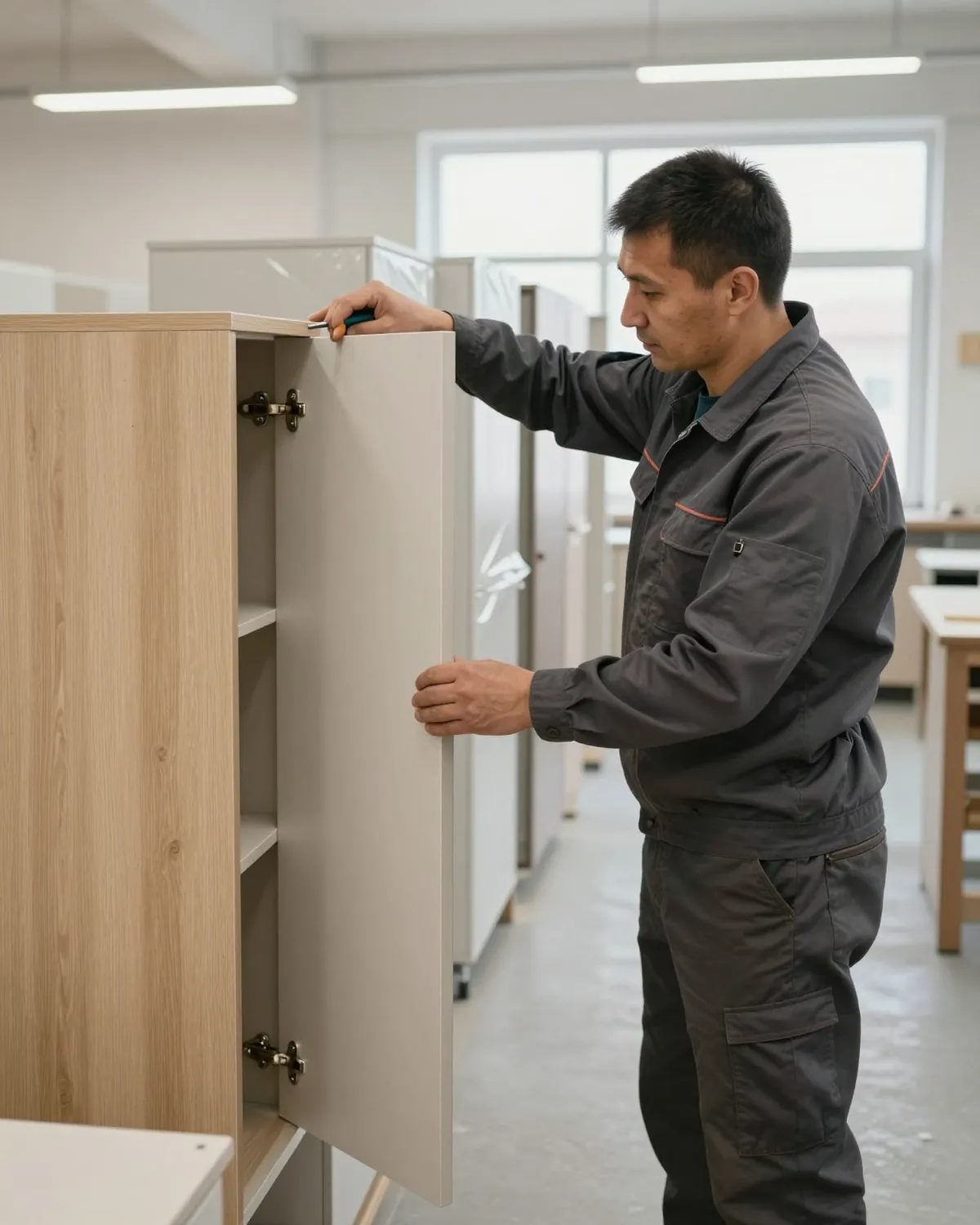
Furniture assembly carpenter11 years
★ 4.81 · 47 ratings
For business · Museums
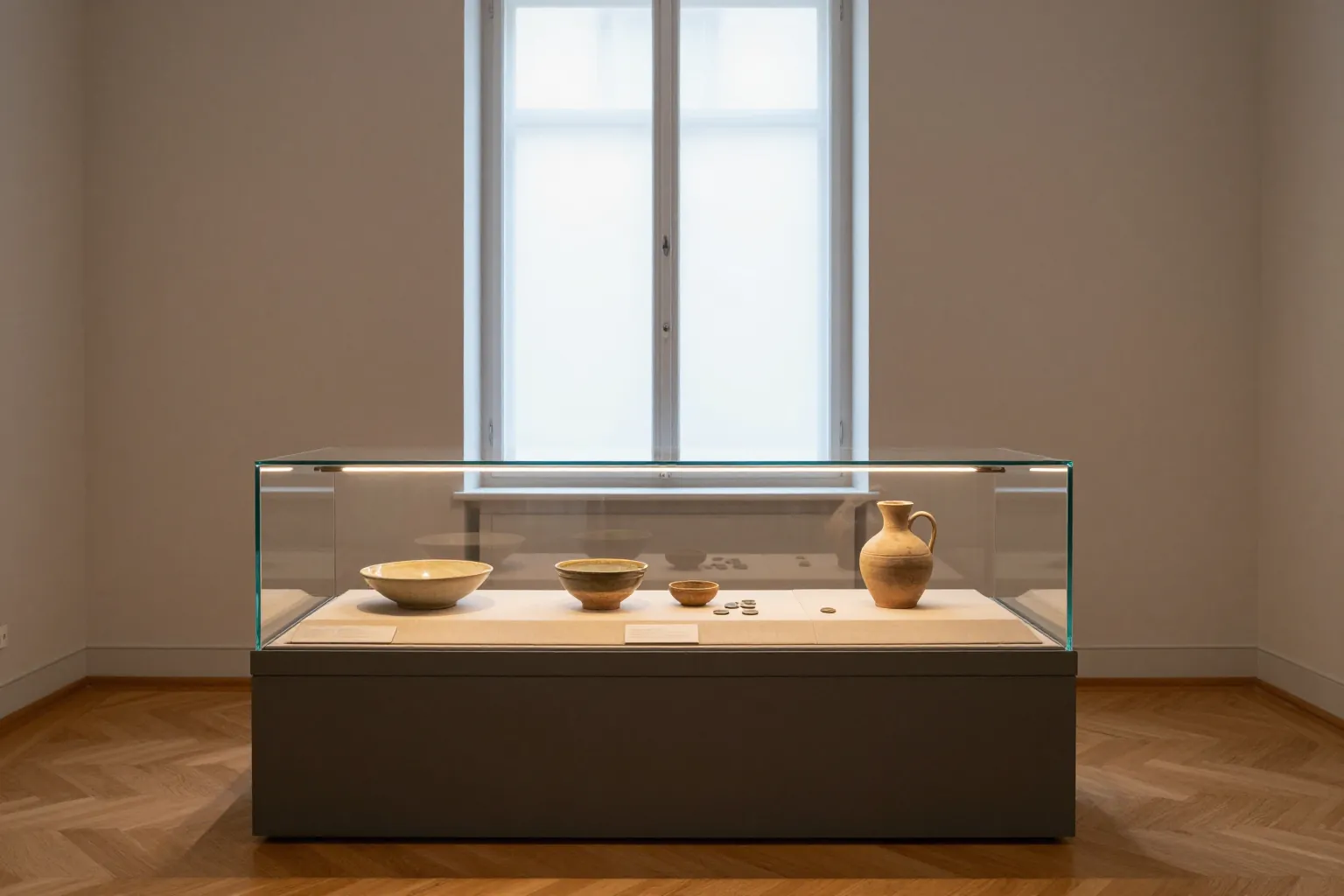
We make display cases to fit the shape and size of the exhibit: horizontal, vertical, wall-mounted boxes and island cases, with anti-reflective glass, concealed lighting and a lock. Measurement and 3D design are free, the price is fixed in the contract, and the item comes with a 24-month warranty.
Measurement and 3D design are free and carry no obligation · price fixed in the contract · Kaspi Instalments up to 24 months
01Types
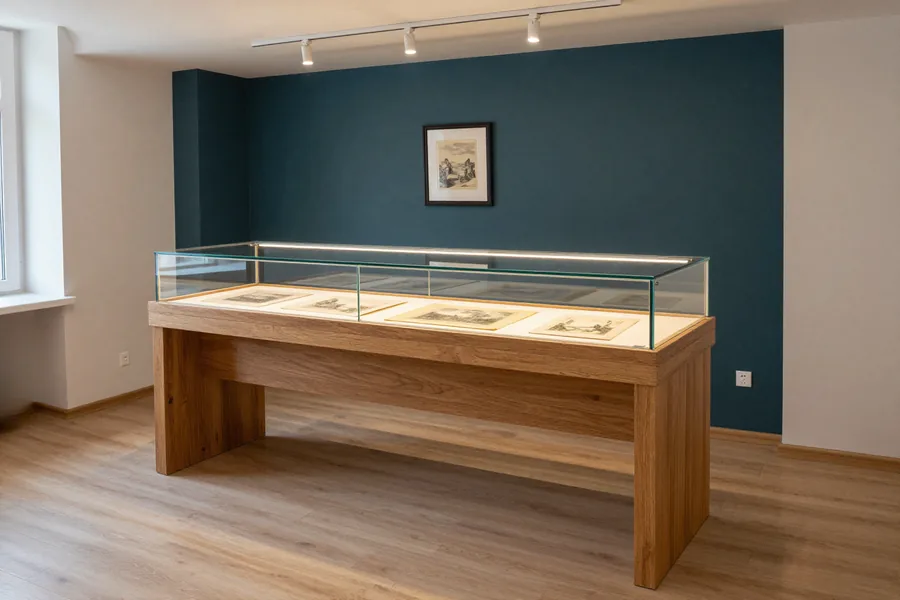 01
Solid oak carcass with museum glass and LED: the lid is angled towards the visitor, so graphics read without glare.
from 560 000 ₸
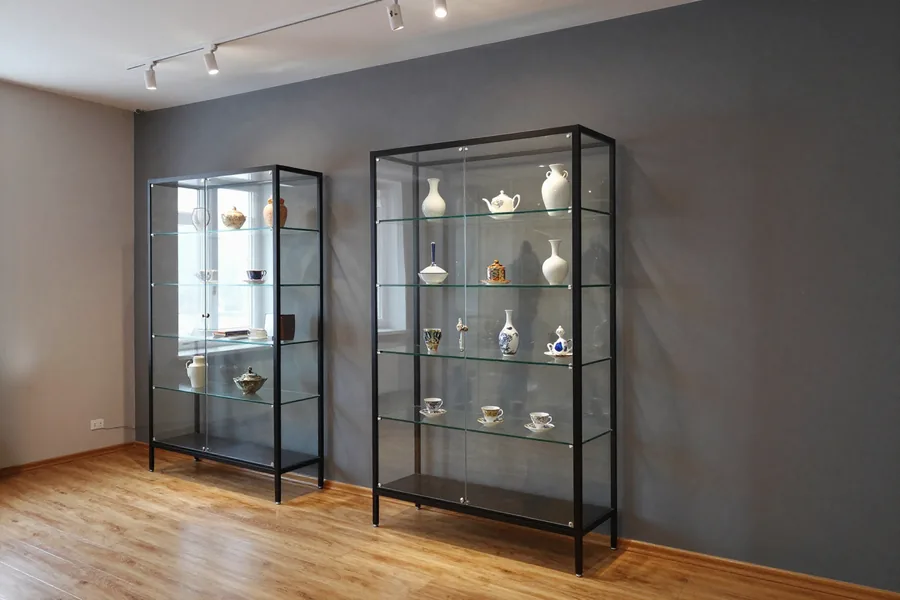 02
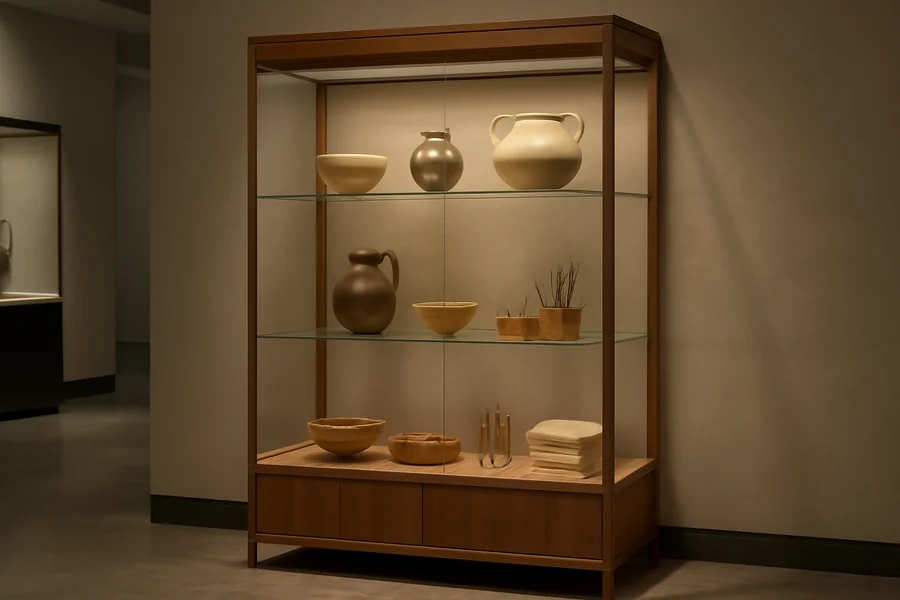
Tall cabinet on a metal frame for tableware, costumes and sculpture, with the light hidden in the profile.
from 450 000 ₸
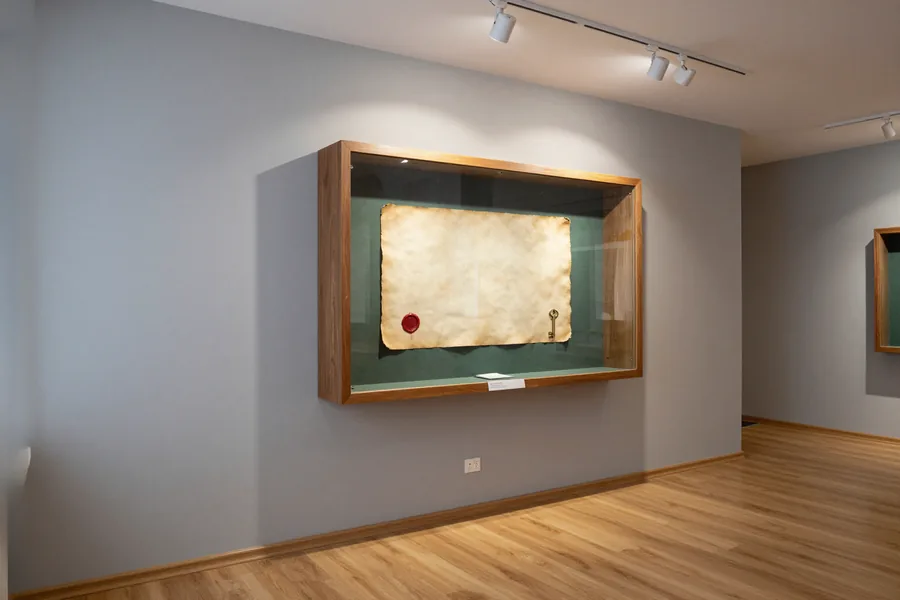 03
A shallow wall-mounted case with museum glass: the frame tilts open, so a conservator can work without taking the case down.
from 180 000 ₸
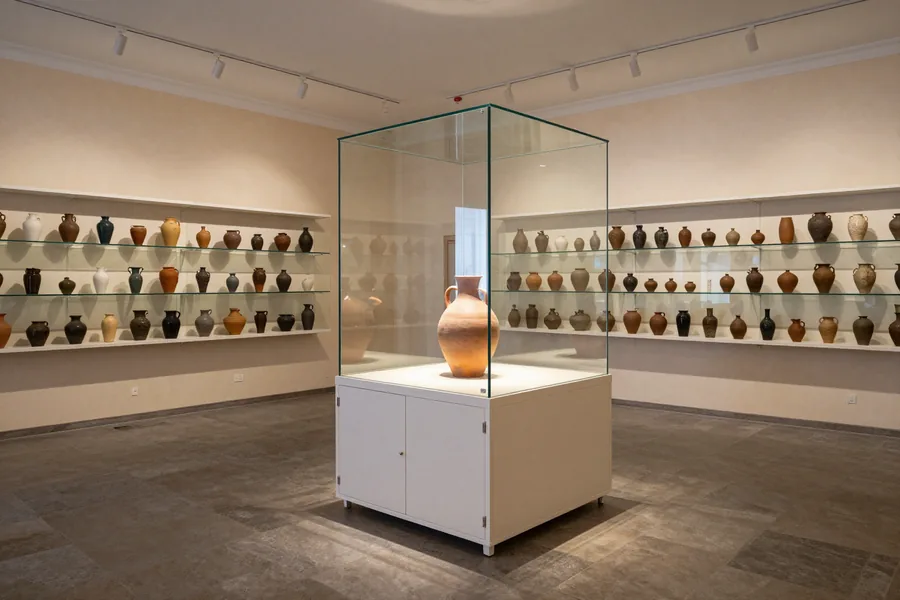 04
A square display case for the center of the hall: a view from all four sides, and the mirrored plinth makes the carcass look lighter.
from 650 000 ₸
 05
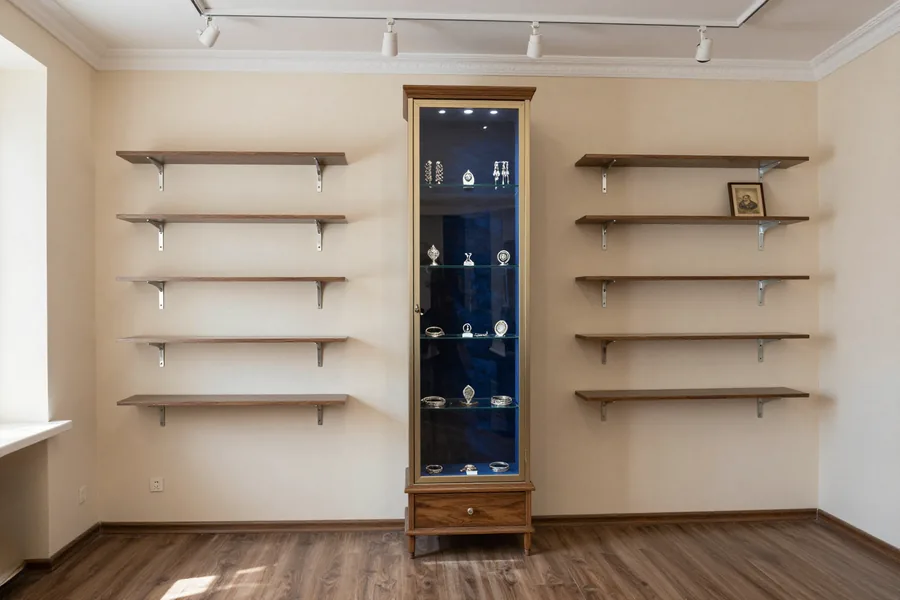
A narrow carcass with velvet-lined shelves: jewelry at eye level, little floor space needed.
from 280 000 ₸
 06
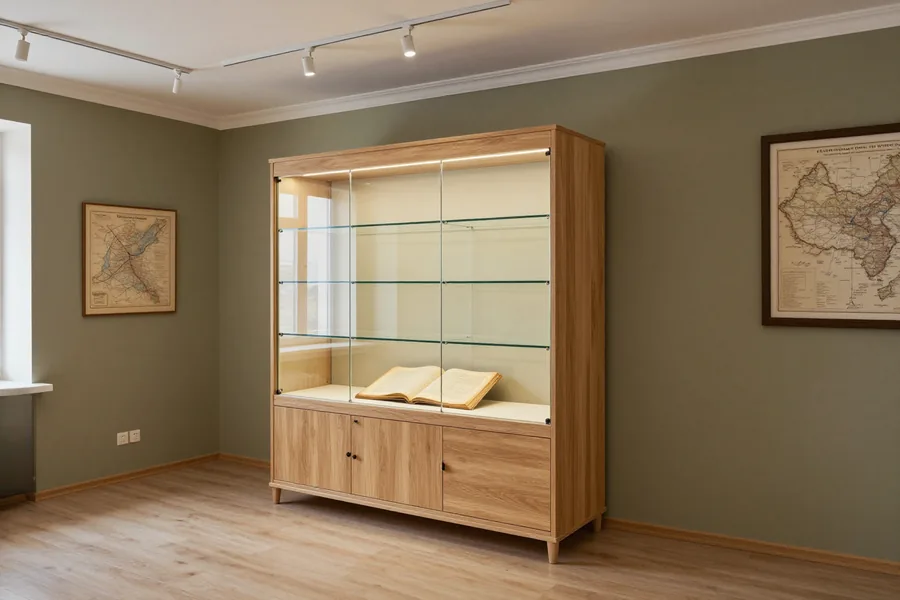
Glass, a door seal and a silica gel compartment: for paper, fabric and organic items that dust harms.
from 230 000 ₸
02Projects
Item, volume, materials and lead time — per project.
 Museum
State Museum, Medeu District
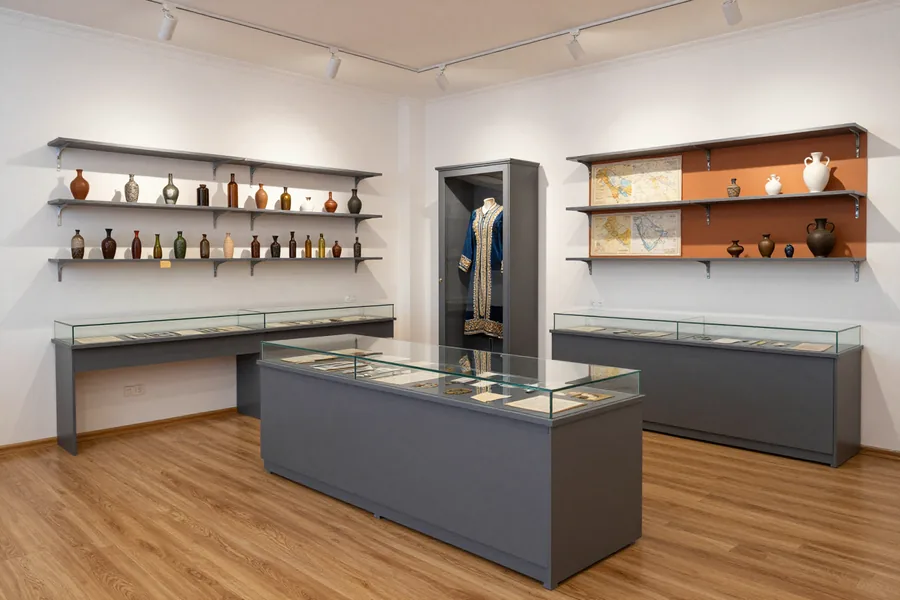
A full local history museum hall, turnkey: horizontal table display cases for coins and documents, a vertical wardrobe for a costume, wall-mounted cases for maps and storage shelving — all in a single matte graphite color.
 Museum
Art Museum, Bostandyk District
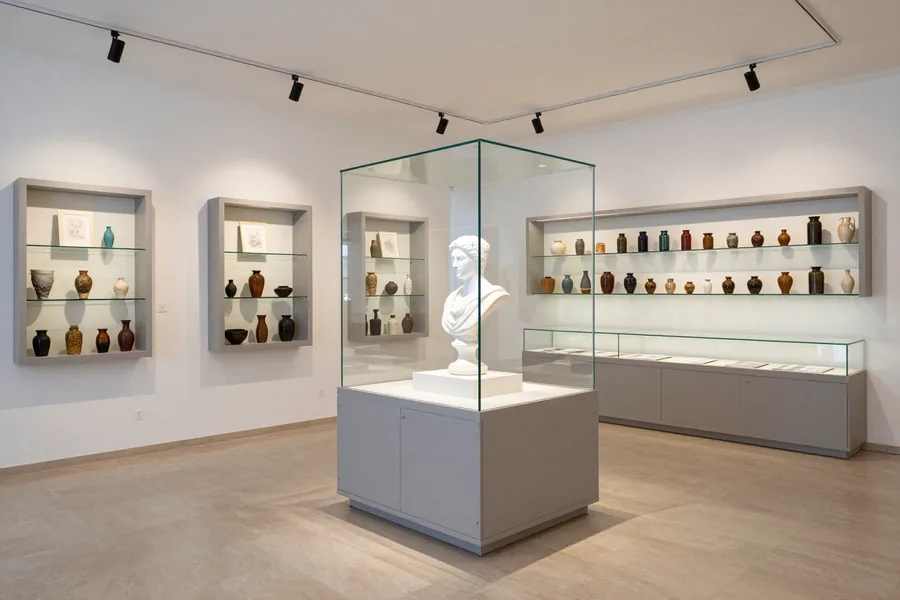
For the art museum we made wall-mounted display cases for paintings, an island display case with a full-circle view for a sculpture and horizontal display cases for graphic works — light gray frames, museum lighting without ultraviolet.
 Museum
History Museum, Almaly District
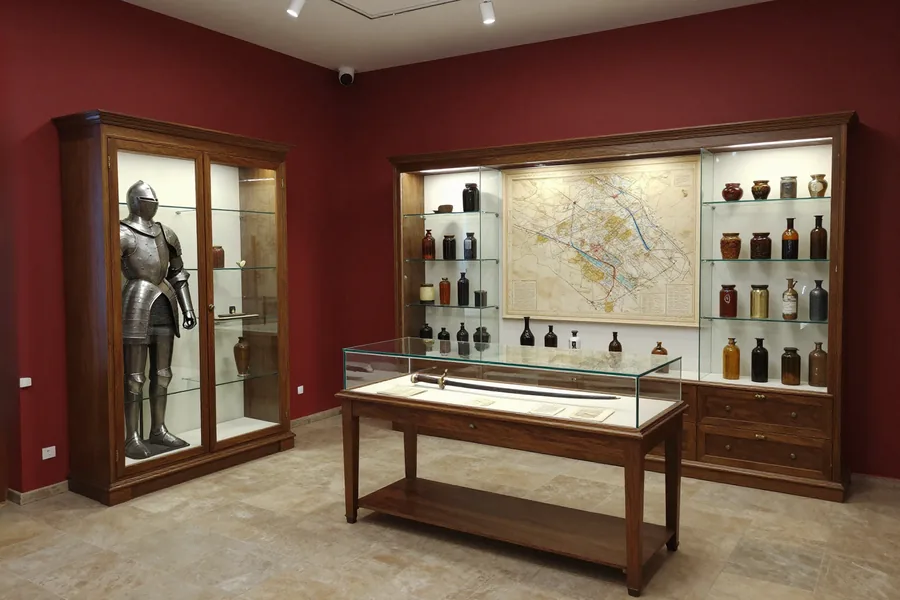
History Museum: vertical cabinets for costumes and armor, horizontal display cases for weapons and documents, wall-mounted display cases for maps — dark wooden frames to match the character of the exhibition.
 Museum
School-Gymnasium, Auezov District
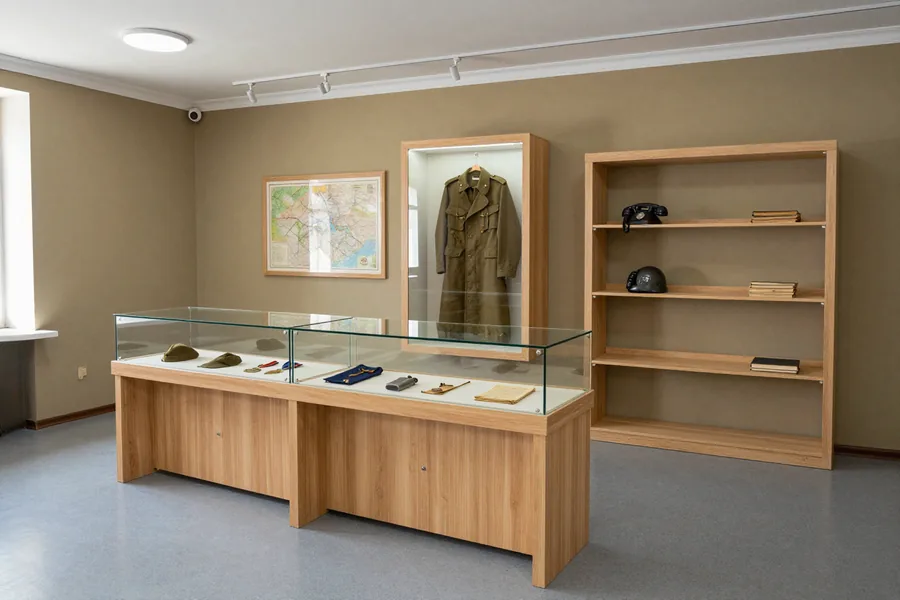
School museum of military glory: wall-mounted display cases for photographs and documents, a horizontal display case for personal items and open shelving — light, budget-friendly laminated chipboard and safety glass.
 Museum
City Museum, Medeu District
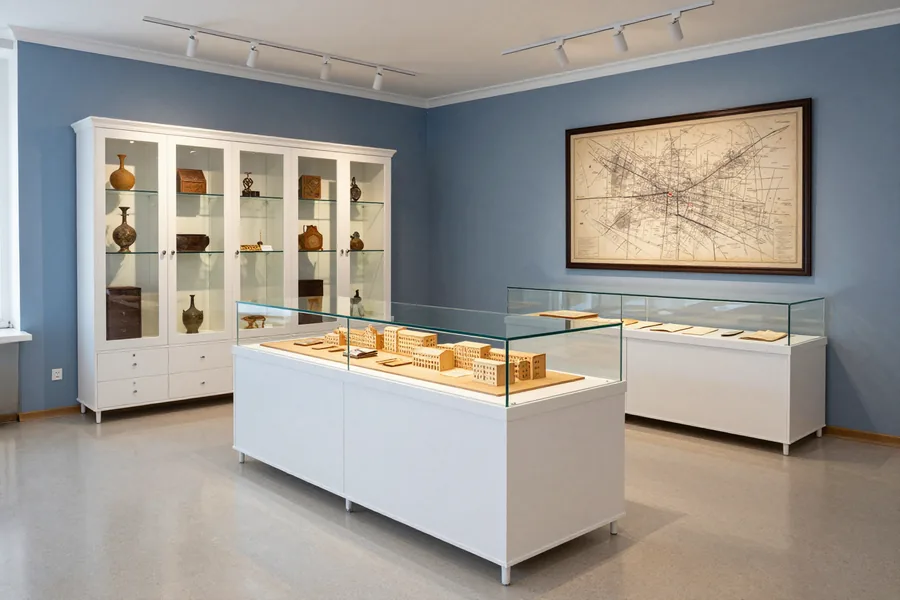
City Museum: island display cases with a full-circle view for a model and landmark items, horizontal display cases for documents and vertical cabinets — white matte carcasses and hidden lighting.
 Museum
Crafts Museum, Bostandyk District
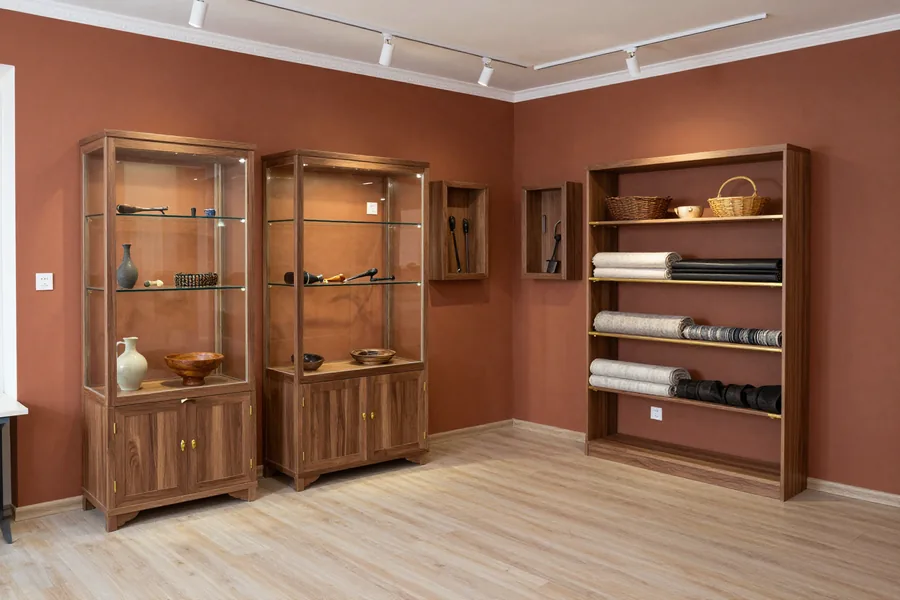
Museum of Folk Crafts: vertical display cases for items, wall-mounted niche cases for tools and open-storage shelving — wood, glass and brass hardware to match the warm character.
03How we work with museums
04Prices
The "from" price is for the item in its basic configuration; the final price depends on dimensions, type of glass, lighting and lock. After a free measurement and design, we fix the cost in the contract.
05For businesses
We work with LLPs, sole proprietors and public organizations by bank transfer. Price, materials and lead times are set in the contract before production begins.
Request a contract and invoice06Principles
01 / 06
07Production
Six steps in our 600 m² workshop. You can see each of them with your own eyes: the showroom and production are under one roof.
Egger · Kronospan · E1
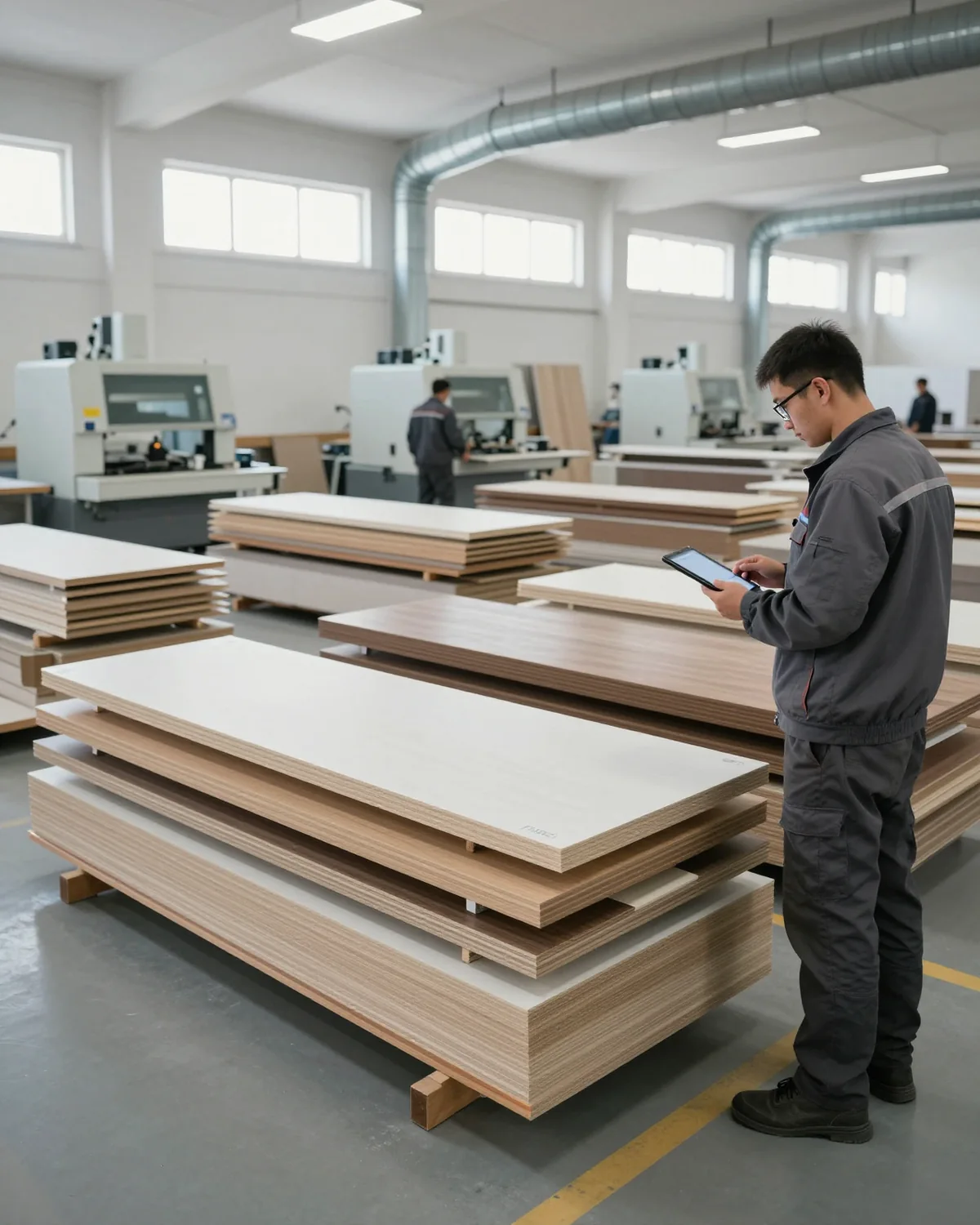
Egger and Kronospan boards of emission class E1 arrive at the workshop warehouse. There are 40+ laminated chipboard decors, 16–18 mm thick. Class E1 — for halls and storage rooms.
Laser measuring to 1 mm
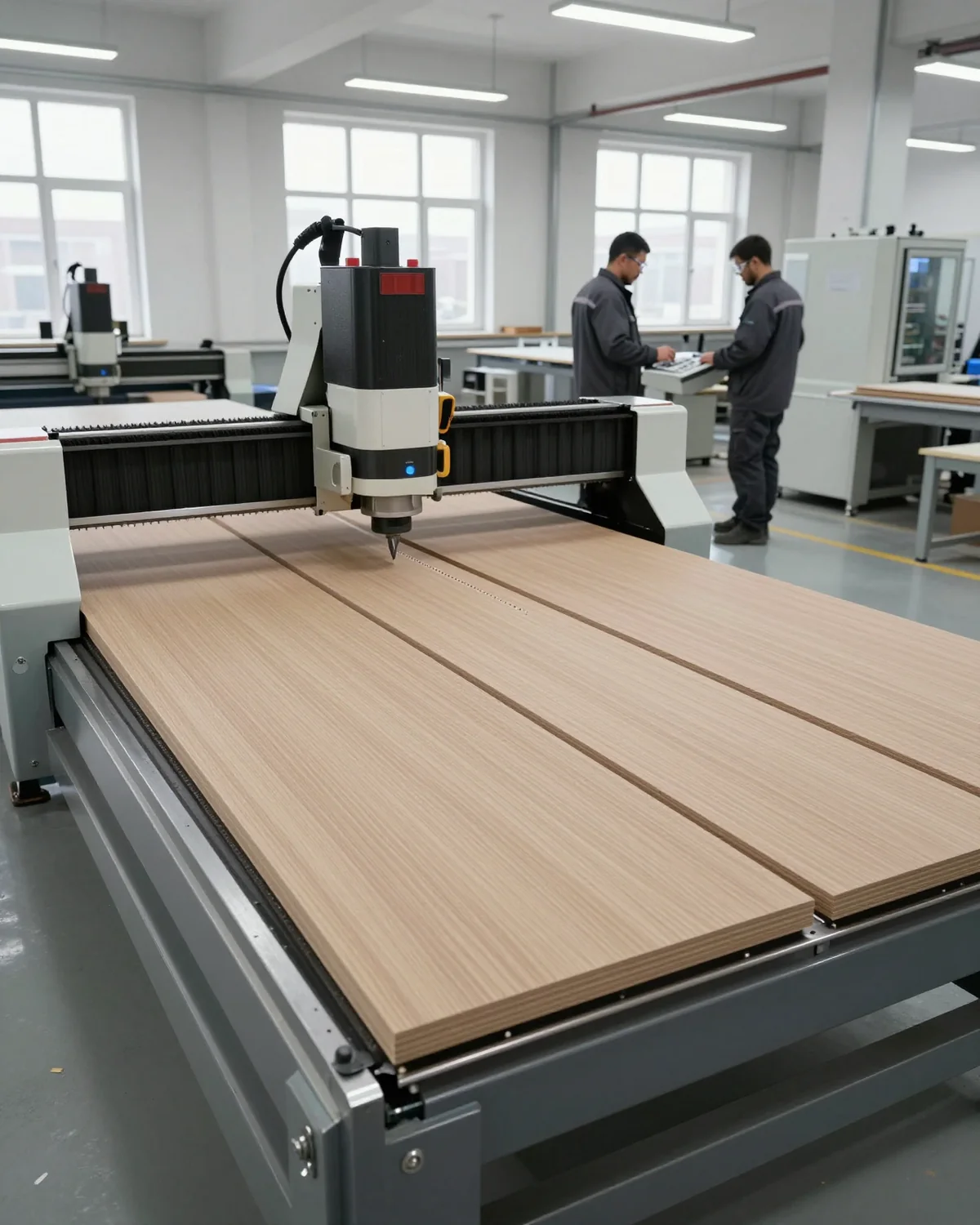
A design engineer prepares the drawings, and the machine cuts the board to them. Dimensions come from a laser measurement accurate to 1 mm.
Blum · Hettich · Boyard
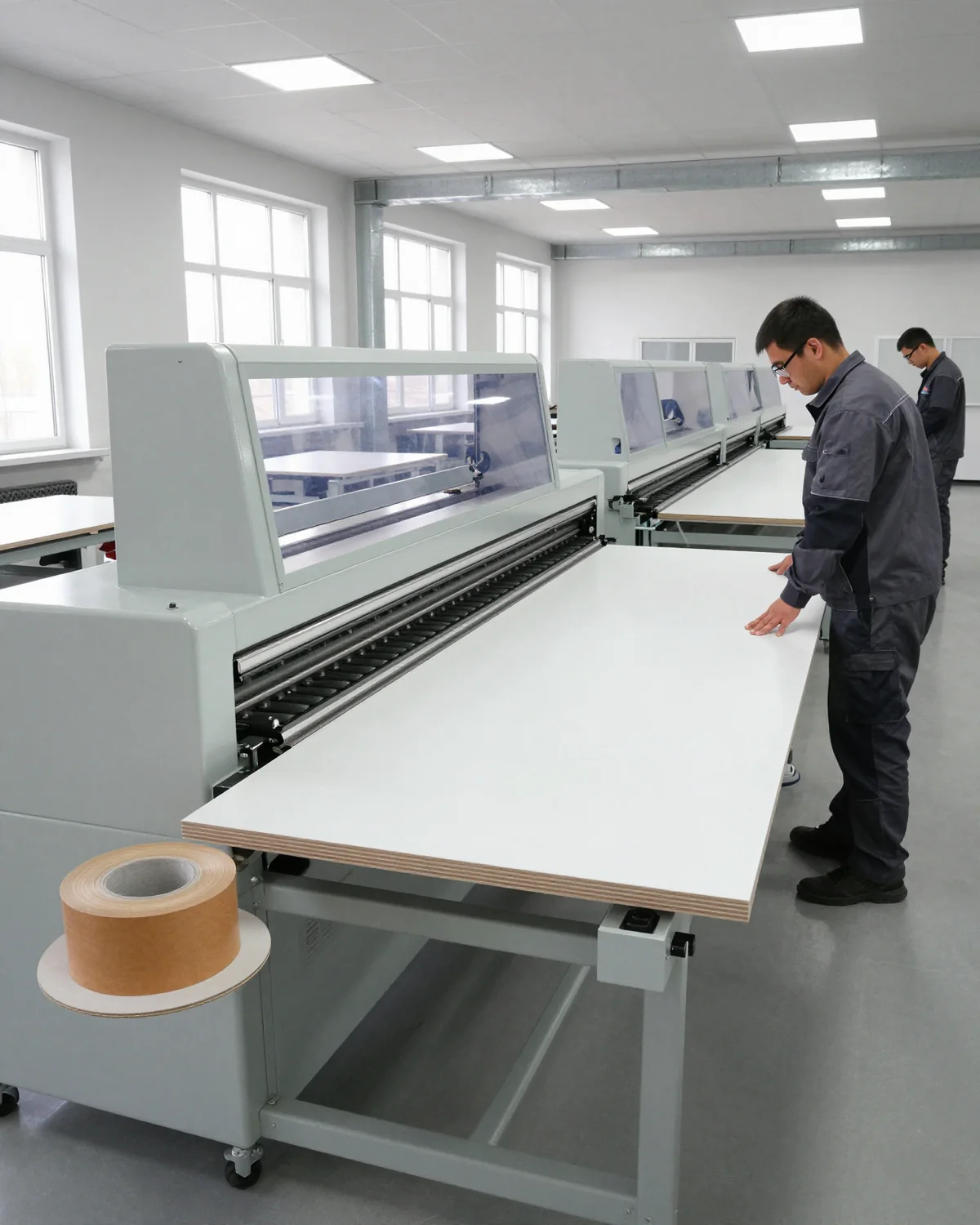
The edge-banding machine seals the edges, then we drill holes for Blum hinges and Hettich runners.
Any RAL colour
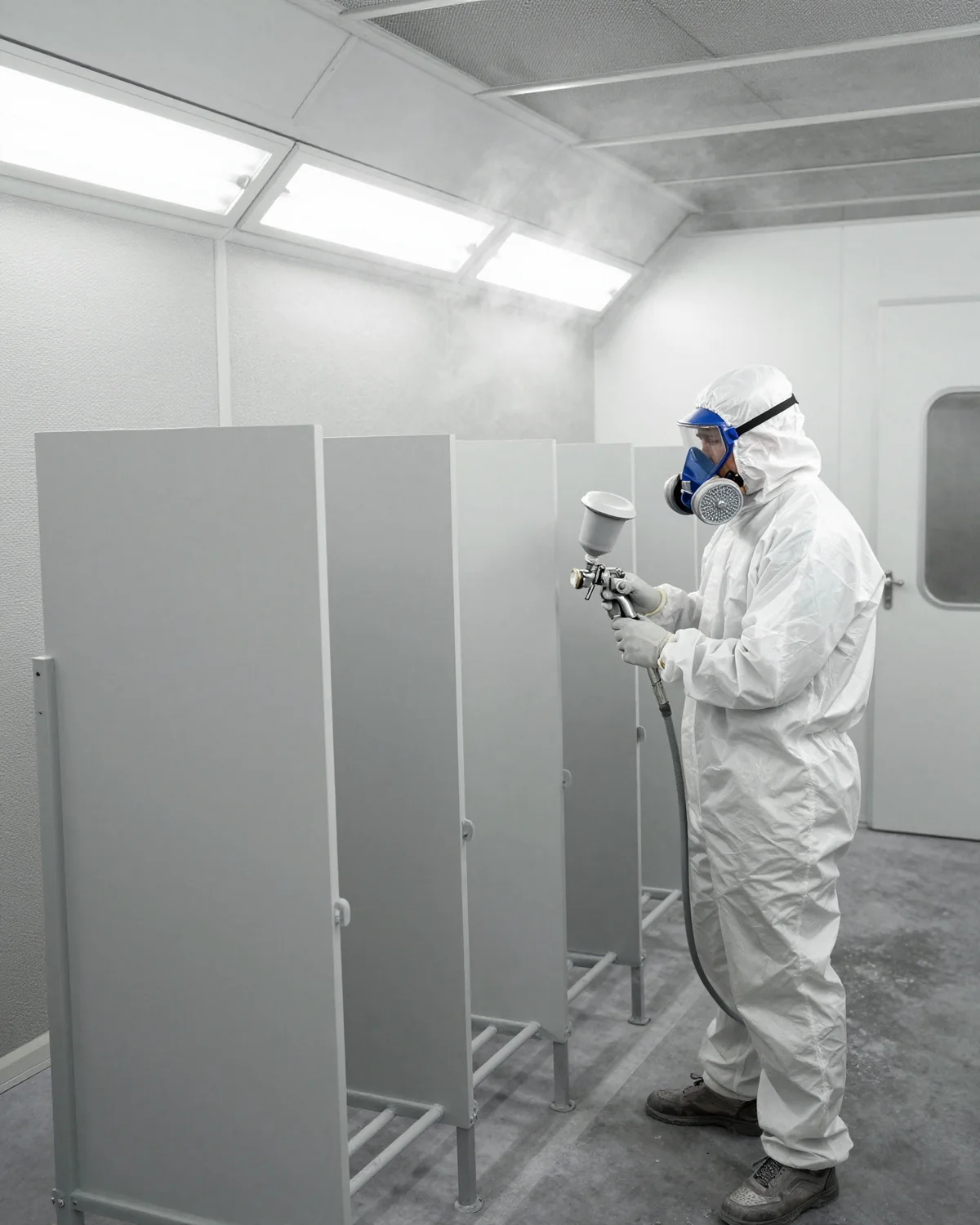
A finishing specialist paints fronts to RAL — matt and gloss. We assemble every display case completely before shipping: we check the fit of the glass and the seal, the operation of the lock and the lighting.
Pre-assembly in the workshop
We assemble the modules in the workshop before dispatch, checking front gaps and drawer travel. The quality control department signs the item off for shipping.
Installation to fit the venue's schedule
We deliver, bring in, assemble in 1 day, adjust the furniture and clean up after ourselves. Warranty of 24 months from signing the acceptance certificate.
08Team
MEBLIX workshop craftsmen who make and assemble furniture to order.
01 / 07Furniture assembly carpenter11 years
★ 4.81 · 47 ratings

Cabinet furniture repair craftsman20 years
★ 4.99 · 73 ratings
Furniture and kitchen unit assembler23 years
★ 4.97 · 300 ratings

Made-to-order furniture maker7 years
★ 4.26 · 32 ratings

Furniture maker5 years
★ 4.23 · 30 ratings

Joiner and carpenter20 years
★ 5.0 · 113 ratings
Furniture front and hardware fitter17 years
★ 4.61 · 92 ratings
09FAQ
Didn’t find the answer? Message us — a manager replies, not a bot.
Ask on WhatsAppWe install tempered glass in all carcasses, and anti-reflective glass where windows and lamps reflect in the glass. In wall-mounted cases and boxes for flat exhibits we install museum glass.
The price list above has a display table with lighting for coins and a vertical display cabinet with LED lighting, each with its price shown there. We calculate the exact amount after measuring and fix it in the contract.
Yes, a vertical display cabinet with LED lighting on a metal frame suits a mannequin, and it is in the price list above. We take the height and depth of the carcass from the mannequin with allowance for the podium, and hide the lighting strip in a profile above the costume.
We choose the opening method to suit the exhibit: on a wall-mounted case the frame tilts open, on a wardrobe we can make a rear door, on a horizontal display case the lid lifts on hinges. We fit a lock to the door, and the key stays with the curator.
Yes, we design the carcass to the dimensions of the object with a margin for the podium and backdrop. At the measurement we take the dimensions of the exhibit and the space in the hall, then show the display case in a 3D design.
No, we hide the strip in an aluminium profile or under the top lid, and the power supply in the plinth. The visitor sees only the light on the exhibit, without bright diode dots on the glass.
Yes, a round island display case with a rotating platform is in the price list: tempered glass, stainless steel and mirror, with the price shown there. The platform turns the object if the island stands close to the wall.
We check the width of doors, lifts and staircases at the measurement. If the passage is narrow, we make the carcass collapsible: our team assembles the plinth, frame and glass already in the hall.
A wall-mounted display box for medals in solid ash with museum glass and cloth suits awards, and it is in the price list above. The awards are attached to the fabric, and the box hangs on the wall like a frame.
Yes, we cut glass to order sizes in our own workshop, so we will make a new pane according to the drawing of your display case. Tempered glass, when struck hard, shatters into small blunt fragments rather than sharp shards.
10Reviews
4,9
average rating
on Google and Zoon
Everyone can see a review on the platform: this is how other people check whom to trust with an order. If something went wrong, write to us and we will reply within 1–2 business days.
Message us on WhatsApp11Article
We make museum display cases in our own workshop in Almaty for a specific exhibit: horizontal, vertical, wall-mounted boxes and island cases. We install tempered or anti-reflective glass, concealed LED lighting, sealing and locks. Free measurement and 3D design in 1–2 days, installation by our own team, 24-month warranty under the contract.
The shape of the carcass depends on the item itself and on the side from which the visitor looks at it. A mistake in shape is immediately visible: the exhibit either gets lost or presses against the glass.
| Shape | Which exhibit | How it is viewed |
|---|---|---|
| Horizontal table display case | Documents, maps, coins | From above, leaning over |
| With slanted glass | Graphics, engravings, manuscripts | At an angle, standing |
| Vertical cabinet display case | Dishes, costumes, sculpture | From the front, at eye level |
| Pencil display case | Jewelry, small plastic art | Up close, from one side |
| Wall-mounted box | Flat items, awards | From the front, at the wall |
| Island case | An item interesting from all sides | All around |
We make horizontal carcasses in two main variants, and the choice between them determines how the visitor will see the exhibit. The variant with slanted glass made of solid oak and museum glass raises the far edge of the top: a sheet of graphics or an old manuscript turns toward the person, and they do not need to lean over the table. Lighting in such a carcass runs along the top edge and does not shine into the eyes. The variant with solid sides made of laminated chipboard and tempered glass closes the lower part of the carcass, where the wiring, the silica gel compartment and the pedestal mounts are hidden, and glazing remains only on top. For halls with children's tours, solid sides are more convenient: they show no palm prints. If the display has a lot of paper, it is worth ordering the slanted variant — that way the text reads without glare from ceiling lights.
We place an island display case in the center of the hall when the item is interesting from all sides: a sculpture, a model, a jug with painting all around. A round carcass made of tempered glass and stainless steel with a mirror in the base gives an all-round view without corners or posts. A square island on a mirrored plinth made of laminated chipboard is easier to fit into a rectangular hall, and the mirror below makes the heavy carcass visually lighter. A rotating platform is needed where the island has to be placed closer to a wall or column: the exhibit slowly turns, and the visitor sees the back side without walking around the display case. We design custom museum display cases of this type to the dimensions of the exhibit with a height margin for the pedestal. It is important to leave a free circle around the island — without it, the whole point of the all-round view is lost.
A small item gets lost in a large carcass. It needs its own shape, a suitable background and light that emphasizes the embossing, cut or enamel rather than reflecting in the glass.
We make the display cabinet narrow and tall: the MDF carcass with velvet-coated shelves and tempered glass keeps jewellery at eye level, and the visitor examines it from a short distance. This shape takes up little space, so several cabinets can be placed side by side, dividing the collection by era or maker. The velvet on the shelves dampens the shine of the shelf itself, and against a dark background silver and stones look brighter. In the production of museum display cases, the display cabinet is one of the most precise jobs: the glass edges are narrow, the joints are in plain sight, and any skew is noticeable. The shelves inside are best made at different heights: rings and brooches go closer to the eyes, large necklaces lower down. For each shelf, decide in advance whether it needs its own lighting, so the carcass doesn't have to be reworked later.
We place medals and orders in a wall-mounted display box made of solid ash with museum glass and a cloth backing. The box is shallow, the award is attached to the fabric vertically, ribbon down, and hangs on the wall like a frame. Coins are more convenient to show horizontally, in a display table with hidden LED lighting and a lock: the visitor looks from above and sees the obverse, and for the reverse a second specimen can be placed alongside. Light for coins and medals is best directed from the side at a slight angle: this brings out the relief of the minting, whereas with light strictly from above the metal simply glares. A lock on the coin table is essential, as a small item is easy to walk off with. If the collection of awards grows, the box should be ordered with spare space on the backing, and the cloth should be chosen in a shade that is easy to repeat in the next box of the same series.
Glass is the main surface of the carcass through which the visitor sees the exhibit. The safety of the hall, the amount of glare and how faithfully the colour of the item is conveyed all depend on its type.
We use tempered glass in carcasses because it is noticeably stronger than ordinary glass and breaks differently: under a strong impact the pane shatters into small blunt fragments rather than splitting into sharp shards. For a hall where groups and children walk through, this is the main safety requirement. We cut the glass to the order's dimensions in our own workshop, so the pane fits precisely into the profile without gaps through which dust could get in. We choose the thickness according to the size of the pane and the load: the lid of a large horizontal display case and the narrow door of a display cabinet work differently. After tempering the pane can no longer be cut, so all holes for hinges and locks are marked in advance according to the drawing. The final size of the pane is best confirmed after measuring the niche or the place in the hall, not from a standard catalogue.
Anti-glare glass eliminates reflections from ceiling lights and windows, so we use it in cases where the visitor views the exhibit at an angle or where the hall is brightly lit. A custom museum display case with such glass is especially important for works on paper, photographs, and dark objects: on ordinary glass they are almost invisible due to the reflection of the visitor themselves. We use museum glass in wall-mounted boxes with flip-up frames, medal cases, and inclined cases for works on paper—where the item is flat and the glazing is very close to it. The side edges and doors remain made of standard tempered glass. Before choosing, it is helpful to stand in the hall at different times of day: if windows are reflected in the glass, without the anti-glare option the display will only be partially visible.
| Glass type | What it provides | Where suitable |
|---|---|---|
| Tempered | Strength, safe fragments | All carcasses, doors, edges |
| Anti-glare | Fewer reflections from lamps and windows | Bright halls, works on paper |
| Museum | Clear view of flat exhibits | Wall-mounted boxes, cases |
| Mirror | View of the reverse side | Base, back panel, bottom |
Light inside the case should fall on the object while the source itself remains invisible. If the visitor sees the strip or an LED point, attention drifts away from the exhibit.
We hide the LED strip in an aluminum profile along the top edge or under the lid, so the visitor sees light on the object, not the strip itself. The profile simultaneously dissipates heat and diffuses light, so bright LED points do not appear on the glass. LEDs generate almost no heat, which is important for paper, fabric, and photographs kept in a closed case for a long time. The wire and power supply go into the base: they are out of sight, a child cannot reach them, and an electrician can replace the unit through a separate hatch without removing the glass. We design museum display cases with lighting together with the light from the start—otherwise the strip later has to be glued outside the profile. It is more convenient to place the switch in the base on the curator's side so visitors do not touch it during a tour.
A mirrored back panel shows the reverse side of an object, letting visitors see the painting on the back of a vase or the inscription on the reverse of a medal without walking around the case. In an island square display case, a mirrored plinth works differently: it reflects the floor of the hall, making the heavy carcass seem to float above it. In a round island display case, the mirror at the base illuminates the object from below with reflected light. A mirror requires careful lighting adjustment: if the strip is placed incorrectly, the LEDs themselves will appear in the reflection. A mirror is worth installing only where the reverse side of the exhibit is genuinely interesting — otherwise it merely doubles the number of objects and distracts. For documents and graphic works, a mirrored back panel is usually unnecessary; a matte neutral background suits them better, as it reflects neither the strip nor visitors' faces.
A closed carcass protects an object only when it has no gaps and the humidity inside does not fluctuate with the weather and the number of visitors in the hall.
We install sealing around the perimeter of the door and where the glass meets the profile: it closes the gaps through which dust is drawn into the carcass. Custom museum display cases with climate protection are assembled from glass, sealing, and a silica gel compartment — this is a separate line item in the price list, because such a carcass requires greater precision in the joints. Dust inside an ordinary display case settles on exhibits and the backing, and it has to be cleaned by opening the carcass, and every opening is a risk to the object. A sealed door closes more tightly, so we select hinges and a lock that press the leaf evenly along its entire length. If the display includes fabric, paper, or organic materials, it is better to choose a sealed carcass right away: retrofitting a finished display case is more difficult than making a new one.
Silica gel is a sorbent that absorbs excess moisture inside a closed carcass and smooths out its fluctuations. In the hall, humidity changes with the weather, heating, and visitor flow, but in a tightly sealed display case these fluctuations are noticeably weaker if a sorbent is placed inside. Silica gel is placed in a separate compartment, usually in the plinth or under the podium, behind a perforated panel, so that air can reach it while the granules do not get to the exhibit. The compartment is made accessible from outside or from below, and the curator replaces the cassette without opening the display and without touching the objects. Silica gel works only in a sealed carcass — in a display case with gaps it quickly becomes saturated and stops helping. That is why the sorbent compartment and the door sealing are designed together as a single protection system.
The carcass's journey from drawing to hall passes through measurement, workshop, and installation crew. At each step, they check what would later be difficult to fix on site.
Making museum display cases starts for us with a free measurement and a 3D design in 1–2 days: it shows how the carcass will sit in the hall and where the lighting cables will run. Then the work moves to our own 600 m² workshop in Almaty: cutting laminated chipboard, painting MDF in enamel, glass cut to the order's sizes, and assembling the frame from aluminium profile. Carcasses made of E1-class Egger and Kronospan laminated chipboard are edged with PVC or ABS so the ends don't absorb moisture during wet cleaning of the hall. Before dispatch we assemble every display case in full: we check how the panes sit, whether the doors close, whether the locks work and whether the lighting comes on. This test assembly catches mistakes in the workshop, where they are easy to fix, rather than in the hall on the eve of an exhibition opening.
We deliver and install display cases with our own team, and we agree the time around the venue's schedule — in the evening, on a day off for visitors or on a sanitary day. A large island carcass or a tall wardrobe won't fit through every door, so we check the width of openings, lifts and stairwells already at the measurement. If the passage is narrow, we design the carcass to be dismantled, with a separate plinth and panes that are assembled on site. Within Almaty and up to 30 km, delivery is free for a large order; the threshold is stated on the Delivery and payment page, and beyond 30 km there is a surcharge. On site the team levels the carcass, connects the light and checks how the seal fits. The curator arranges the exhibits in the display case after installation, once the glazing has been cleaned and the dust from the work has been removed.
A good display carcass goes unnoticed: the visitor sees the object, not the glass, the tape or the hinges. Below are the solutions that achieve this.
12Calculation
Choose the carcass shape, dimensions, glass and lighting in the calculator — the calculation will be sent to the manager on WhatsApp. We calculate the cost for each item.
13For business
We fit out the pharmacy end to end — from the pharmacist's counter and prescription shelving to cabinets for medicines, flammable liquids and stock.
We make display cases to the dimensions of the sales floor: wall-mounted up to the ceiling, island, corner with radius glass, and counter display cases with lighting and locks.
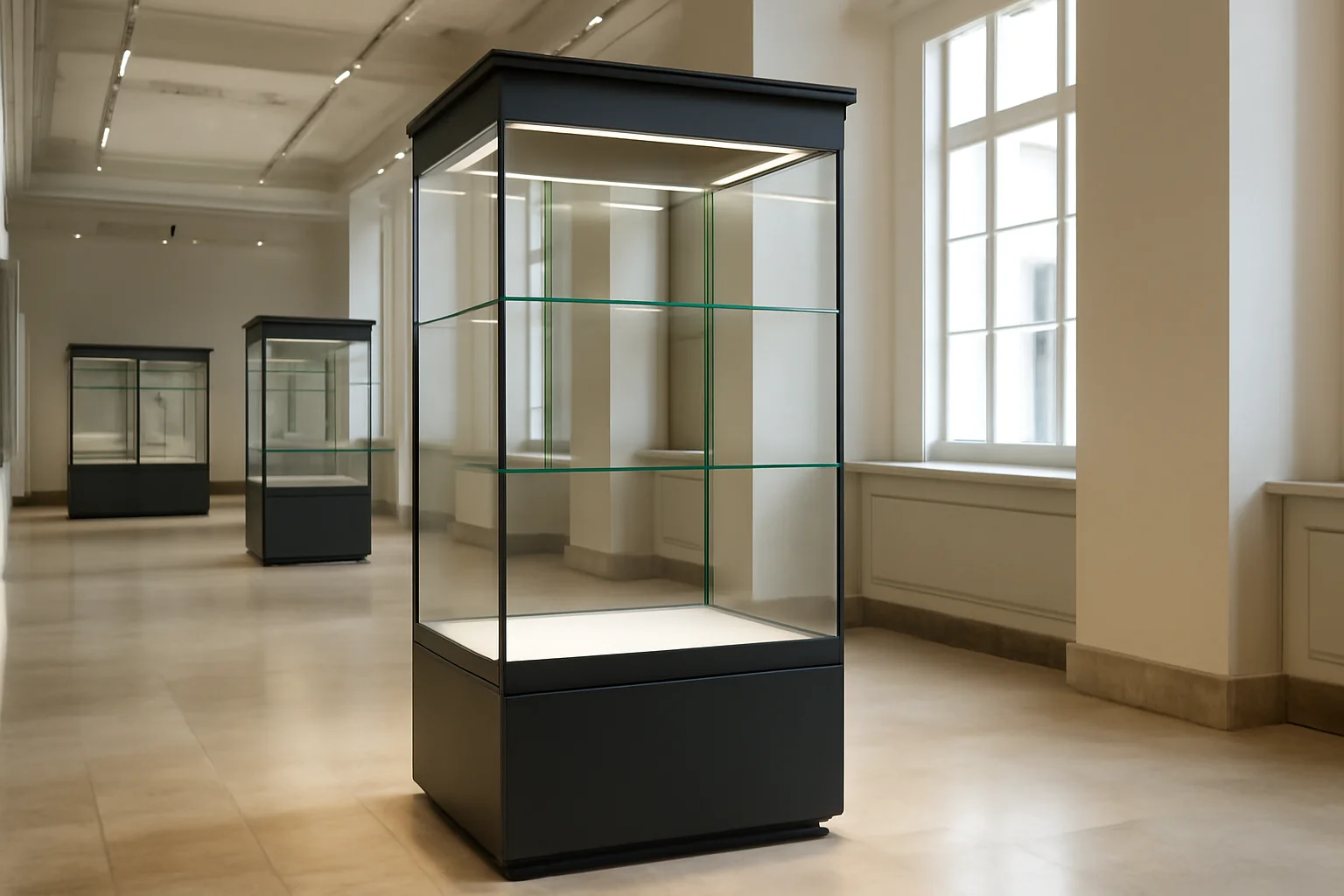
We fit out the museum hall and storage room with a set in a single decor: display cases for exhibitions, table display cases, open and sliding shelving for collections.
We fit out the salon end to end: reception, workstations for specialists, mirror stations, manicure area, shelving and waiting area in a single decor made of materials that withstand water and daily cleaning.
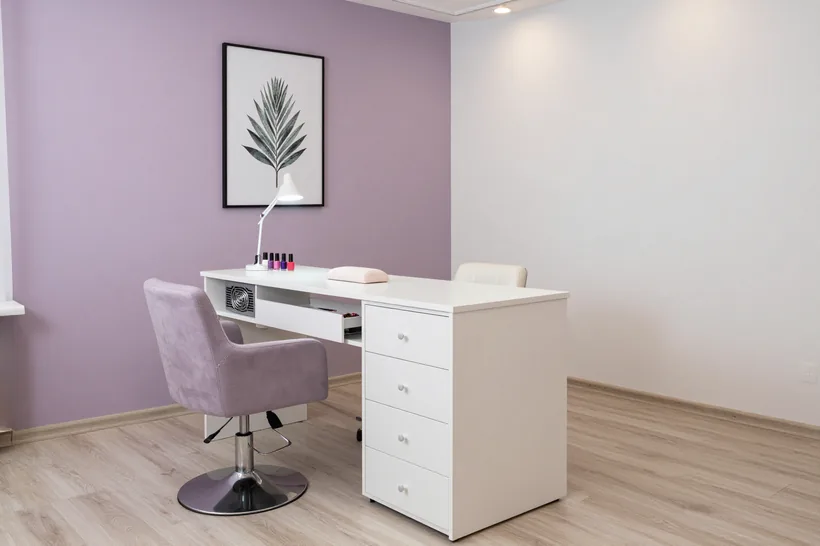
We make workstations for specialists to match the specialist's height and the room size: simple, with lighting, with a built-in extractor, folding for home, double and with stone.
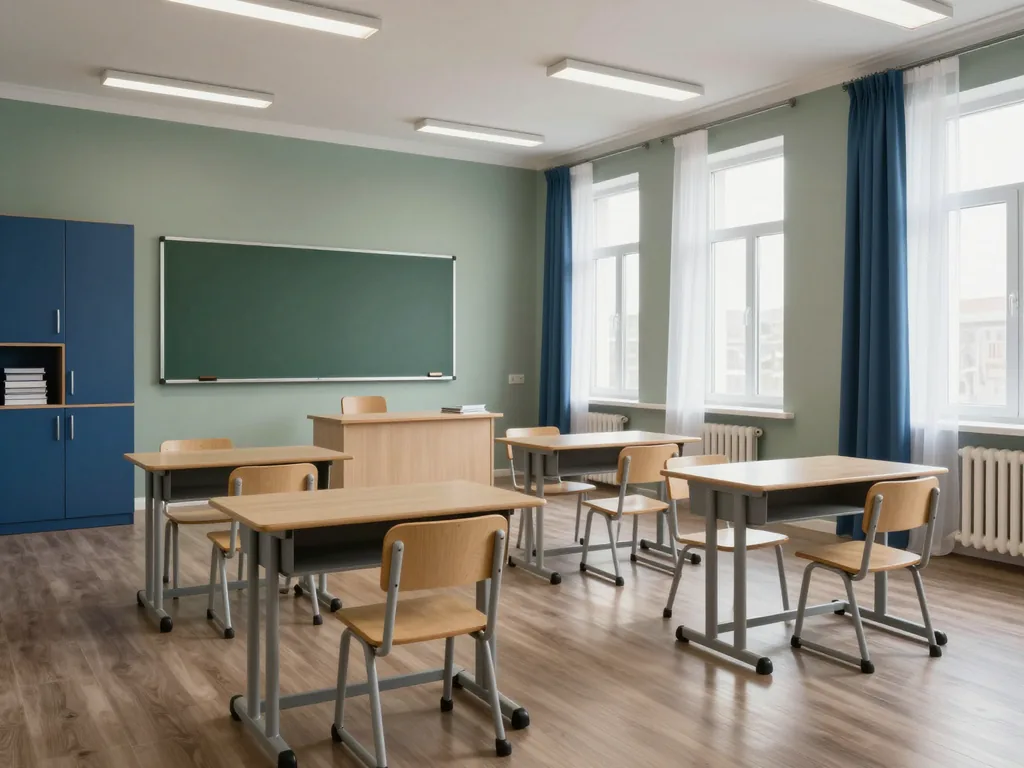
We make desks adjustable for height, chairs, teacher's desks and cabinets for classrooms and kindergartens with rounded corners and edge banding on every end.
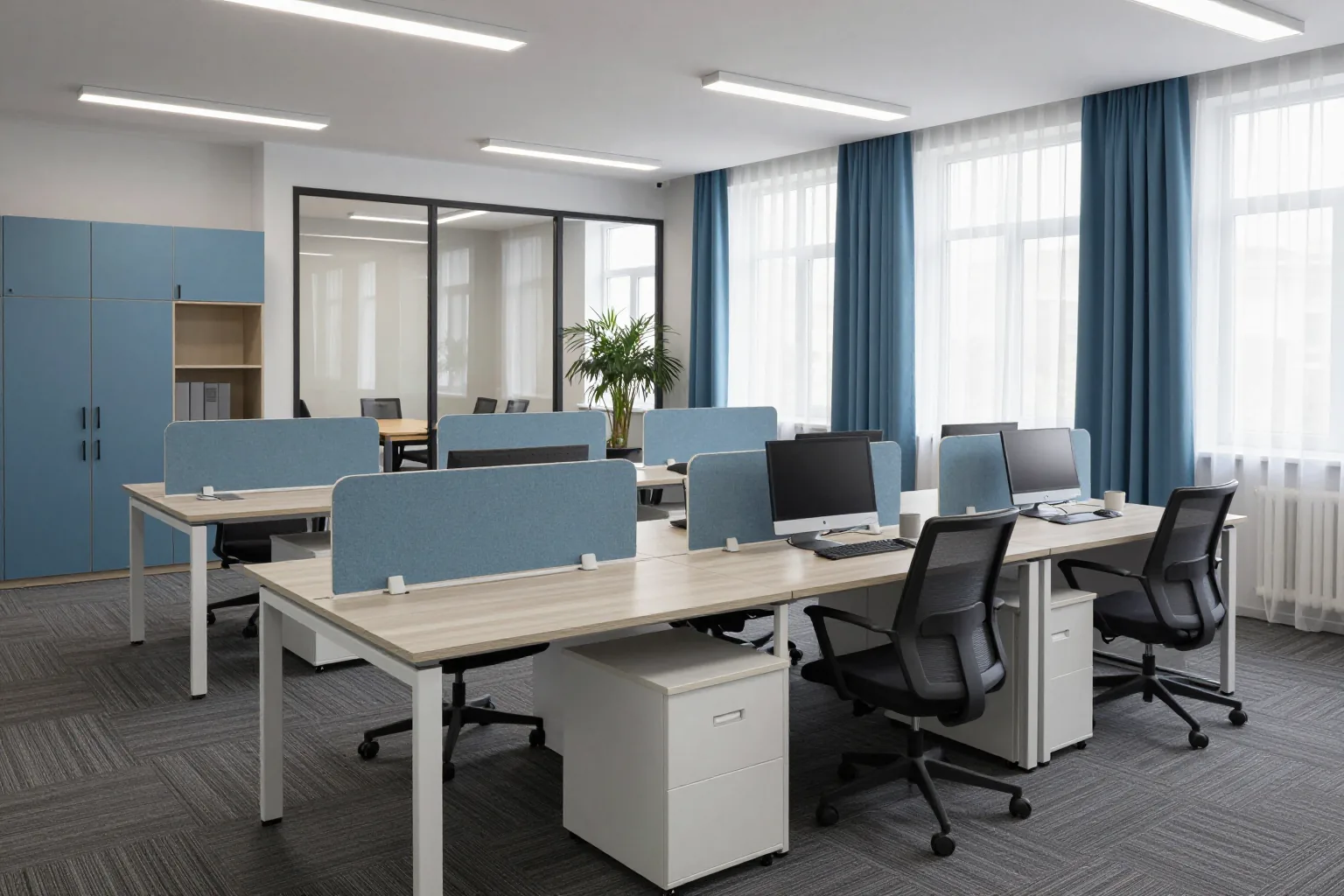
We design and make cabinet furniture for offices with a precise fit to the space and a single decor per floor.