
Temirzhan Nurpeisov
Furniture assembly carpenter11 years
★ 4.81 · 47 ratings
For business · Kindergartens
We make tables on screw legs and steel frames that adjust to the neighbouring GOST height group — from E1 laminated chipboard with rounded corners. Measurement and 3D layout are free, the price is fixed in the contract, warranty 24 months.
Measurement and 3D design are free and carry no obligation · price fixed in the contract · Kaspi Instalments up to 24 months
01Types
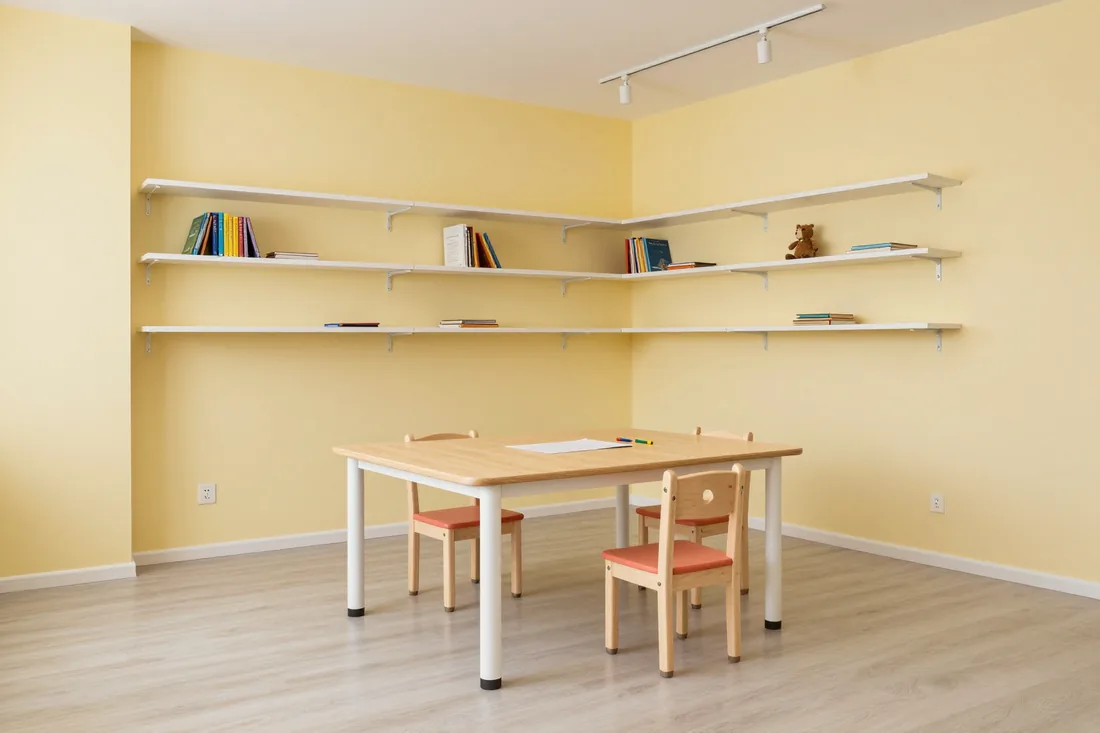 01
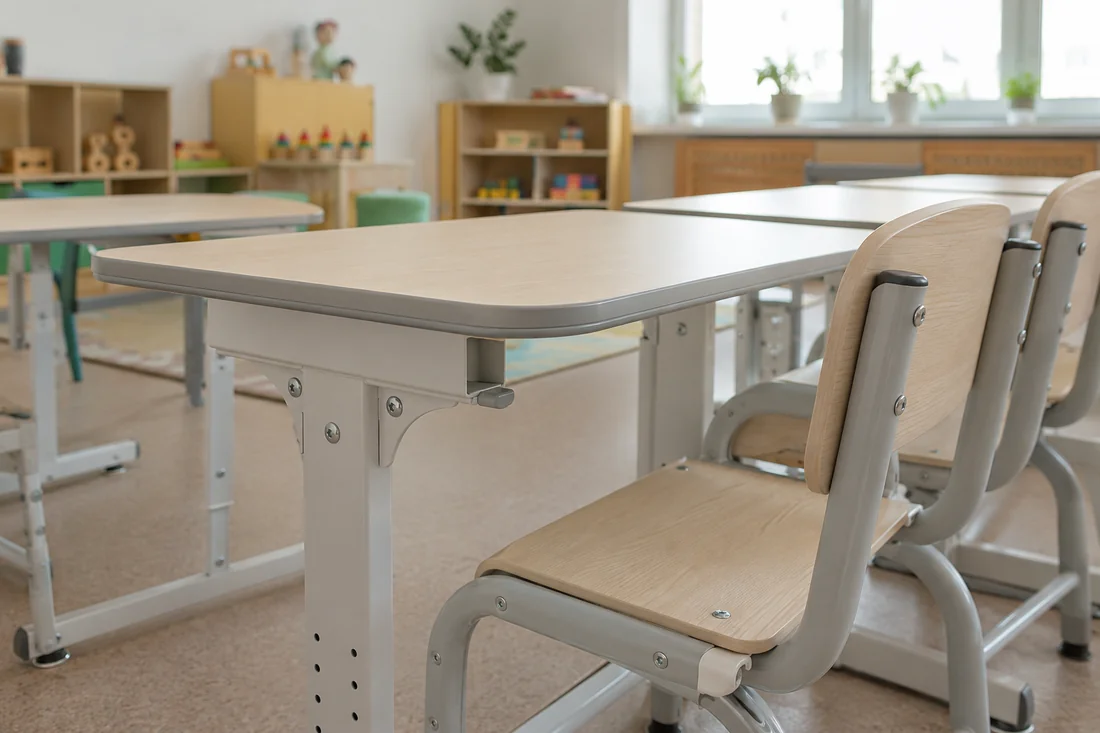
A lightweight two-seat table with height that adjusts to the neighbouring height group — the most popular option for group rooms.
from 18 900 ₸
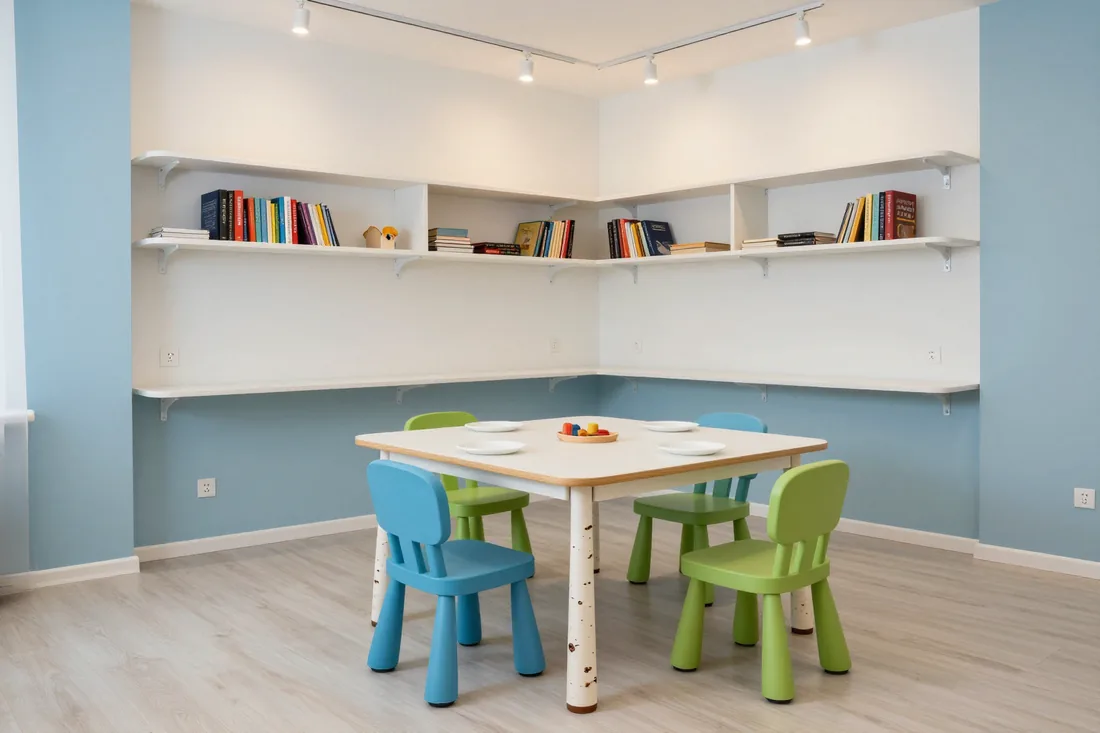 02
A wide tabletop for four children handles the shared load and suits lunch, play and group activities.
from 24 900 ₸
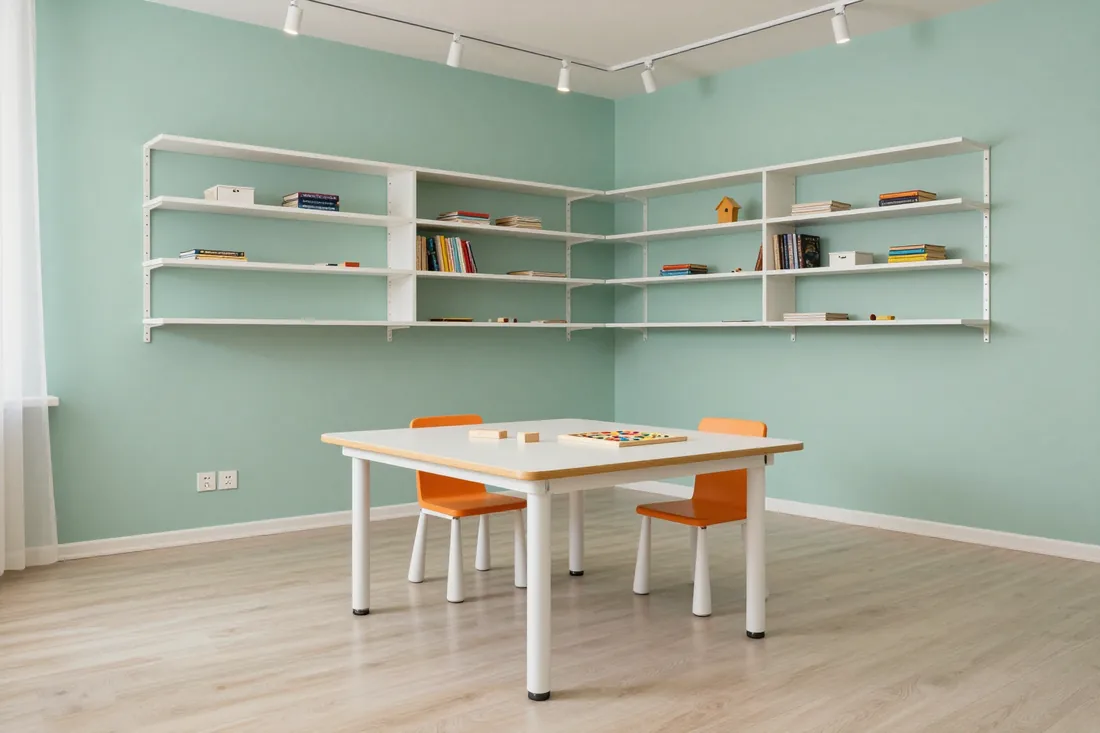 03
Height changes by turning the supports and is matched precisely to the children's height, even between standard marks.
from 21 900 ₸
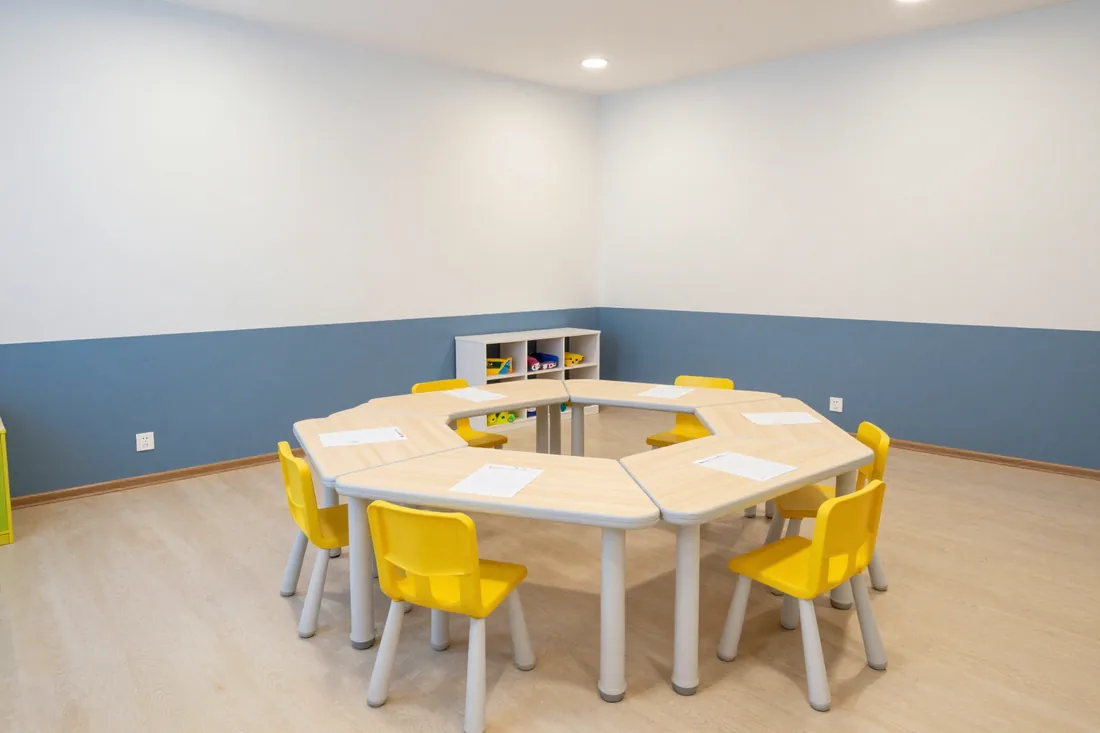 04
Adjustable trapezoids fold into a semicircle or hexagon — all modules are set to the same mark.
from 22 900 ₸
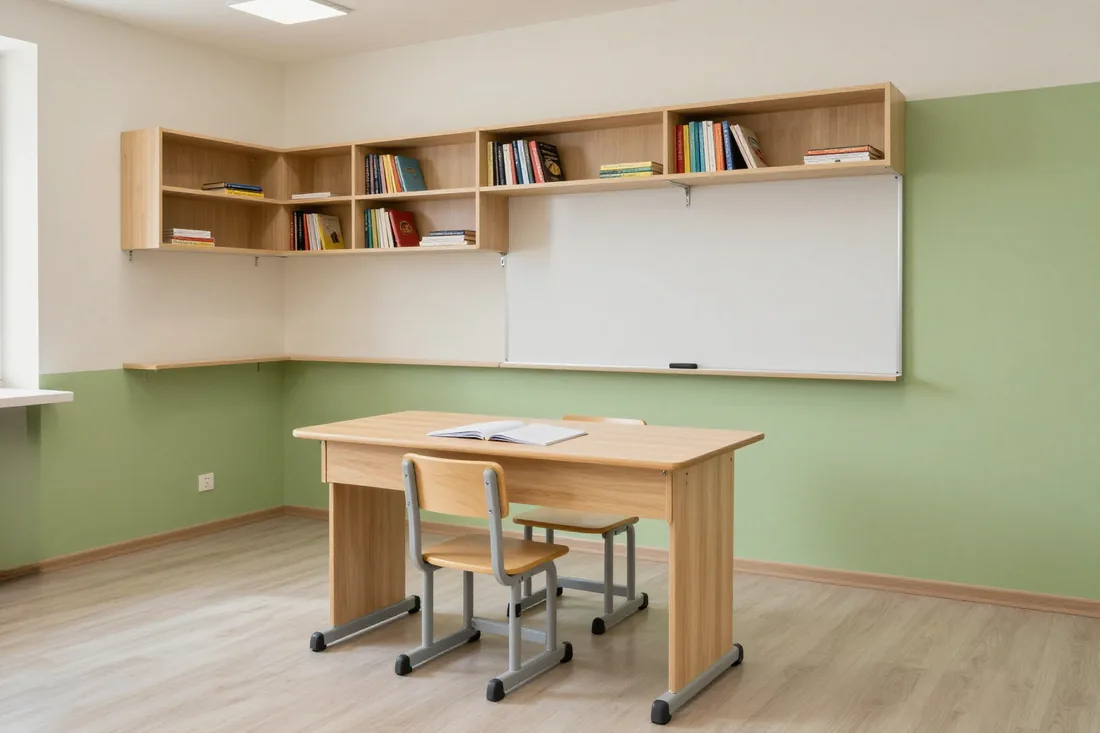 05
A desk on a steel frame changes height and tabletop tilt — for the preparatory group and writing.
from 27 900 ₸
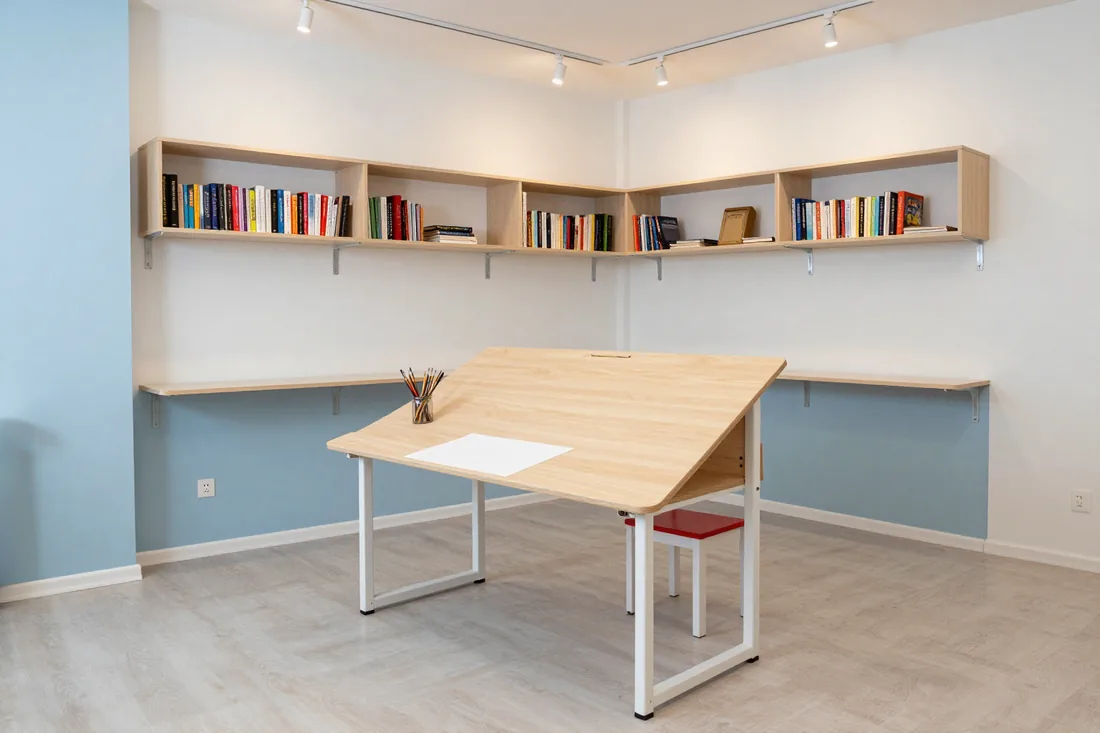 06
Tabletop tilt for drawing and reading; for eating and modelling it returns to the horizontal position.
from 26 900 ₸
02Projects
Site, scope, materials and lead time — per project.
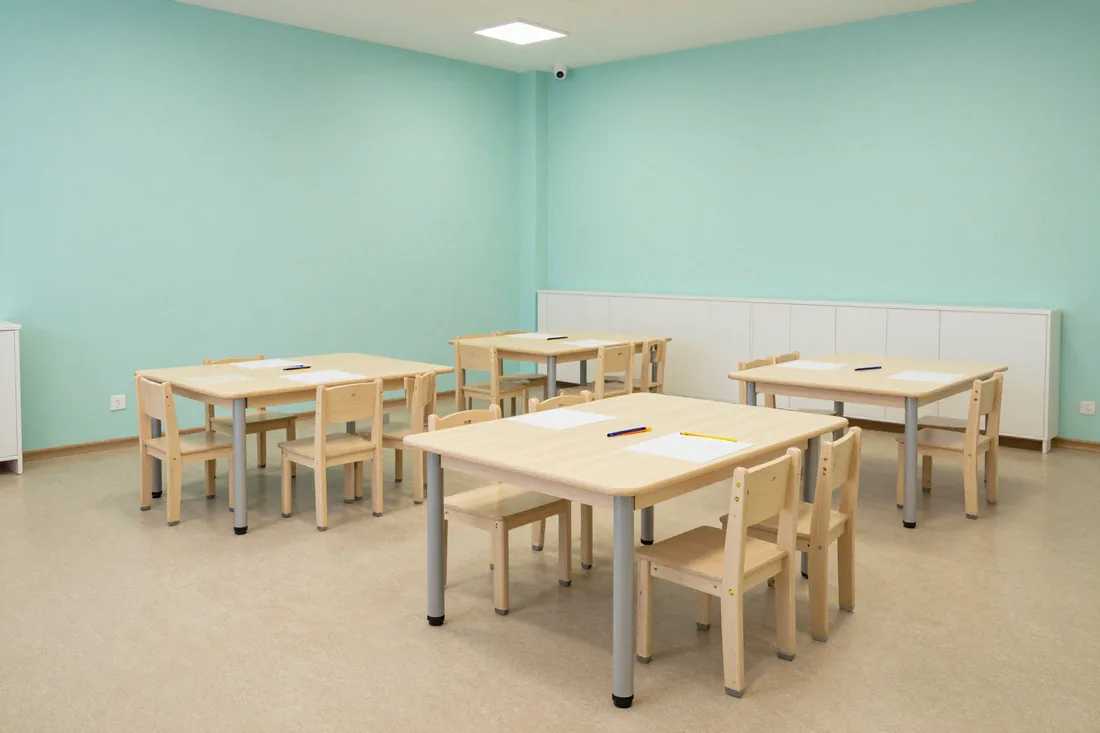 Kindergarten
Balbobek Kindergarten, Bostandyk district
Equipped the junior group with twelve two-seat tables with height adjustment for groups 1–3. Height was set to the children's stature, the supports were colour-coded — the tables grow with the children.
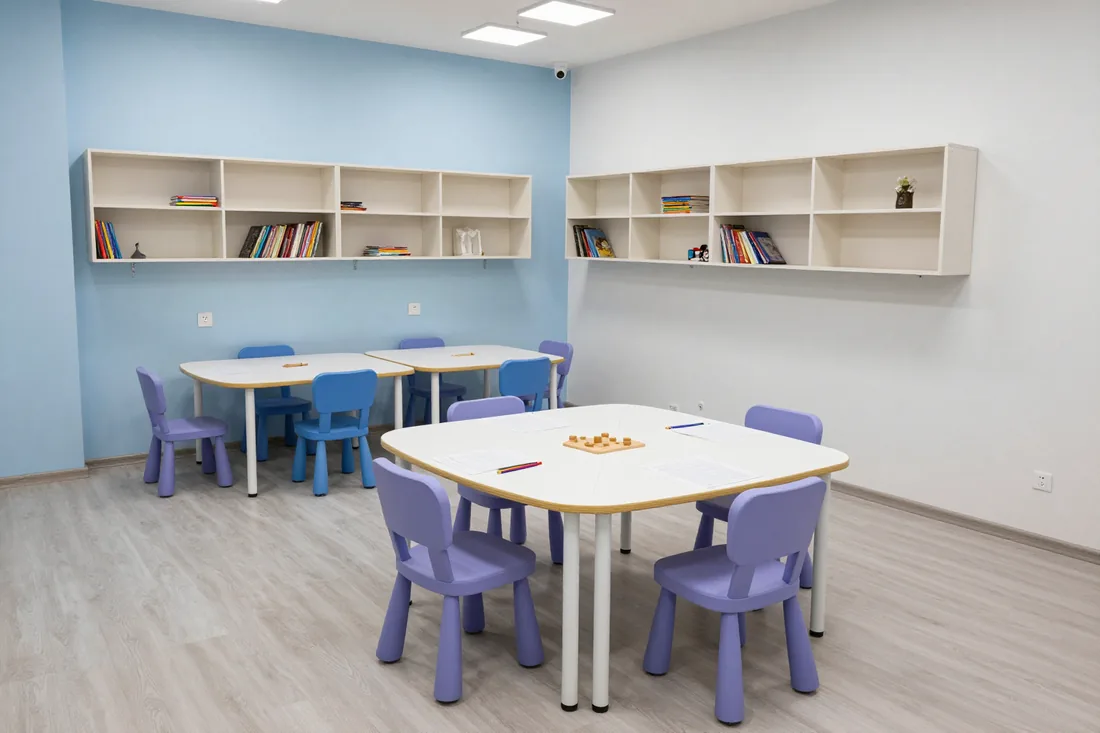 Kindergarten
Umnichka Development Centre, Medeu district
Ten trapezoid tables fold into a circle and a wave for different activities. The height of all modules was set to one height group — we rearrange the layout in a minute for play or creativity.
 Kindergarten
Private kindergarten, Esentai City, Medeu district
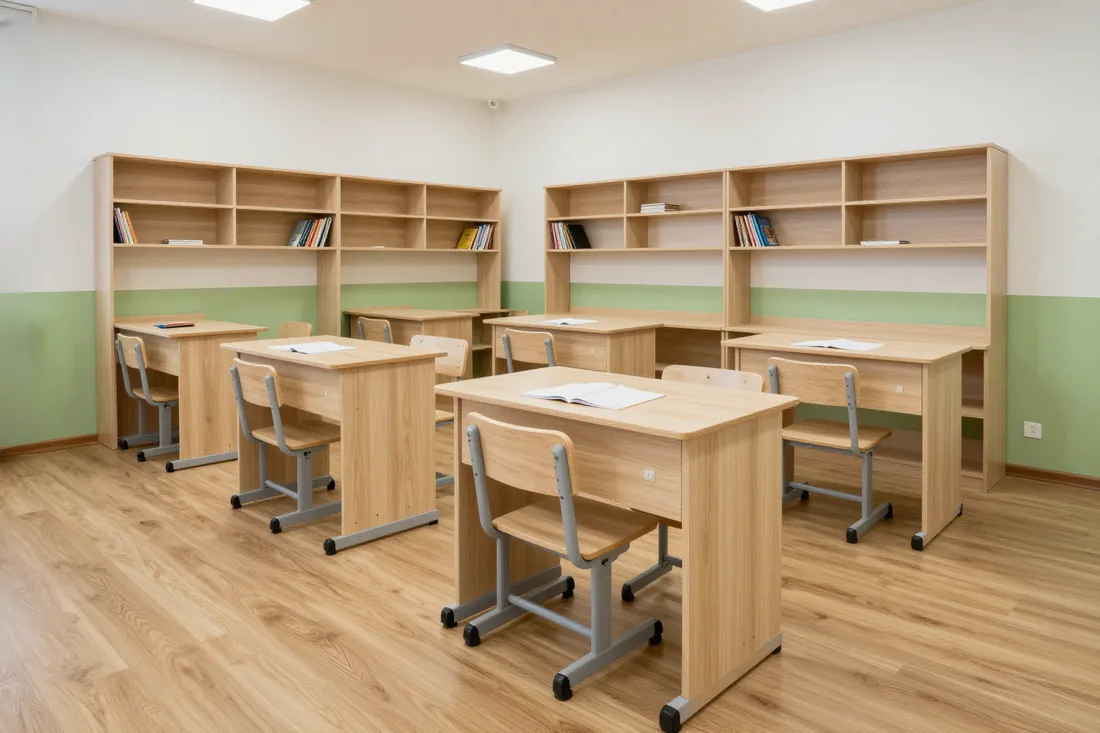
Sixteen growing desk-tables with smooth height adjustment for the preparatory group. They rise to 640 mm — children will still sit at them in first grade, with correct posture and a straight back.
 Kindergarten
Aigolek Kindergarten, Almaly district
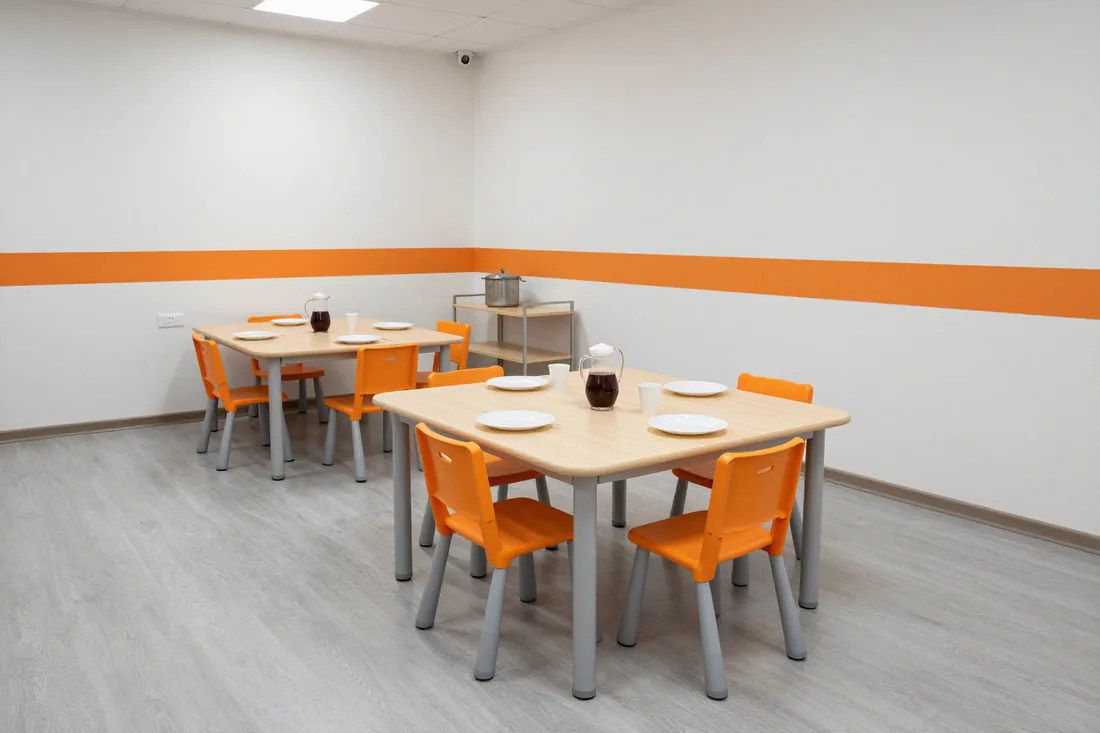
Twenty four-seat tables on a metal frame with telescopic height adjustment for the dining room. A single height per height group, the caps on the supports are quiet and do not scratch the floor.
 Kindergarten
Berezka Kindergarten, Auezov district
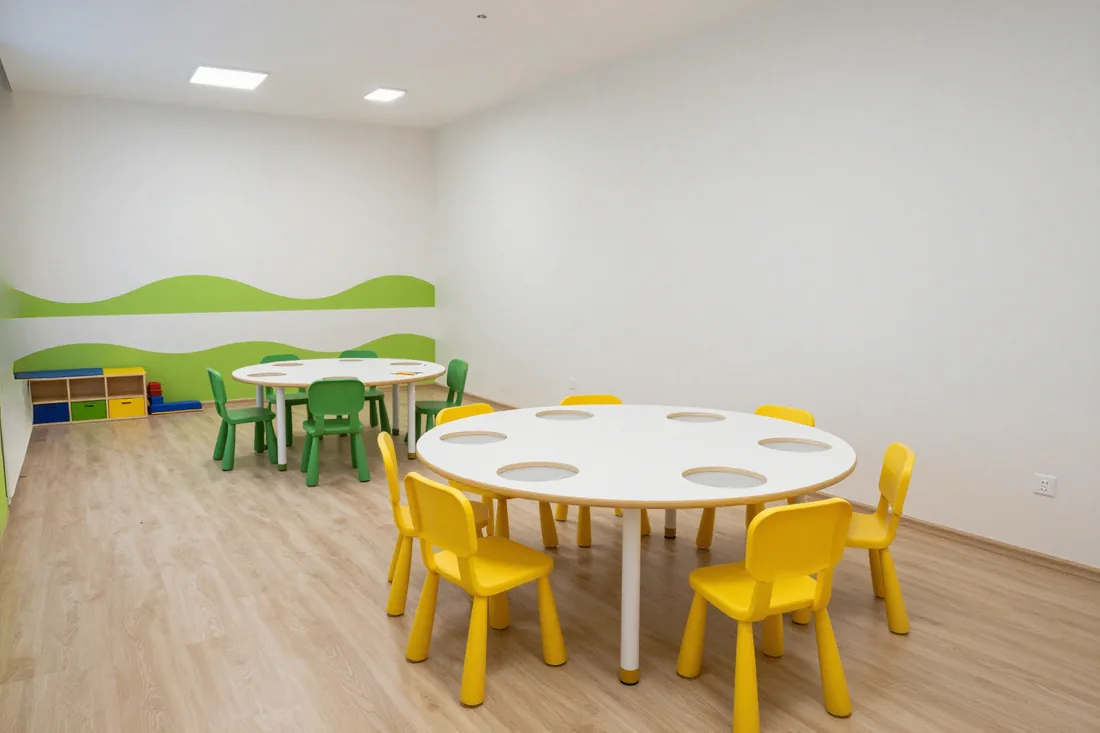
Built a play area from modular daisies for 6 children and round tables with no sharp corners at all. The height of all tables was set to the height group — children sit facing each other.
 Kindergarten
Kunshuak Development Centre, Nauryzbai district
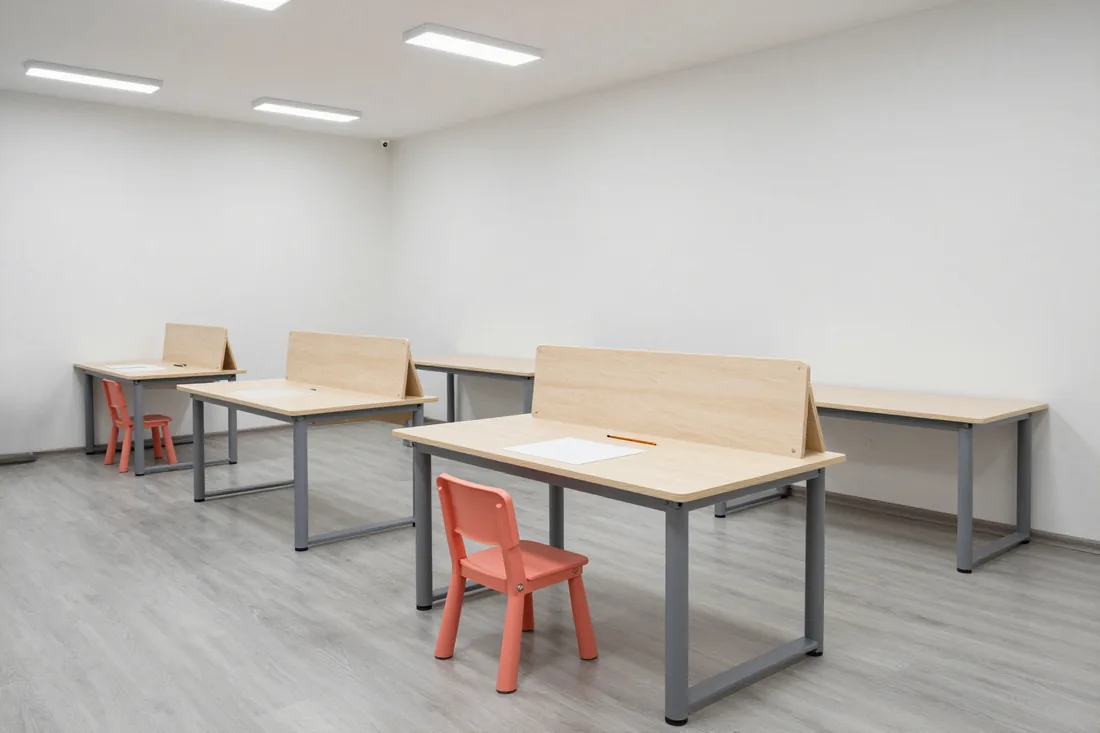
Twelve tables with height adjustment and tabletop tilt up to 30° for the art and drawing room. A stop bar holds the pencils, posture stays straight — the child's back does not get tired during class.
03How we work with kindergartens
04Prices
The from price is for a table with an adjustment mechanism in E1 laminated chipboard with rounded corners and PVC edging. The final price for a set per group is fixed in the contract after a free measurement.
05For legal entities and public-sector clients
We work with private and public kindergartens by contract and bank transfer. Items, height groups, decor and installation date are set in the contract before production begins.
Request a contract and invoice06Principles

01 / 06
07Production
Six steps in our 600 m² workshop. You can see each of them with your own eyes: the showroom and production are under one roof.
Egger · Kronospan · E1
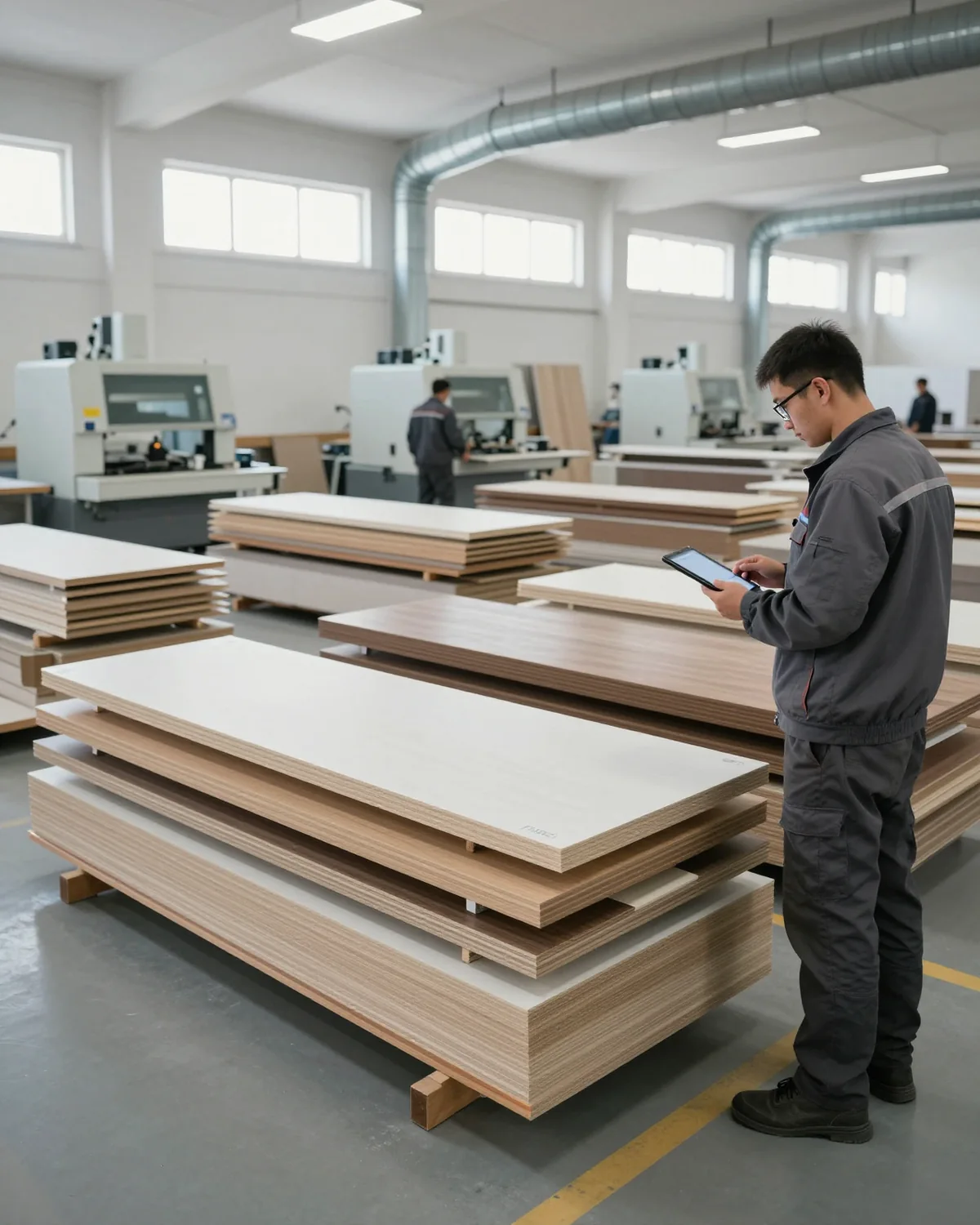
Egger and Kronospan boards of emission class E1 arrive at the workshop warehouse. 40+ laminated chipboard decors, 16–18 mm thick. Class E1 — for kindergarten groups and bedrooms.
Laser measuring to 1 mm
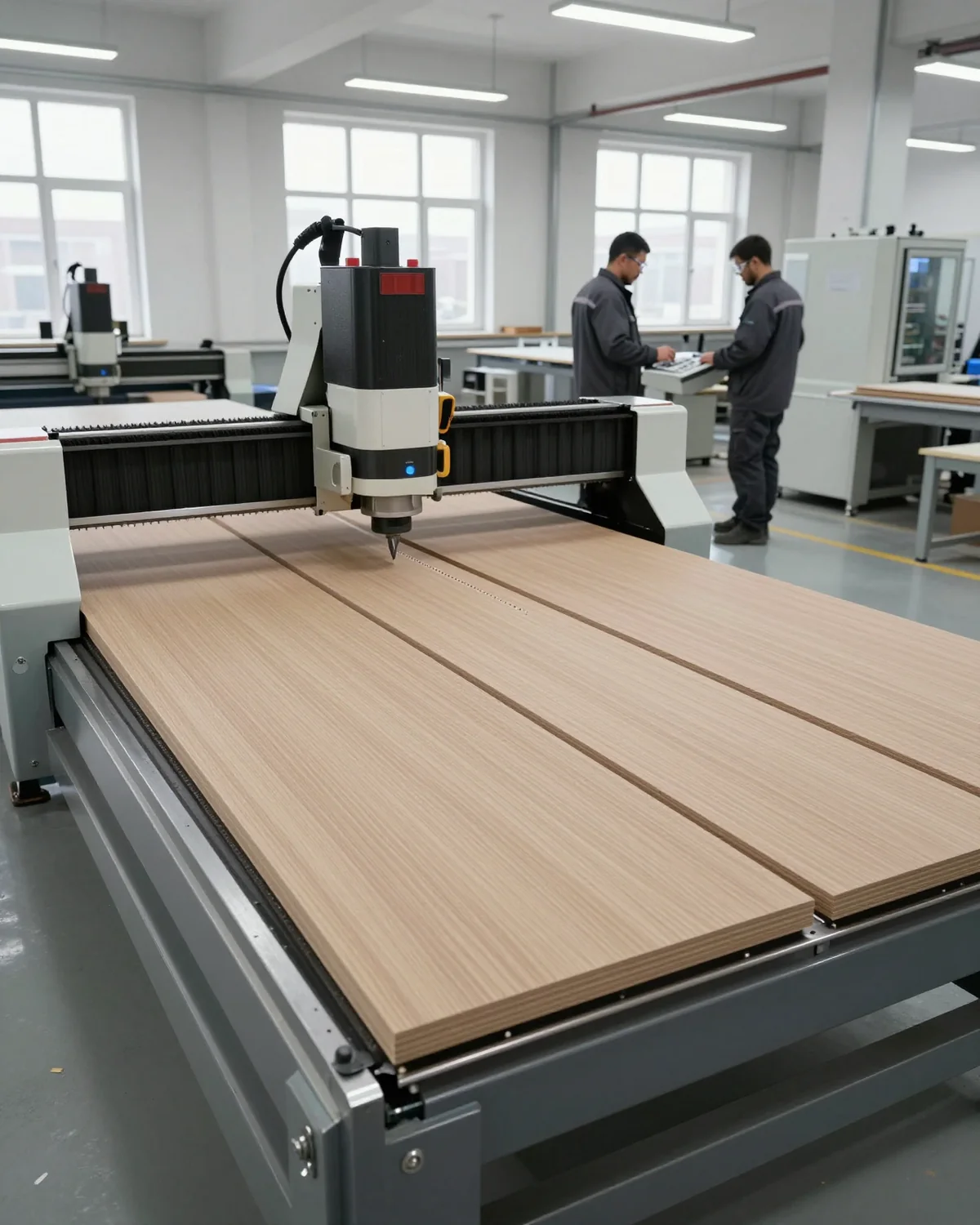
A design engineer prepares the drawings, and the machine cuts the board to them. Dimensions come from a laser measurement accurate to 1 mm.
Blum · Hettich · Boyard
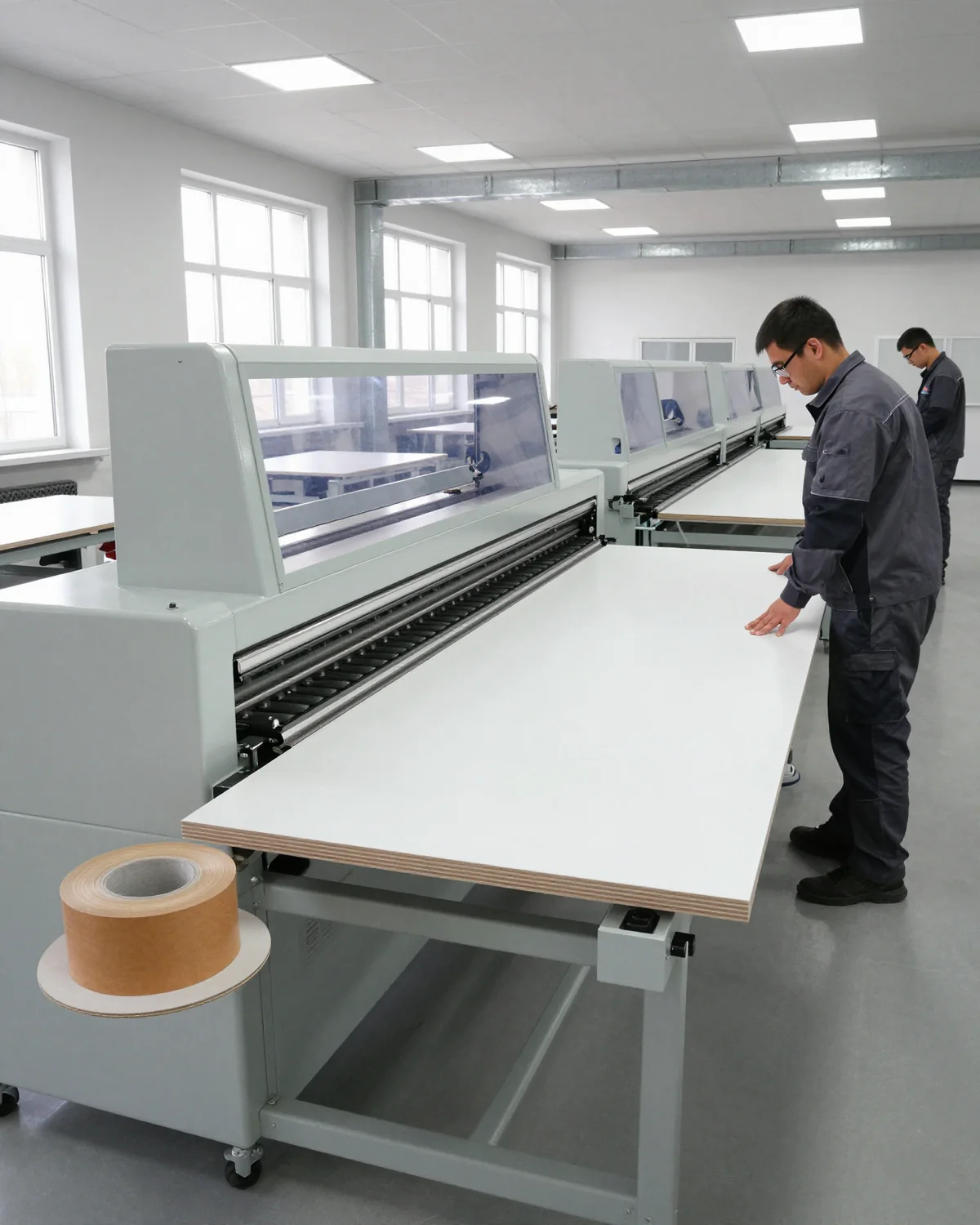
The edge-banding machine seals the edges, then we drill holes for Blum hinges and Hettich runners.
Any RAL colour
A finishing specialist paints fronts to RAL — matte and gloss. At the control assembly we check the mechanism's movement and the countertop's stability at the lowest and highest adjustment settings.
Pre-assembly in the workshop
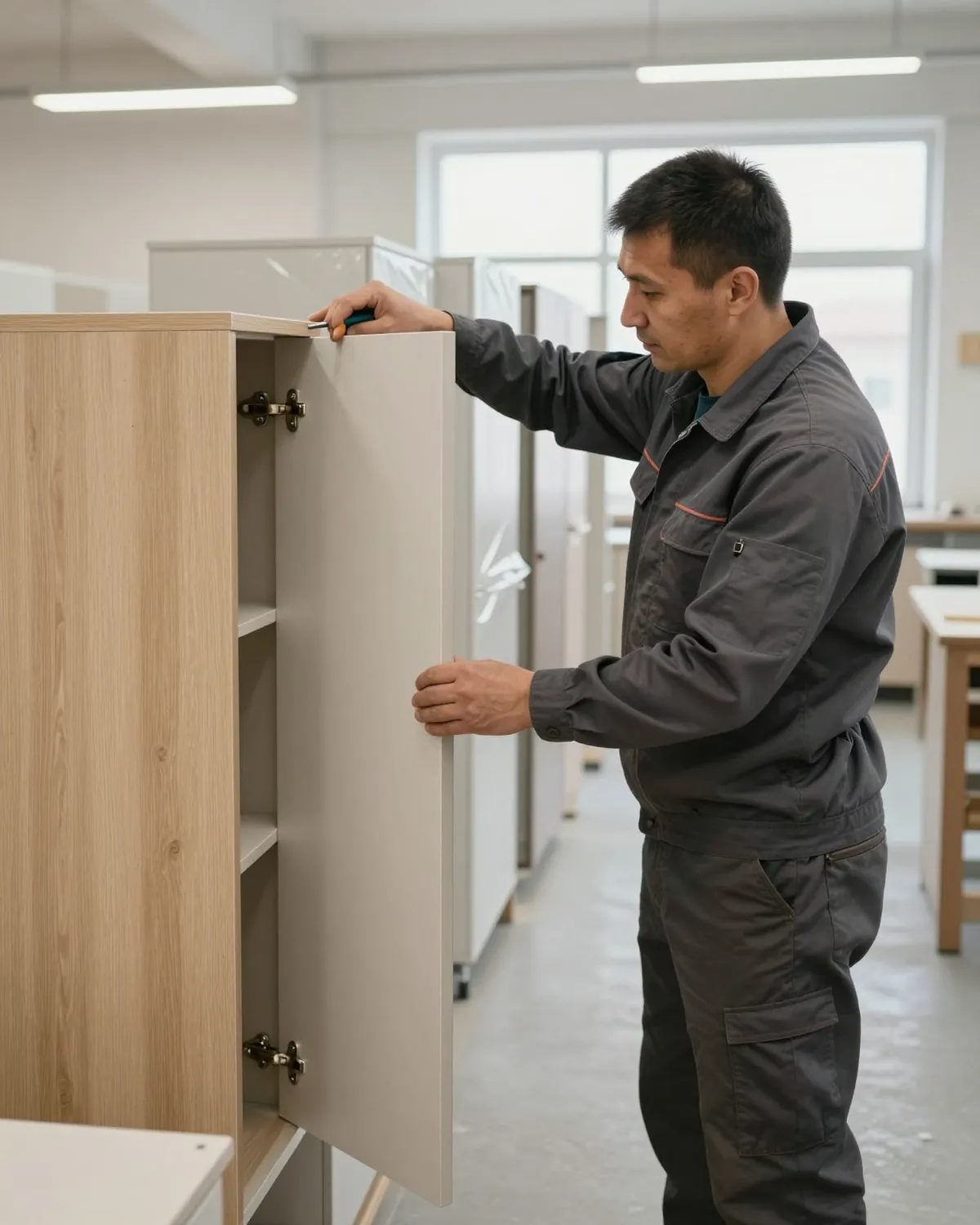
We assemble the modules in the workshop before dispatch, checking front gaps and drawer travel. The quality control department signs the item off for shipping.
Installation around the kindergarten's schedule
We deliver, bring in, assemble in 1 day, adjust the furniture and clean up after ourselves. Warranty of 24 months from signing the acceptance certificate.
08Team
MEBLIX workshop craftsmen who make and assemble furniture to order.
01 / 07Furniture assembly carpenter11 years
★ 4.81 · 47 ratings

Cabinet furniture repair craftsman20 years
★ 4.99 · 73 ratings
Furniture and kitchen unit assembler23 years
★ 4.97 · 300 ratings

Made-to-order furniture maker7 years
★ 4.26 · 32 ratings

Furniture maker5 years
★ 4.23 · 30 ratings

Joiner and carpenter20 years
★ 5.0 · 113 ratings

Furniture front and hardware fitter17 years
★ 4.61 · 92 ratings
09FAQ
Didn’t find the answer? Message us — a manager replies, not a bot.
Ask on WhatsAppEach model adjusts to the adjacent height group per GOST 19301. For the nursery and preparatory groups at the same time, it's better to take different models so the desk stands steady.
No, on the telescopic frame you just move the bolts to the holes of the required row and tighten them. During installation we'll show the facilities manager how to do this without skewing.
A frame with fixed increments is more convenient for frequent readjustment, while screw supports are for precise height adjustment and uneven floors. We'll choose the mechanism type during the measurement.
The most affordable option is the single "Solo"; if children sit in pairs, the two-seat "Duet" is better value. Prices for both desks are in the price list on this page. We quote the total for the whole group after the measurement, once the number of seats is known.
Yes, on uneven floors screw supports help: one leg is turned slightly and the wobble disappears. On the telescopic frame we check floor levelness during the measurement and select the right glides.
Yes, the mechanism is inspected once a season: the threads are cleaned with a dry brush, bolt tightness and paint chips are checked. We don't use thick grease, as it collects dirt.
Yes, the trapezoids and "Romashka" modules connect into a single shape. The main thing is to set all modules to the same setting, otherwise a step appears at the joint.
Yes, for such a classroom a growing desk or a desk with a tilt is used. The height is set to the children's height, and the tilt helps when writing in copybooks.
Yes, for LLPs, sole proprietors and government institutions we work under a contract and by bank transfer. For public procurement we prepare a commercial proposal and a specification to match the technical requirements.
First check that the bolt or lock nut is tight and the thread is clean. If the support still sags, write to us: the item is covered by a 24-month warranty under the contract, and it's better not to let a stripped hole get to the point of repair.
10Reviews
4,9
average rating
on Google and Zoon
Everyone can see a review on the platform: this is how other people check whom to trust with an order. If something went wrong, write to us and we will reply within 1–2 business days.
Message us on WhatsApp11Article
We make adjustable tables for kindergartens in our own workshop in Almaty: on screw supports and on a steel frame, with and without a tilting countertop. The height adjusts to the adjacent height group per GOST 19301, the countertop is E1-class laminated chipboard with rounded corners and vandal-resistant edging.
Preschoolers' height changes quickly, and group composition is renewed every year. Adjustment lets you fit the countertop to new children without replacing the furniture entirely.
Adjustment pays off when a group's composition changes every year or when children of noticeably different heights use the same room. We make adjustable tables for kindergartens for both scenarios: when a group is recruited anew, the countertop is raised or lowered to suit the new children's height instead of buying new items. In a mixed-age group, some tables are set for the younger children and some for the older ones, and all models stay in the same decor and the same shape. Another scenario is rooms where different ages are scheduled at different times: a speech therapy room, an art studio, a school-readiness room. There the height is changed less often, but without adjustment you would have to keep two sets of furniture in one space. As a result, one set serves several intakes of children in a row, and the storeroom does not fill up with written-off items of the wrong size. The savings are especially noticeable in institutions with many groups, where furniture moves from one to another every year.
Each of our adjustable models adjusts to the adjacent height group per GOST 19301: for example, from the second to the third or from the third to the fourth. The mechanism's range is designed so that in any position the countertop stands steady and does not wobble on extended supports. That is why for the nursery and the preparatory group at the same time it is better to take different models rather than one with maximum travel: at the extreme settings a long leg acts as a lever. When ordering, we look at the actual spread of children's heights and choose a model where both required settings fall in the middle of the range. If an institution runs groups of all ages, it is more convenient to build a specification from two or three models with different ranges than to try to cover everything with one item with a large travel.
| Parameter | Adjustable model | Fixed model |
|---|---|---|
| Changing height group | repositioning the supports | replacing the item |
| Stability | depends on tightening | maximum |
| Maintenance | mechanism check once a season | washing only |
| Where it pays off | changing composition, classrooms | single-age group |
| Marking | changed after adjustment | permanent |
The mechanism determines how quickly the height changes, how precisely all supports reach the same setting, and how much attention the item will need afterwards.
A screw support changes height by rotation: a threaded rod sits inside the leg, and when the support is turned, the countertop smoothly rises or lowers. Our "Vint" model with this mechanism is chosen where the height needs to be matched precisely to specific children, not just to a standard mark. Smoothness is both an advantage and a risk: the four supports are easy to set at different heights, and then the item wobbles. That is why, when adjusting, we bring all supports to the same mark using a tape measure from floor to countertop, and after adjustment we lock them with a lock nut. The screw mechanism suits classrooms where rearranging happens several times a year, and groups where fine adjustment to a spread of heights matters. Keep the thread clean: sand and modeling clay in the gap make rotation stiff, and the supports start to be set with a difference of a few millimeters.
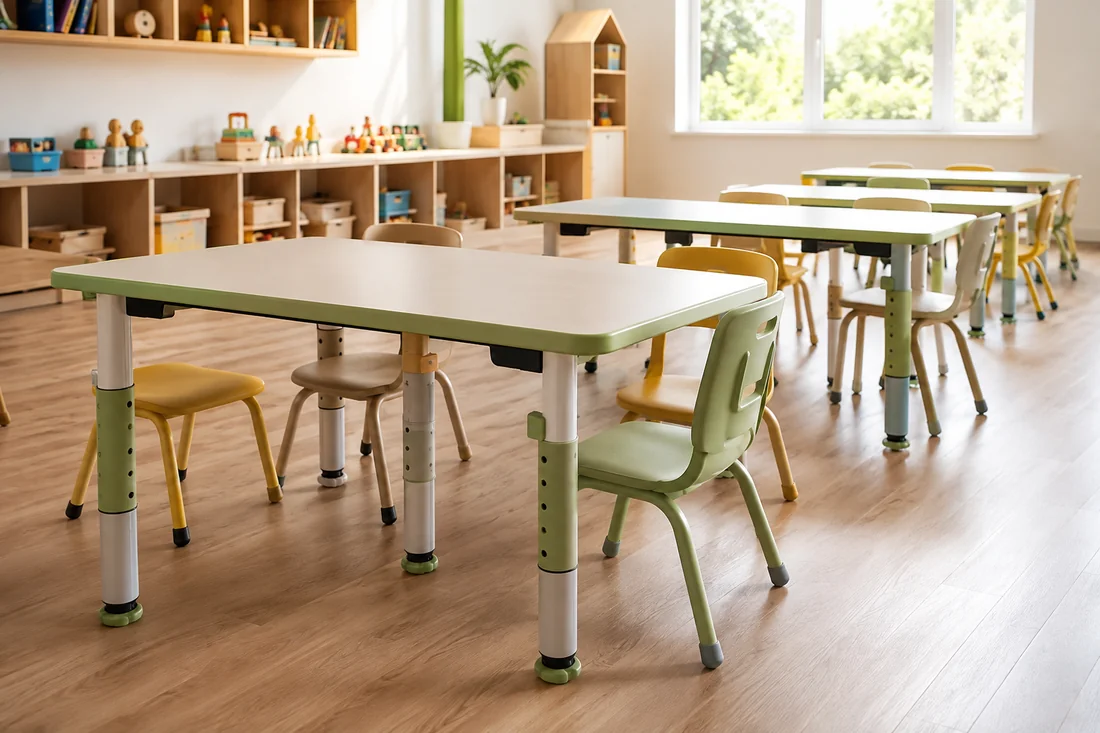
On a steel frame, the inner tube extends from the outer one and is fixed with a bolt in the hole at the required mark. Such legs are used on our "Karkas", "Rastishka" and "Gruppovoy" models: the hole spacing matches the height groups, so it is almost impossible to miss the height. The fixed spacing prevents skewing — if all four bolts are in the holes of the same row, the countertop lies level. The frame is powder-coated, which withstands daily wet cleaning and does not peel from chair impacts. Rearranging on telescopic legs takes less time than on screw ones, and it is easier to entrust to a facility manager without training. There is one drawback: with each adjustment the bolt must be tightened all the way, otherwise the inner tube starts to wobble and knock. That is why, after rearranging, the bolts are checked once more a few days later, when the item has already stood under load.
Changing the height takes little time, but requires order and one responsible adult. A mistake on one leg turns a level countertop into a wobbling and dangerous one.
Only an adult changes the height — a facilities manager, a teacher or a technician — and only when there are no children in the room. The most convenient time is before the new school year, when the groups are already formed and each child's height is known: the adjustment is then done once and lasts the whole year. An unscheduled change is needed if new children join the group during the year, or if it becomes clear that the little ones are sitting with their shoulders raised while the older ones are hunched over the countertop. Signs of the wrong height are easy to spot during a lesson: the child's feet do not reach the floor, they put a hand under their chin or lean their chest on the edge. Before rearranging, it is useful to measure the children's heights in the group again, because preschoolers grow noticeably over the summer and last year's data no longer fit. A height list for the group helps you work out in advance how many items to raise and how many to leave at the previous setting.
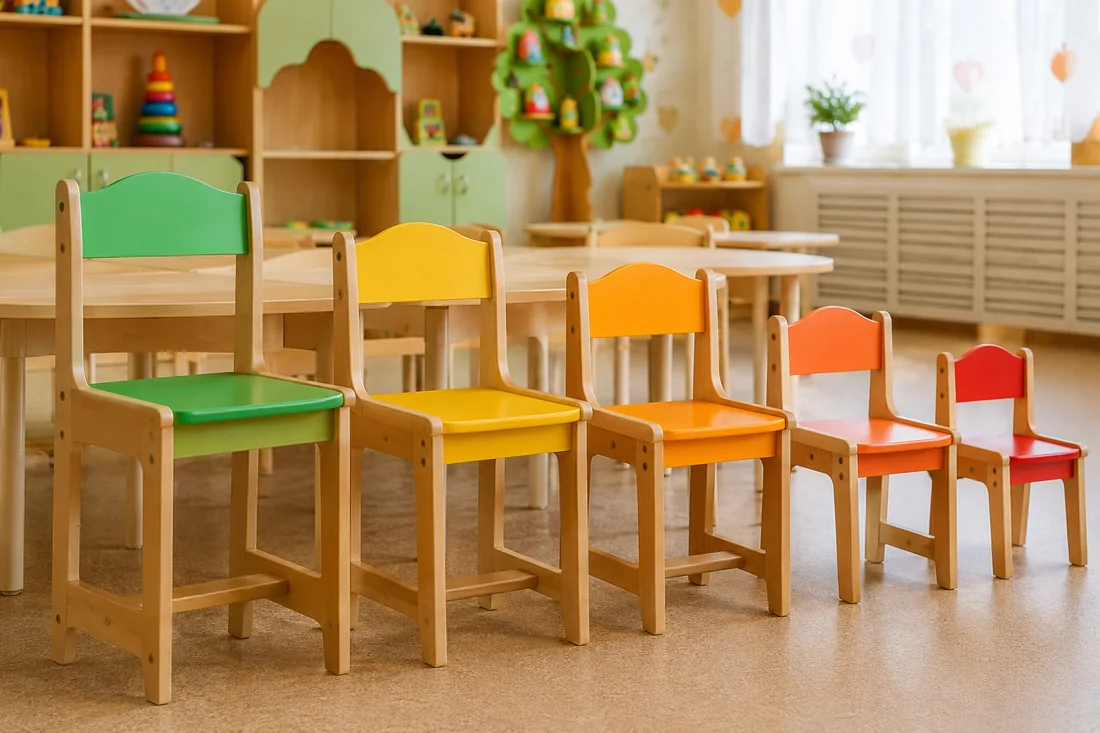
After adjusting, we recommend changing the colour label straight away: it shows the height group the table is currently set to. We apply colour marking by height group to every item, and when the height changes it is important to bring it up to date. If the old label is left in place, the children will be seated according to last year's plan and all the adjustment work will be wasted. Chairs are matched to the new label: a chair of the same height group is placed at each reconfigured place, and the spare ones are passed on to the neighbouring group. With mixed arrangements, where some tables are raised and some lowered, the labels also help the children themselves — a child quickly remembers their colour and sits in their own place. It is convenient to record the result of the adjustment in the group log: the date, the setting and the number of items reconfigured. Then the next time you adjust, you will not have to guess which item was changed and when.
Besides height, some models also have an adjustable countertop angle. The tilt is needed for drawing and writing, and growing desks combine both adjustments.
A tilted countertop takes the strain off the back: the sheet lies at an angle to the eyes and the child does not have to lean their chest over it. Our "Tilt" model on a steel frame is placed in art studios and school-preparation rooms where children draw a lot, write copybooks and look at books. The angle is adjusted with a clamp under the countertop, and the lower edge of the tilted part must not stay sharp — we round it off just like all the corners. For lessons where jars of water and paint stand on the table, the countertop is returned to the horizontal position, otherwise the liquid ends up on the children's laps. That is why it is more convenient when the tilt and height mechanisms work independently: the teacher raises the sheet for drawing without touching the leg height set for the child. This independence is especially important in rooms where children of different heights take turns at the same item.
A height-adjustable desk changes both the height and the tilt of the tabletop, so it is most often chosen for the preparatory group, where children are already learning to write. We make the "Rastishka" desk on a steel frame with E1-class laminated chipboard, and the "Chameleon" transformer table from solid birch on a metal frame for classrooms with a warmer interior. A tilted desk encourages a proper school posture: the back is straight, the elbows rest on the tabletop, and the eyes are at the right distance from the notebook. The transformer comes in handy in classrooms where writing lessons are held in the morning and games and building in the afternoon: the tabletop is lowered to horizontal, and the work surface becomes flat. The solid birch is coated with a water-based lacquer that withstands daily wiping without losing its appearance. Both items match chairs of the same height group, and the pair is selected by a single colour marker.
Adjustment is not limited to simple rectangular models. Shaped items also change height, but they require careful setting when assembled into a single figure.
We make tables for kindergartens with height adjustment in three basic sizes: the single-seat "Solo", the two-seat "Duet" and the four-seat "Quartet". The single-seat model is needed for individual lessons and for a child whose height differs noticeably from the others: their place is adjusted separately without touching the rest of the row. The two-seat is the most popular option for a group room, it is light and is quickly rearranged by one adult. The four-seat handles the overall load better: when four children lean on the edge at the same time, the wide tabletop distributes the weight across all four supports. We make all three sizes from E1-class laminated chipboard with rounded corners and vandal-resistant PVC edging, so they can be combined in one group room with no difference in decor and edge finish. For lunch it is convenient to push several four-seat tables into a long row, having first set them to the same mark.
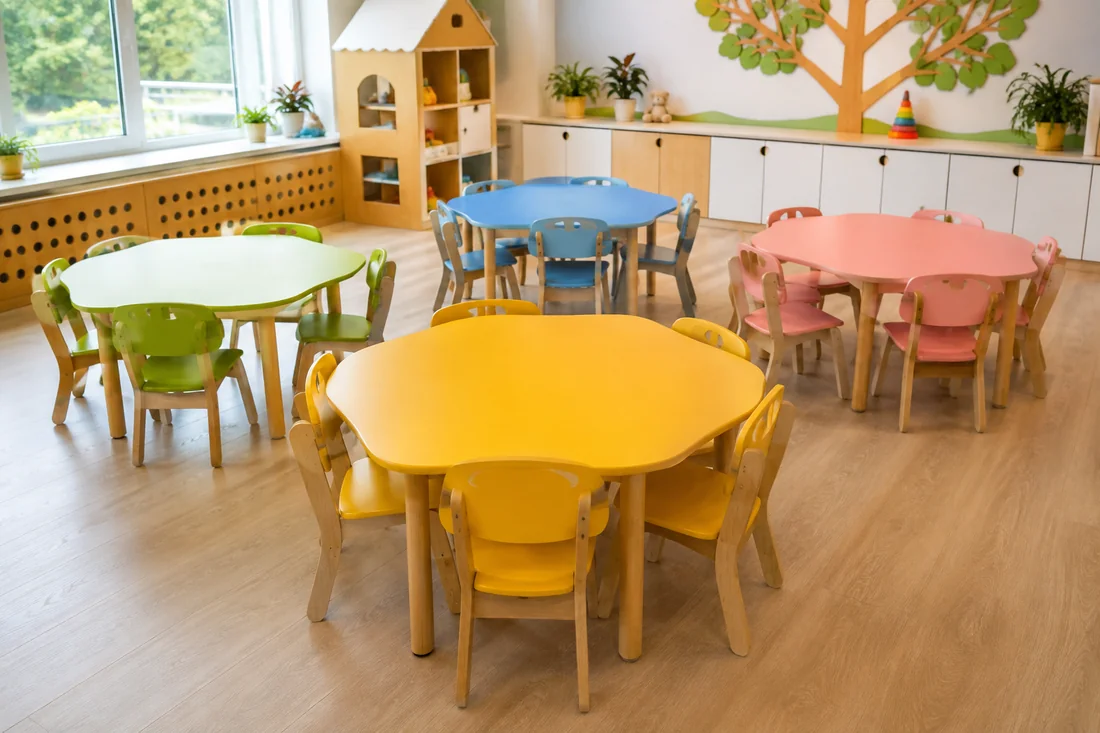
Shaped models are adjustable too: we make the “Trapezoid”, “Semicircle”, “Circle” and the modular “Daisy” with a mechanism for the neighbouring height group. Trapezoids and “Daisy” modules are assembled into a single shape, so during assembly all modules are set strictly to the same mark — otherwise a step appears at the joint between countertops, which sleeves and notebooks catch on. The semicircular model is convenient for a teacher working with a subgroup: the children sit along the arc, and the adult sits in the centre on an ordinary chair. A round table with adjustment suits classrooms where children of different ages take turns at one countertop. For shaped models we recommend a telescopic frame with holes: an identical pitch guarantees that all modules end up at the same height without measuring. After assembly, the shape is checked once more by hand along all joints.
| Model | Purpose | Supports |
|---|---|---|
| “Solo” | one place, individual lessons | adjustable legs |
| “Duet” | two places, rows in the group room | adjustable legs |
| “Quartet” | four places, meals and play | adjustable legs |
| “Screw” | precise fitting to height | screw supports |
| “Frame” | frequent rearranging | steel frame |
| “Group” | high load | frame, 25 mm laminated chipboard |
The mechanism needs attention more often than ordinary group furniture, because it has moving parts. A few simple checks extend its life and keep it stable.
Once a season the mechanism is inspected and cleaned: the thread is checked on screw supports, and the condition of the bolts and holes on the frame. Over time, sand, modelling clay and dust accumulate in the thread, which makes the support turn stiffly and the tightening become uneven. The thread is wiped with a dry brush and not greased with thick lubricant: it collects dirt and soils children's clothes. The powder coating of the frame is inspected for chips and touched up in time so that rust does not appear underneath. If the inner tube of a telescopic leg starts to wobble even after tightening, the bolt is replaced without waiting for the hole to wear out. It is convenient to record the results of the inspection in the same log where height changes are noted — this way you can see which items need attention more often than others. If the mechanism does not hold the mark even after replacing the bolt, it should be shown to a warranty technician rather than tightened further.
We select adjustable tables for kindergartens after a free measurement: we look at the room area, the number of children and the spread of their heights, and within 1–2 days we prepare a 3D layout design. In the specification we list the model, mechanism and adjustment range of each seat so that the head of the kindergarten can see which height groups the set is configured for. We manufacture everything in our own 600 m² workshop, and during the control assembly we check how the mechanism moves and its stability at the extreme settings. The warranty on the item is 24 months under the contract; during installation our team sets the height for the current group. Lead times for each option are in the price list on this page; we accept bank transfer payments from LLPs, sole proprietors and government institutions, and for public procurement we prepare a commercial offer and a specification to match the technical requirements.
Height adjustment pays off only when the mechanism matches the task and is properly maintained. Before ordering, it is worth going through a short checklist.
12Calculation
Choose the model, quantity and material — the request will go to a manager on WhatsApp, and we'll send an exact quote with the adjustment range after the measurement.
13Furniture for kindergartens
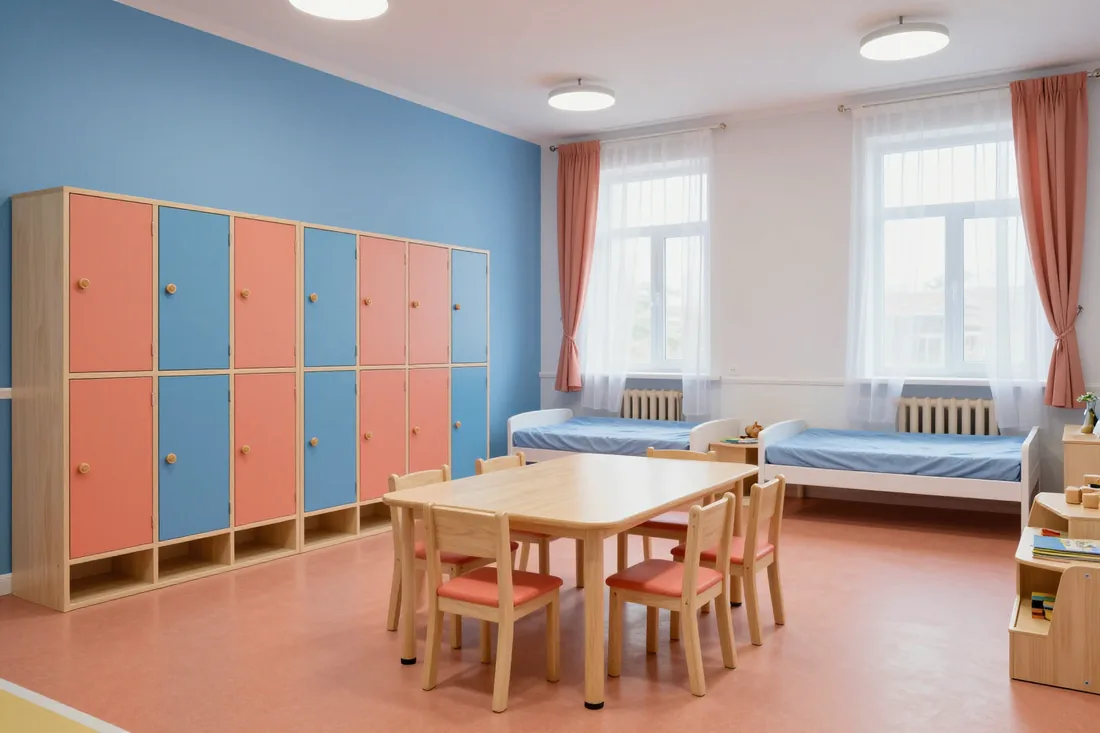
We equip group rooms, bedrooms and cloakrooms with beds, lockers, tables and chairs by GOST height groups in E1 laminated chipboard with rounded corners.
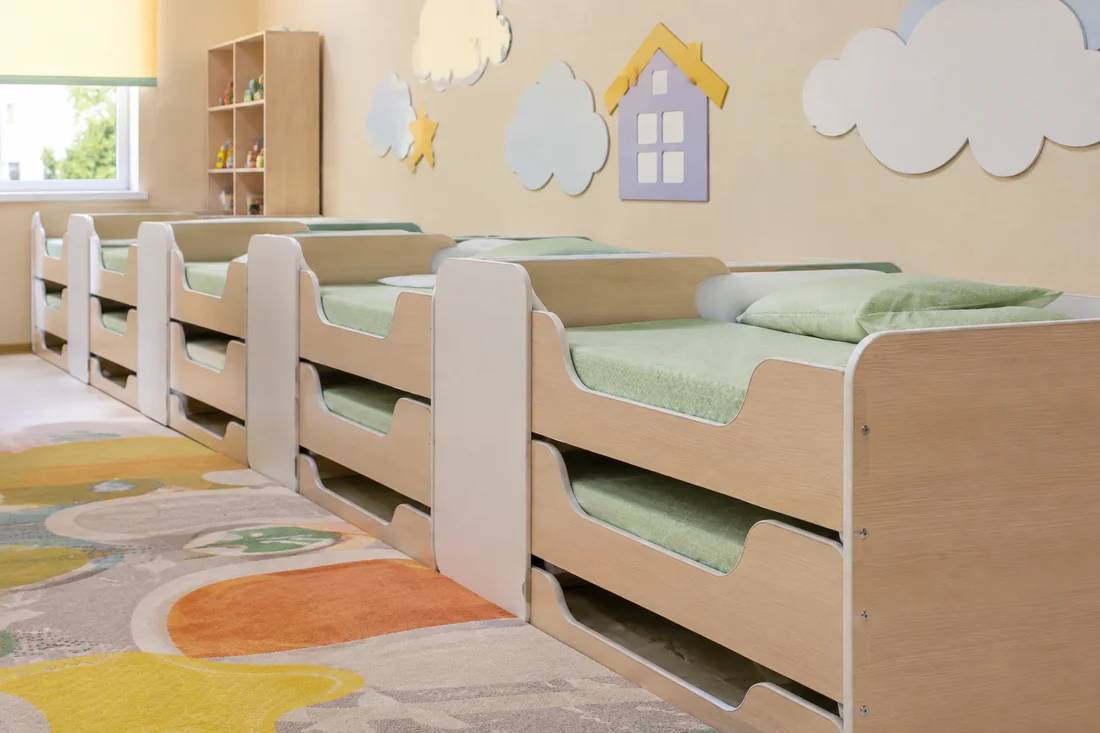
We make single-tier, stackable, nursery and pull-out beds to fit the bedroom area and the height of the children in the group: E1 laminated chipboard or birch solid wood, rounded corners, mattress to fit the bed.
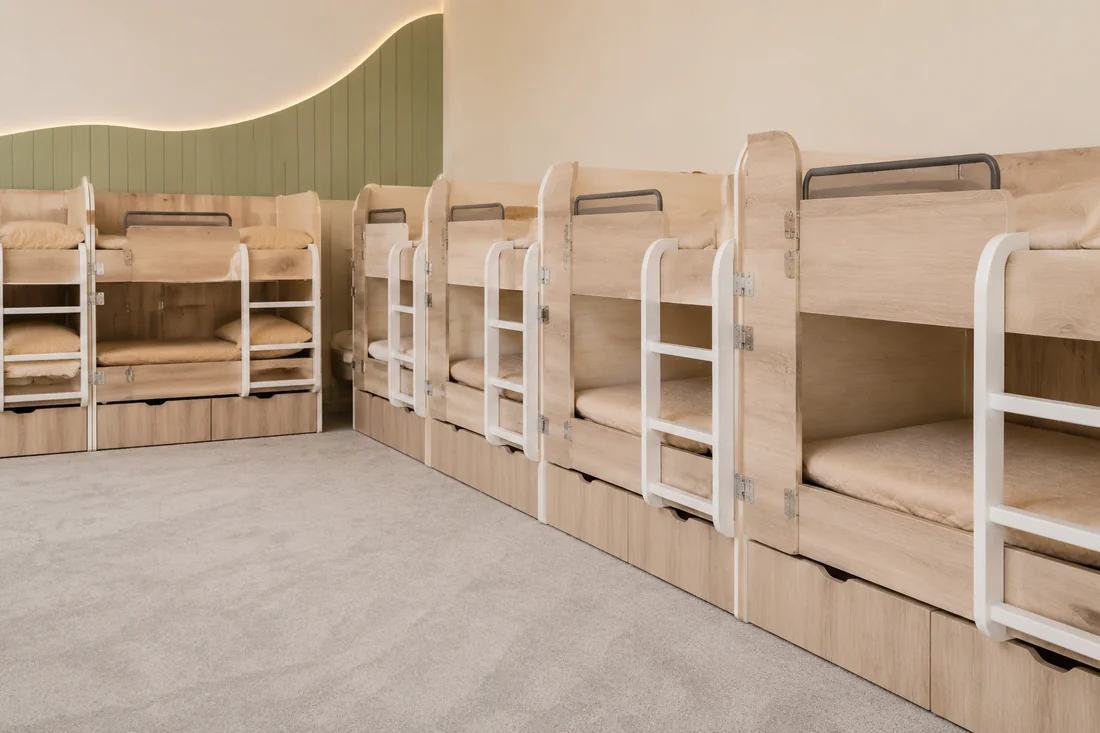
Beds for kindergarten group bedrooms, made to the number of children in the group: two- and three-tier, rails around the top tier, solid wood ladder, E1 laminated chipboard, wall fixing.
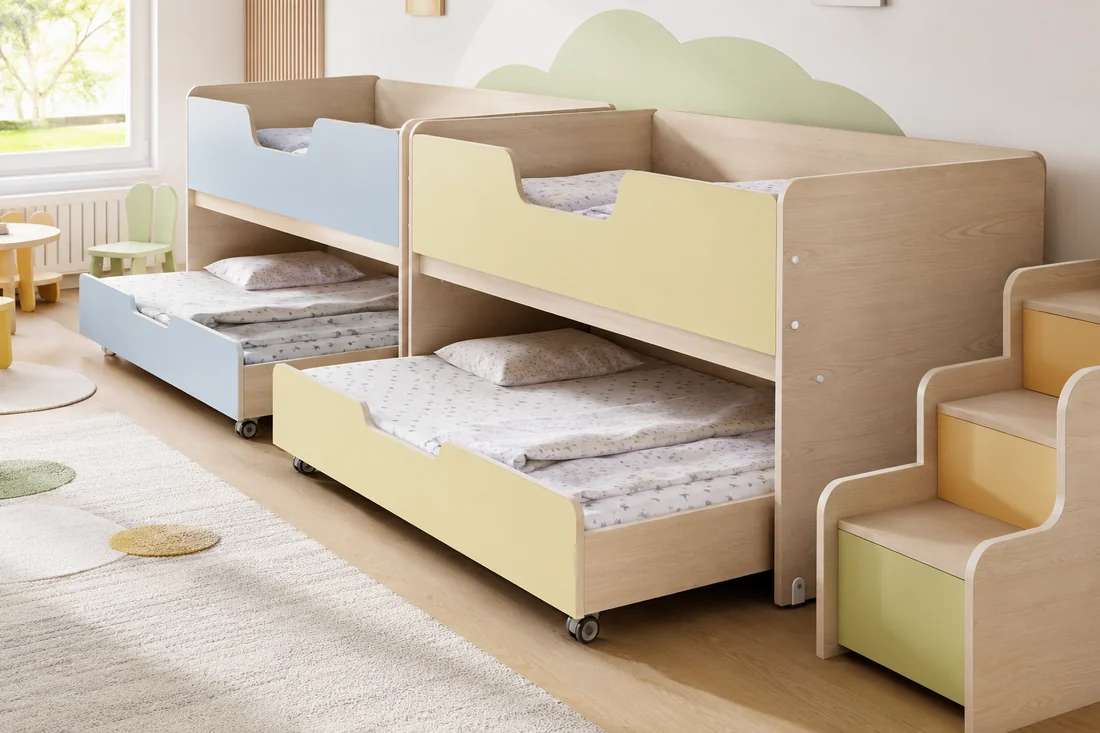
Two or three sleeping places slide one under another and free up the bedroom floor during the day for play and activities.
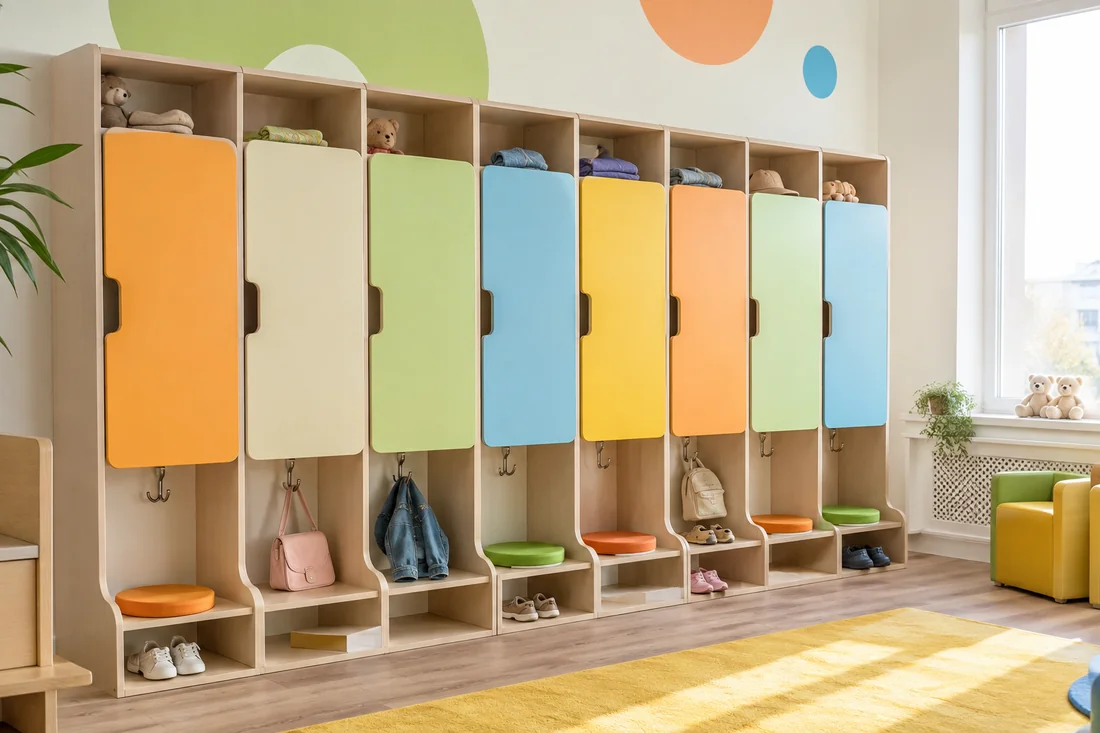
Lockers with personal cubbies, hooks at a child's hand height and a bench for the cloakroom, plus cabinets for supplies, toys and linen in E1 laminated chipboard.
We make rectangular, trapezoid, round and dining tables by GOST height groups in E1 laminated chipboard with rounded corners and a washable countertop.
We make height-graded, adjustable and stackable chairs by GOST groups in E1 laminated chipboard, birch plywood and solid wood, with rounded corners and colour coding.