
Temirzhan Nurpeisov
Furniture assembly carpenter11 years
★ 4.81 · 47 ratings
For business · Museums
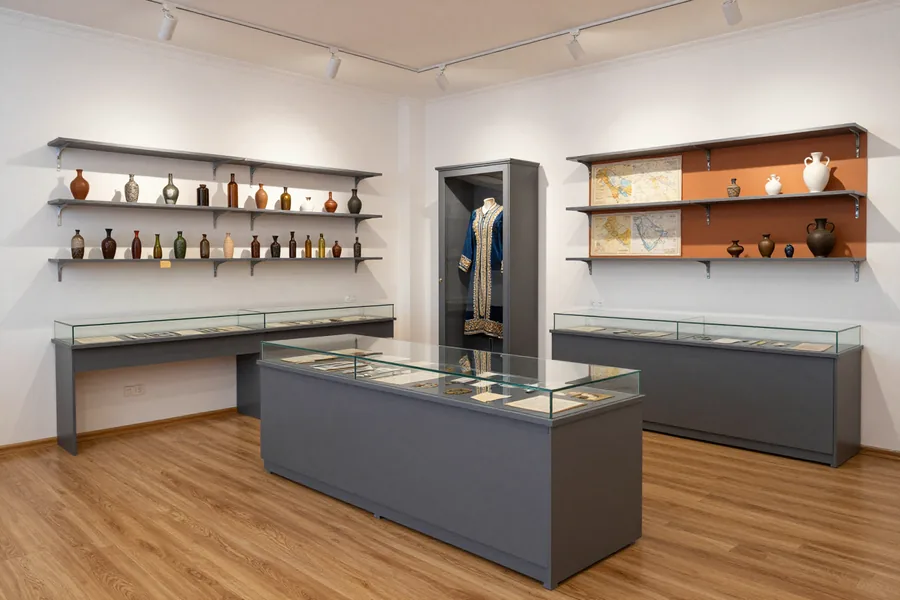
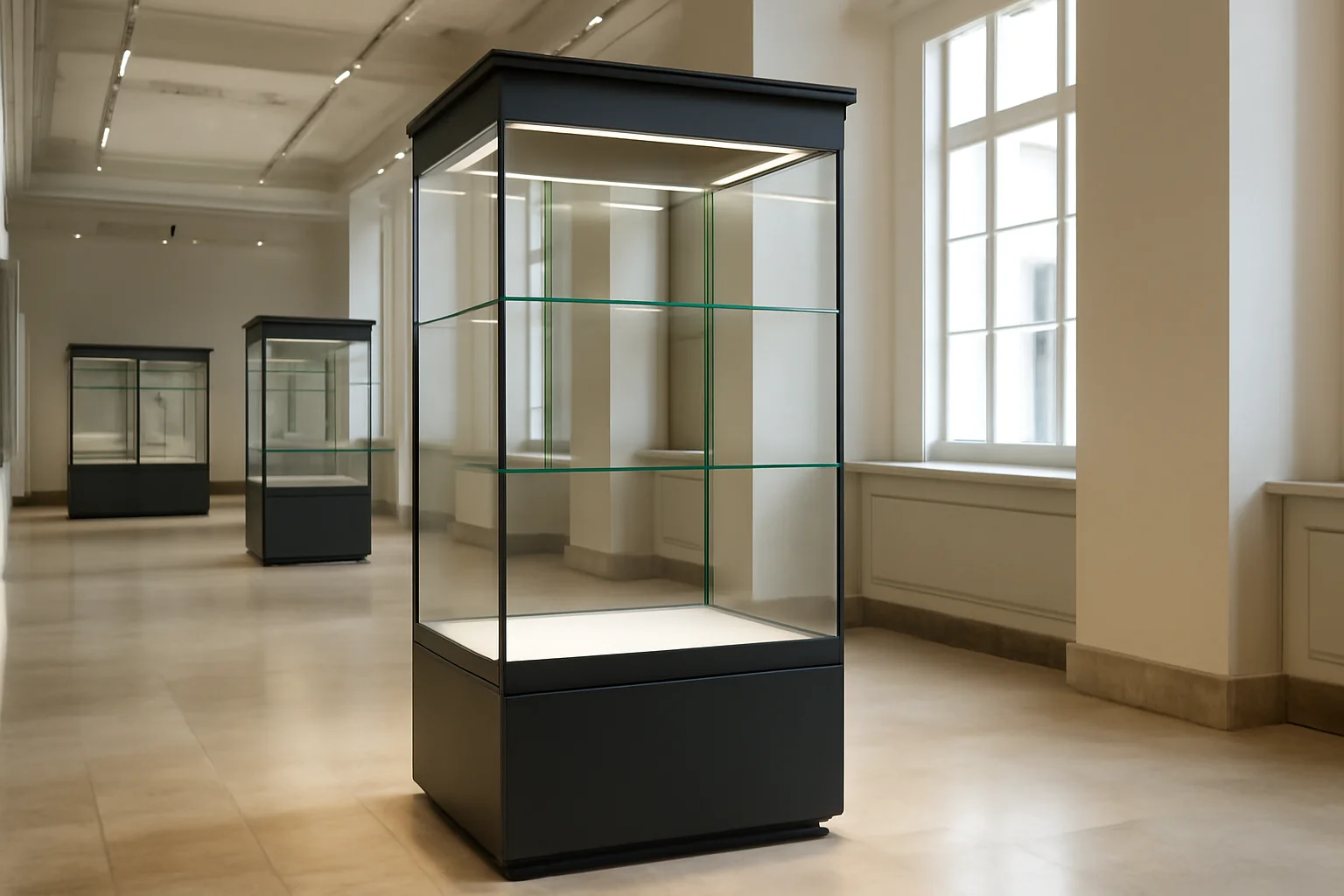
We equip the museum hall and storage room with a set in a single decor: display cases for exhibitions, display tables, open and sliding shelving for the collections. Measurement and 3D layout design are free, the price is fixed in the contract, and the warranty on the item is 24 months.
Measurement and 3D design are free and carry no obligation · price fixed in the contract · Kaspi Instalments up to 24 months
01Types
 01
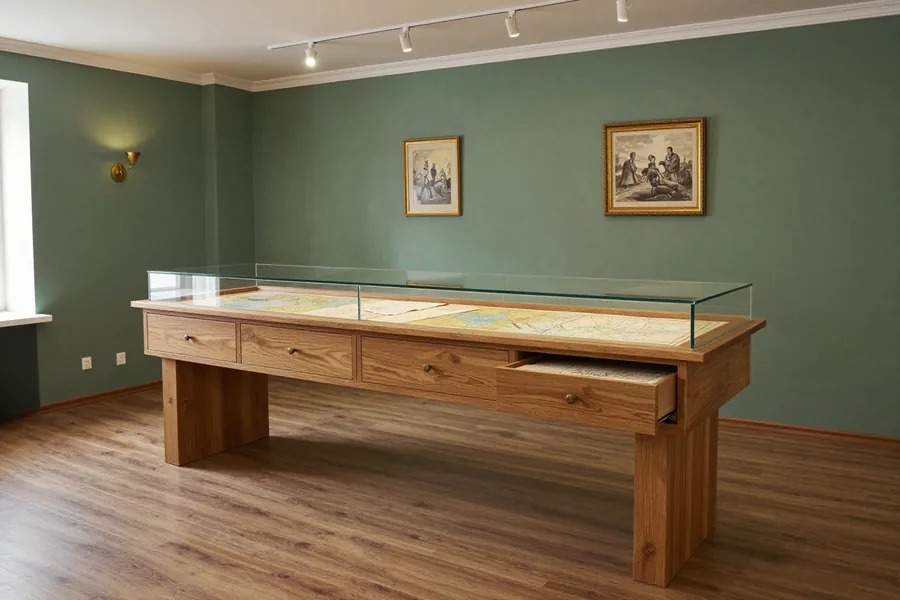
Glass on top, pull-out drawers below: for maps, manuscripts, and bound volumes that are changed when the exhibition theme changes.
from 280 000 ₸
 02
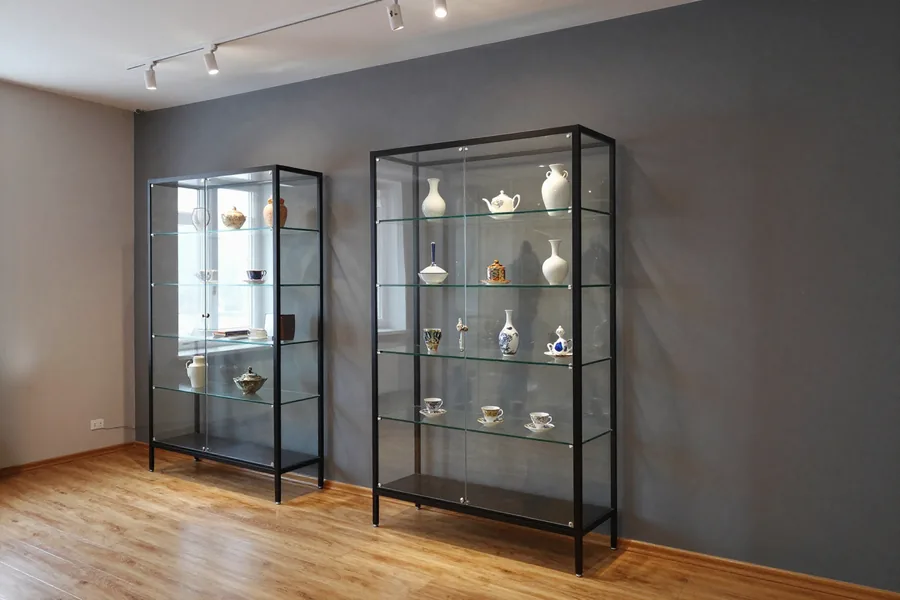
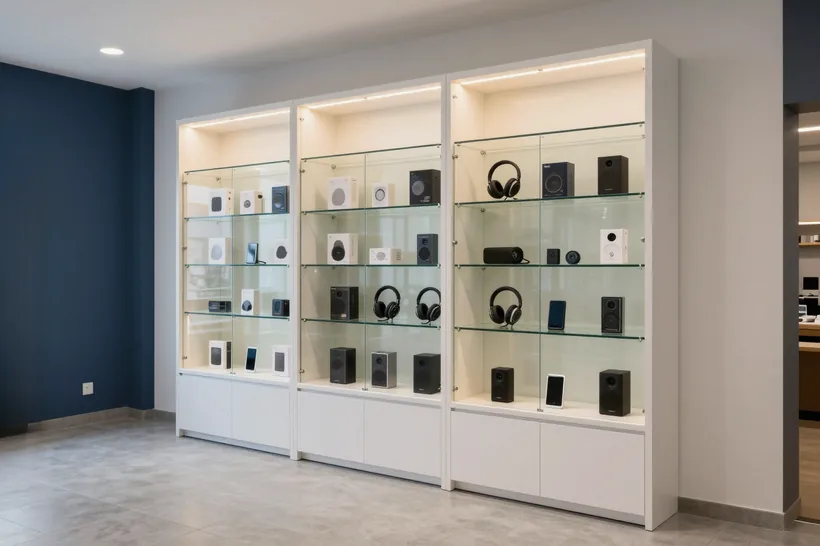
Tall glass cabinet on a metal frame for costumes, mannequins, and bulky items, with light inside.
from 340 000 ₸
 03
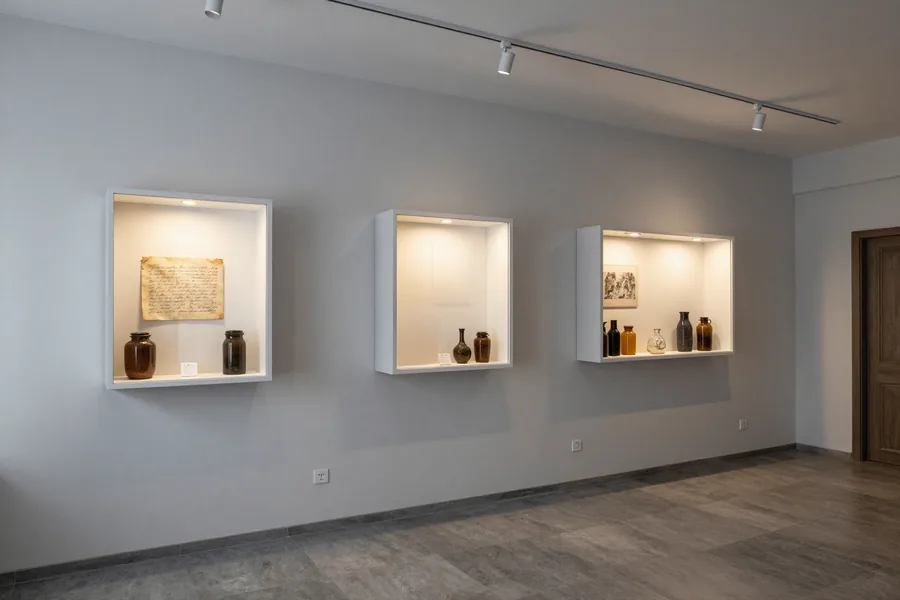
A flat box in an aluminum frame is hung on the wall of a narrow hall or corridor: letters, photographs, engravings.
from 75 000 ₸
 04
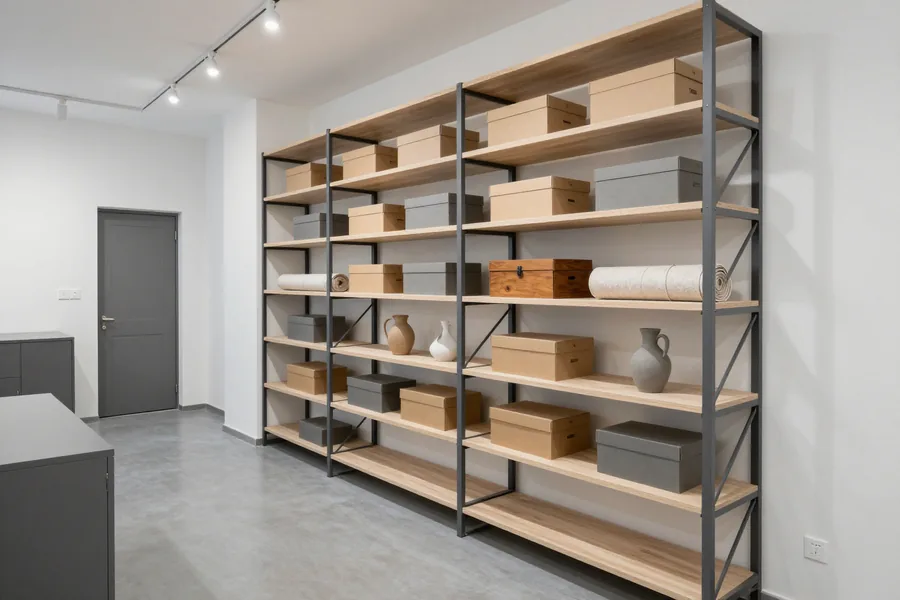
Steel frame with powder coating and laminated chipboard shelves for the storage room: holds heavy items and storage boxes.
from 145 000 ₸
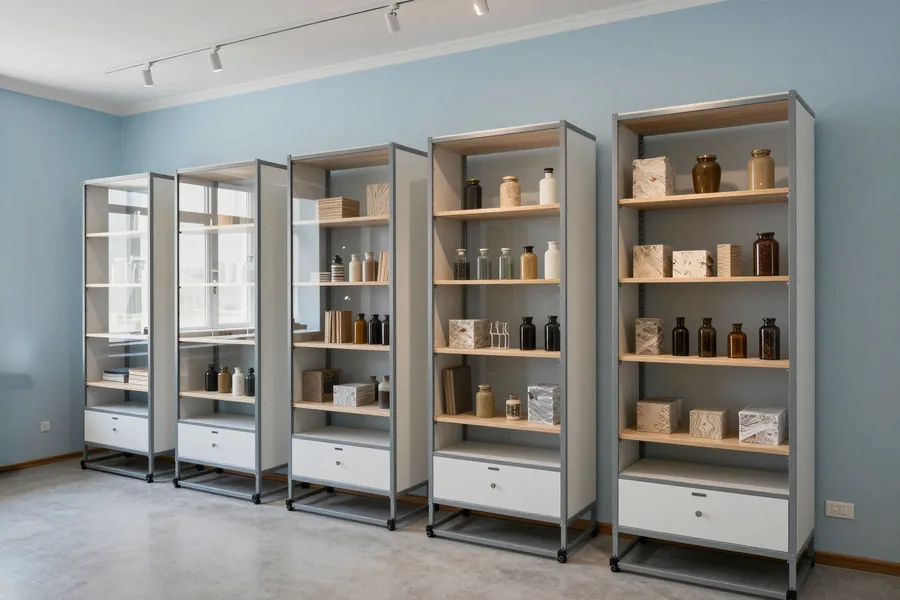 05
Rows on a roller system stand flush against each other and open one aisle at a time: dense storage of the collection behind glass.
from 210 000 ₸
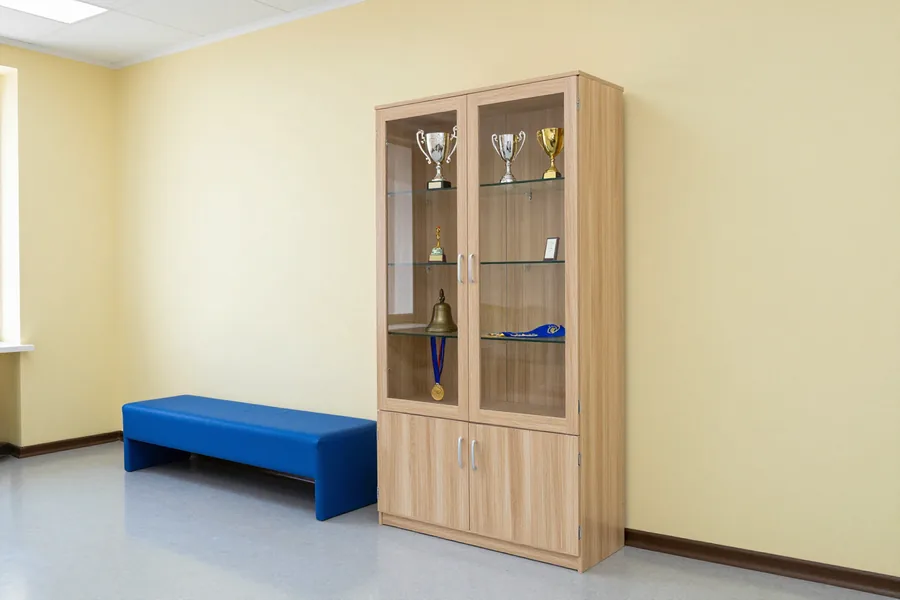 06
A compact laminated chipboard display case with glass for a classroom or common area: awards, letters and objects from the school's history.
from 60 000 ₸
02Projects
Object, scope, materials and lead time — per project.
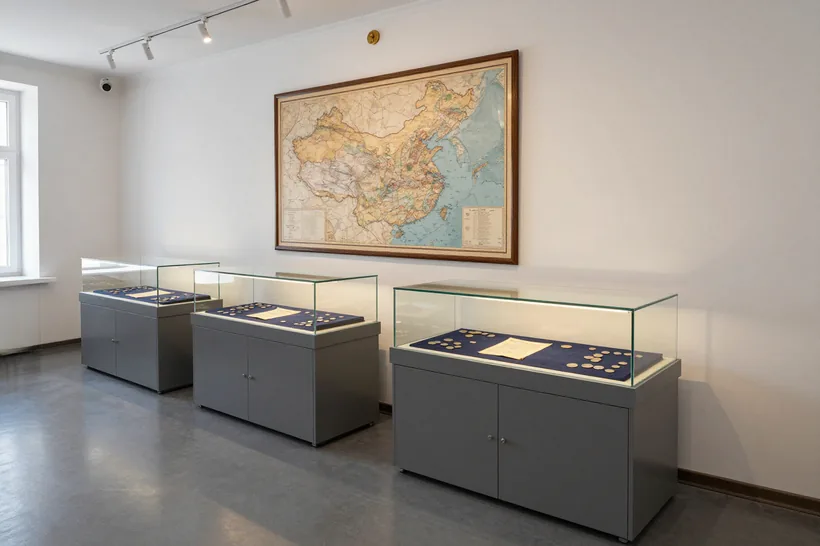 Museum
Dostyk Ave, Medeu district
Low horizontal display cases with slanted glass on top for coins and documents. The exhibit sits on a podium, the visitor looks down from above, lighting around the perimeter.
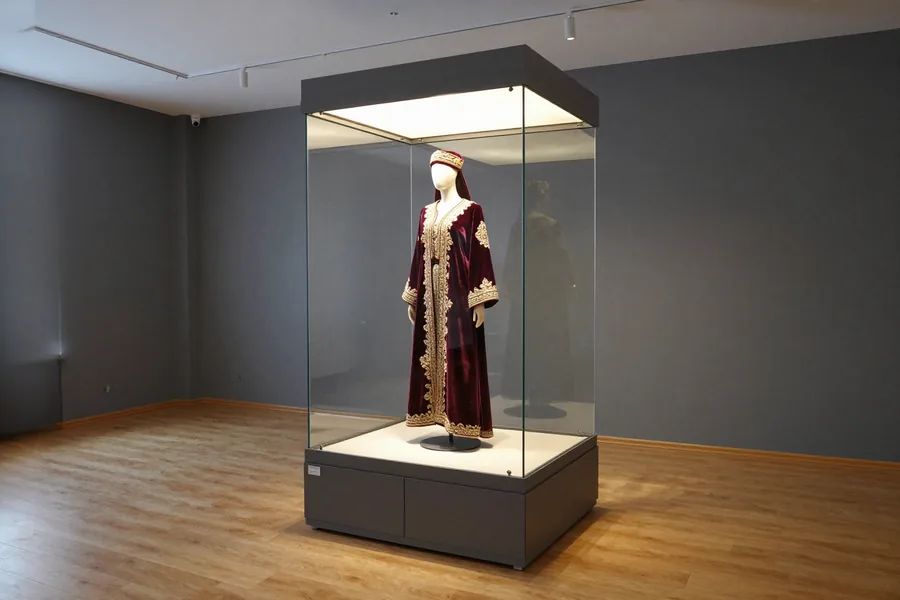 Museum
Esentai City residential complex, Bostandyk district
A freestanding vertical display case with a 360-degree view for a historical costume. Top lighting, rotating podium, glass on four sides.
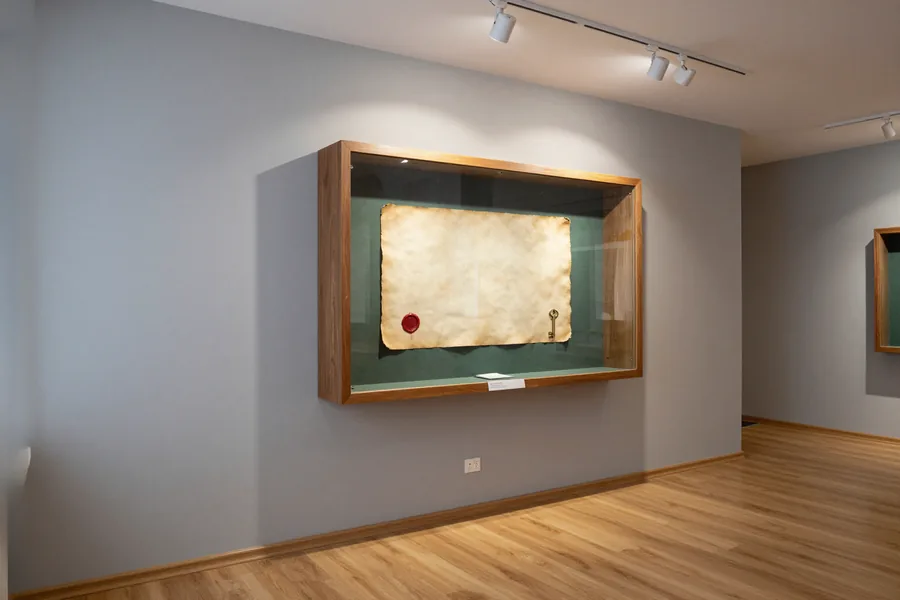 Museum
Orbita microdistrict, Bostandyk district
Shallow wall-mounted display cases for panels and a front-view collection. They save hall space and protect flat exhibits from dust and touch.
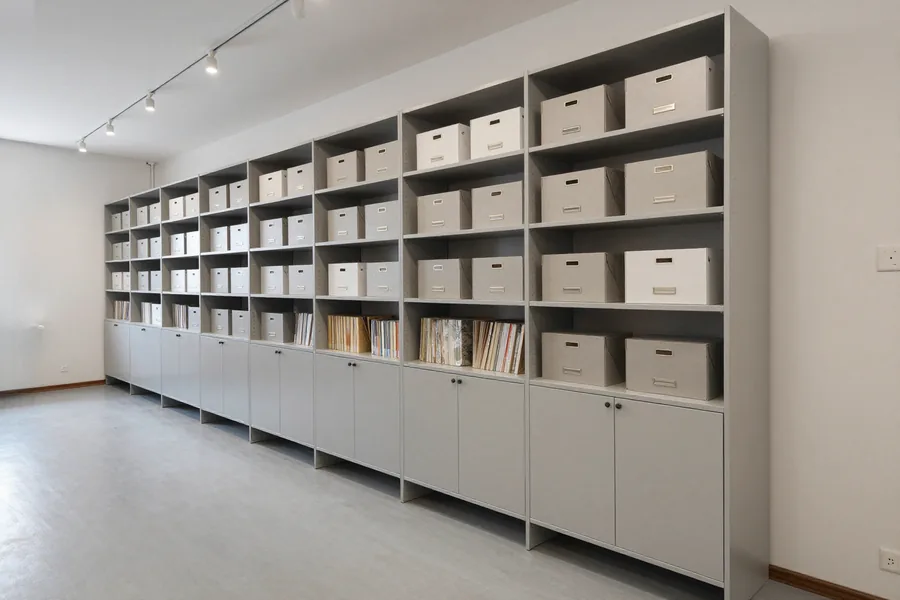 Museum
Koktem microdistrict, Bostandyk district
Collection storage: open and closed shelving in one size, reinforced frame to bear the weight of boxes. Shelves are marked for inventory numbers — the curator finds an item in a minute.
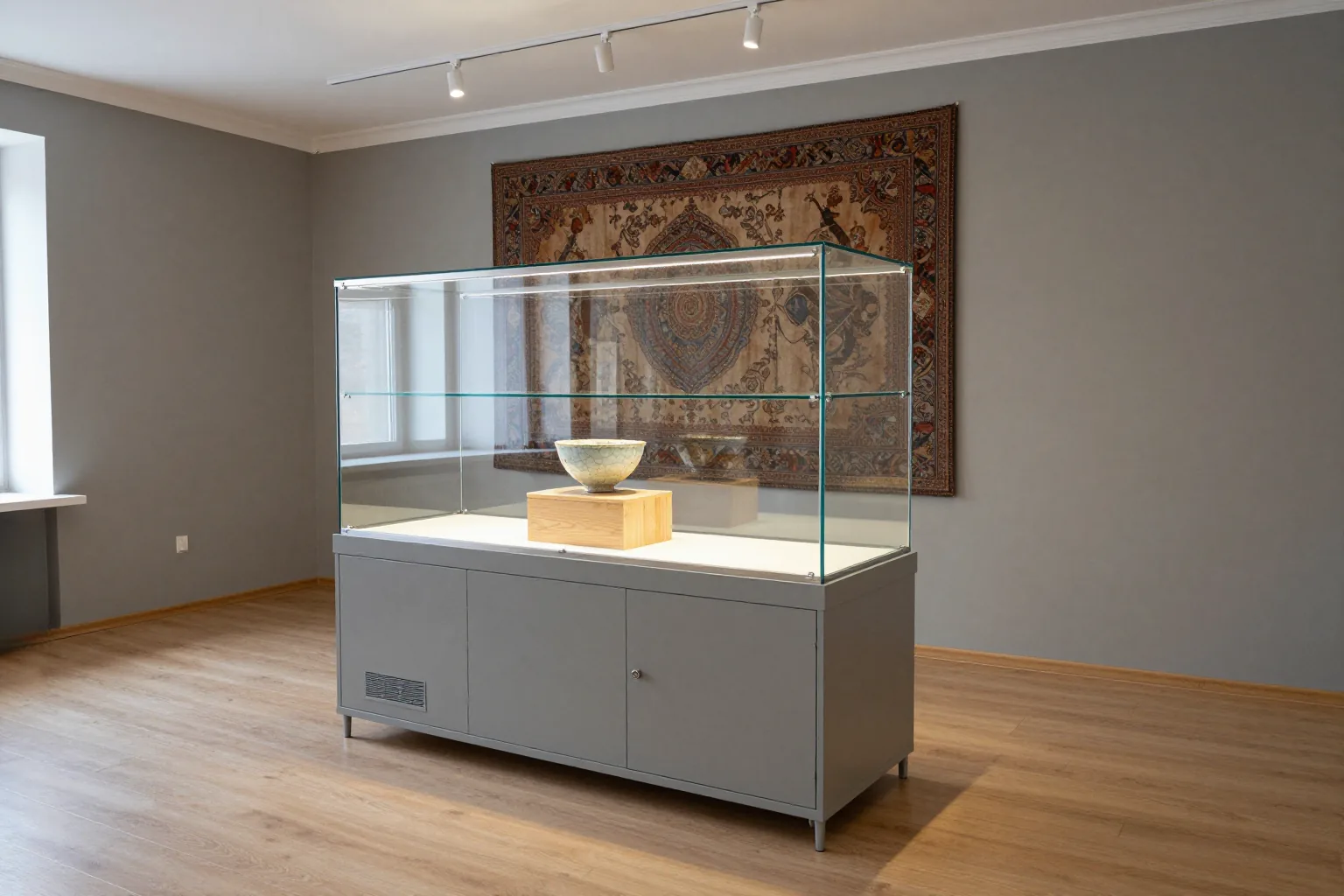 Museum
Nova City residential complex, Almaly district
A display case for a sensitive exhibit with a climate module and humidity control. Laminated glass, UV-free LED, dust seals and a lock with an alarm.
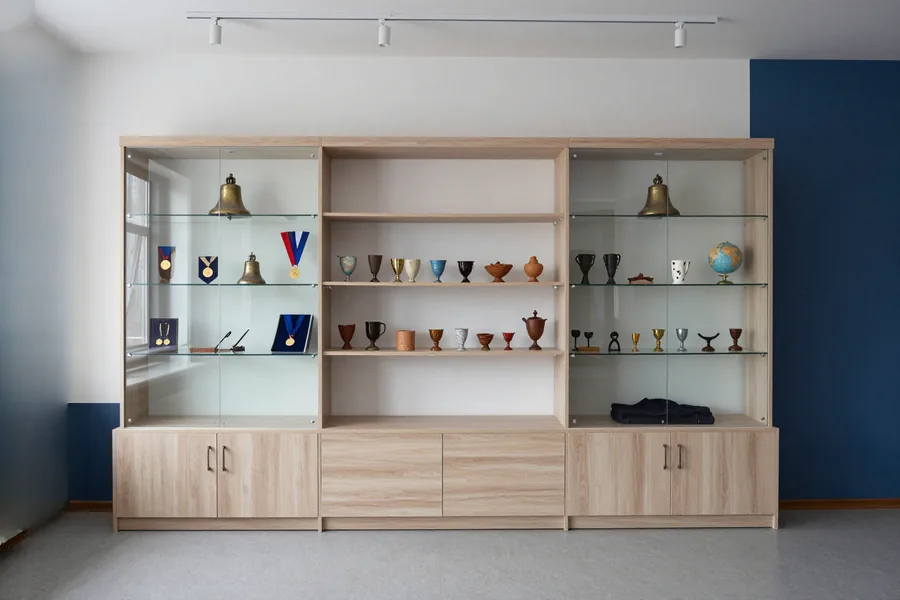 Museum
Aksai microdistrict, Auezov district
A school museum in a common area: two wall-mounted display cases for valuables and an open shelving unit for certificates, cups and crafts. Safety glass with no sharp edges, locks.
 Museum
Zhetysu microdistrict, Auezov district
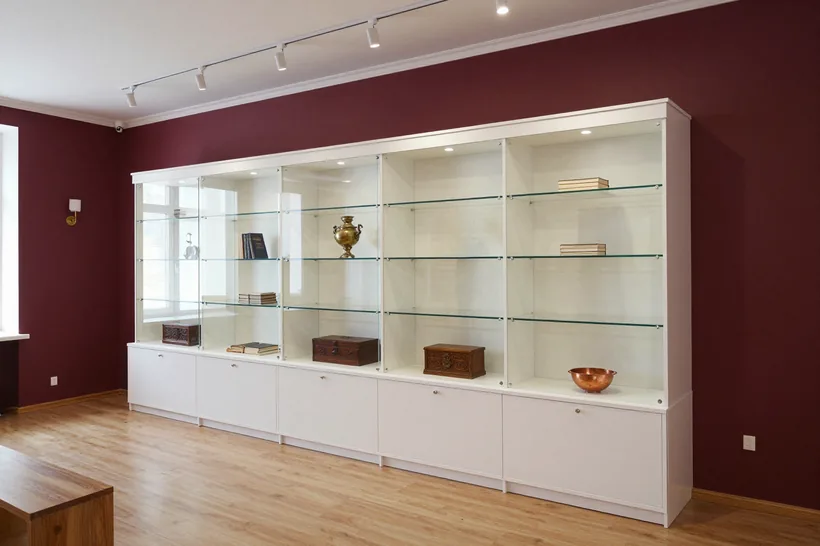
Wall-mounted display case with lighting for museum exhibits: tempered glass and adjustable shelves.
03How we work with museums
04Prices
The "from" price is for an item in the basic configuration; the final price depends on sizes, glass, lighting and locks. After a free measurement of the hall we calculate an estimate for the whole set and fix the cost in the contract.
05For legal entities
We work with LLPs, sole traders and public organizations on bank transfer. Price, materials and lead times are in the contract before production starts.
Request the contract and invoice06Principles
01 / 06
07Production
Six steps in our 600 m² workshop. You can see each of them with your own eyes: the showroom and production are under one roof.
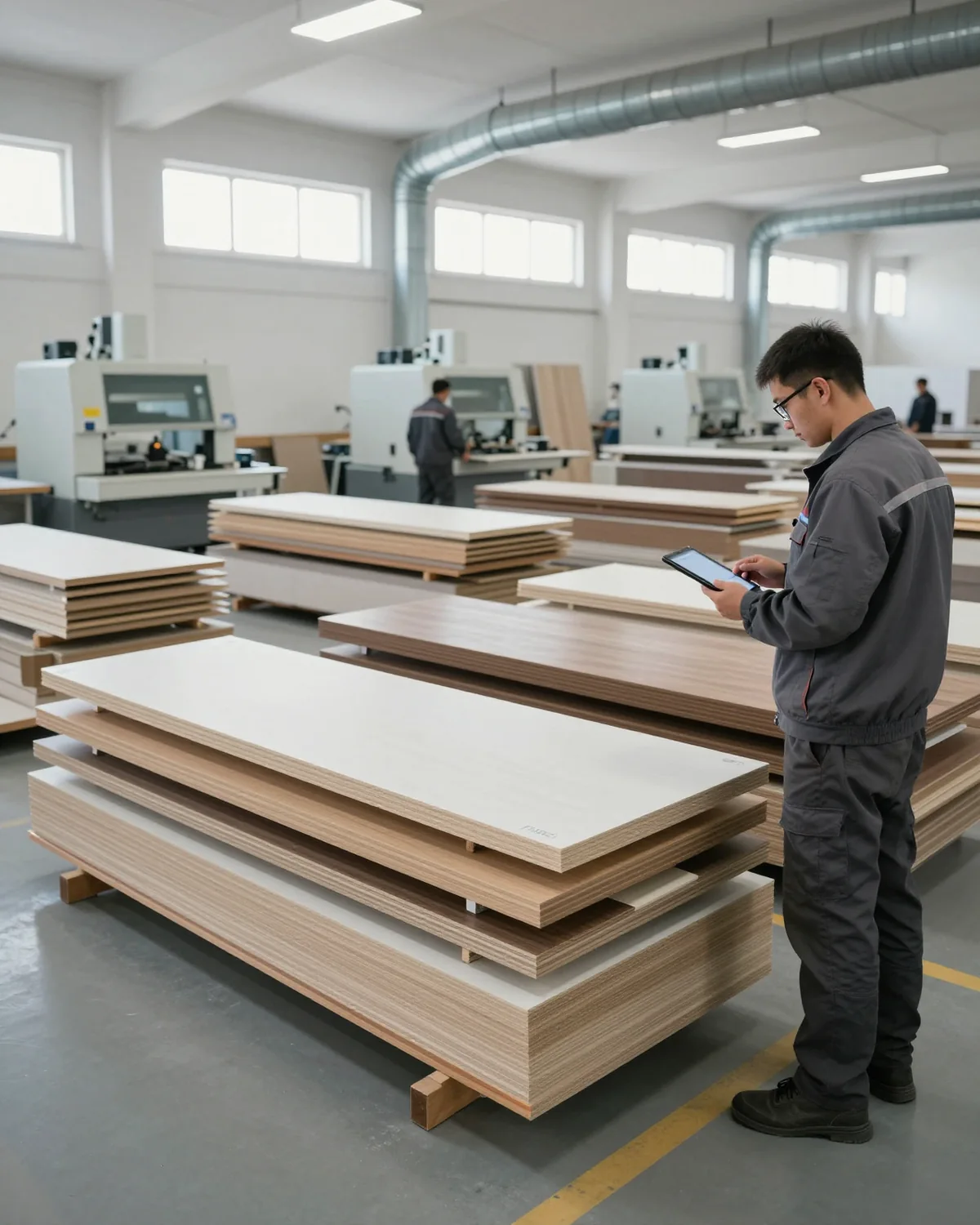
Egger · Kronospan · E1
Egger and Kronospan boards of emission class E1 arrive at the workshop warehouse. Laminated chipboard decors — 40+, thickness 16–18 mm. Class E1 — for halls and storage rooms.
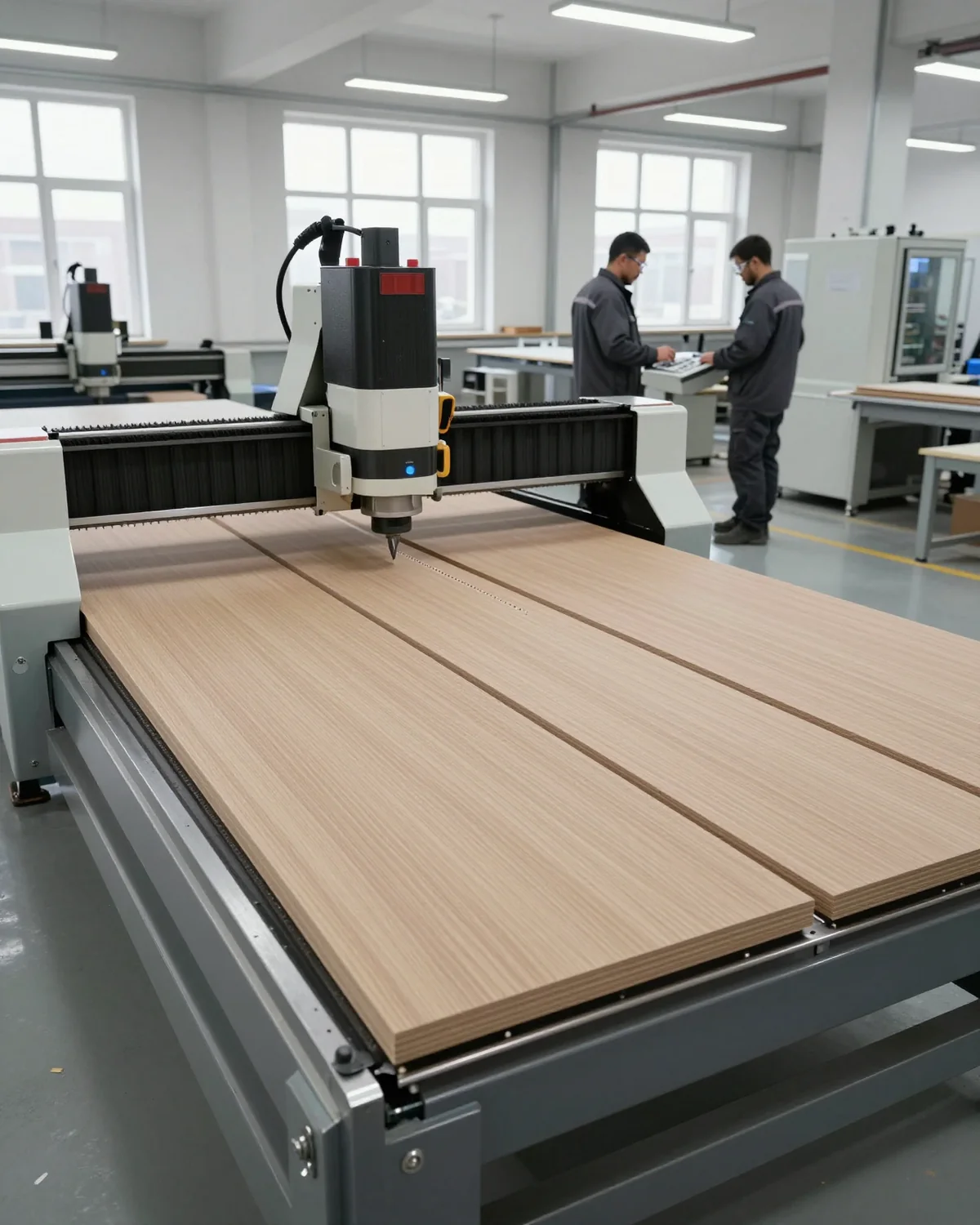
Laser measuring to 1 mm
A design engineer prepares the drawings, and the machine cuts the board to them. Dimensions come from a laser measurement accurate to 1 mm.
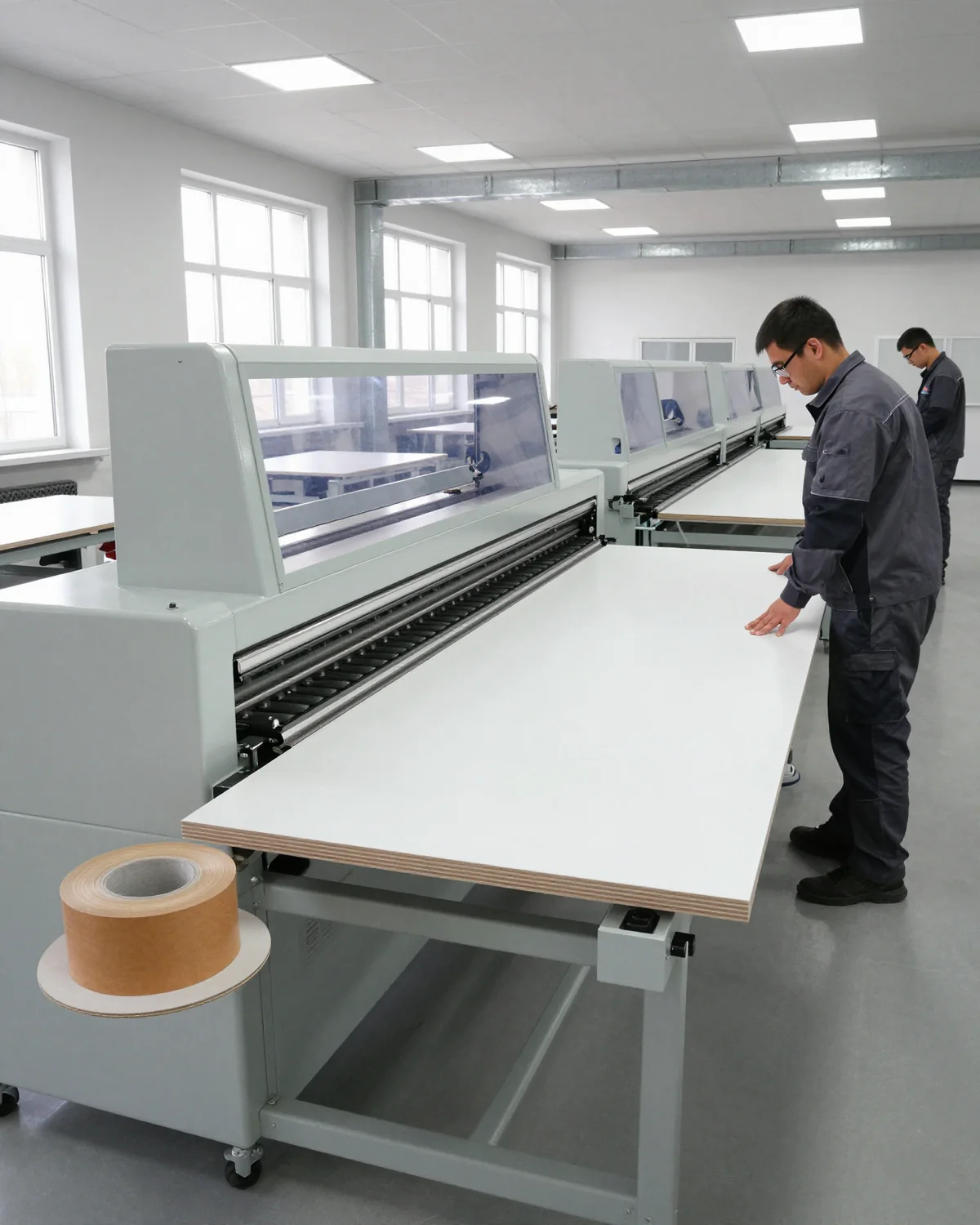
Blum · Hettich · Boyard
The edge-banding machine seals the edges, then we drill holes for Blum hinges and Hettich runners.
Any RAL colour
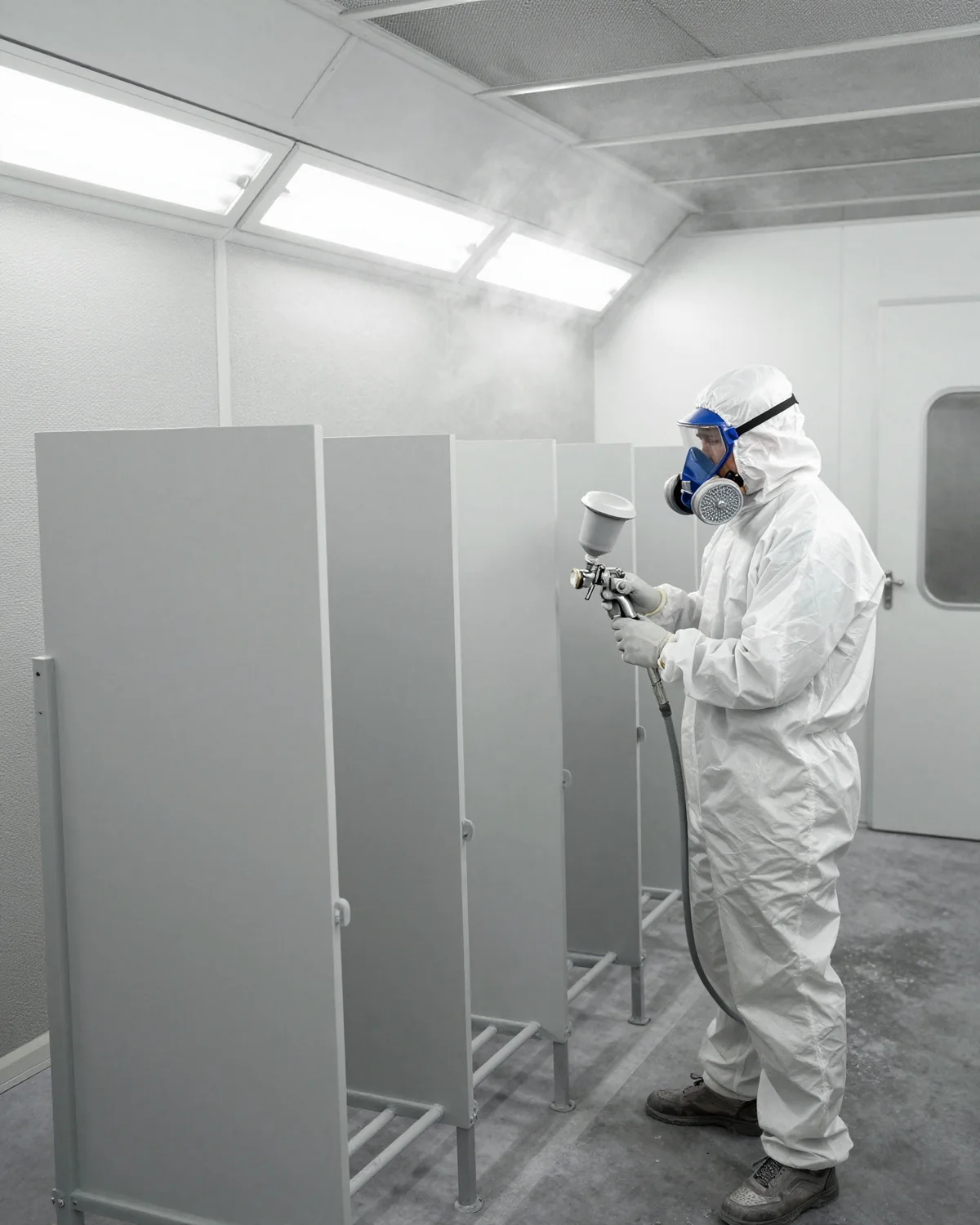
A finishing specialist paints the fronts to RAL — matte and gloss. We cut the glass for display cases to order sizes in our own workshop, so the glass, frame and base come together at the test assembly without any fitting.
Pre-assembly in the workshop
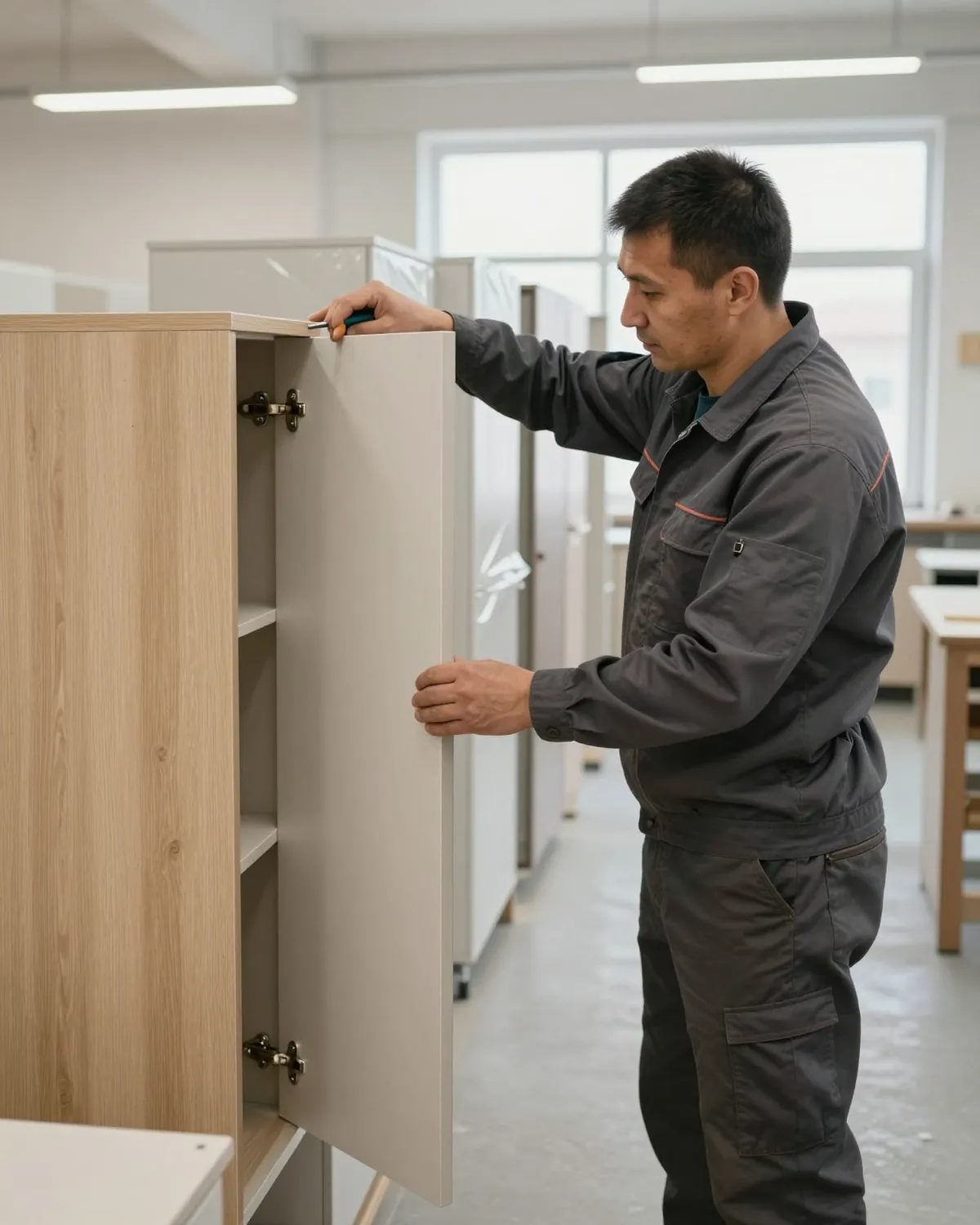
We assemble the modules in the workshop before dispatch, checking front gaps and drawer travel. The quality control department signs the item off for shipping.
Installation to fit the venue's schedule
We deliver, bring in, assemble in 1 day, adjust the furniture and clean up after ourselves. Warranty of 24 months from signing the acceptance certificate.
08Team
MEBLIX workshop craftsmen who make and assemble furniture to order.
01 / 07Furniture assembly carpenter11 years
★ 4.81 · 47 ratings

Cabinet furniture repair craftsman20 years
★ 4.99 · 73 ratings

Furniture and kitchen unit assembler23 years
★ 4.97 · 300 ratings

Made-to-order furniture maker7 years
★ 4.26 · 32 ratings

Furniture maker5 years
★ 4.23 · 30 ratings

Joiner and carpenter20 years
★ 5.0 · 113 ratings

Furniture front and hardware fitter17 years
★ 4.61 · 92 ratings
09FAQ
Didn’t find the answer? Message us — a manager replies, not a bot.
Ask on WhatsAppYes, we do both: display cases and display tables for the hall, open and sliding shelving for the archives. It all comes under one estimate and one contract, in one decor.
A display case for a school museum and a museum shelving unit are both in the price list above, each priced differently. The total depends on the number of display cases and the size of the classroom, and we calculate the estimate after a free measurement.
Yes, we work with public institutions under a contract and invoice with bank transfer payment. 50 % prepayment, the balance — after signing the acceptance certificate, then we hand over the certificate and the delivery note.
Yes, a sliding glass shelving unit on a roller system is in the price list. The rows stand close together and open one aisle, so more of the collection fits in the same storage room. We check the floor level during the measurement.
Yes, after a free measurement we prepare a 3D layout project in 1–2 days. It shows the visitor route, aisles for groups and the positions of the display cases, and any element can be moved before ordering.
Yes, our team does the installation at an agreed time: in the evening, on a sanitary day or a day off. The items go through test assembly in the workshop, so work in the hall takes less time.
Yes, we take repeat orders in the same decor based on the saved project. So a school or city museum can expand the exhibition in stages, and the hall stays consistent.
We install mortise, code and magnetic locks. A code lock is convenient if several staff members open the display case; a magnetic one leaves no keyhole on the glass.
For heavy items, an open metal shelving unit works well: a steel frame with powder coating and laminated chipboard shelves. We recommend placing heavy items on the lower shelves, and we choose the shelf spacing to fit the storage boxes.
Tell us the opening date during the measurement, and we'll plan production and installation around it. Lead times for each option are in the price list on this page; for a tight schedule, a rush order is possible.
10Reviews
4,9
average rating
on Google and Zoon
Everyone can see a review on the platform: this is how other people check whom to trust with an order. If something went wrong, write to us and we will reply within 1–2 business days.
Message us on WhatsApp11Article
We make museum furniture as a complete set in our own workshop in Almaty: horizontal and vertical display cases, table display cases, open and sliding shelving for collections. First comes a free measurement of the hall and a 3D layout project in 1–2 days, then manufacturing and installation by our own team to fit the museum's schedule, with a 24-month warranty.
An exhibition doesn't rest on glass cabinets alone. The hall needs tables for documents, storage within the curator's reach, and overall decor that ties the objects into a single space.
| Display case type | What is shown in it | Where it is placed |
|---|---|---|
| Horizontal | Documents, coins, awards, small items | Center of the hall, islands |
| Vertical | Costumes, dishware, bulky items | Along walls and in corners |
| Wall-mounted | Photographs, engravings, letters | Narrow halls and corridors |
| Hanging | Flat exhibits at eye level | Above cabinets and sideboards |
| Corner | Small collections | Free corners of the room |
| Table display case | Maps, manuscripts, newspaper archives | Center of the hall, reading area |
We make the table display case from solid oak: glass sits on top, the exhibit is beneath it, and pull-out drawers are below. This horizontal museum display case suits maps, manuscripts, photographs and newspaper archives that visitors examine from above, leaning over the table. The drawers solve a second task: they hold replacement sheets, copies and items that the curator swaps when the theme changes. The wood in this item isn't chosen for decoration — visitors stand right up to the table and see the texture from half a meter away, so laminated chipboard looks worse here. We agree on the countertop height during the measurement: it differs for adult visitors and for children's groups. If the exhibition changes often, it's better to order drawers for the full depth of the table right away rather than half-depth ones — large-format replacement sheets won't have to be folded.
We handle a museum's outfitting with one estimate and one contract: display cases, tables and shelving come out of our workshop in the same decor and with the same hardware. For the client this means one acceptance, one act and one warranty for all items, rather than correspondence with three suppliers. For the hall it means a cohesive look: plinths of the same height, identical glass profiles, one shade of wood or enamel. The set can range from a single item to a full turnkey outfitting of the space. Repeat orders matter separately: when the museum receives new acquisitions, we make the next display cases in the same decor, from the saved project. That's why it's worth choosing a decor sample with years ahead in mind — a fashionable but rare board shade will be harder to match later.
Layout starts not with choosing cabinets but with the path a person will take from the entrance to the last exhibit. The sizes and types of furniture are then selected to fit that path.
We start with a free measurement of the hall and a 3D layout design, which we prepare in 1–2 days. We design furniture for museums based on the actual space: the measurement specialist notes windows, doors, radiators, columns, sockets and floor level differences. In the 3D design you can see how a visitor enters, where they look first and where they turn toward the exit. We place the display cases along this route so that each one opens up to the eye rather than hiding behind the next. We consider windows separately: direct sunlight on glass causes glare and fading of paper and fabric, so the most fragile items go toward solid walls. It is useful to coordinate the route with the guide before approving the design: they know where the group lingers longest, and that is where more space should be left.
A group of schoolchildren does not line up at an exhibit — they stand in a semicircle, and the second row peers over the shoulders of the first. That is why the aisle between glass cabinets in a hall where tours are given is planned with a noticeable margin, not the minimum for one adult. A continuous row along the wall creates a bottleneck: while some are looking, others cannot get past. It is more convenient when horizontal museum display cases stand as islands in the center and vertical ones along the walls, and the group walks around the island in a circle. In front of the island there needs to be free space where the guide fits, and at the entrance a place where the group gathers and takes off outerwear without blocking the first exhibits. If the hall is small, it is better to remove one island than to squeeze the aisles: a cramped hall tires visitors faster than an empty corner.
The visitor sees only part of the collection; the rest lives in the back room. There what matters is not appearance but load capacity, order and quick access to the required storage unit.
We make open museum shelving on a powder-coated steel frame with laminated chipboard shelves. Such a frame holds stones, metal, ceramics and document folders, and the coating does not rust or dirty your hands. We make the shelves adjustable: items in the collection vary in height, and the shelf spacing is chosen for boxes and mounts, not the other way around. The open design gives access from any side, so the curator sees the labeling immediately without opening doors. When arranging, it is better to put heavy items on the lower shelves and light boxes on top: the shelving is more stable and safer to work with. If the back room is long, museum shelving is placed in rows across the room, leaving an aisle for a trolley, and the height of the top shelf is limited by the height of the curator with a stepladder.
We assemble the sliding shelving from laminated chipboard and tempered glass on a roller system: the rows stand close to each other and slide apart only where a passage is needed. In an ordinary storage room, a lot of floor space is wasted between rows of open shelving, but here there is a single passage, and it moves to the section you need. Glass doors protect items from dust and keep them in view, so the curator does not have to open each section looking for a storage unit. The roller system requires a level floor: we check for unevenness during the measurement and take it into account in the project. The sliding option is advantageous where the collection is growing but the room cannot be enlarged. It is worth deciding in advance who works in the storage room and how often: if access to several rows is needed at the same time, part of the collection is better left on open shelving.
| Parameter | Open metal | Sliding glass |
|---|---|---|
| Dust protection | No, boxes are needed | Yes, glass doors |
| Floor space use | A passage at every row | One movable passage |
| Heavy items | Best suited | Suitable for medium |
| Access to several rows | Simultaneously | One at a time |
| Floor requirements | Ordinary floor | Level floor |
A school museum usually occupies one classroom, a recreation area or a section of a corridor. The area is small, the visitors are children, and the room often also serves as an ordinary classroom.
We assemble furniture for a school museum as a compact set: two or three wall-mounted display cases, one horizontal case in the center and shelving for items that are not yet on display. Wall-mounted cases do not take up floor space, and the classroom remains suitable for a lesson, a class hour or a meeting with veterans. The horizontal cabinet in the center becomes the main focal point of the exhibition — it holds letters, awards and documents. The shelving is placed against the back wall and closed with doors if classes are held in the classroom. We make the carcasses for schools from E1-class laminated chipboard with PVC or ABS edging: the board withstands cleaning and accidental hits from a backpack. Before the measurement, it is useful to make a list of exhibits with approximate sizes — this immediately shows how many shelves and what depth will be needed.
We draw up the school hall project for the full set right away, even if the budget currently covers only one or two items. A school can start with the main table and one wall-mounted case, then order the rest later — in the same finish, from the same project, without redoing the layout. With this approach, museum display cases for a school museum gradually come together into a cohesive hall rather than a random collection of cabinets from different years and colors. New acquisitions in school museums come from alumni and students' families all the time, so it is worth ordering shelving with a reserve of shelves. For a school as a publicly funded organization, we work under a contract and invoice, and each stage is documented separately. It is convenient for the museum head to keep the project and a finish sample in the museum folder: a new teacher can continue what was started without looking for a contractor all over again.
The carcass material determines how many years the hall will last without repairs, while the lighting and locks determine how comfortably the curator can leave the exhibits overnight and over the weekend.
| Item | Carcass material | Why |
|---|---|---|
| Horizontal and vertical display case | MDF, tempered glass | Smooth enamel, safe glass |
| Corner and wall-mounted display case | Aluminum profile, glass | Light frame, slim edges |
| Display table with drawers | Solid oak, glass | The grain is visible up close |
| Open shelving | Powder-coated steel, laminated chipboard | Holds a heavy collection |
| Sliding shelving | Laminated chipboard, tempered glass | Protection from dust |
| Display case for schools | Laminated chipboard, glass | Sturdy and practical |
We install LED lighting in display cabinets: it barely heats the object, gives even light and lasts a long time without replacing bulbs. A museum display case with lighting shows the exhibit even in a hall with poor overhead light, and fabric, paper and photographs do not overheat under the lamp. We conceal the strip in a profile or under the top lid so that the visitor sees the light on the object, not the light source in their eyes. We route the wire and power supply into the base — they are out of sight, a child cannot reach them, and the museum's electrician can replace the unit without disassembling the cabinet. We agree on the light direction in the project: overhead light suits dishware and sculpture, side light emphasizes the relief of coins and medals. Fragile paper is best not kept under constant lighting — for it, a switch that the curator turns on during a tour is more convenient.
Museums, schools and other publicly funded organizations purchase equipment against documents. It is important to understand the payment, acceptance and installation procedure in advance so the opening of the exhibition is not delayed.
We handle delivery and installation with our own team and agree the time around the institution's schedule — in the evening, on a sanitary day or on a day off for visitors. Before dispatch, every item is test-assembled in our workshop, so all that remains in the hall is to position and secure the furniture, with no on-site fitting of parts and no sawdust. Within Almaty and up to 30 km, delivery is free for a large order, the threshold is stated on the Delivery and payment page; beyond 30 km there is a surcharge. It is best to remove exhibits from the work area in advance during installation: the team works with furniture, and moving collection items remains the curator's responsibility. We sign the acceptance certificate after installation, once the customer has checked every wardrobe, lock and light.
We give a 24-month warranty on every item under the contract. If the wardrobes use Blum hardware — hinges, lift mechanisms or drawer runners — it is covered by the manufacturer's 25-year warranty; Hettich and Boyard have their own warranty. Lead times depend on the item and the material: a glass case on an aluminium profile and a solid oak table are made differently, and the lead times for each option are in the price list on this page. If the opening of the exhibition is tied to a date, a rush order is possible, and we discuss its terms when you place the request. It is easier to plan backwards: the opening date, then installation, then production and measurement. That way the museum has time to arrange the exhibits in the finished wardrobes, prepare the labels and hold a trial tour, not just to have the furniture installed.
The showroom setup consists of several decisions that are best made before ordering, not after installation. Below are the main ones.
12Calculation
Choose the type of display case or shelving, the size and the lighting in the calculator — the calculation will go to the manager on WhatsApp. We quote per item and per hall set.
13For business
We equip the pharmacy as a whole — from the pharmacist's counter and prescription shelving to cabinets for medicines, flammable liquids and the stockroom.
We make display cases to fit the sales floor: wall-mounted up to the ceiling, island, corner with curved glass, and counter display cases with lighting and locks.
We make display cases to fit the shape and size of the exhibit: horizontal, vertical, wall-mounted boxes and island ones, with anti-reflective glass, hidden lighting and a lock.
We equip the salon as a whole: reception, workstations for specialists, mirror stations, manicure area, shelving and waiting area in a single decor made of materials that withstand water and daily cleaning.
We make workstations for specialists to match the specialist's height and the room size: simple, with lighting, with a built-in extractor, folding for home, double and with stone.
We make desks adjustable for height, chairs, teacher's desks and cabinets for classrooms and kindergartens with rounded corners and edge banding on every end.
We design and make cabinet furniture for offices with precise fit into the space and a single decor per floor.