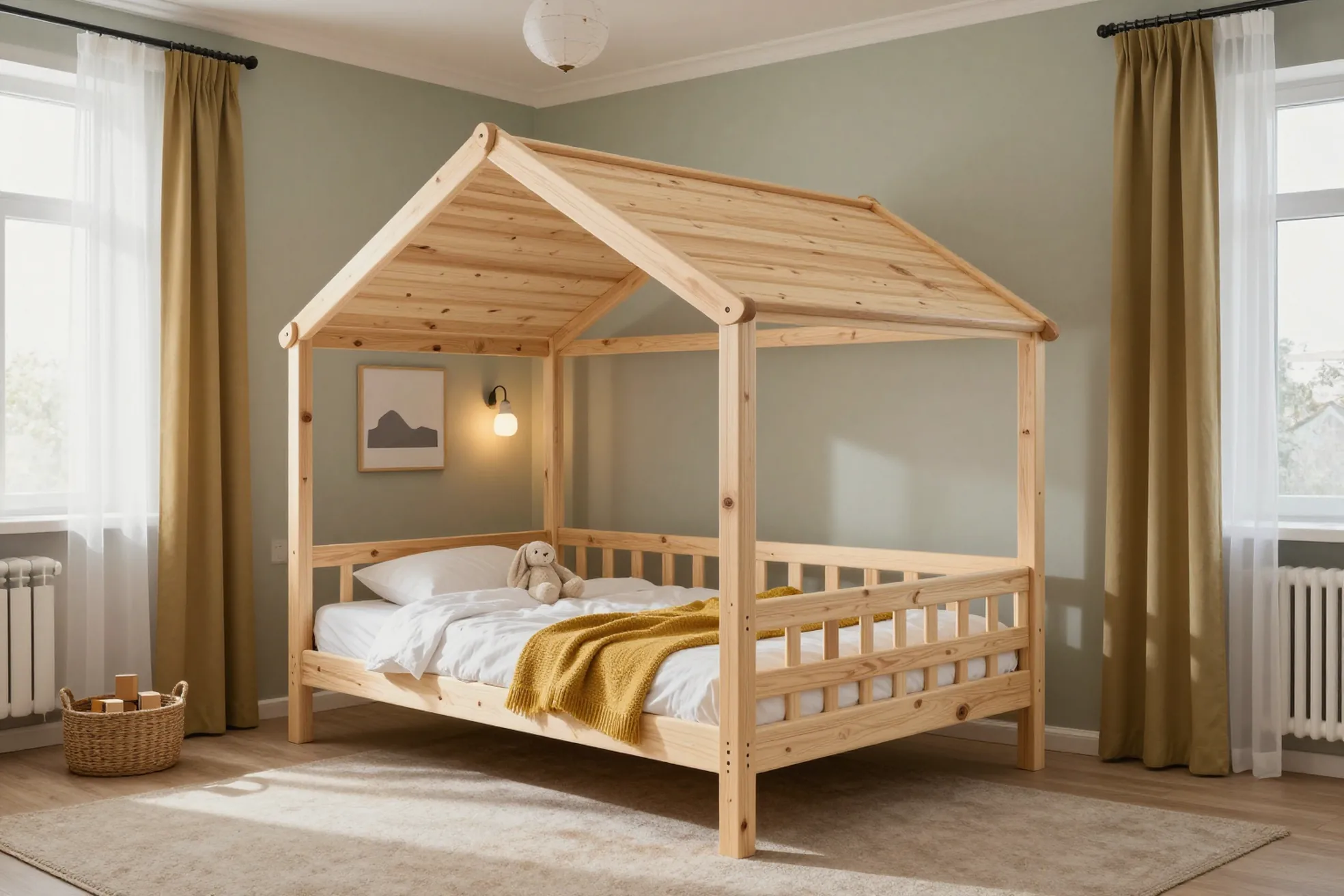
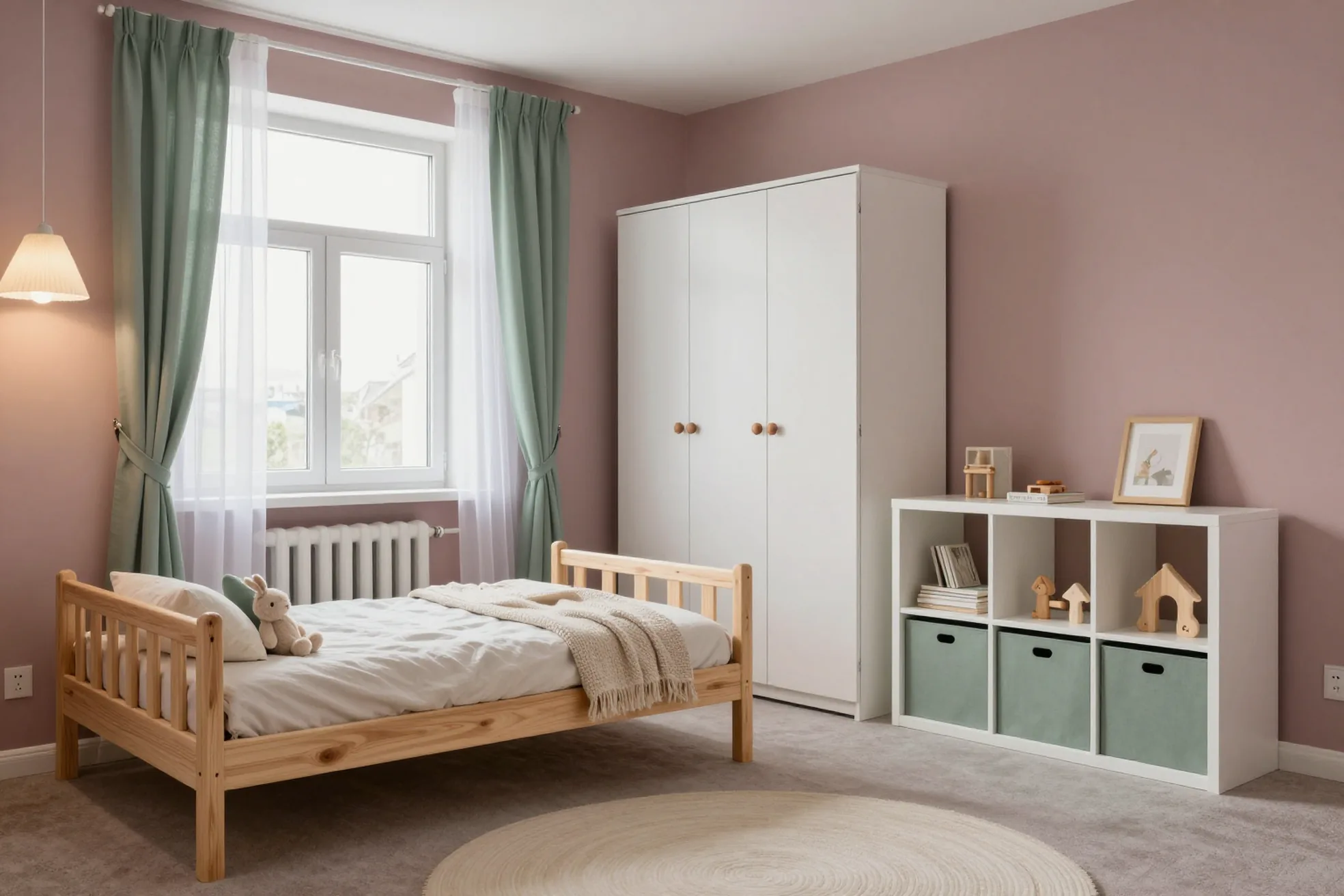
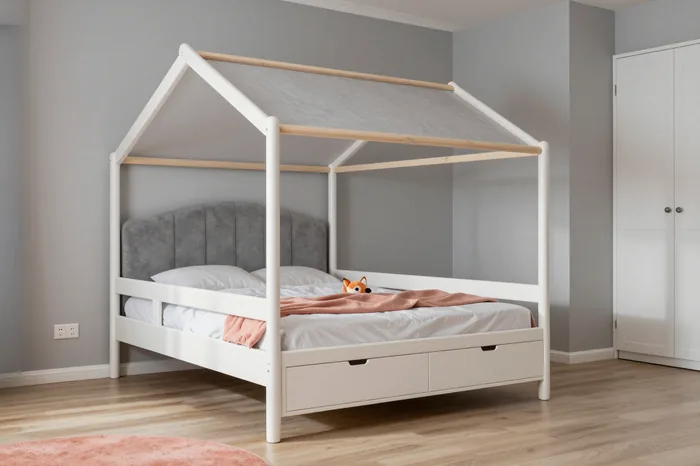
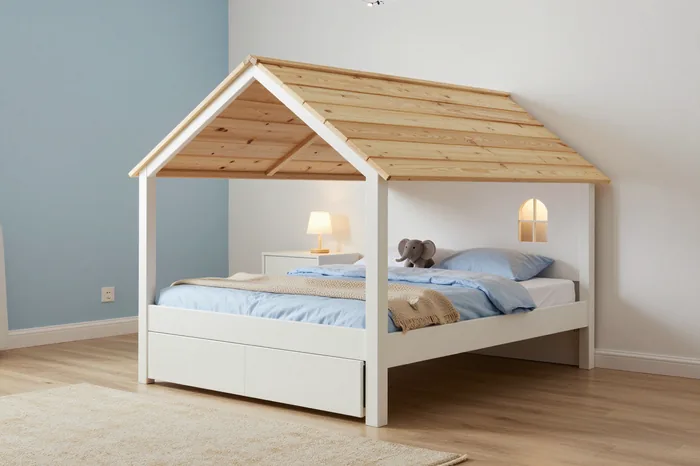
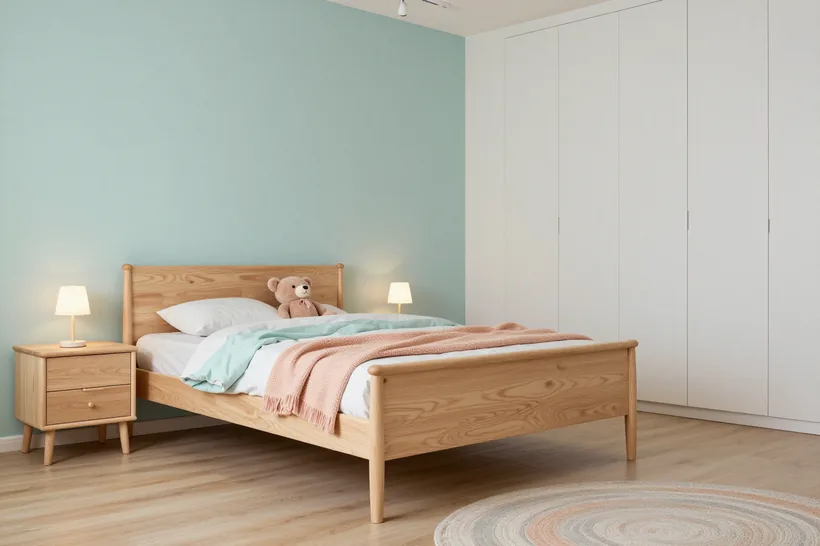
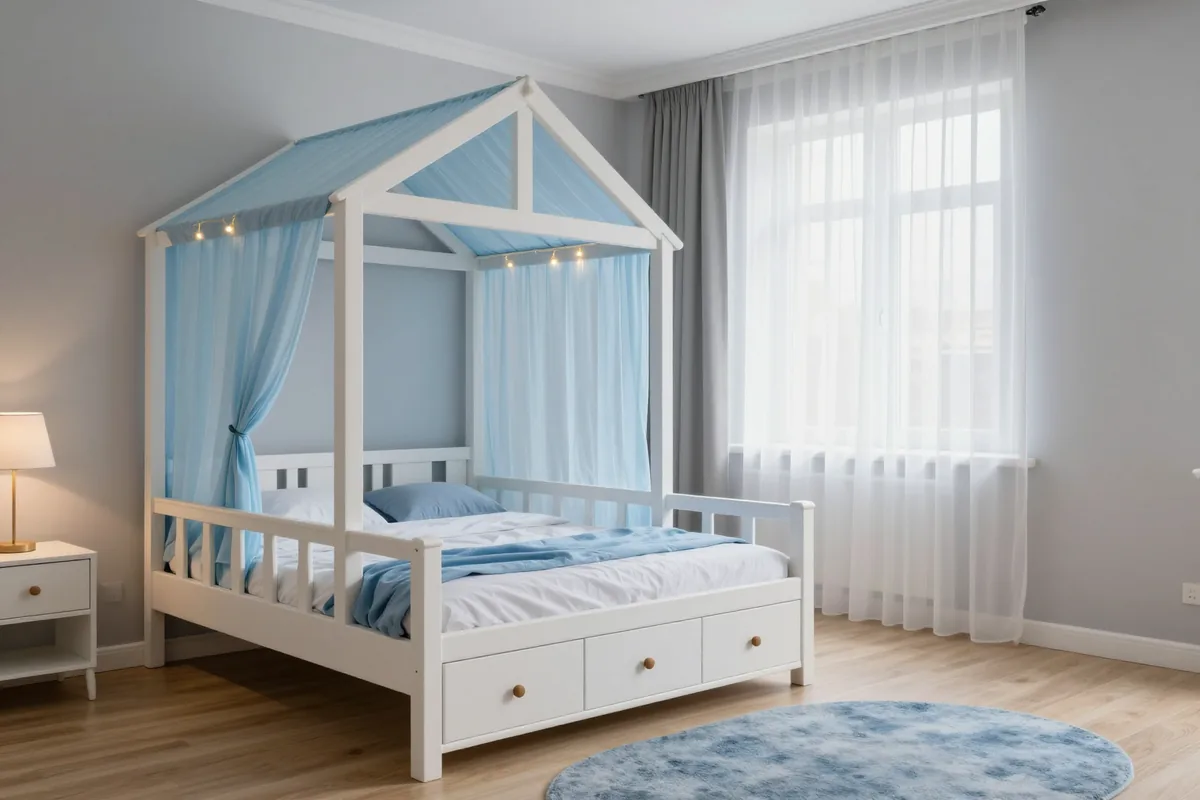
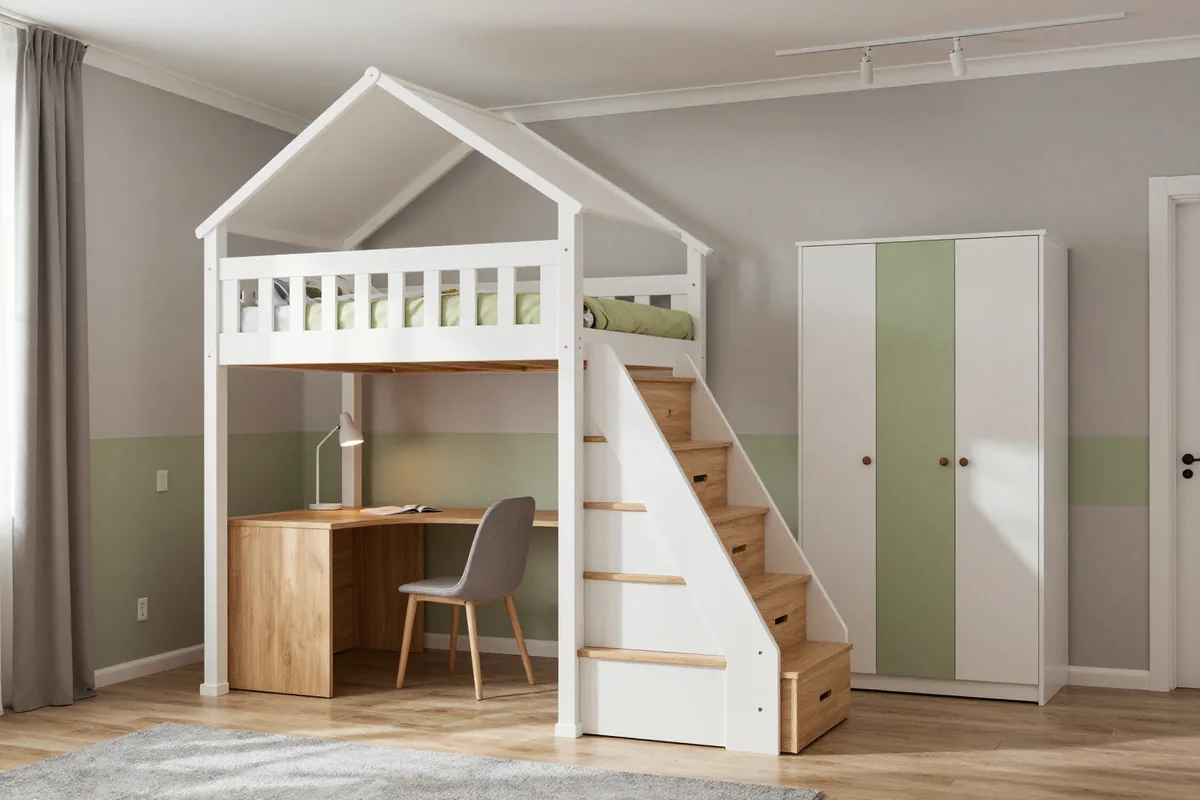
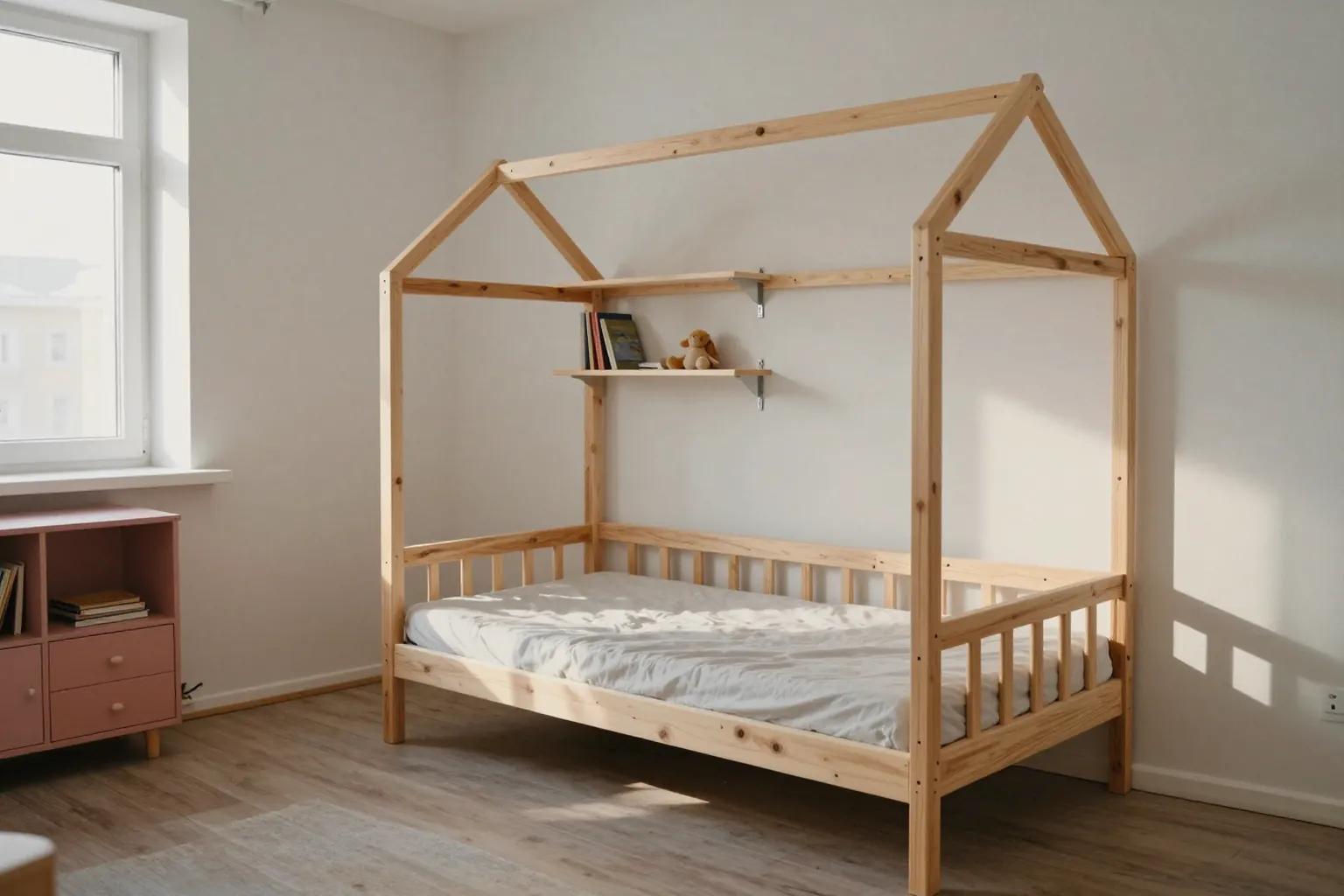
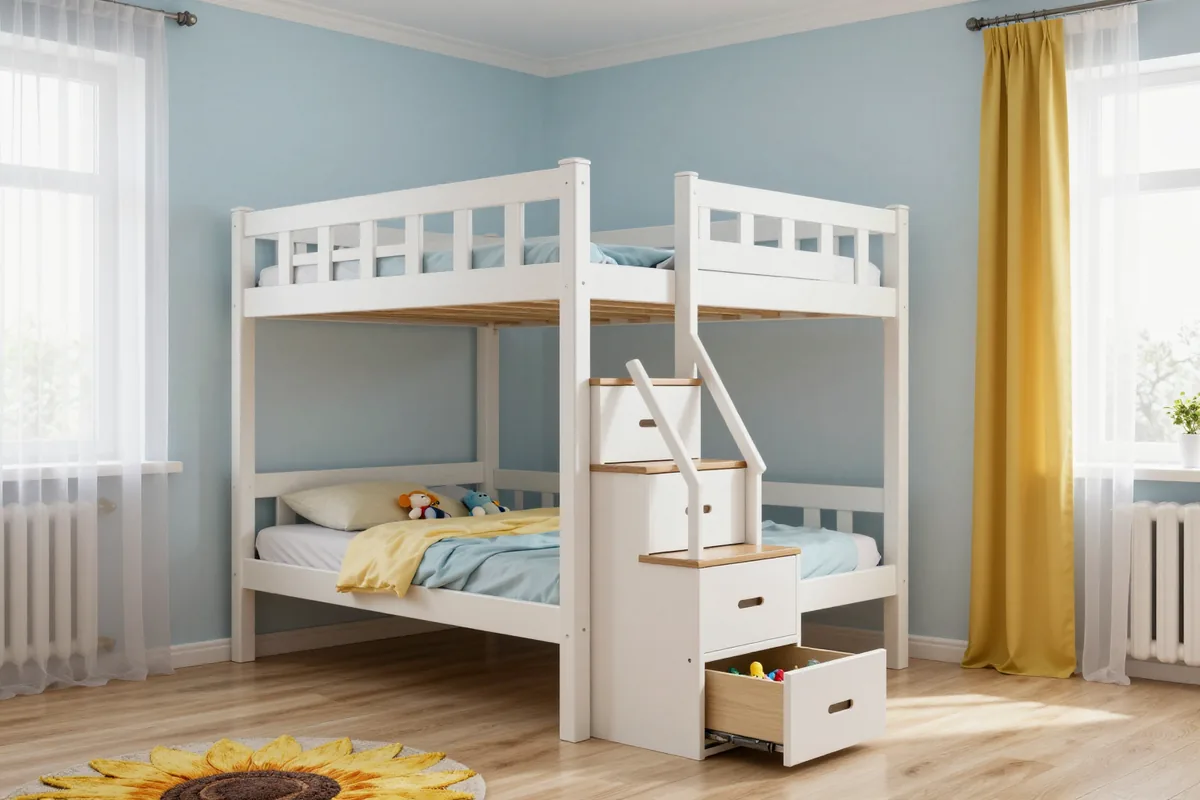
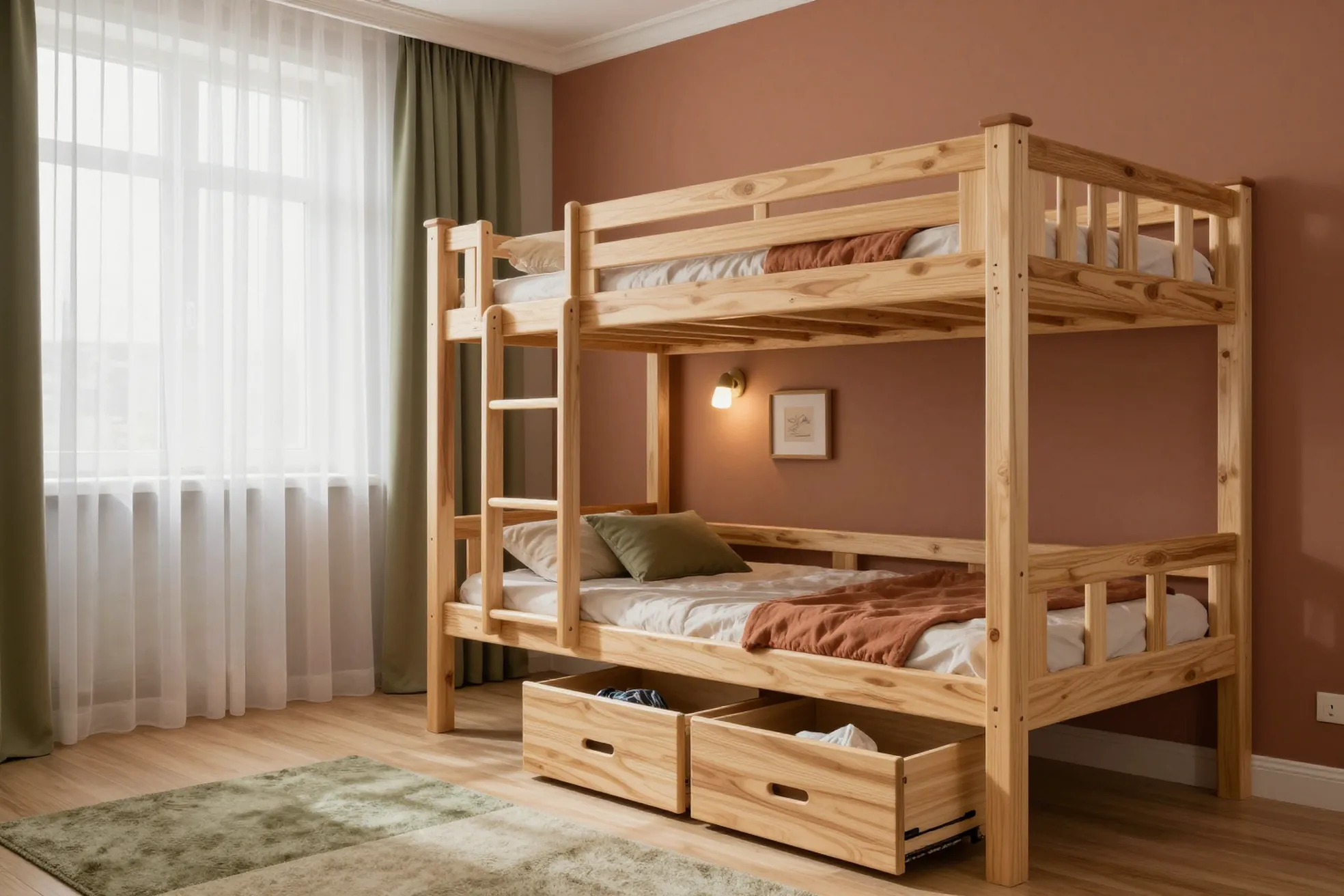
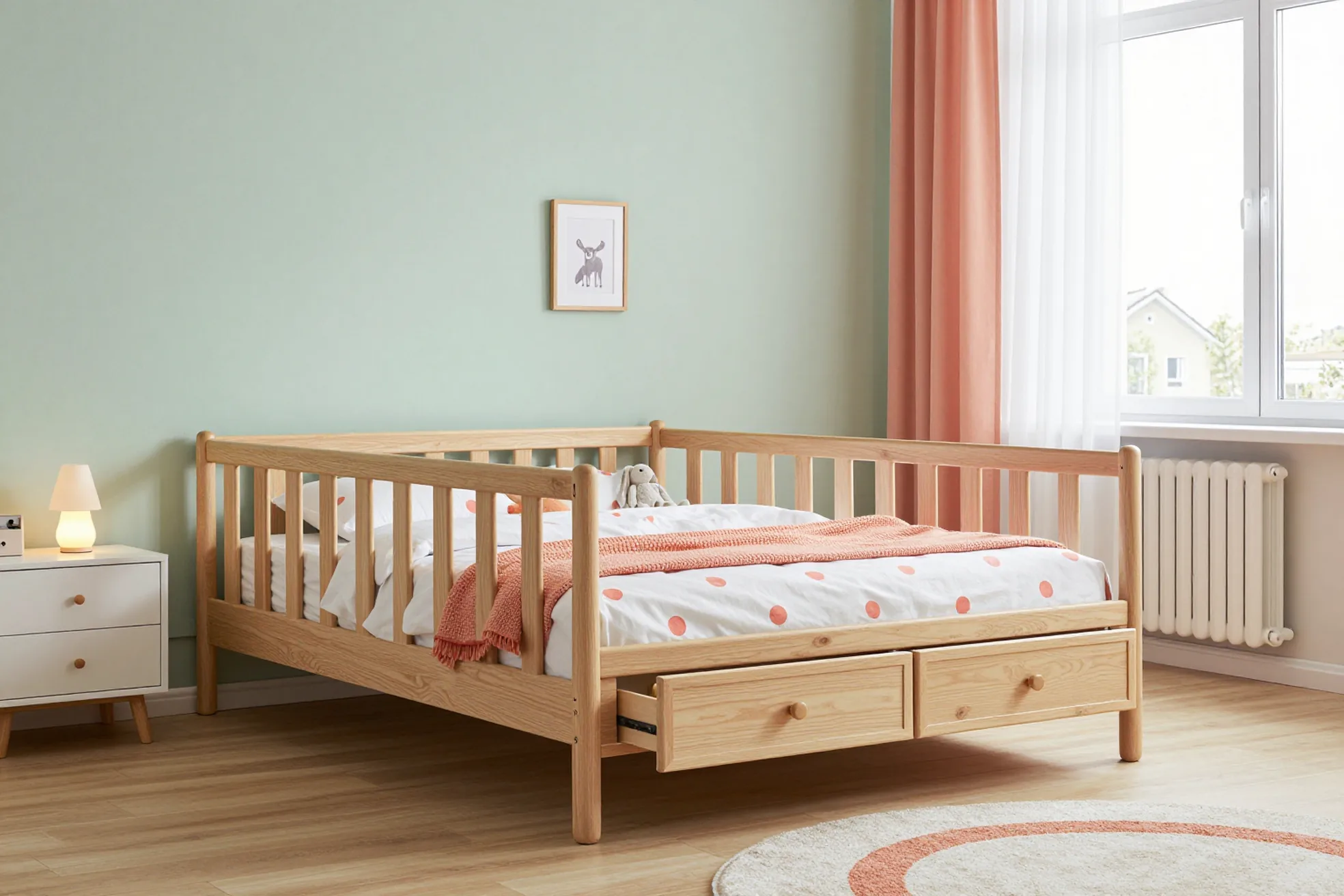
A house bed from MEBLIX is made to fit your room and your child's height. We design the frame in Egger chipboard, PVC-wrapped MDF, enamel or solid wood, fit it with Blum hardware and install it with our own crews. Measuring and a 3D design take 1–2 days, and the bed comes with a 24-month warranty under the contract.
A house bed is more than a bed with a roof. Here is how it compares with a standard bed and a loft bed, who it suits and how it gets used.
House bed, standard bed or loft bed
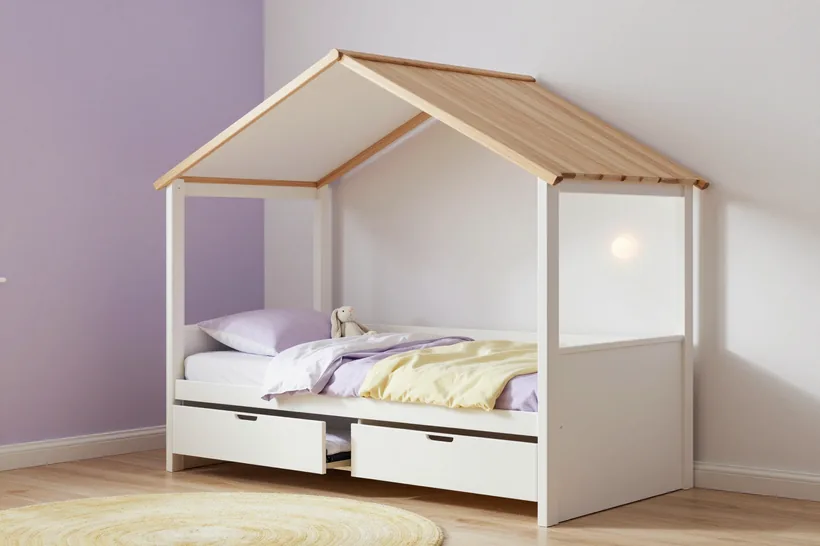
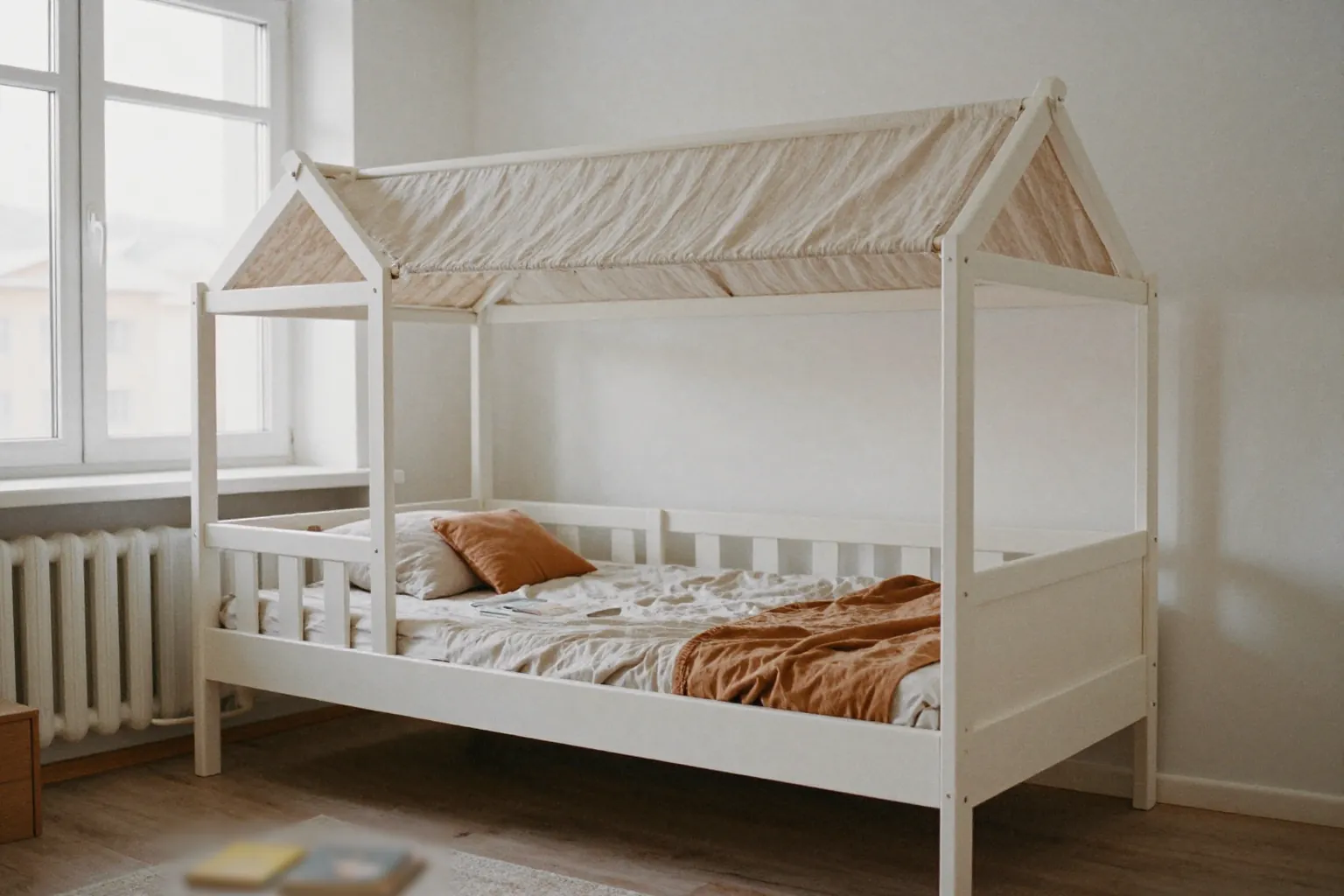
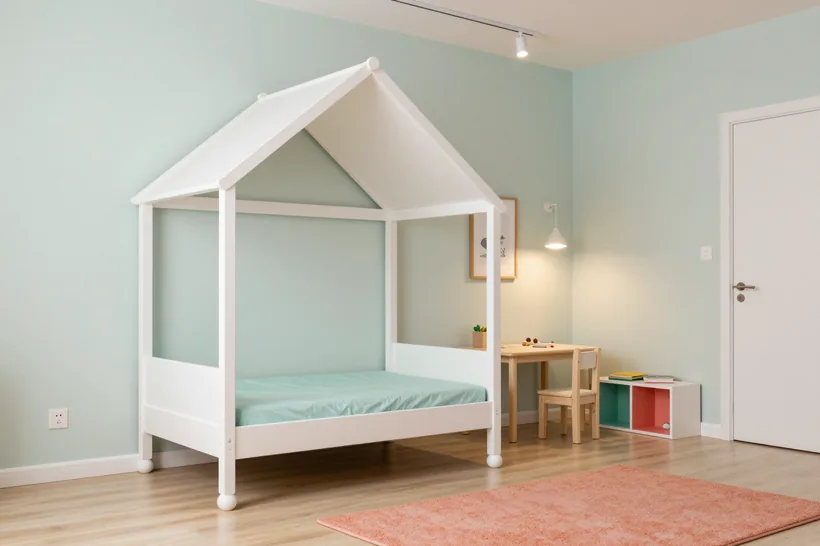
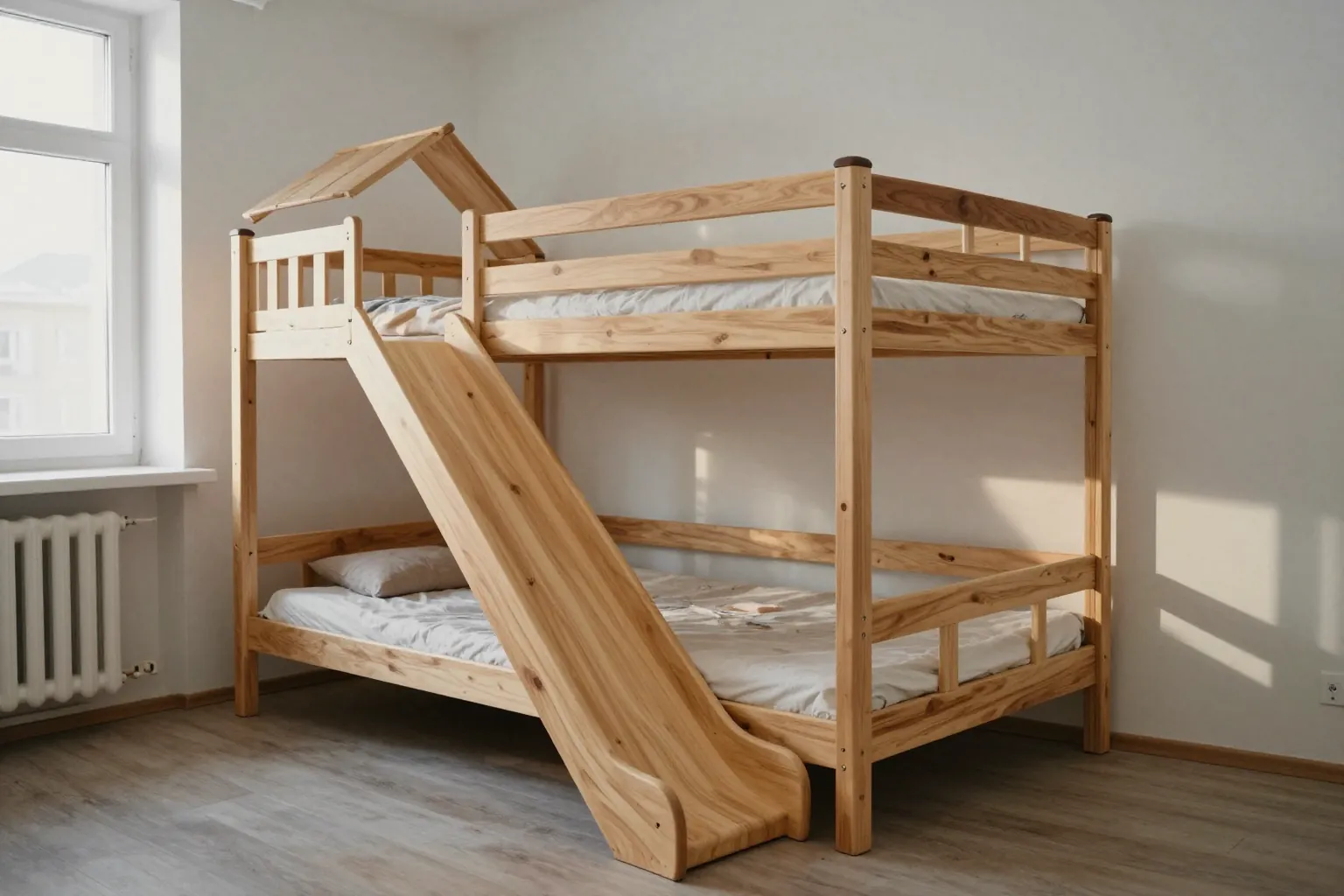
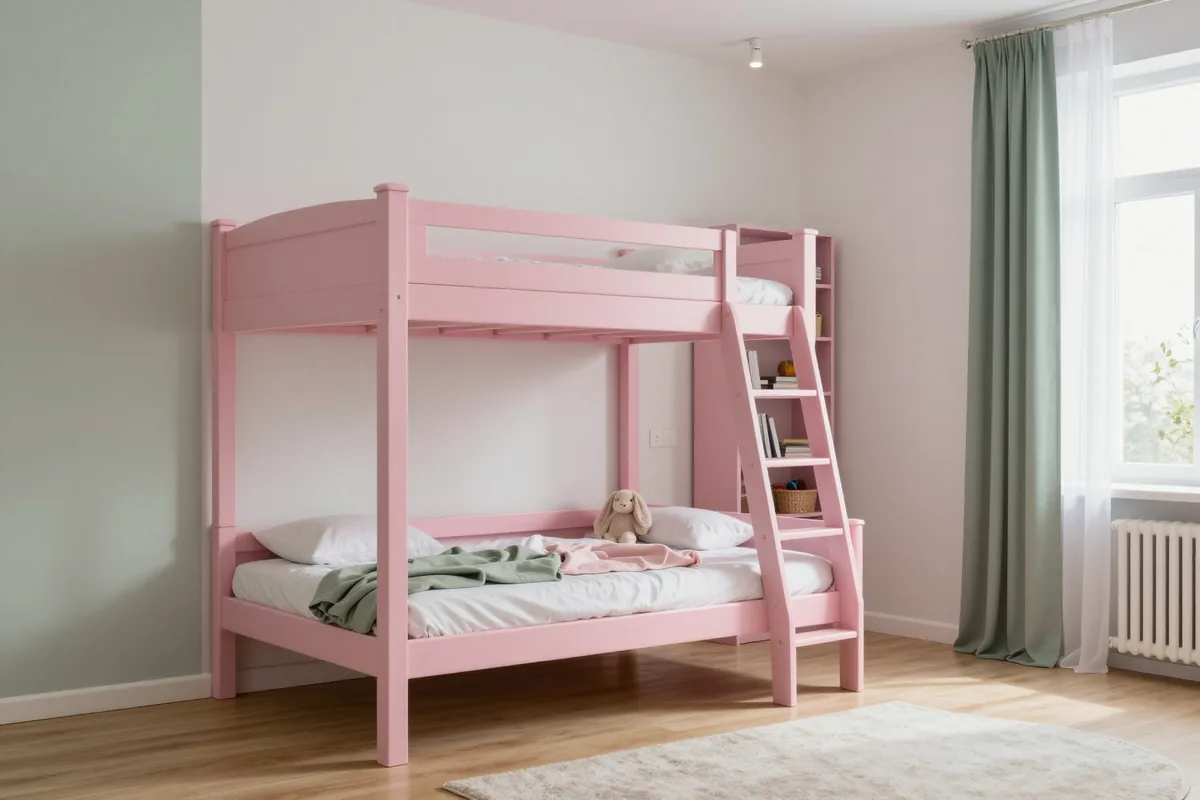
Unlike a standard bed, a house bed has a roof and supporting side walls; unlike a loft bed, its upper level is decorative, not somewhere to sleep. The two roof slopes double as stiffening ribs: they tie the sides together and stop the frame working loose during play. The side walls carry the base, so we make them from the same board as the side rails, with no thin inserts. A loft platform has to hold a person's weight, which means different supports and a guard rail all round; a house bed has one sleeping place and a purely visual top. If your child needs a second sleeping level, choose a loft — pick the format by how it will be used, not by the picture.
What age it suits
Most clients order a house bed for children aged 3–4, when they move from a cot to a bed of their own. A rail along the long side feels sheltered, and the low entry means no high walls to climb over. Later the space under the roof becomes a place for drawing, blanket tents or building sets. The format grows with the child: the rail comes off, while the play area stays popular until school age. That is why we leave extra length in the sleeping place and allow for a lower rail if the bed moves to a new room.
Configurations
| Configuration | What it adds | Best for |
|---|
| Basic with a side rail | A guard along the long side | Younger children moving out of a cot |
|---|
| With drawers | Storage under the base | Small rooms, bedding and toys |
|---|
| With a ladder | Side access to the upper level | Two-level version with a play area |
|---|
| With a play area | Open space under the roof | Preschoolers and pretend play |
|---|
Sizing a house bed to the room and the child
The size comes from two numbers: your child's height and the free space in the room. Here is what we check at the measuring visit, before anything is cut.
Length and width
We add 30–35 cm to your child's current height, so the bed lasts several years. Width starts at 70 cm for a preschooler and 80–90 cm for a school-age child: on a narrow mattress a teenager keeps hitting the rail. The side walls and roof add 15–25 cm to the frame on each side, more on models with a ladder, so the margin is measured on the inner size, not the outer footprint. Otherwise the mattress ends up tight against the end wall and the child sleeps with bent legs.
Alcoves and sloping ceilings
Many of our house beds go into an alcove or under a sloping ceiling, so the frame follows the room's real dimensions, not a standard module. The measurer takes the opening width at three points: walls in panel buildings can be 2–4 cm out. A sloping ceiling sets the height of the front post, which we trim on site, moving the roof ridge back to keep headroom above the bed. In an alcove we leave a 1–2 cm fitting gap so the frame can go in and come out, and cover it with a trim strip that also lets the mattress breathe.
What the 3D design shows
Measuring and the 3D design are free and take 1–2 days. The drawing shows clearance from the window, radiator and door, socket positions and windowsill height. Almaty flats often have bay windows and angled corners, so we also check diagonals and floor level; a 1–2 cm difference is taken up by adjustable feet. The design also checks how drawers open and how easy it is to get into bed — far cheaper than altering a finished frame. The approved design is then used for cutting and for the test assembly in the workshop.
Frame materials and hardware
The frame material decides how long the bed keeps its shape and whether it starts to wobble. Here are the options, and the part hardware plays.
Which frame material to choose
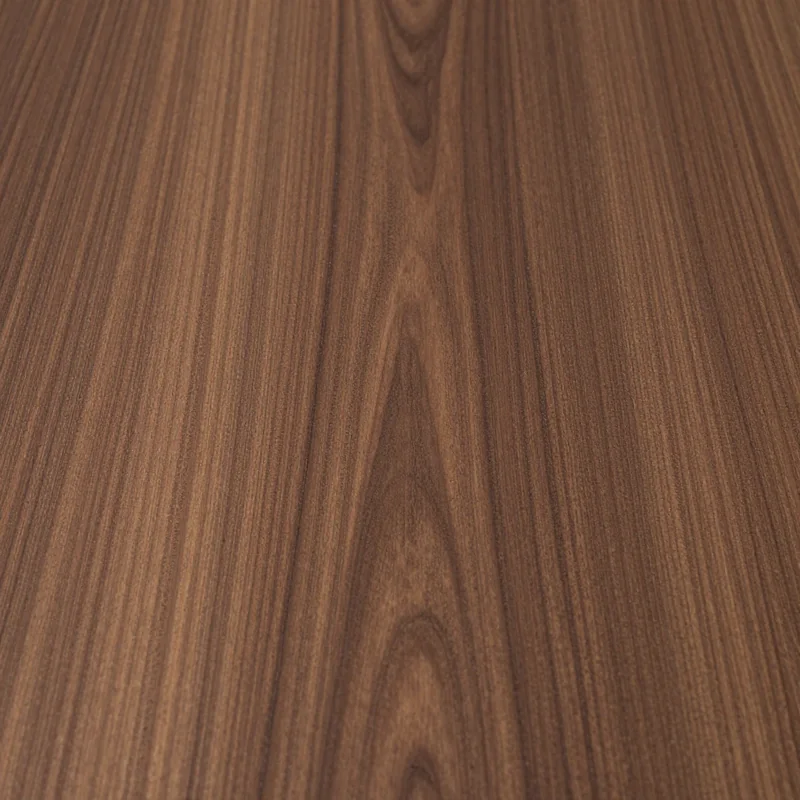
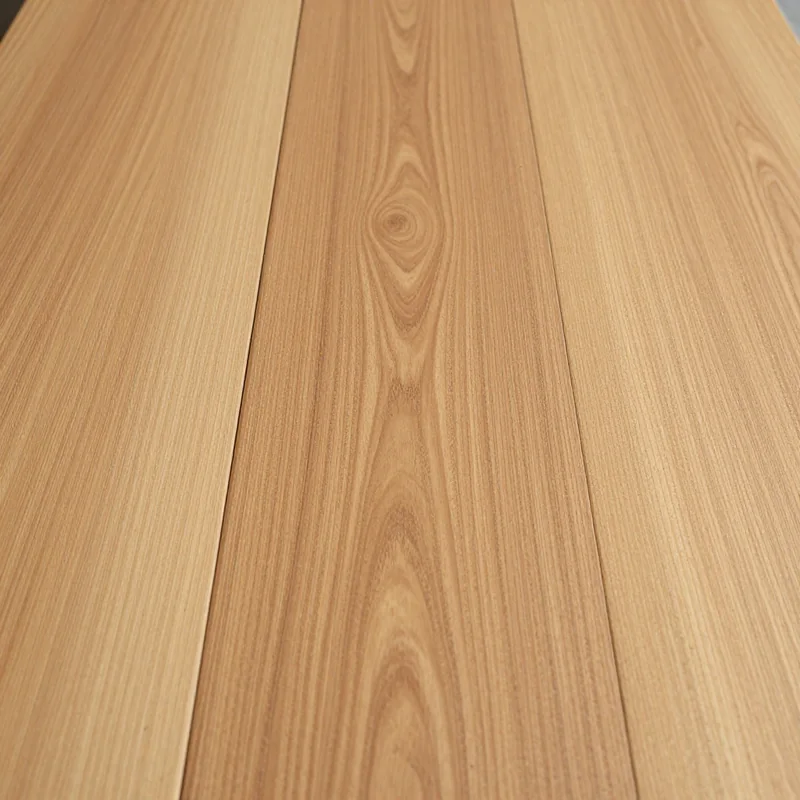
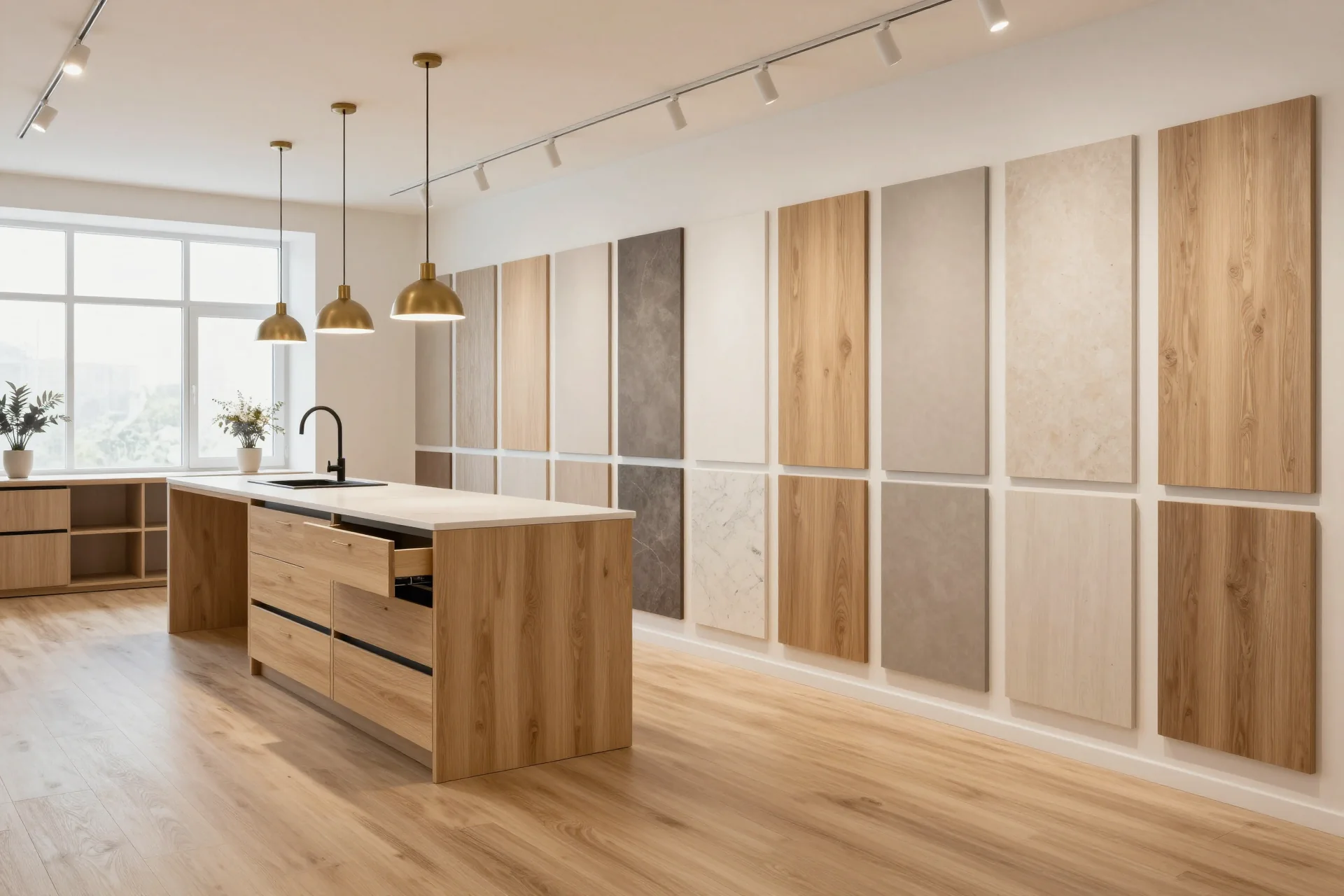
| Frame material | In everyday use | Best for |
|---|
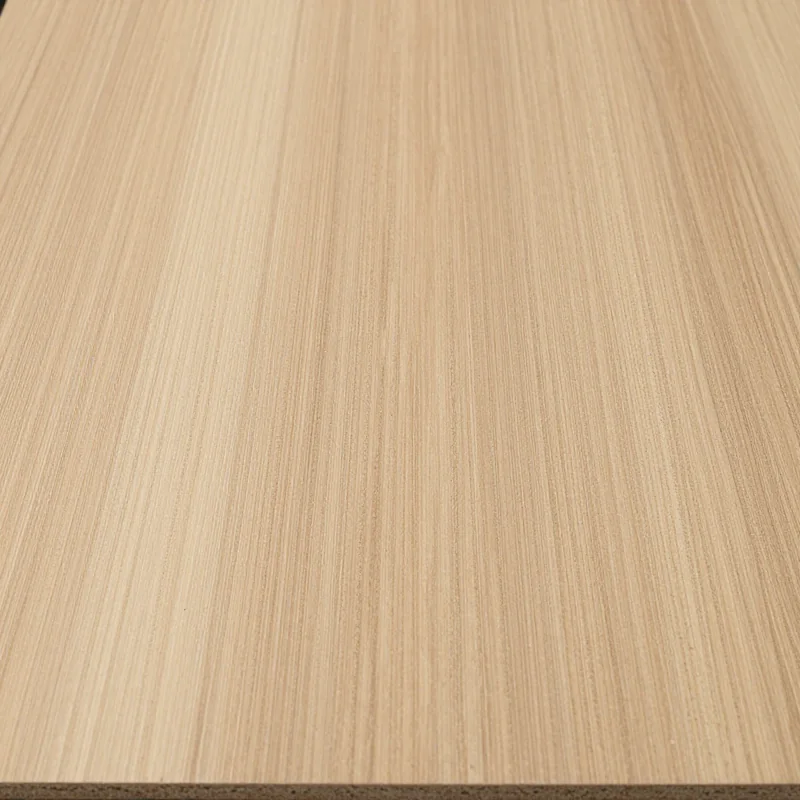
| Egger and Kronospan chipboard | Handles everyday loads, smooth surface | The standard choice for active kids |
|---|
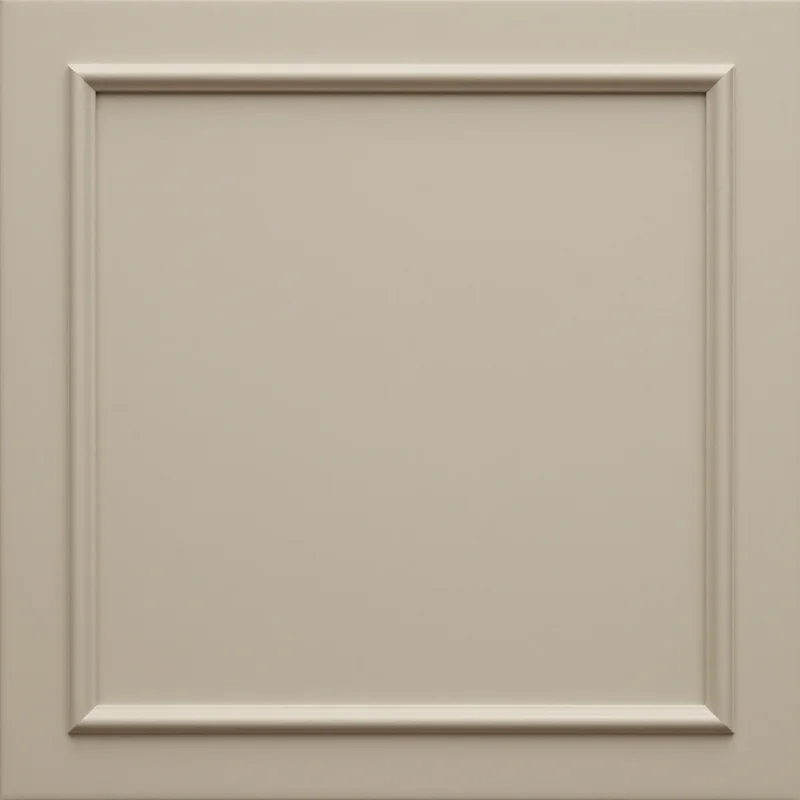
| PVC-wrapped MDF | Can be milled into shaped details | Rounded edges, arches, carved fronts |
|---|
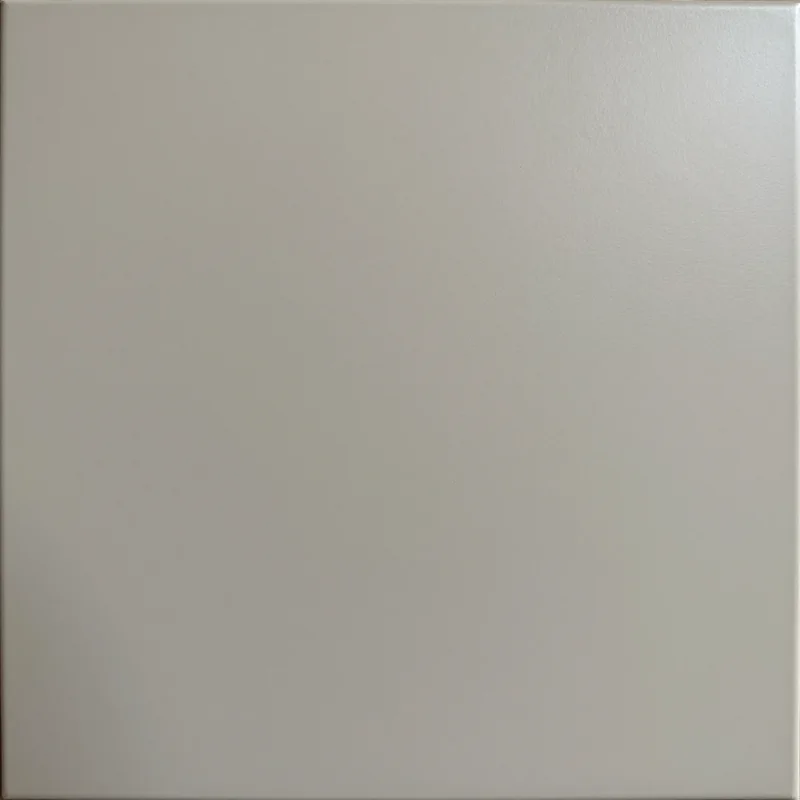
| Enamel | Matt or gloss, needs careful handling | Coloured frames in an exact shade |
|---|
| Solid wood | Heavy frame, natural grain | Exposed edges and genuine wood |
|---|
Why Blum hardware matters
We use Blum, Hettich and Boyard hardware, and Blum mechanisms carry a 25-year manufacturer's warranty. Hinges and drawer runners take all the movement: a child leans on the rail, slams a door and pulls the toy drawer out ten times an evening. A cheap soft-close works loose within a season and the door sags, even though the frame is fine. Hardware wears faster than board, so save on the finish, not on the mechanisms. At test assembly we check every hinge and runner before the order leaves.
Caring for chipboard and enamel
Wipe chipboard with a soft, slightly damp cloth and a cleaner without chlorine or solvents; acetone and hard sponges leave dull patches. Enamel is sensitive to chips and ages faster next to a radiator or in direct sun. Never flood the edges when cleaning — water in the edging is the quickest way to ruin a bed. Edging and rounded corners are applied at the cutting stage, and they decide whether the board survives an accidental spill.
Safety built into the design
A house bed has its own safety points: openings, the ladder, rails and wall fixing. This is what we check in the design and at test assembly.
Rail height and the gap to the mattress
The gap between the rail and the sleeping surface is no more than 2–3 cm, so a hand or foot cannot get trapped. Rail height is measured from the top of the mattress, not the bottom of the base, because the mattress on its slats takes up part of the height. The guard runs without breaks where sections meet, and the ladder entry stays open. The 3D design shows the rail line against the mattress, and the gap is checked again once the mattress is in.
Corners and edges
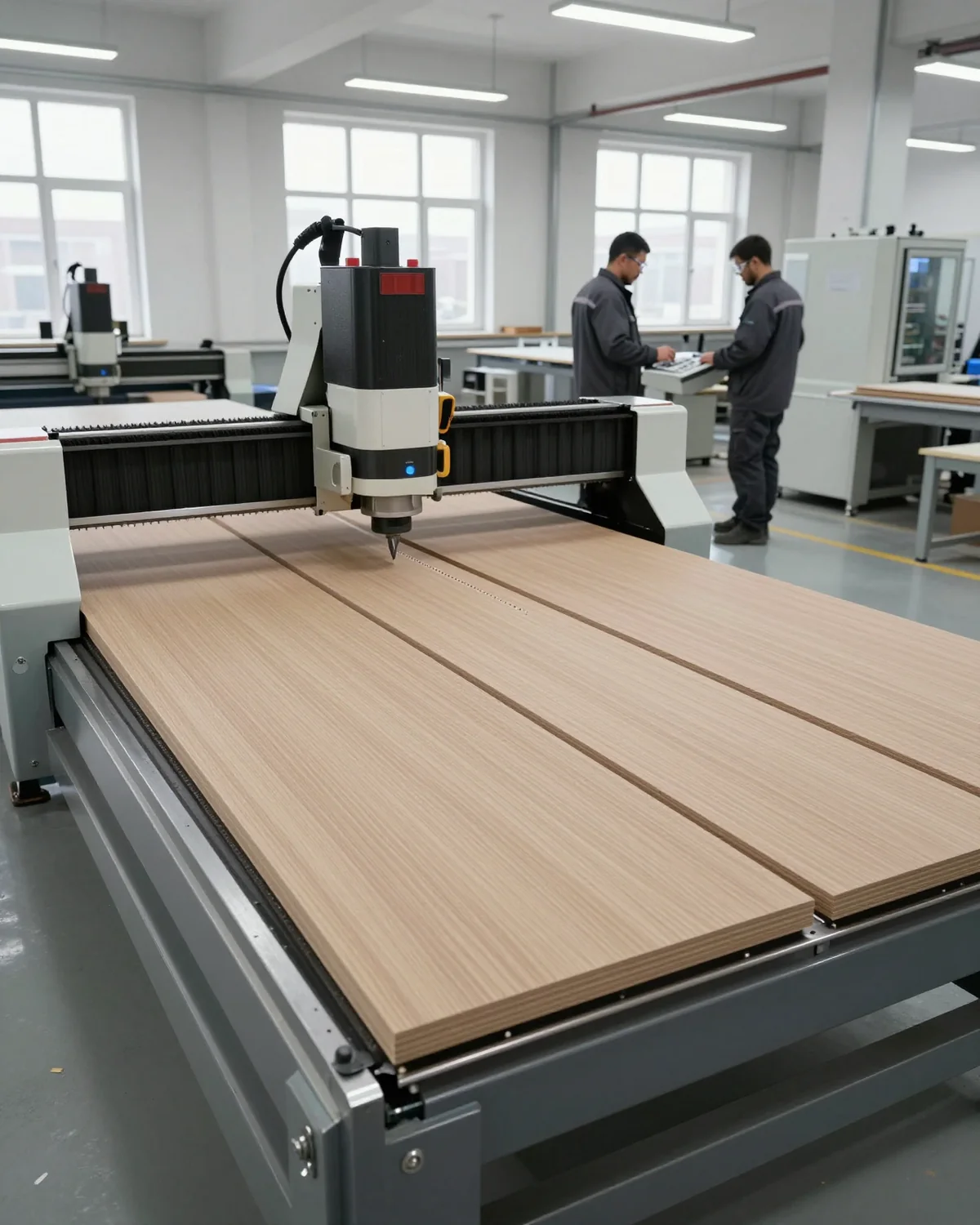
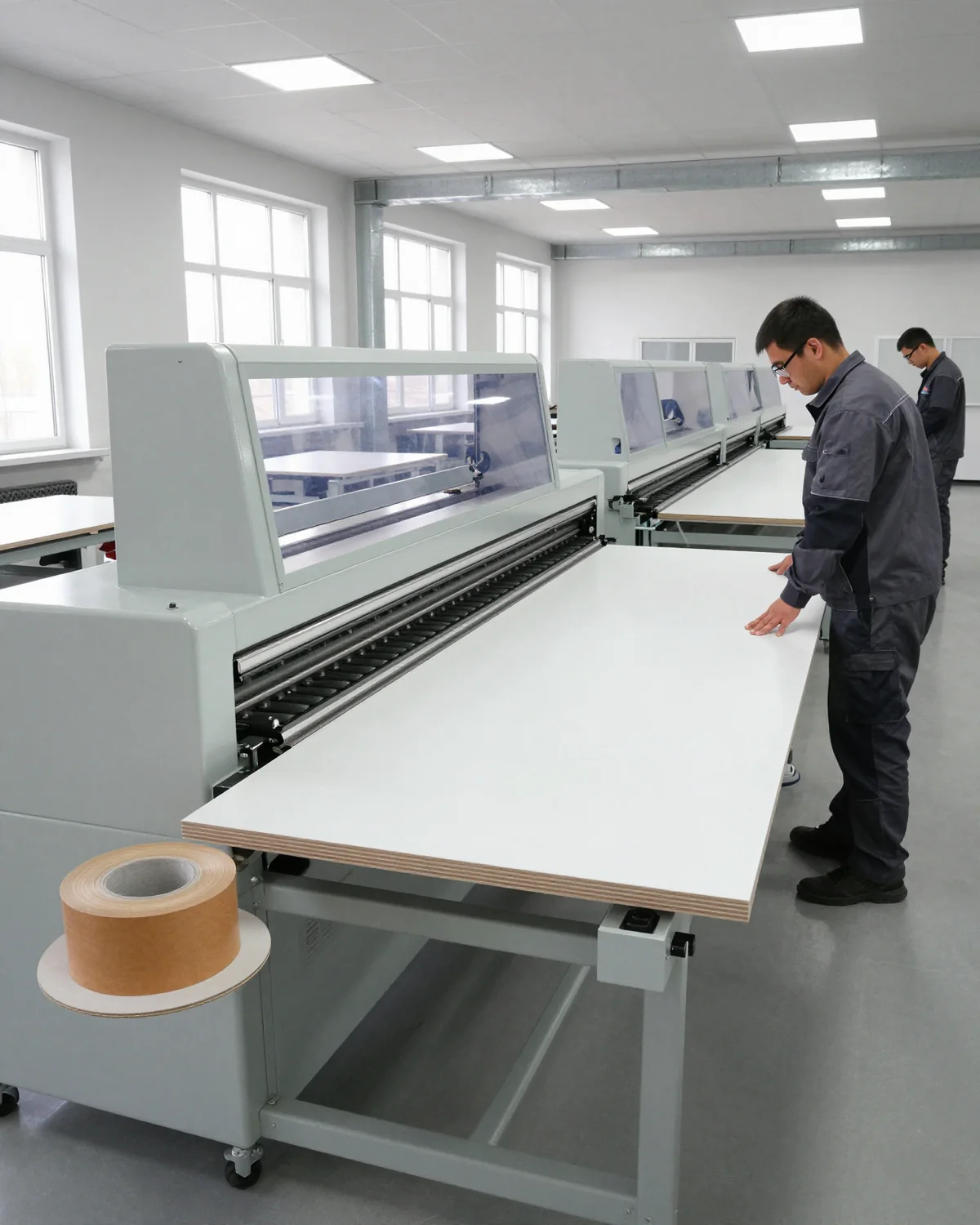
Every edge is covered with edging, including the inner cut-outs for the house's windows and doorways: an exposed chipboard edge soaks up moisture and crumbles. Corner radii are set in the cutting map and chamfered by machine before assembly — that cannot be reproduced by hand later. Blum and Hettich hardware goes into pre-drilled holes, so visible faces have no extra holes.
Fixing to the wall
We fix the bed to the wall with standard brackets, so it cannot tip if a child hangs from the roof or climbs on top. Two or three brackets go along the back, near the top rail where the pull-out force is greatest; the fixings come with the bed. Plasterboard needs a built-in backing piece, brick and concrete need anchors. If the wall cannot take fixings, we offer a version with a wider base and lower frame, which takes up more depth.
How to order a house bed and how long it takes to make
An order goes step by step, from measuring to the acceptance certificate. Here is how lead times depend on the material and what installation includes.
Lead times by material
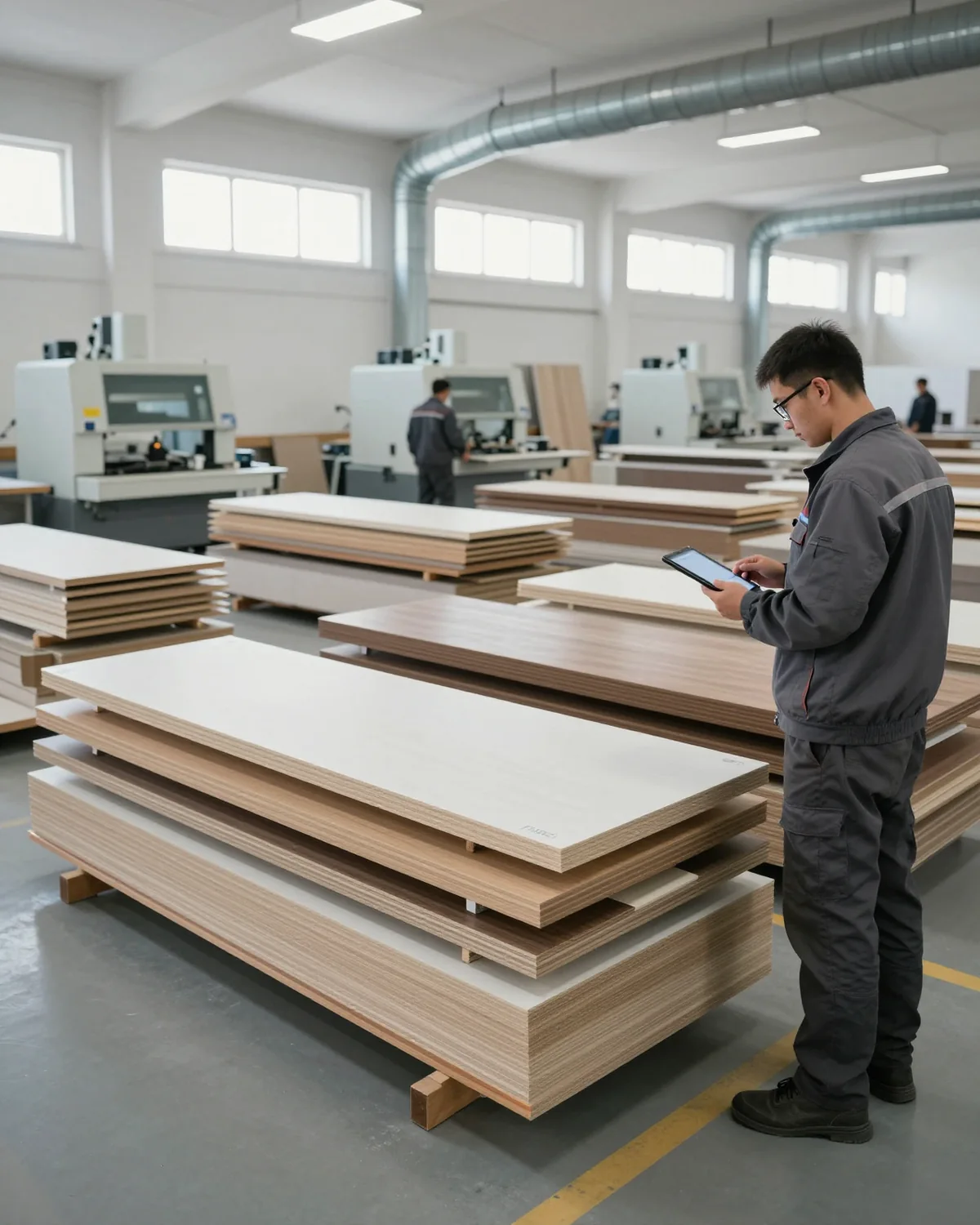
In our 600 m² workshop cutting, edging and painting run one after another, so enamel and solid wood take longer than Egger or Kronospan board. Rush orders are possible, but enamel and solid wood need time to dry and be polished, and that stage cannot be rushed without losing quality. Lead times for each option are in the price table on this page. If you need the bed by a date, allow time for delivery and installation, and choose enamel early.
Installation and acceptance
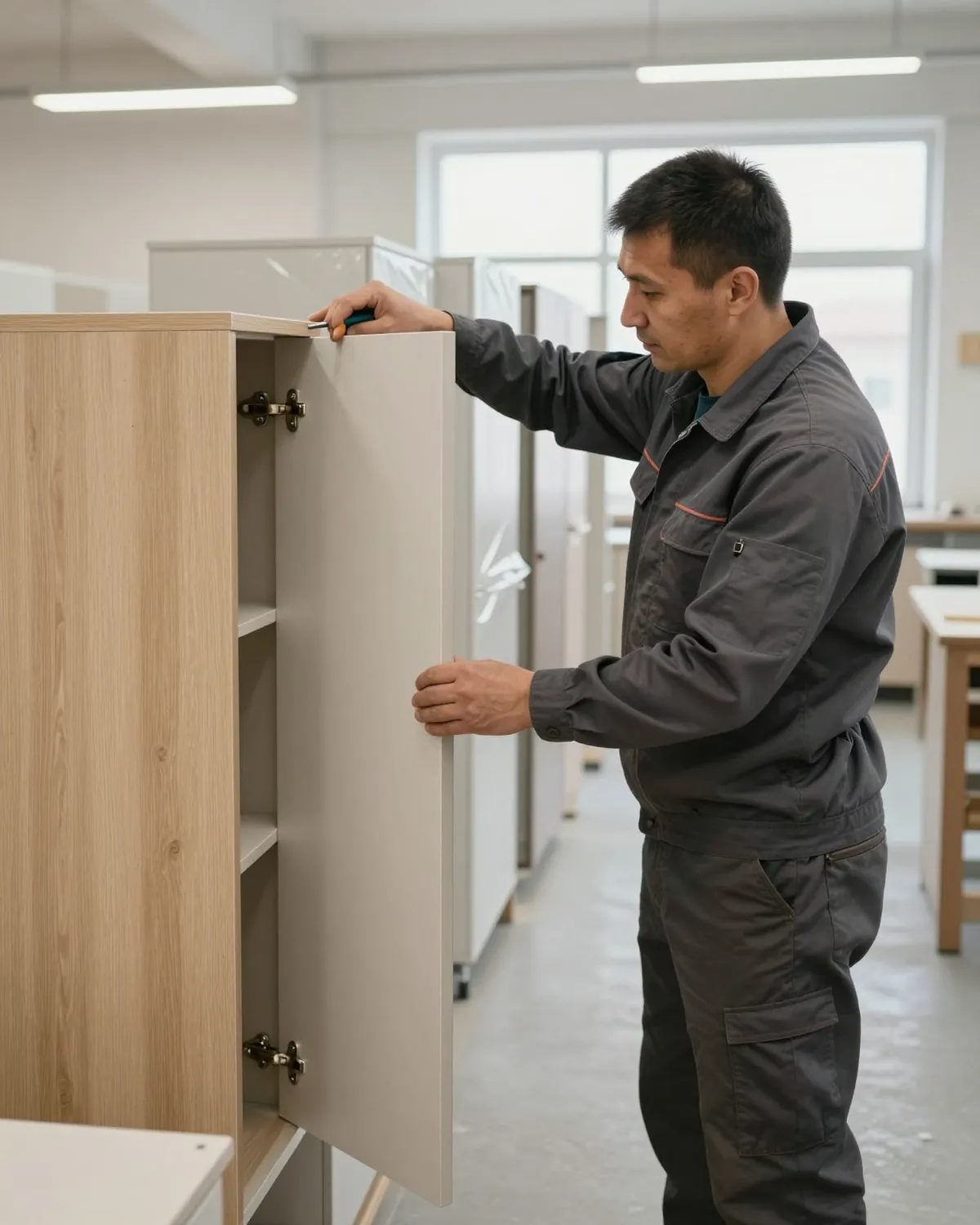
Our own crews install the bed, and you sign the acceptance certificate in your room, not from a workshop photo. Every house bed is test-assembled before dispatch, so on site it fits without adjustment. The crew assembles and levels the frame, fixes it to the wall and checks its stability. You sign only after inspecting the edges, gaps and the Blum, Hettich and Boyard hardware; any comments go into the certificate first.
Warranty and payment
The bed has a 24-month warranty under the contract, and Blum hardware a 25-year manufacturer's warranty. Payment is 50 % upfront and 50 % after acceptance, by bank transfer. The prepayment starts cutting and the purchase of Egger and Kronospan boards. The contract is signed together with the design, so you have both the drawing and the commitments in hand.
The bottom line on house beds
Five things decide how well a house bed will serve: design, size, material, safety and the order of work.
- Design: a roof and supporting side walls set it apart from a standard bed, and a decorative upper level from a loft bed.
- Size: the sleeping place is 30–35 cm longer than the child's height, and non-standard rooms are designed to their real dimensions.
- Materials: choose the frame for lifespan and care, and the hardware for load, because mechanisms wear faster than board.
- Safety: a small gap to the mattress, rounded corners, edging on every edge and fixing to the wall.
- Process: lead times depend on the material, acceptance happens on site, and warranty terms are fixed in the contract.