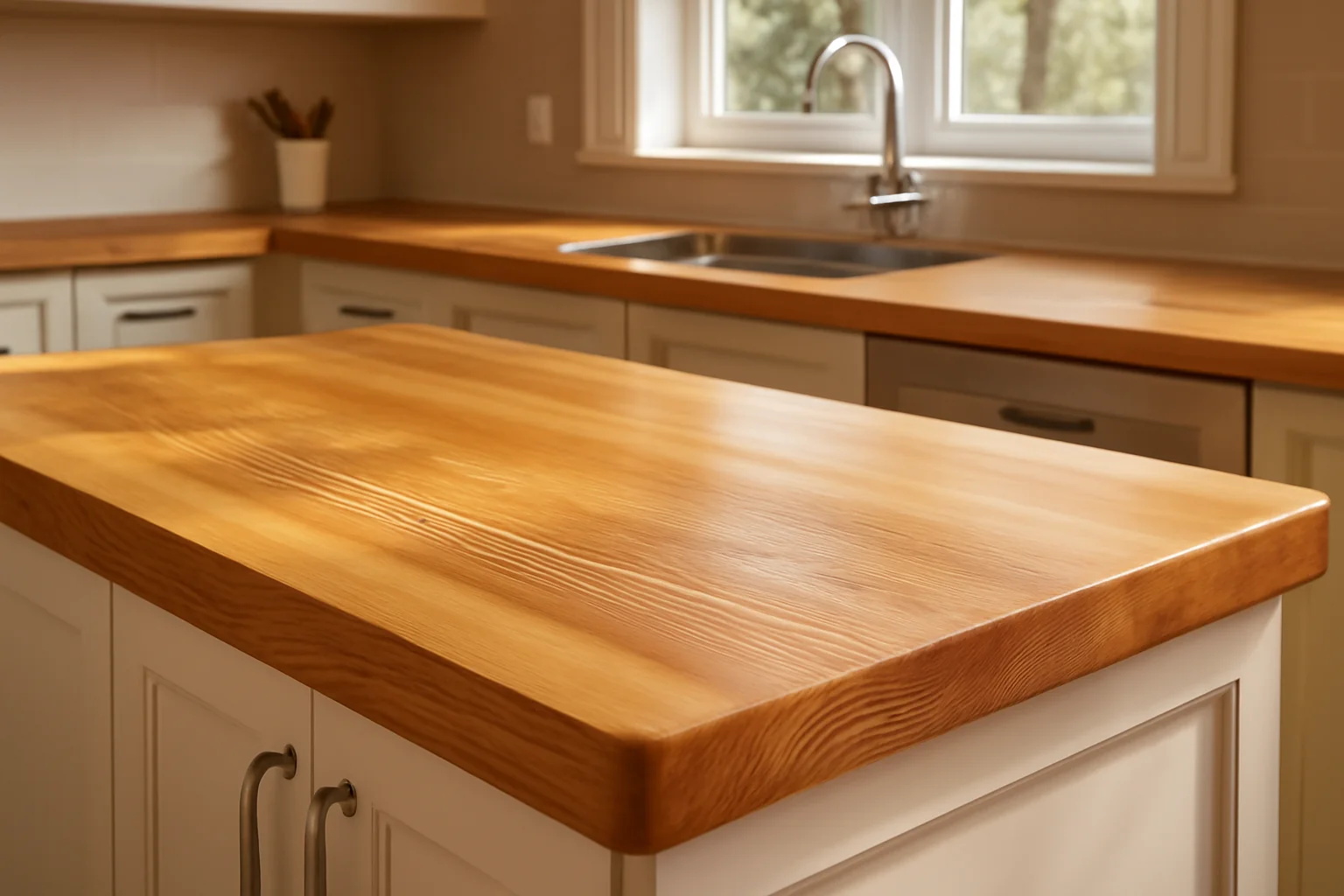
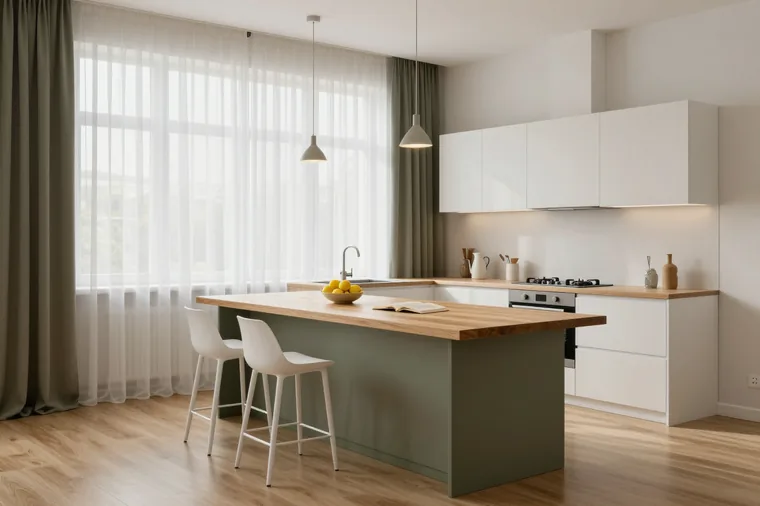
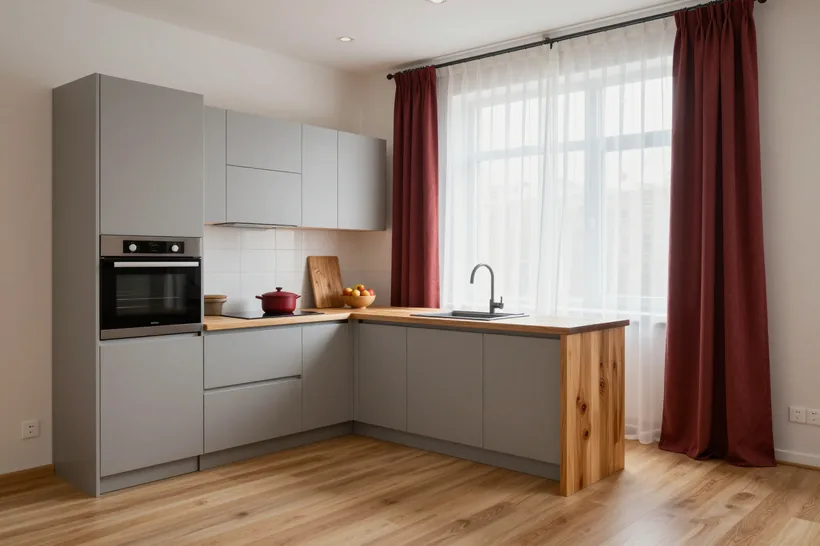
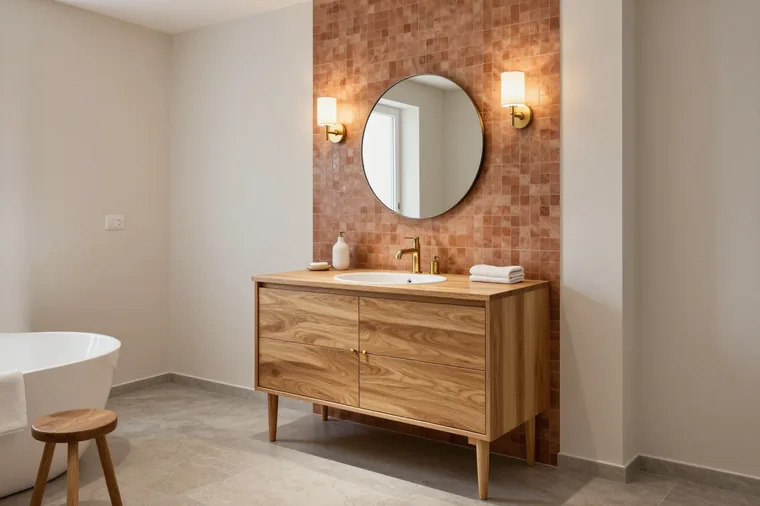
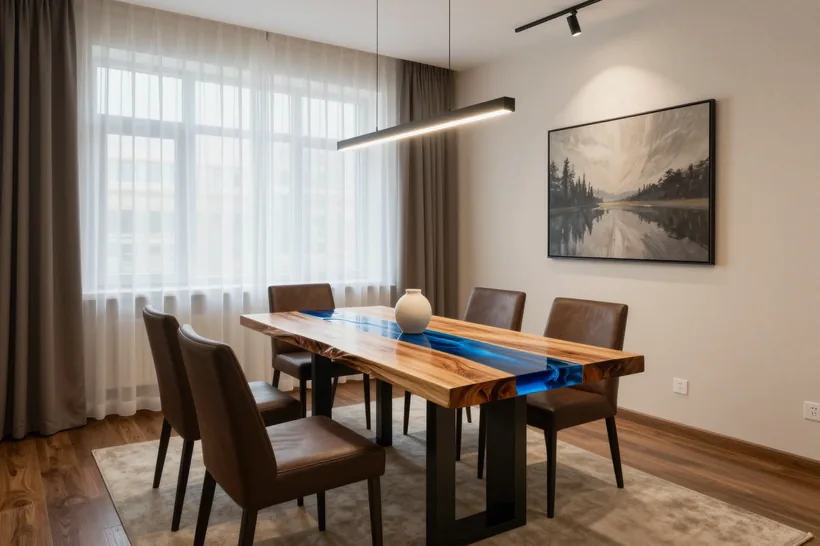
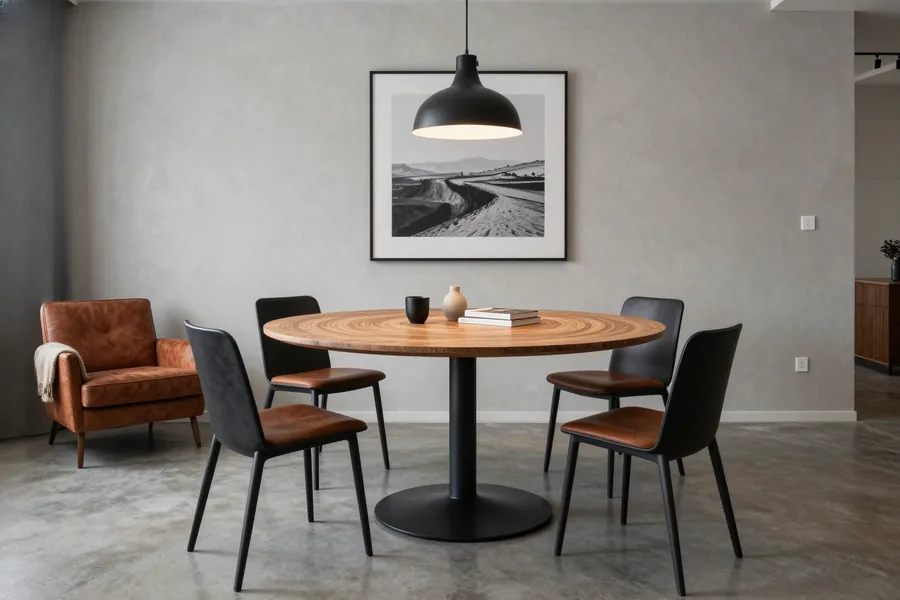
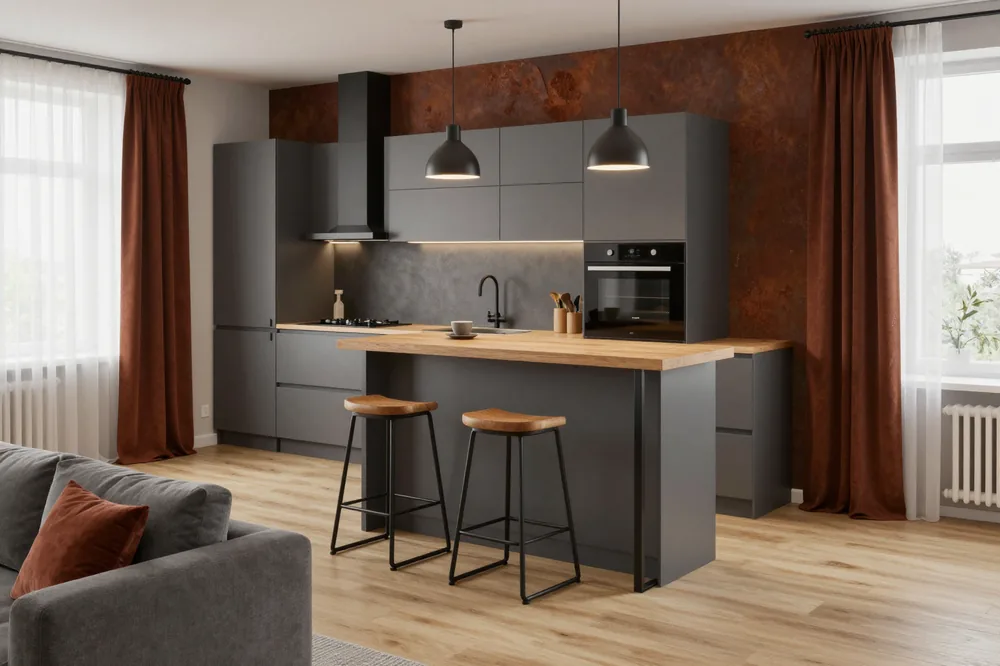
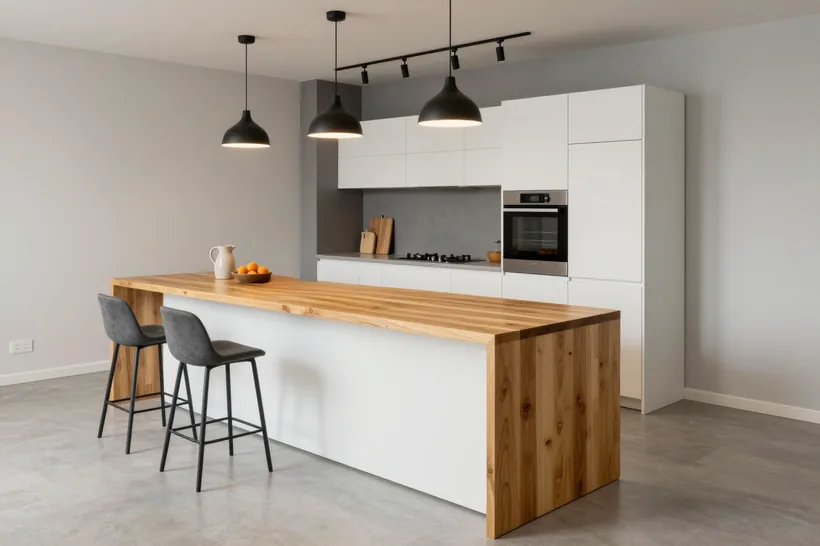
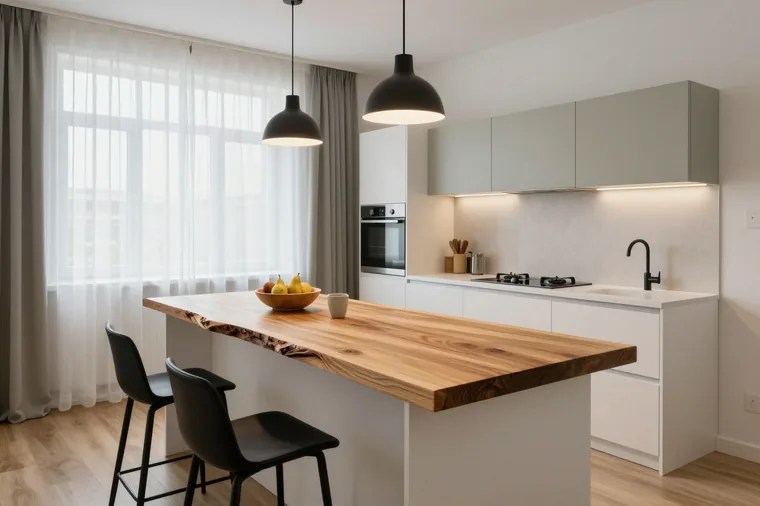
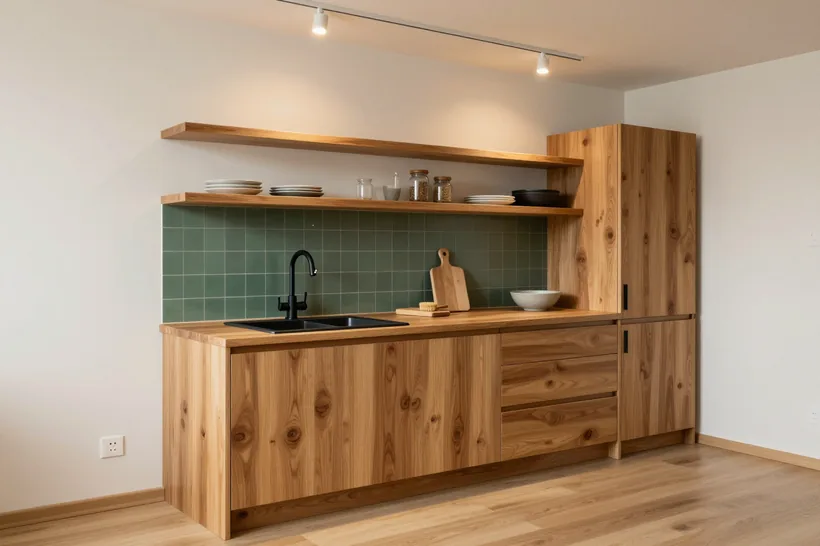
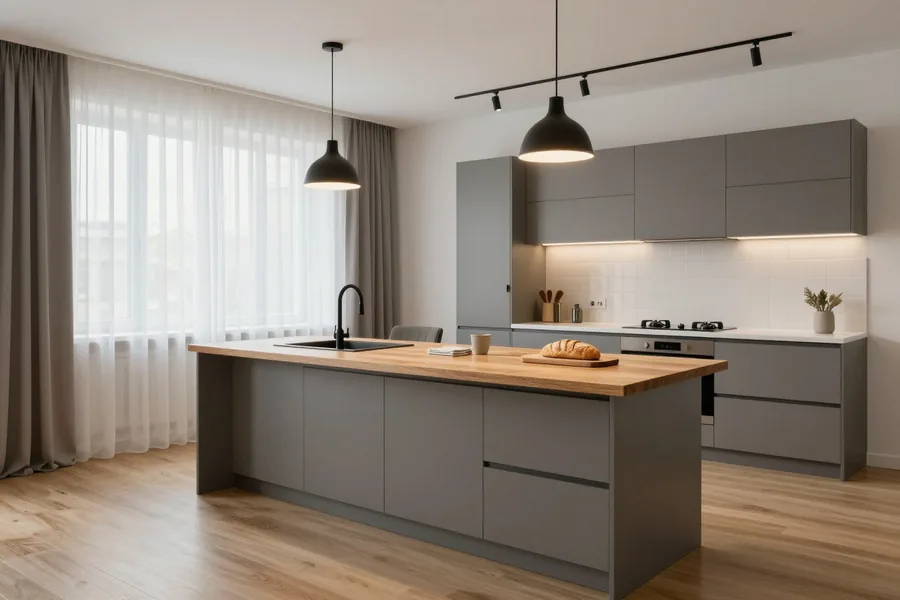
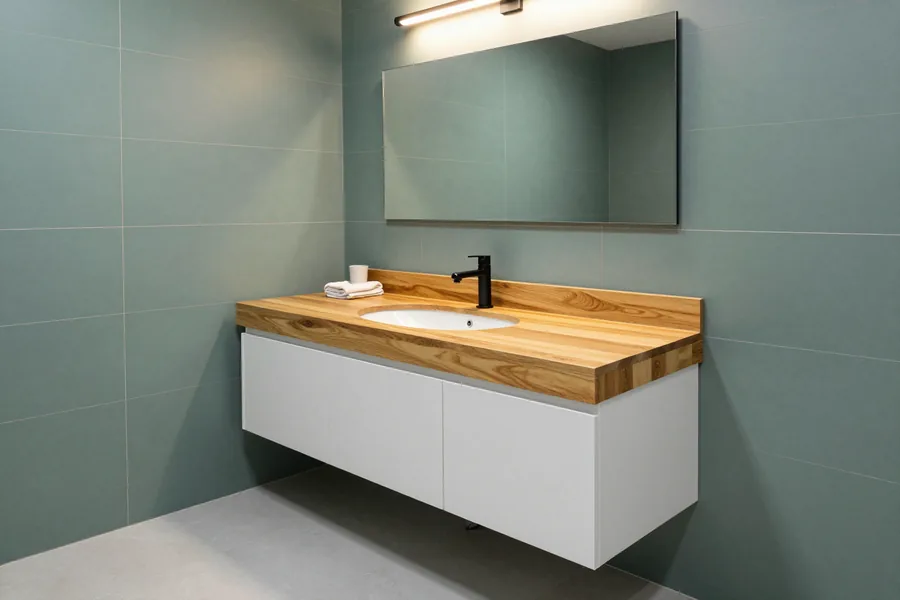
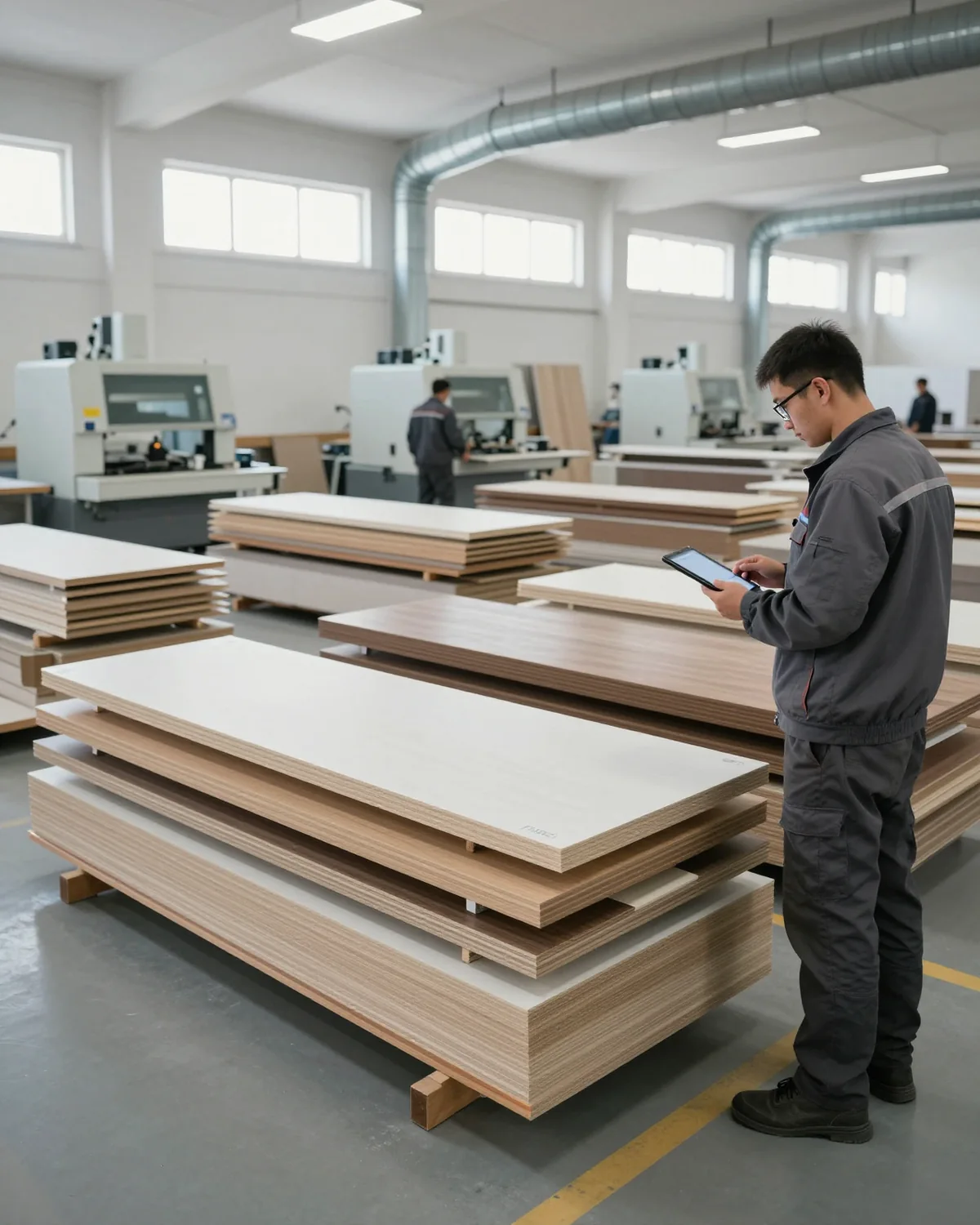
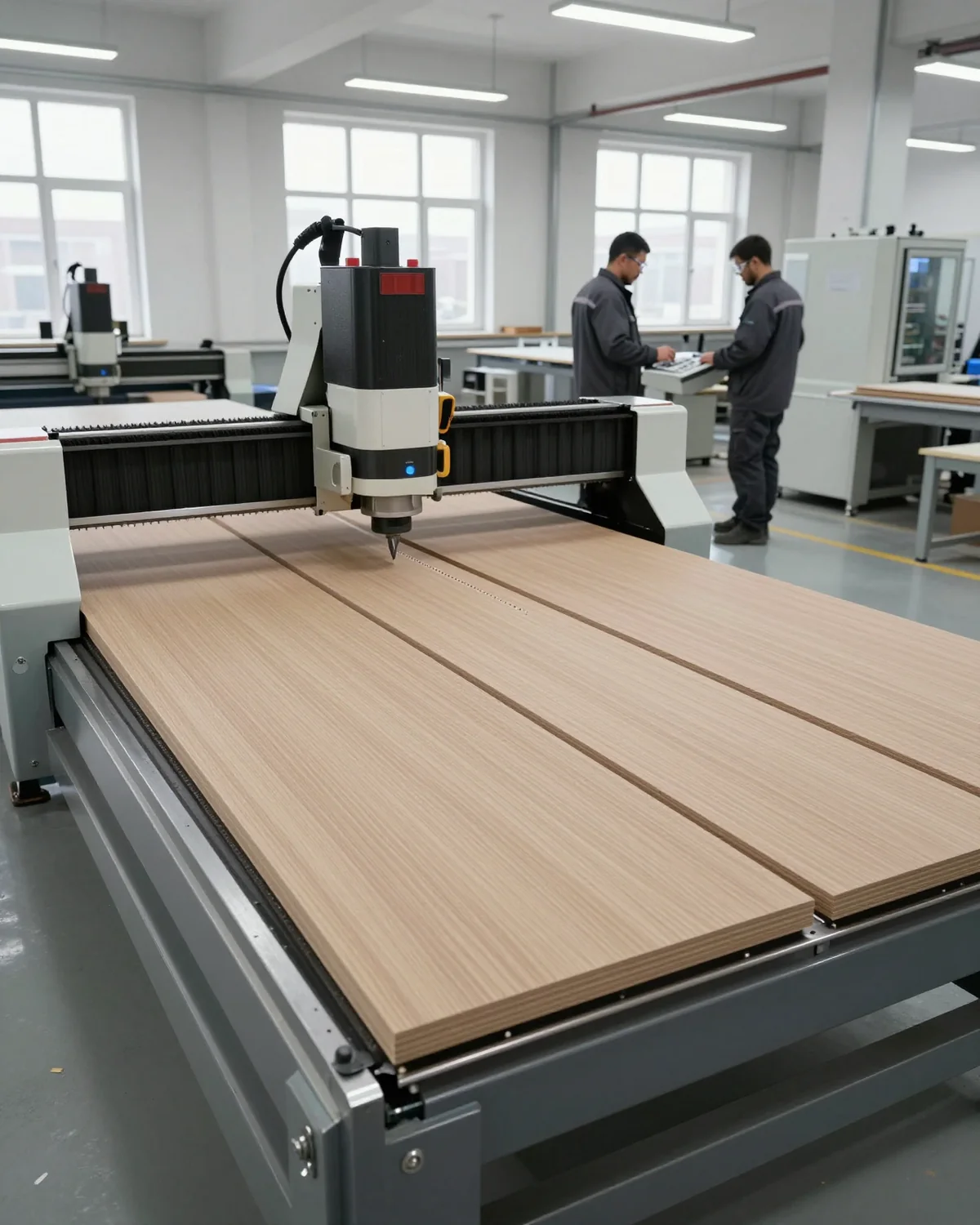
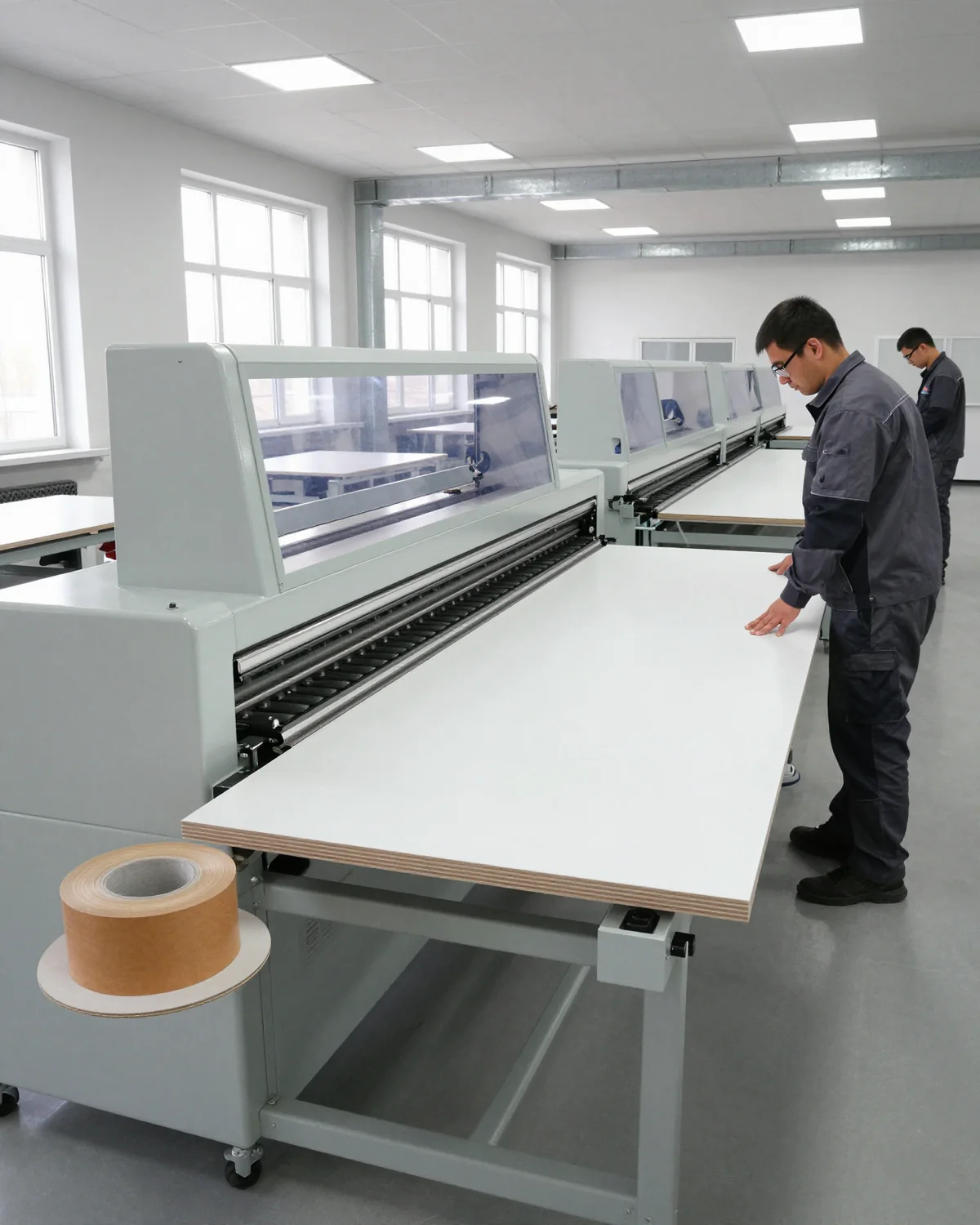
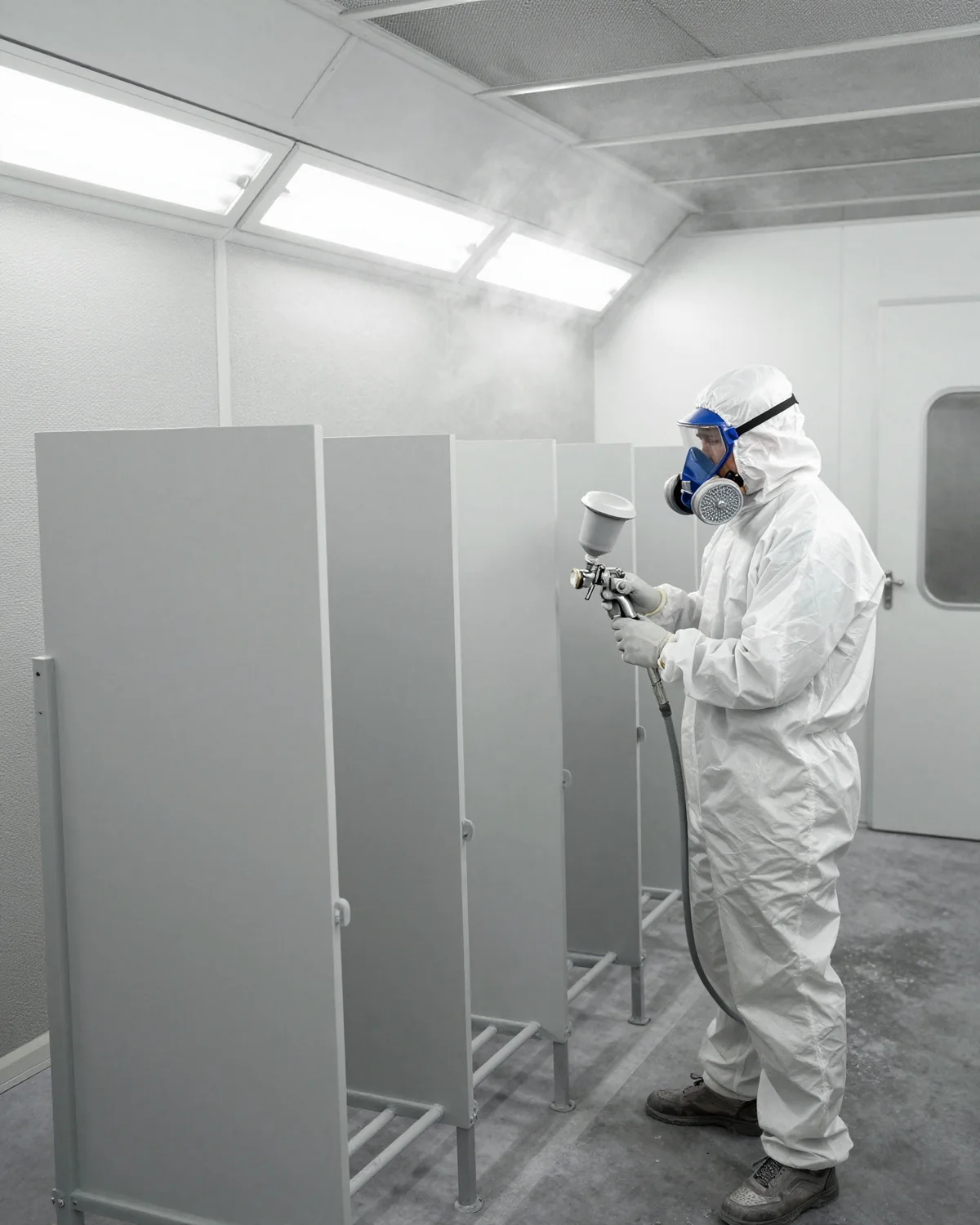
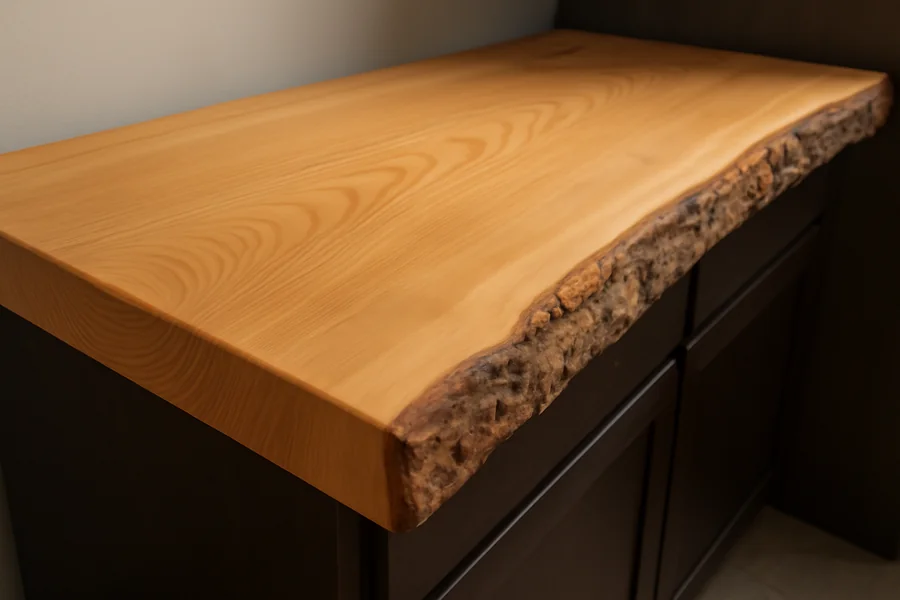
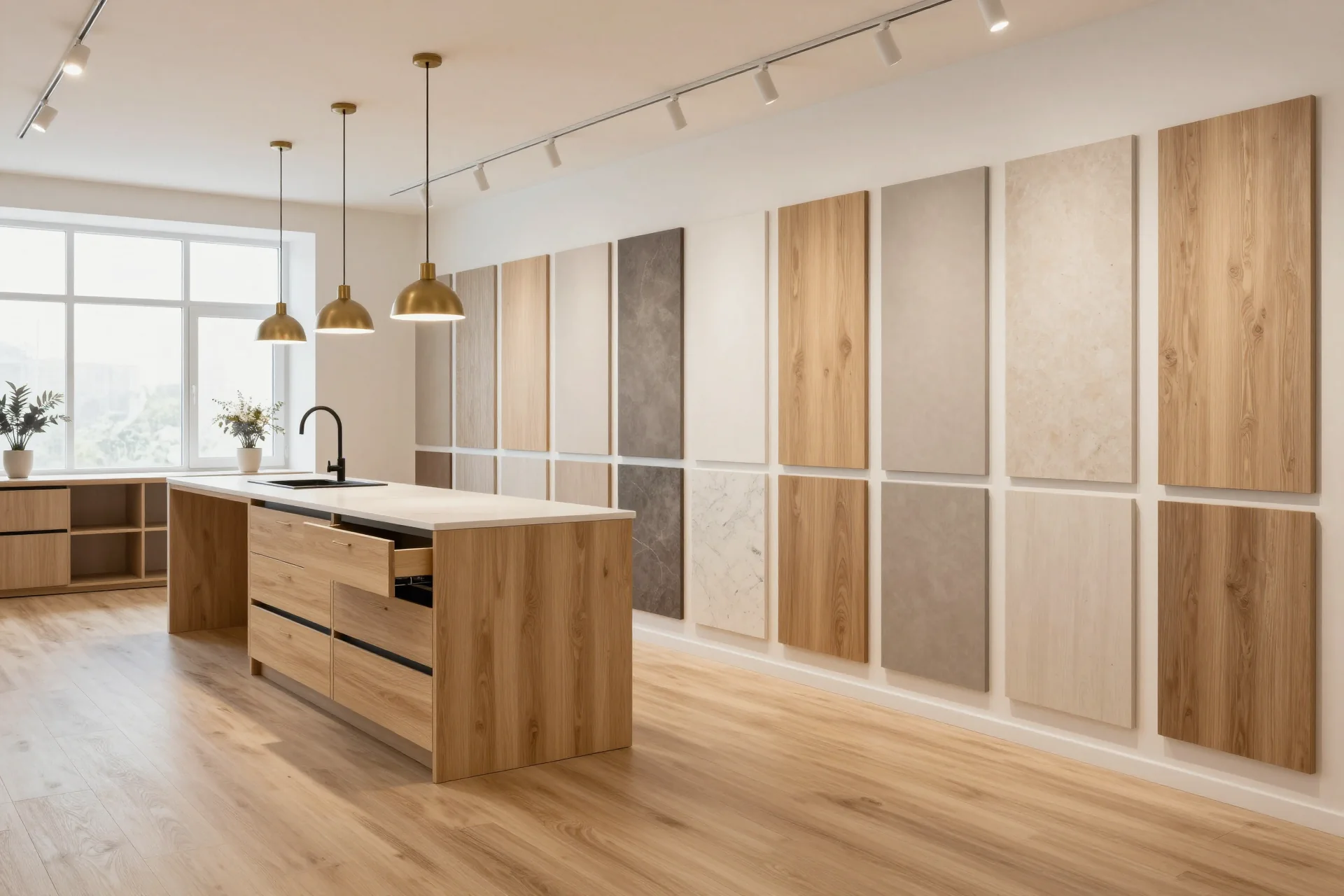
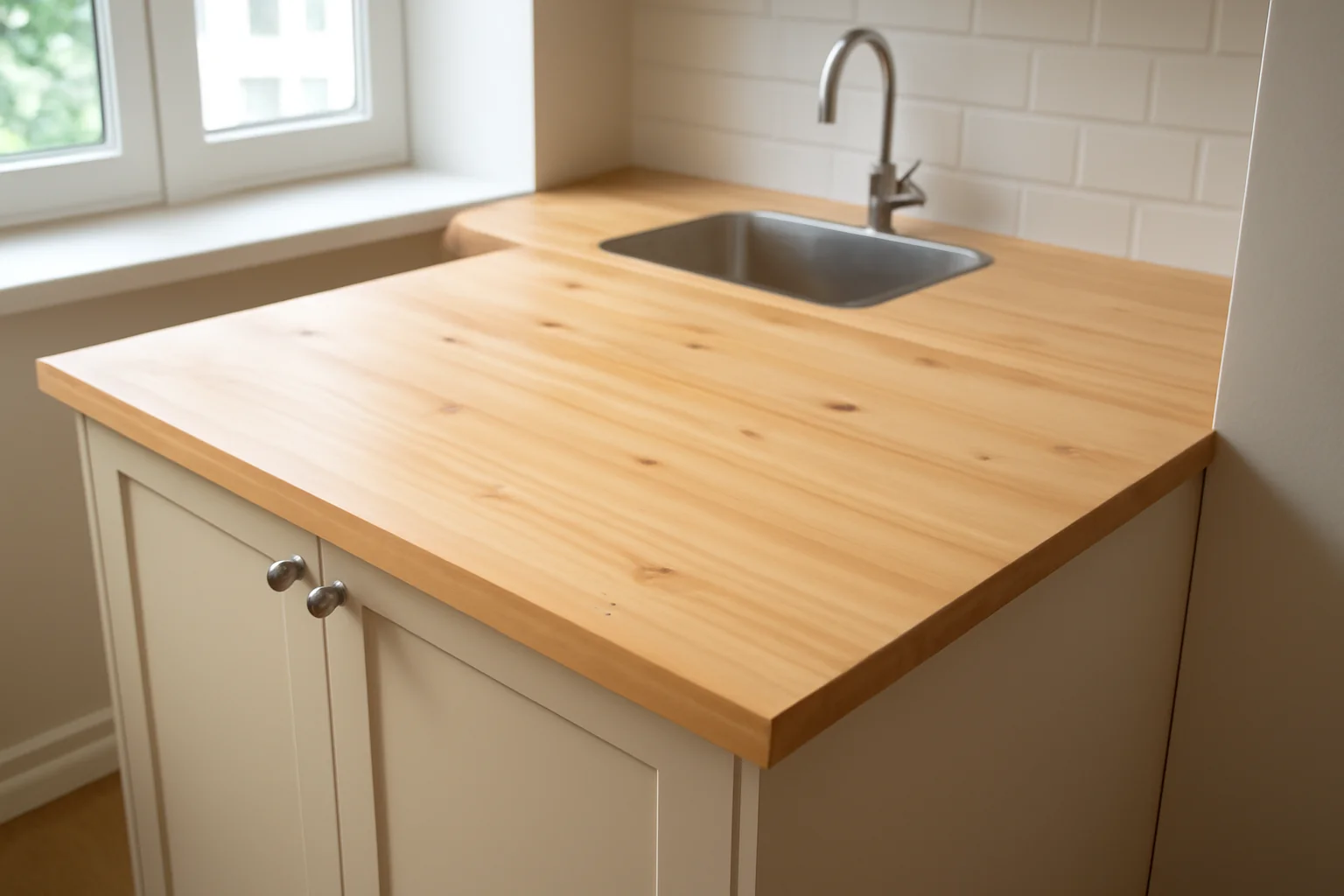
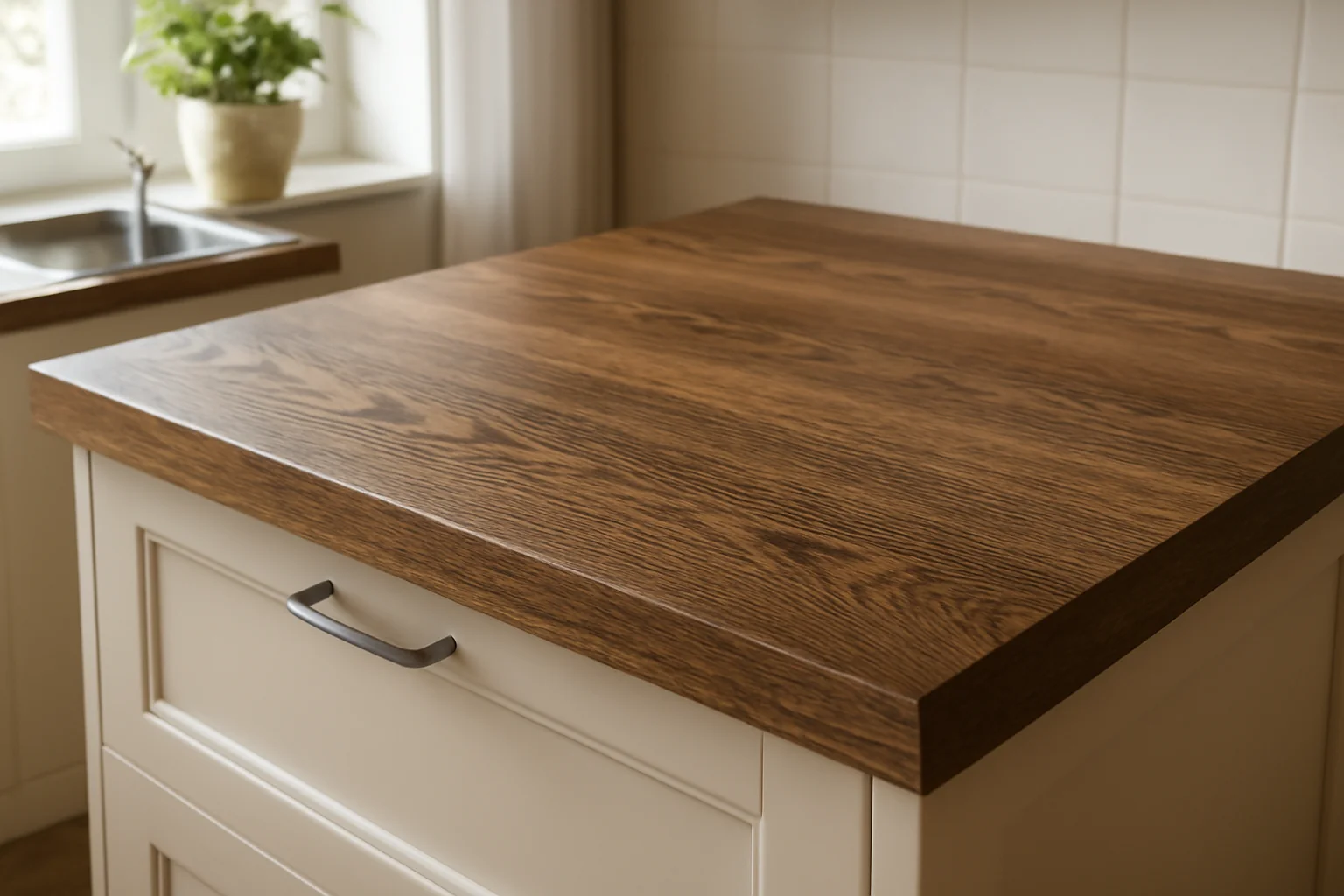
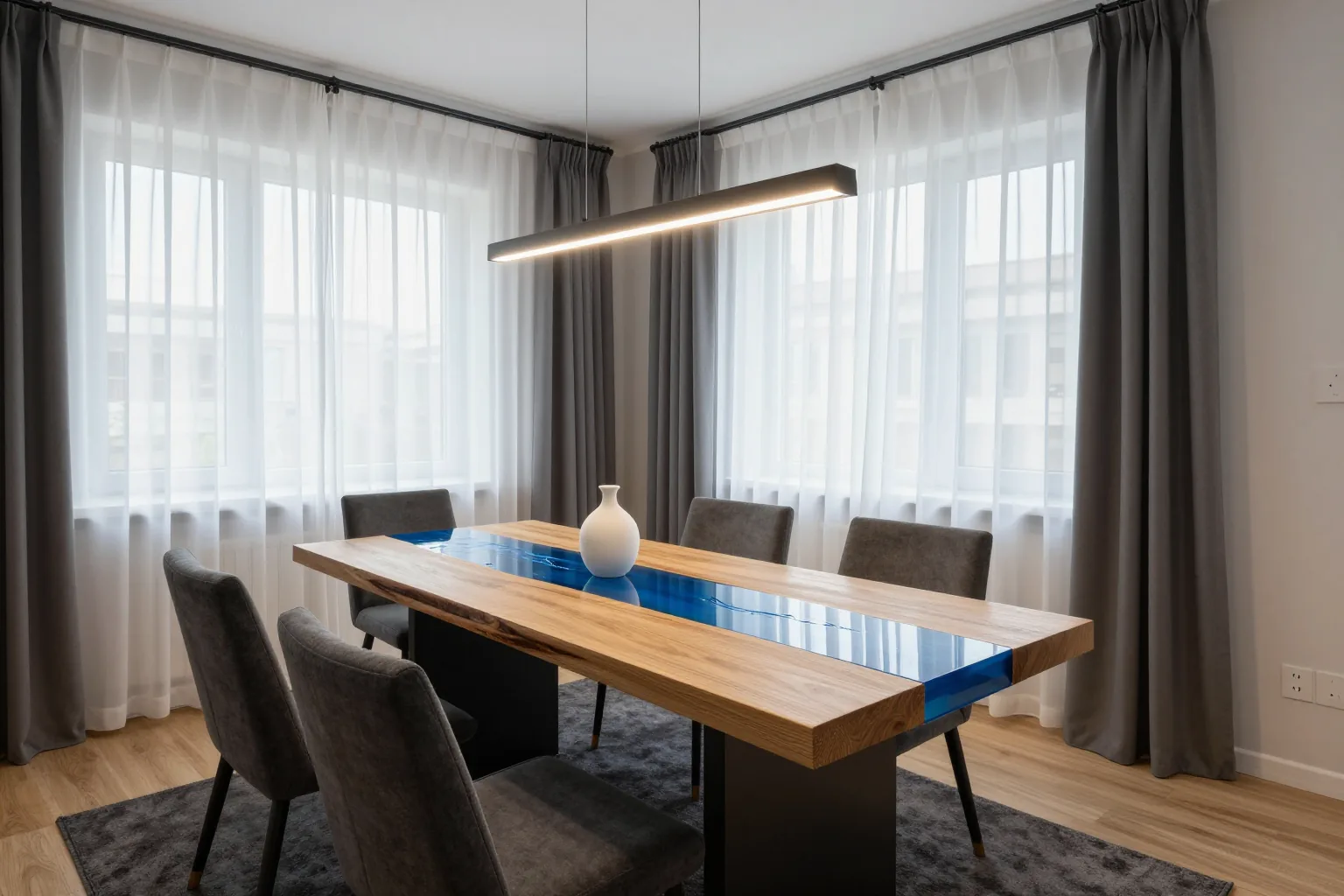
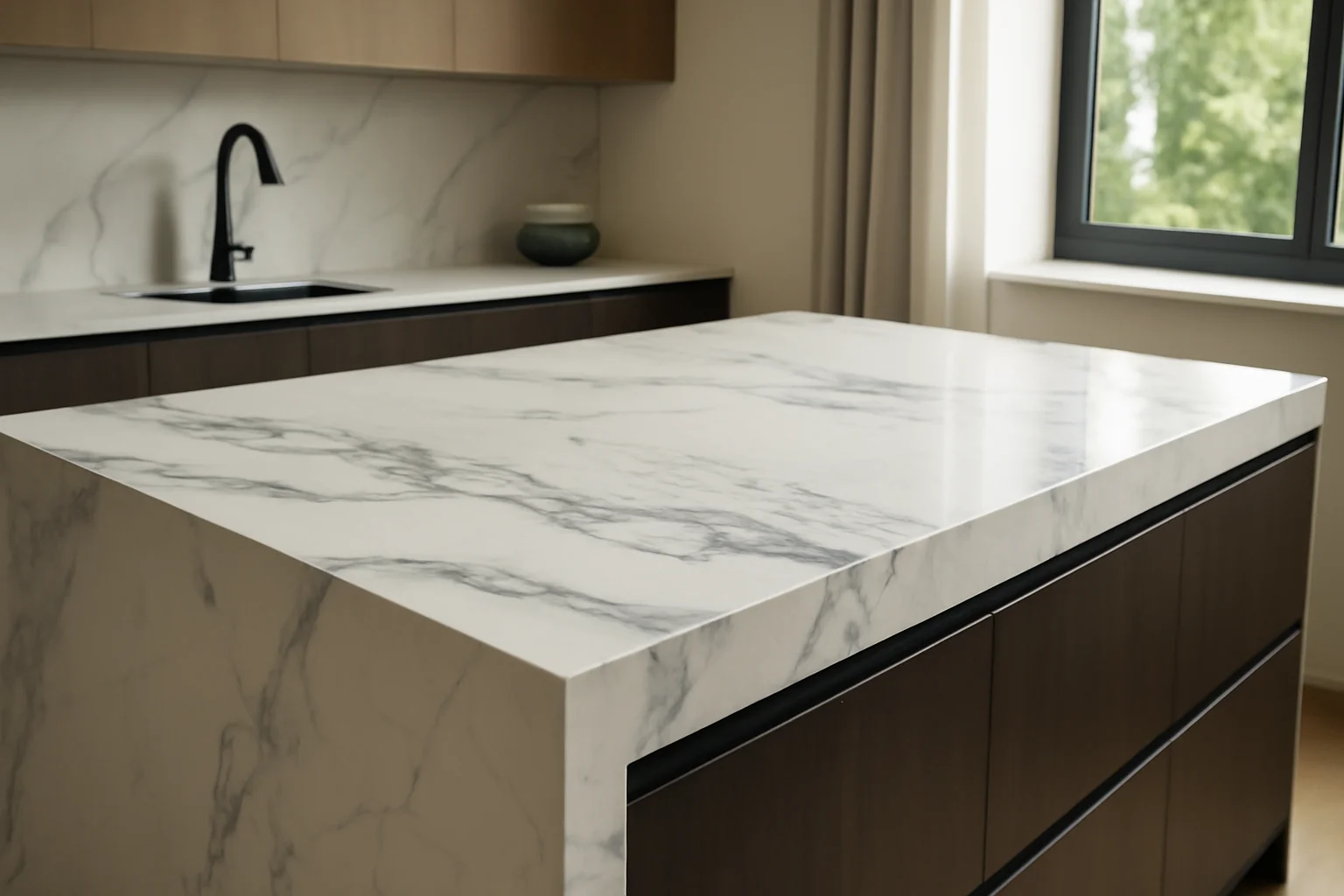
A custom larch countertop from MEBLIX is solid wood cut precisely to fit your space: on-site measurement, a 3D design in 1–2 days, production in our own 600 m² workshop and installation by our own crews. We give a 24-month warranty on the item under contract and have been working in the Almaty market for 13 years.
Larch is chosen for a kitchen surface for its dense wood and natural resistance to moisture. We break down how the species behaves at the sink, on the end grain and in a dry climate, and which of its properties are taken into account at the design stage.
Why larch is chosen for a kitchen countertop
Larch is harder than pine and more resistant to moisture thanks to its dense structure and natural resins, so it is chosen for the work surface more readily than soft conifers. In hardness, solid larch is inferior to oak but noticeably superior to pine and spruce, and the resins in the fibers act as a natural impregnation. Oak, meanwhile, is heavier and more expensive to machine, while pine is softer — it dents more easily from a knife and hot cookware. Resins also have a downside: there is more of them on the cut and at the end grain, so the finish is chosen with the resin content in mind rather than by default. In practice this means oil and lacquer require different preparation of the panel: resinous areas are sanded differently, otherwise the finish will go on in patches.
Will the countertop warp from moisture and the sink
With us, solid larch behaves predictably at the sink if the end grain is protected and the joint to the sink is sealed — water does not get into the open fibers. The species' moisture resistance does not override the physics of wood: fibers absorb water through the end grain many times faster than through the face, and swelling starts right there. The cutout for the sink requires sealing the end grain — it is impregnated and closed before the bowl is installed, and the joint with the sink rim is glued with sealant. The main risk is not the sink bowl itself but the unsealed end grain of the cutout: that is where water seeps in first, so end-grain protection is built into the design rather than added on during installation. It is easy to check: if the design does not describe the end grain of the cutout at all, ask the technician before cutting.
How larch behaves in the dry climate of Almaty
In the dry climate of Almaty, solid larch gradually releases moisture, so we stabilize the panel before cutting and install it with gaps for seasonal movement. The wood arrives at the workshop at one moisture level and, in an apartment with dry air, releases it and shrinks slightly — hence the gaps at the walls and the carefully planned joints to the backsplash. Darkening of larch is a natural process in light, not a defect; re-sanding and refreshing the finish restore an even look to the surface without changing the part itself. Over time the light areas shift to a warm honey tone — this is the natural behavior of the species in light. If the original color matters to you, choose a finish with UV protection and plan the refresh in advance — it is cheaper than replacing the panel.
Engineering a larch countertop without sagging and gaps
We break down the components that make up a durable countertop: the type of panel, the thickness for the span, cutouts for appliances and the joint to the wall. These are decisions made before cutting and not redone afterward.
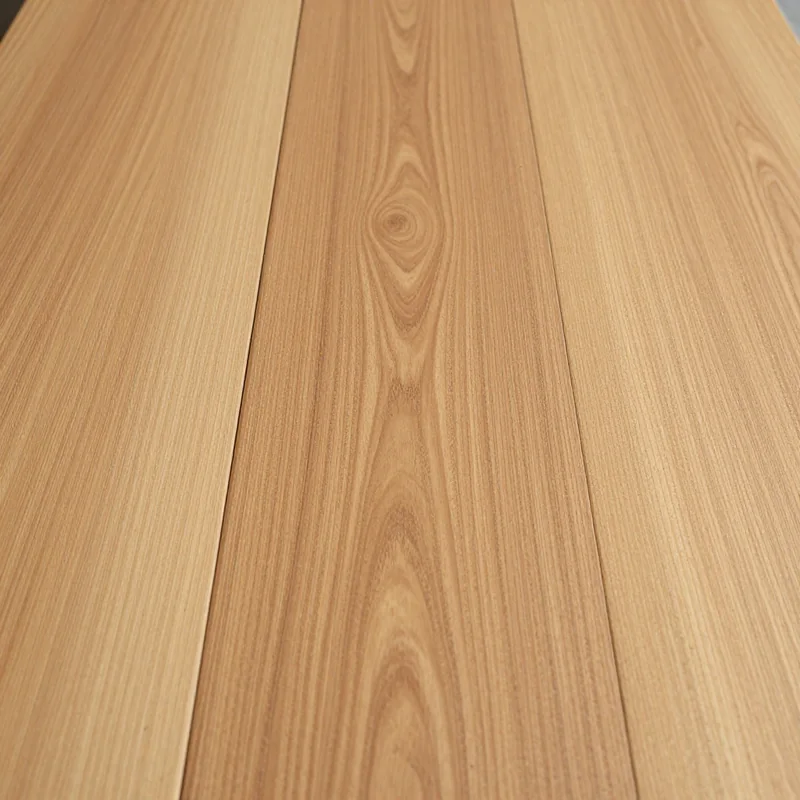
Solid-lamella or finger-jointed panel for the kitchen
comparison of panel types by grain pattern and stability. A solid-lamella panel gives an even pattern, while a finger-jointed one gives stability along the length| Panel type | Pattern | Behavior over a span | When it is chosen |
|---|
| Solid-lamella | solid, even lamellae | stable over short and medium sections | visible cut edge, emphasis on texture |
|---|
| Finger-jointed | lamellae joined along the length | less prone to warping over long sections | long countertops, islands |
|---|
| Finger-jointed with supports | same pattern, plus a frame | holds its shape over spans from 2.5 m | a full-kitchen island, a bar area |
|---|
What thickness is needed so the countertop does not sag
We select the thickness based on the span length and the spacing of supports: the wider the unsupported span, the greater the solid wood thickness needed and the more important intermediate supports become. For an Almaty kitchen, spans between cabinets of 600–900 mm are typical, and over that length a 40 mm solid wood works; on an island from 1800 mm without supports, a frame or an apron underneath is already needed. We calculate the load in advance: a sink with water and a cooktop with pots create point pressure on a local area, not along the entire length. Sagging is rarely related to thickness alone — more often the culprit is support spacing that is too wide in the sink and cooktop zone, where load and moisture coincide. That is why in the design we place an additional support at each heavy unit rather than relying on a margin in the cross-section.
Cutout for the sink and cooktop and edge protection
We make cutouts for the sink and cooktop according to the design and seal the edge right away so the cut does not absorb water. We make the cutout on a machine using a template with an allowance for the specific appliance model: an overmount and an undermount sink have different edge geometry, and for a cooktop the ventilation gap matters. We seal the edge with a moisture-resistant compound and edge banding in the color of the solid wood, and sand the cut smooth — otherwise the fibers rise at the first damp cloth. The cutout edge is the most vulnerable spot in solid wood, so its protection is planned before cutting: redoing a sealed edge after installation is harder than building it into the design. If the appliances have not been purchased yet, we ask for a template or the exact dimensions of the model before production starts.
How to join the countertop to a curved wall and the backsplash
We capture the wall curvature during the measurement and build it into the cutting plan, so the item fits against the wall without gaps or on-site trimming. The measurement specialist goes along the entire junction line and records deviations for each section — in panel buildings, a difference along the length of the kitchen is common. A template is built from these points, and the edge follows the contour of the wall. We plan the joint with the backsplash together with the tile height: the countertop either goes under the backsplash or meets it with sealant, and this determines where the line runs. A ready-made panel of a fixed size does not follow a curved wall — either a gap remains or it is covered with a trim piece that eventually comes loose. We level the plane with a laser during installation so that the backsplash line and the wall joint match up.
Finish and care for a larch countertop
We look at how solid wood is protected in the kitchen, how to maintain the surface in daily use, and what to do when the protective layer has worn and the wood has darkened.
What to finish a larch countertop with in the kitchen
comparison of three types of protective finishes for solid wood| Finish | Protection | Renewal | Behaviour on larch |
|---|
| Oil | against moisture and stains, natural texture | locally, section by section | brings out the resinous character and grain |
|---|
| Lacquer | dense film | full recoating | requires a perfectly flat, prepared panel |
|---|
| Wax | soft protection | regular | suitable for moderate loads |
|---|
How to care for the surface every day and what you must not wash it with
- Soft cloth and warm water: basic daily care with gentle products; abrasive sponges leave matte scuffs on the protective layer.
- Wood care products: choose mild household chemicals; chlorine and strong solvents destroy the protection after a few uses and dry out the fibres.
- Wipe up water straight away: don't leave puddles by the sink and on the seams for long, otherwise moisture gets into the end grain and the edge.
- Don't cut directly on the surface: use a board; deep scratches can't later be removed by spot sanding without a trace.
- Don't put hot items down without a trivet: sudden heat damages the protective layer and leaves pale rings on oil.
- Check the seams and the joint with the splashback: inspect the edge by the sink once a season; early darkening is easier to stop.
How to renew the finish and bring back the colour after years
We renew the finish and sand down based on the condition of the surface: first the worn protective coat is removed, then the protection is applied again. The craftsman assesses the depth of scratches, stains and darkening by the sink, then selects the abrasive grit and the type of finish for the specific panel. Local areas are sanded spot by spot, the whole surface — when the wear is even across the area. Darkened larch doesn't have to be replaced — sanding brings back the tone, but only if the thickness of the solid wood allows the top layer to be removed without losing strength. On thin panels you can't take off much, otherwise the item loses rigidity and starts to sag under load. That is why the technicians agree the sanding depth against the thickness allowance, not "by eye". If the end grain by the sink has already taken on moisture, sanding alone won't do — the condition of the edge is assessed separately before work begins.
Larch or other materials for a kitchen surface
We compare solid larch with oak, board materials and quartz honestly, for a real kitchen: where each species and each material falls short, and where it holds up confidently.
Larch or oak — which is more practical for the kitchen
Oak is harder and handles impact loads better, while larch is more resistant to moisture thanks to its natural resins and is noticeably easier to work to a custom size. On the Brinell scale oak gives around 3.7–3.9 units, larch — about 2.5–2.9, so a heavy pan dropped by accident will leave a dent on larch where oak would come away without a mark. On the other hand, the resins in larch wood act as a natural water-repellent layer: by the sink and the hob such a worktop behaves more calmly if the end grain is sealed and the surface is coated with oil or lacquer. Larch is softer to machine than oak — milling the sink cut-out and fitting to a curved wall go more easily. The choice between them isn't about "better or worse", but about what matters more in a particular kitchen: oak's resistance to impacts or larch's moisture resistance and weight.
Larch solid wood vs laminated chipboard, HPL and quartz
comparison of materials by resistance to moisture, scratches and repairability| Material | Moisture | Scratches | Repairability |
|---|
| Solid wood | with edge protection and coating | medium | sanding and refinishing |
|---|
| Laminated chipboard / HPL | high resistance | medium | replacing the section |
|---|
| Quartz | high resistance | high | limited |
|---|
When to choose larch solid wood
We recommend larch solid wood when natural texture, precise fitting to the space and the ability to refresh the surface years later matter. We mill the board for the specific cutout of the sink and hob rather than fitting a ready-made panel on site, so the joint with the backsplash and an uneven wall comes out tight. We also use Egger and Kronospan boards in projects, but for surfaces with an exposed edge and visible texture we more often choose larch: with sufficient thickness it can be sanded and re-oiled, restoring a smooth look without replacing the whole part. MEBLIX does not resell ready-made furniture but manufactures the item itself — from measurement to installation. If your kitchen sees heavy use and minimal care, board materials are more practical — wood shines where someone is ready to look after it.
How to order an item and how we control quality
We walk through the item's journey from the first measurement to the signed acceptance report: what happens at each stage, how custom cutting differs from a ready-made panel and what is checked on acceptance.
Why a ready-made panel does not solve a custom task
A ready-made panel of a fixed size does not follow the curvature of walls and does not account for cutouts for your appliances, so we make items precisely for the space. Walls in apartments rarely come out level — we record the variation along the length of the kitchen during measurement and build it into the cutting. A store-bought panel is designed for rectangular geometry, so it is trimmed on site and the edge stays exposed until installation — unlike factory cutting. With custom cutting we take actual measurements, allow for the joint and close the edge in the workshop — the item arrives on site with ready cutouts for the sink and hob. The difference shows up during installation: on-site trimming creates dust, the risk of chipping and an unprotected cut, while factory cutting arrives with the edge already closed and the cutouts ready. We build the cutouts for the sink and hob into the project before cutting so the edge is closed in the workshop, not on site.
How the work goes from measurement to installation
- Measurement on site: we take the geometry of the space and the curvature of the walls, and record the position of utilities and appliances.
- 3D design in 1–2 days: we agree on sizes, cutouts and joints before cutting so that changes do not go into production.
- Manufacturing in a 600 m² workshop: cutting, edge banding, painting and assembly all happen at our facility under one control.
- Test assembly: we check the item before it goes to the site, while any mismatches are still easy to fix.
- Installation by our own crews: we install and sign the acceptance report after installation, not upon shipment.
- Rush order: lead times for each option are in the price list on this page; if needed, we take the order on an expedited basis.
What to check on acceptance and what warranties we provide
On acceptance we check the geometry, the fit against the wall and sink, the condition of the edges and how the cutouts perform, and the warranty on the item is 24 months under the contract. We verify the geometry by diagonals and level: the solid wood must lie without sagging along its entire length, and the gap at the wall must stay even along the whole junction. We inspect the edges near the sink and hob separately — that is where wood reacts to water first if the protection is not watertight. We check the sink cutout for alignment with the bowl, and the edge for absence of chips. Blum hardware, if it is in the project, is accepted under the manufacturer's 25-year warranty — that covers hinges, lift mechanisms and drawer runners, but not the worktop itself. The acceptance certificate is signed after installation, so all remarks are recorded on site — it is easier to fix them before the order is closed than to come back to them months later.
The bottom line on larch countertops
The main thing that determines the result with larch solid wood in the kitchen is everything from choosing the species to accepting the finished item.
- Species matched to the task: solid wood resists moisture thanks to natural resins, but it needs edge protection and a well-thought-out finish.
- Engineering matters more than the panel type: thickness, support spacing and protection of the cutout around the sink determine whether there will be sagging and gaps.
- The finish is chosen by care routine: oil is renewed locally, lacquer gives a dense film, wax requires regular renewal.
- The comparison is honest: oak is harder, panel materials are easier to care for, solid wood wins on repairability.
- Ordering to size: measurement and individual cutting solve what a ready-made panel does not cover.